Chris Whitty ‘vetoed lowering of coronavirus alert level’
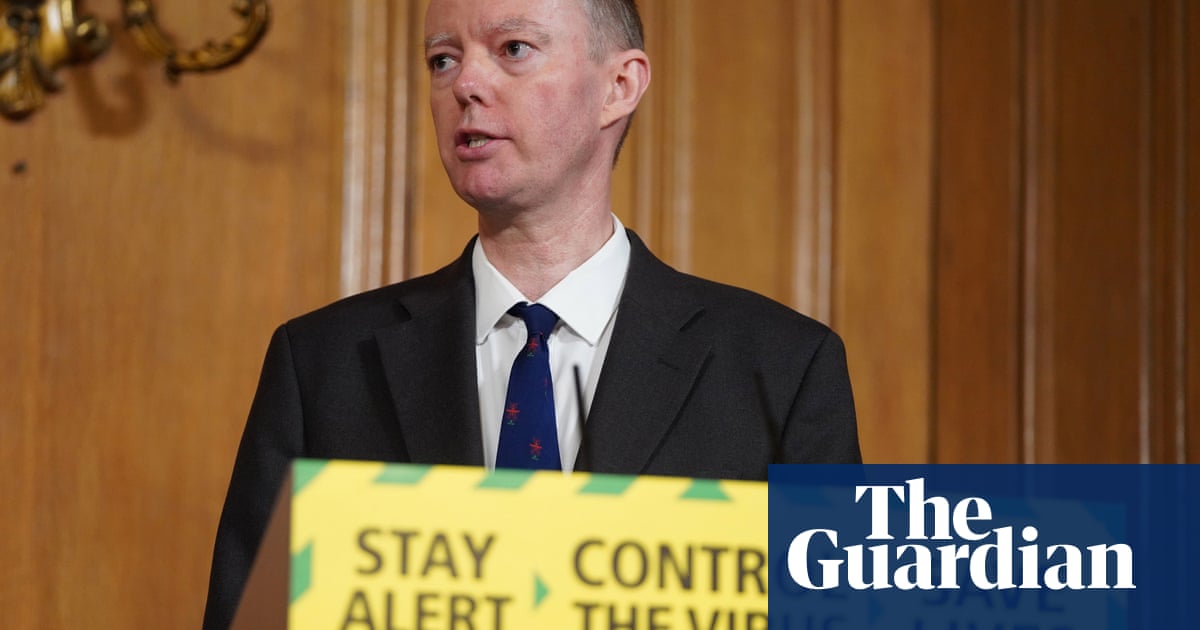
The decision for England’s official coronavirus alert level to remain at four despite this week’s easing of some lockdown restrictions was made by the chief medical officer, Downing Street has said, indicating he vetoed the government’s wish for it to be lowered.
Prof Chris Whitty’s decision was guided by data provided by the government’s new Joint Biosecurity Centre (JBC), Boris Johnson’s spokesman added.
The government’s formal roadmap for emerging from coronavirus restrictions, published last month, gave a different rationale, stating: “The JBC will be responsible for setting the new Covid-19 alert level to communicate the current level of risk clearly to the public.”
The expectation had been that by the time Monday’s loosened rules came into force, with more businesses opening and groups of up to six people allowed to meet outside, the five-point alert system would have been reduced from four, which means coronavirus transmission “is high or rising exponentially”, to three, where the virus is only “in general circulation”.
However, the level stayed the same, with ministers saying it was “transitioning from level four to level three”.
This prompted speculation that the JBC, set up to help guide the UK out of lockdown, had blocked the change. This in turn prompted some confusion as to whether the JBC was even yet operational, and thus how it could decide.
Asked about this, Johnson’s spokesman said: “The Joint Biosecurity Centre has begun operating. It’s reporting to a director general based in the Department for Health and Social Care. It has a data and analysis team which is analysing the data on coronavirus to inform the alert level, and the testing scheme.
“In terms of the setting of the alert level, it’s ultimately for the chief medical officers, who are informed by the data which has been collected, collated and analysed by the JBC.”
Asked whether this meant Whitty had decided the level must remain at four, the spokesman said: “There are the four chief medical officers, but Chris Whitty is the chief medical officer for England.” Scotland, Wales and Northern Ireland have their own chief medical officers.
Questioned whether the relaxation of lockdown rules in effect went against Whitty’s judgment, the spokesman said: “I don’t accept that. With the decisions in terms of the easements we made yesterday, I’ll stress again how cautious they were, and how we’re moving forwards at a very gradual rate. Secondly, they were based upon us meeting the five tests, and that is what we are currently doing.”
The roadmap also set out five tests for easing restrictions, covering areas such as infection rates, testing capacity and the impact on the NHS.
The spokesman added: “The very gradual changes that we made yesterday were guided by the scientific and medical advice.”
Read the original article at The Guardian