Companies strive to keep working under Covid-19 restrictions – business live
Sales of used cars slumped 30.7% across the UK in March as showrooms closed due the Covid-19 lockdown, wiping out solid growth in January and February, according to the main industry group.
The Society of Motor Manufacturers and Traders (SMMT) said sales declined 8.3% in the first three months of the year, with 1.8m used cars sold. Sales of petrol cars fell by 9.3% while diesel sales were down 7.8%, and the average price slipped 0.2% to £13,601.
Demand for plug-in electric vehicles grew by 13.6%, however, thanks to a bumper first two months when more zero-emission vehicles came onto the used car market.
The number of hybrids changing hand also rose, by 11.5%, taking the total number of used alternatively fuelled vehicles to 36,493 – still a tiny proportion of the overall market.
Superminis remained the most popular second-hand model, making up 33% of sales, and black remained the most popular colour choice.
The SMMT said that while showrooms remain closed consumers are still browsing used cars online, and hopes that demand will pick up when people return to work, with the government asking them to avoid public transport and drive, cycle or walk instead.
Mike Hawes, the SMMT’s chief executive, said:
“This subdued activity is likely to continue into the second quarter. While it is tricky to predict future demand, the impact of social distancing requirements on public transport means that, for many people, the car will play an even more important role in helping them travel safely to work.
Reopening new and used car outlets will support this, enabling more of the latest, cleanest vehicles to filter through to second owners and help support the UK’s green growth agenda.”
Last week the SMMT reported that new car sales tumbled by 97% in April

The chief executive of Vodafone has ruled out making a rival offer to challenge the £31bn mega-merger of Virgin Media and O2 in the UK, citing issues including the rising threat of Netflix in the TV space.
Vodafone had previously been thought to be the most likely player to combine its UK business with Virgin Media, having done previous deals with parent Liberty Global. Last year, Liberty Global sold its German and Eastern European cable TV assets to Vodafone for €18bn.
The two companies struck a joint venture deal in the Netherlands in 2016, combining cable and mobile networks in the same model as the Virgin Media/O2 merger.
Nick Read, the chief executive of Vodafone, said that the company would not look to disrupt the deal between Telefonica and Liberty Global, which will create a joint venture to challenge BT and Sky in the UK.
“We remain very focused on our organic strength and we believe the market remains structurally favourable to us,” said Read, in a call with media as Vodafone published results for the year to the end of March.
“I feel that the appropriate strategy is our organic strategy to drive value for all stakeholders.”
Read raised issues including the longer-term outlook for owners of traditional TV players such as Virgin Media citing the rise of Netflix, which has more than 12m UK subscribers, and the risk of consumers “cord-cutting” from expensive TV packages.
He also added that the national roll-out of next-generation full fibre broadband will overlap with Virgin Media’s cable household network, which will mean increased competition to retain customers.
As flagged earlier, Vodafone also paid out its €2.4bn dividend, despite many companies opting to save the cash outlay to weather the impact of the coronavirus, pointing to the company’s resilient business model and strong balance sheet.
“We are supporting our many shareholders who rely on the dividend as an essential part of their income,” he said.
“We have a progressive dividend policy and when you look at our free cash flow generation this year…. We have good headroom.”
Vodafone also gave insight into the impact of working from home and government lockdowns across Europe.
In April, Vodafone said that in Europe customer data usage rose by 15%, voice traffic increased by 40% and fixed broadband usage was up as much as 70% in some markets. However, travel restrictions meant that mobile roaming traffic has fallen by 65% to 75%.
My colleague Richard Partington has outlined the government’s new guidance to UK companies, here.
Office workers should consider holding meetings outside, shop changing rooms should be cleaned after every user and takeaway customers should wait in their cars, under sweeping new back-to-work guidelines issued by the government on Monday.
Companies across Britain will have to consult with their staff and union officials about how they will keep employees safe as they return to work amid the gradual lifting of lockdown measures.
Under pressure from Labour and trades unions to impose safeguarding measures as the economy gradually reopens after more than a month of lockdown, the guidelines give limited time to some firms as they plan to reopen as soon as this week.
They range from urging office workers to sit back-to-back, rather than face-to-face, to limiting numbers in lifts and closing down canteen…
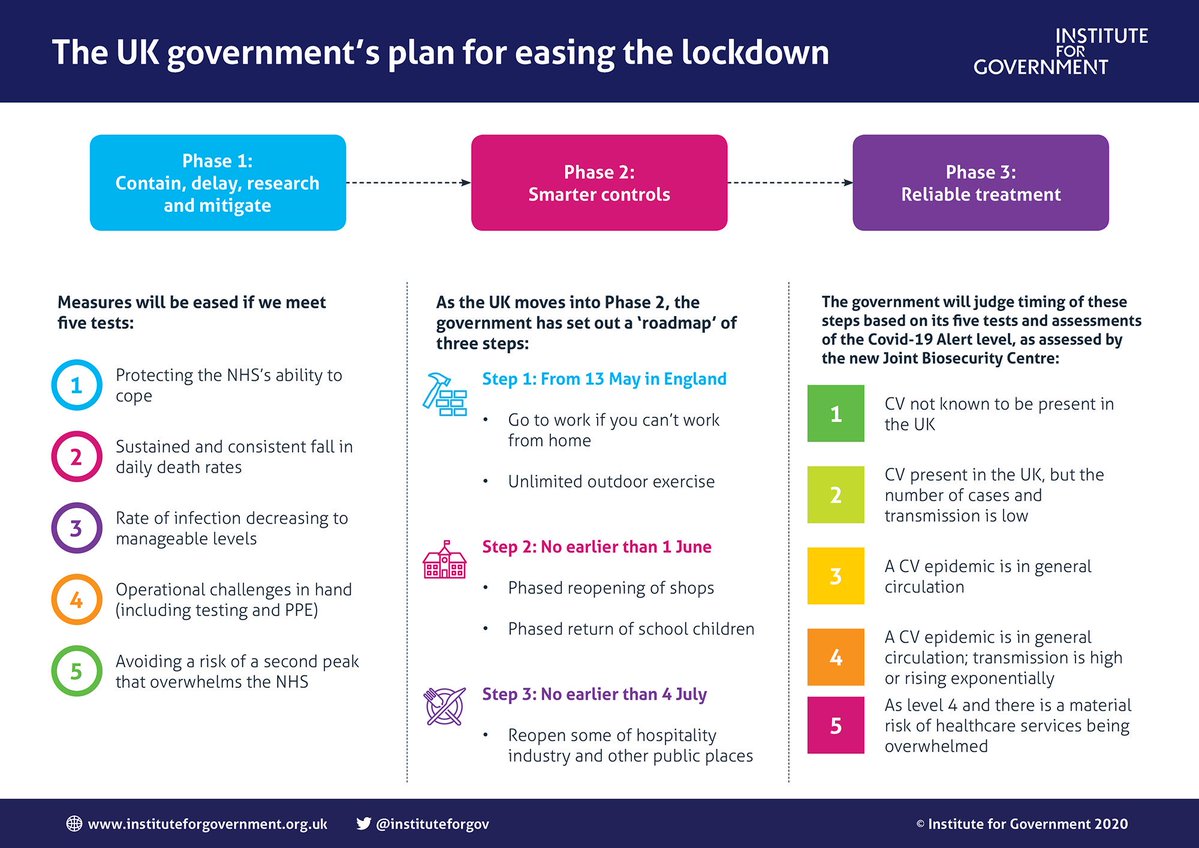
Hannah White
(@DrHannahWhite)The @instituteforgov * has distilled 48 pages into one graphic for you… pic.twitter.com/YthYoPCz9b

Ben Hancock, MD of Oscar Acoustics – an acoustics insulation firm — reports that the construction industry is busier this week.
He has employees working onsite at various building sites, who say activity has picked up notably.
This follows Boris Johnson’s speech on Sunday night, in which he said those who can’t work from home (ie, in construction or manufacturing) should be “actively encouraged” to get back to work.
But is it really safe? Hancock is worried that some workers may not properly understand the new ways of working:
With regards to the PM’s speech, I do have real concerns over our ‘safe operating procedures’ being affected by those who have not been properly briefed on them.
It took us the three weeks following the last big Boris speech to formulate and action the changes. If people return this morning having not consulted site management and are not aware of the new rules and systems, there are going to be issues.
Our teams have reported that there are far more people on site this morning. Where it was taking them 50 mins to drive to the sites last week, it took 1h 50m to get there this morning and on arrival, the car parks were full. So far, people seem to be sticking to the rules, e.g following one way systems, and 2 metre distancing.
It is something we are very closely monitoring.
The 6% jump in Vodafone’s shares this morning following its results has helped to lift the FTSE 100 by 25 points, or 0.4%.
France and Germany are becalmed, though, as traders worry about a second wave of Covid-19 infections scuppering plans to reopen economies.

At 5969 points, the FTSE 100 is up roughly 20% from its lows in March, but still down 20% this year.
Neil Wilson of Markets.com says investors are somewhat flummoxed:
Stock markets are in a bit of a muddle right now. On the one hand there are signs of economies emerging from stasis. New York governor Cuomo says three regions of the state will reopen this weekend. Britain has moved from ‘stay home’ to ‘stay alert’, Europe is reopening: there is light at the end of the tunnel, and markets are always first to move. Massive stimulus from central banks and governments helps, too.
But on the other hand, stimulus government stimulus can’t go on forever. Businesses will need to get back to a new normal of reduced earnings in the main. House Democrats are said to be plotting a 4th massive stimulus bill this week, but it’s not clear whether this will pass. Signs of second-wave outbreaks across South Korea, China and even Germany stoke fears among investors that economies will, if not shut down again at scale, look very different to before as countries take sustainable steps to reopen.

Shares in property company Land Securities have slumped by 10% this morning, after the coronavirus crisis hit its operations.
With some tenants struggling to pay their rent in the lockdown, Land Securities has been forced to slash the value of its property assets by 8.8% or £1,179m.
One recently completed development, Westgate Oxford, has reduced in value by 28.1%.
This revaluations means Land Securities made a pre-tax loss of £837m for the 12 months to 31 March, up from a £123m loss in the previous year.
The Covid-19 crisis came on top of the problems in the UK retail sector, the company explains:
The majority of the valuation deficit is attributable to our Retail segment, which suffered a 20.5% decline over the 12 months as a result of the challenging environment and ongoing structural changes, exacerbated at the year end by the early effects of Covid-19.

High street suit maker Moss Bros is also outlining plans to resume operations, following the UK government’s moves to ease the lockdown.
Moss Bros told shareholders it will restart its online operations on May 13, with a “reduced workforce”.
The company, which had closed its stores in March, says it has made some redundancies “where necessary and unavoidable”. It has also used the government’s Job Retention scheme to furlough some workers.
Moss Bros is also getting ready to reopen its high street shops saying:
The Board also notes the Government’s recent update regarding the potential phased reopening of shops from 1 June and is developing plans to reopen its stores in an orderly manner in light of this.

Good morning, and welcome to our rolling coverage of the world economy, the financial markets, the eurozone and business.
There’s an edgy mood in the markets this morning, amid concerns that reopening the global economy after the Covid-19 lockdown will be harder than hoped.
As Associated Press puts it:
Optimism over plans for reopening in many countries after shutdowns aimed at battling the pandemic has taken some hits from reports of new waves of infections in states and countries that are further ahead in lifting lockdown measures.
Investors pointed to small but disconcerting increases of infections in South Korea, China and elsewhere.
In Germany, infections rose late last week, while Wuhan also reported its first case since lifting its lockdown in April. And in South Korea, a growing cluster of cases have been linked to a single patient who visited a series of nightclubs in Seoul.
Such incidents highlight just how hard it will be to return to normality.
This has weighed on Asia-Pacific stocks today, where the Australian S&P/ASX 200 index lost 1% and Hong Kong’s Hang Seng shed 1.45%.
Holger Zschaepitz
(@Schuldensuehner)Global mkts turn to Risk-Off mode as anxiety grows over 2nd coronavirus wave after Chinese city where pandemic originated reported 1st new cases since lockdown was lifted. Asia stocks & US Futures lower. Bonds unch after y’day’s sell-off w/US 10y at 0.7%. Gold 1700, Bitcoin $8.7k pic.twitter.com/zK9qnvjZaI
Ipek Ozkardeskaya, senior analyst at Swissquote Bank, explains:
The Hang Seng led losses in Asia as a renewed coronavirus panic would mean a longer period of grounded planes and less retail activity in the city, as the housing bubble starts to burst.
European markets (which had such a strong run in April) have dipped back in early trading:
DailyFX Team Live
(@DailyFXTeam)Indices Update: As of 07:00, these are your best and worst performers based on the London trading schedule:
FTSE 100: -0.20%
France 40: -0.39%
Germany 30: -0.52%
US 500: -0.62%
Wall Street: -0.67%
View the performance of all markets via t.co/2NUaqnUPED pic.twitter.com/pOybnYwnxh
On the corporate front, supermarket chain Morrisons, DIY chain Kingfisher, property firm Land Securities and mobile network giant Vodafone are all reporting results.
The agenda
- 1.30pm BST: US inflation rate: expected to drop to just 0.4% in April, from 1.5%
Read the original article at The Guardian