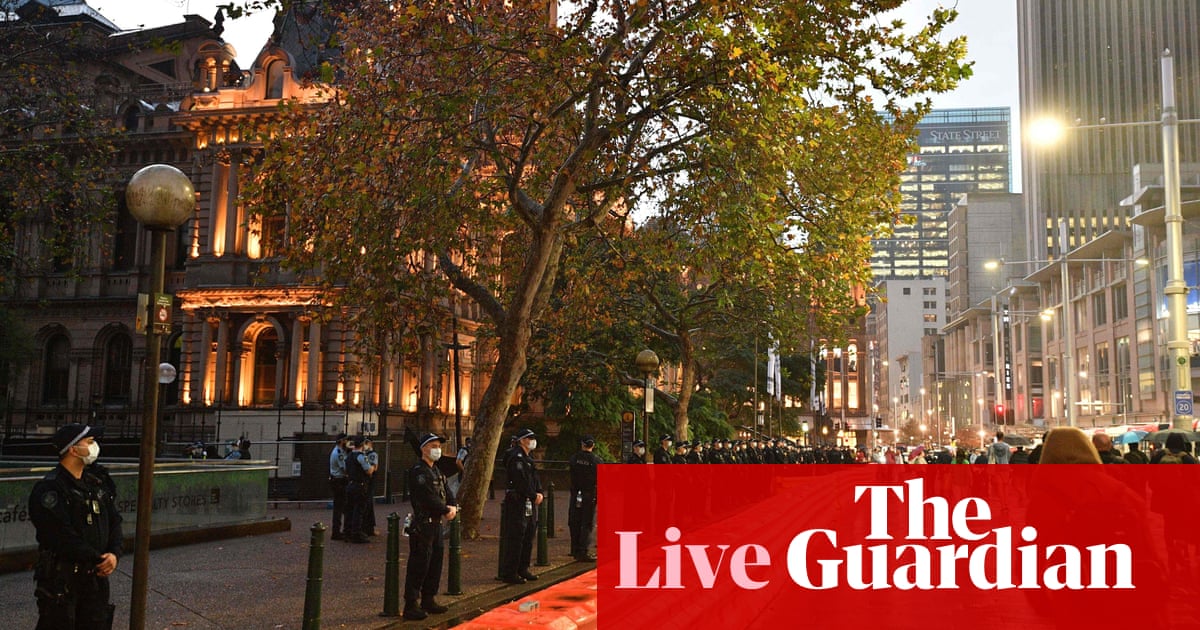
With the Black Lives Matter protest in Sydney winding down, we’re going to wrap the blog up for the evening. Here are today’s key events:
- The national cabinet met and reconfirmed its commitment to the 3-step easing of restrictions, with some changes. Those changes include lifting the 100 person limit on gatherings due in stage 3 of the plan which most states move to from next month. Instead the 1 person per 4sqm rule will apply.
- Plans are also under way for easing of restrictions on large gatherings. Stadiums that can seat up to 40,000 people will be able to host 10,000 people under step 3.
- The prime minister, Scott Morrison, confirmed planning has commenced to allow the safe return of international students to Australia.
- South Australia set a date of 20 July for the reopening of its borders. Queensland is aiming for 10 July.
- Rose Bay Public School in Sydney closed due to a suspected covid-19 case that was later confirmed to be positive.
- Black Lives Matter protestors gathered at Sydney’s Town Hall and Hyde Park on Friday night to draw attention to Australia’s record on Indigenous deaths in custody. They were met with a large police presence.
- Scott Morrison apologised after he incorrectly stated Australia had no history of slavery.
- NSW postponed local government elections until 2021.
Thank you for joining us. Enjoy your weekend. We will be back here tomorrow.
A small queue of protesters are slowly walking to Central station, chanting all the way. Still no arrests, and police are just shepherding the crowd as it walks.
Organisers are encouraging them to avoid Central Station.
Only about 20 people end up going into Central, where police pepper sprayed protesters last Saturday. Everybody else leaves. It truly seems to be over now.
Despite the main crowd of protesters dispersing in Hyde Park, there are still small marches and protests throughout the city.
At Town Hall a few minutes ago, a large crowd formed, and were given a move on order by police. After police threatened to arrest them, protesters moved on.
But a march is still winding its way down to Central station, where police pepper sprayed people last Saturday.
Still no arrests have been made, and police are just shepherding they crowd as it walks, and blocking off traffic.
It’s hard to estimate numbers, but I can see fewer than 100 people in front of me.
The ABC is reporting the WA government will rename the King Leopold Ranges in the state’s Kimberley region.
The King Leopold Ranges are named after the former king of Belgium – King Leopold II – whose atrocities and violent reign of the Congo Free State led to up to 10 million deaths. He has no connection to WA and never visited.
The WA Land Minister Ben Wyatt told the ABC King Leopold II was an evil tyrant who had should not be honoured in WA.
The second the protest reaches the Captain Cook statue in Hyde Park, it ends. Police are standing at the sides of the crowd, doing nothing, when organisers begin shouting, “Its over. Go home”.
The crowd filters through Hyde Park as organisers shout “disperse”.
“Everyone get your friends together and go home. There’s no fight to win here but an arrest.”
In five minutes, there’s nobody near the statue but media. But protesters are still slowly making their way out of the park back down Park St in the city, as police follow. They have started shouting at people to go home as well.
10 minutes later, the park is empty. No arrests were made, as far as I can see.
The protest has now moved to Hyde Park where there are between 200 and 300 people. At 6.30 there were only about 20 people outside Town Hall who weren’t media.
Mounted police are also in the park.
It’s 10 minutes before another Sydney Black Lives Matter protest is scheduled to start, and NSW police are out in force at Town Hall.
A line of police officers have put up barriers around the town hall but media, observers and bystanders are milling around, and nobody has been moved on or arrested as far as I have seen.
There are about 100 officers around Town Hall.
NSW Health has confirmed that a suspected case of coronavirus that closed Rose Bay public school in Sydney today was positive.
The department says an expert panel reviewed the test results and concluded it was a case of Covid-19.
But the date of the infection is still unclear.
“This case may be an older infection. The source of infection is also being investigated,” NSW Health said.
It is identifying close contacts and telling them to isolate.
“It should be noted that the case interview has determined this person did not attend any recent mass gathering, including protests,” the department said.
People held in prisons in Western Australia will be allowed face-to-face visits again “within a few weeks”, the state corrective services minister, Francis Logan, has said.
Inmates have been denied face-to-face visits since late March to prevent the spread of Covid-19, and were instead given free telephone calls, extra mail privileges, and in some cases access to video calls. Prisons are potential hotbeds for the virus – a global report said it was potentially a “death sentence” in overcrowded facilities.
Thalia Anthony, an Australian academic, called it a “ticking time-bomb”.
Logan said prisoners will still have to comply with physical distancing rules during visits, so no hugging. Inmates will still be able to access video-conferencing kiosks.
Logan said:
”Stopping social visits was not an easy task and came with its own risks to the good order of a prison or custodial facility.
“But it is to the credit of the department and each custodial facility that they worked cooperatively, including with prisoners, to put in place measures that almost completely eliminated the threat of the virus taking hold inside.”
My colleague Melissa Davey has another update on the Surgisphere scandal.
Some of the world’s leading medical journals are reviewing their processes after they were forced to retract studies based on flawed data. This follows a Guardian investigation revealing serious flaws in the database behind studies that were published by the New England Journal of Medicine and Lancet.
You can read more about the latest developments here:
The parliament sitting is starting to wind down now, so I will hand you over to Lisa Cox. She’ll be keeping an eye on the Sydney protest for you, so make sure you watch out for that.
Thanks to everyone who joined me this week. I’ll be back on Monday when the sitting resumes for the last week before the winter break.
Have a wonderful weekend and take care of you.
From AAP:
The Indigenous Australians minister, Ken Wyatt, has conceded a referendum on recognising Indigenous people in the constitution is unlikely in this term of parliament.
Wyatt said the Morrison government remained committed to a referendum.
“We have always said this would be done when consensus was built and it has the best chance of success. It is unlikely this will happen in this term of parliament,” he said.
An Indigenous voice to government will be pursued before a referendum.
“Constitutional recognition is too important to rush and too important to fail. We will not be placing a timeline on this process,” he said.
Wyatt had pushed for a referendum in this term of parliament, which is due to expire in 2022, but Scott Morrison had rejected the timetable.
National federation reform:
Following on from national cabinet’s agreement to continue as the ongoing forum for first ministers, to form the national federation reform council (NFRC) and to cease the council of Australian governments (Coag), national cabinet today had further discussions regarding the architecture to fundamentally transform federal relations and achieve policy outcomes in areas of shared interest to create jobs and to improve the lives of all Australians.
National cabinet has announced six initial priority areas of reform, and the formation of six reform committees:
- Rural and regional Australia
- Skills
- Energy
- Infrastructure and transport
- Population and migration
- Health
These committees will be driven by leaders of national cabinet and tasked to progress a rapid jobs agenda.
Deregulation will be taken forward by the council of federal financial relations (CFFR) as a matter of priority.
National cabinet held further discussions regarding the role of the CFFR, which is led by the commonwealth treasurer and made up of treasurers of states and territories. The CFFR has a central role in the new system, supporting the work of national cabinet as it focuses on job creation. Specifically, national cabinet has tasked CFFR to progress targeted reforms in areas such as tax, deregulation and housing. CFFR will report to national cabinet on findings and recommendations of these commissioned reform projects, with input from expert advisory groups. Further information on reform projects to be undertaken by the CFFR will be provided shortly.
The CFFR will also take on responsibility for coordination of all commonwealth/state funding agreements, including national partnership agreements. National cabinet has asked that CFFR commence a review of existing agreements with a view to consolidation and rationalisation. This includes identifying agreements that could be ceased in order to streamline responsibilities and to reduce duplication and overlap. CFFR will provide national cabinet with an update on its progress and a plan for implementation by the end of August.
As new commonwealth/state national partnership agreements are developed, it will be CFFR’s responsibility to negotiate funding elements, in consultation with relevant portfolio ministers.
National cabinet agreed to work closely and carefully to return international students on a small, phased scale through a series of controlled pilots.
This planning process will take time and require well thought through plans from state and territory governments. Preconditions will include the reopening of internal state and territory borders, as well as the return to on-campus learning for the benefit of domestic students and the international students who are already in Australia.
Closing the Gap
Today national cabinet reaffirmed its commitment to improving the lives of Indigenous Australians so this generation and the next can have the same expectations and opportunities as all Australians. We are doing this in partnership with Indigenous Australians for the first time, working together to decide how policies and targets are developed and delivered.
National cabinet was provided with an update on the new Closing the Gap national agreement, and set of targets, that will empower Indigenous Australians to transform their lives. The new national agreement will set ambitious, yet achievable targets for all governments and will ensure that there is shared accountability and shared responsibility to achieve those targets.
The agreement is very close to final as the draft is now with states and territories for consideration before the joint council in July. Our aim is to have the agreement signed by the end of July.
Outdoor events including stadiums
For outdoor venues up to 40,000 spectator capacity, ticketed and seated events will be able to be held in front of a crowd of no more than 25% of capacity under step 3.
States and territories will make decisions on when to move to step 3 under CovidSafe plans.
At a minimum, CovidSafe arrangements must be maintained including:
· 1 person per 4sqm;
· staying 1.5 metres away from other people whenever and wherever possible;
· maintaining good hand washing and cough/sneeze hygiene;
· staying home when unwell, and getting tested if you have respiratory symptoms or a fever; and
· downloading the CovidSafe app to allow identification and traceability of people that have been in contact with a confirmed Covid case.
For outdoor venues of more than 40,000 spectator capacity, further advice is being sought from the AHPPC, with arrangements to be settled by the states and territories on a venue by venue basis.
National cabinet reiterated that high-risk outdoor events without ticketed seating such as music festivals do not form part of step 3 and will be considered following further advice from medical experts.
Read the original article at The Guardian