Coronavirus live news: Australian PM says virus ‘most likely’ came from Wuhan market
On Wednesday, Pedro Sánchez will once again ask Spanish MPs to approve an extension of the state of emergency that underpins one of the strictest coronavirus lockdowns in Europe.
If recent days and parliamentary sessions are anything to go by, the prime minister will not be in for an easy ride.
At a time when opposition parties elsewhere in Europe are rallying around the flag, the adversaries of Sánchez’s socialist-led coalition are using the virus as a cudgel.
The government has been bitterly criticised for allowing huge marches around the country to celebrate International Women’s Day on 8 March, for reacting too slowly to the pandemic, and for inconsistencies and delays in publishing some statistics.
On Monday, the leader of the conservative People’s party (PP) announced that he felt unable to support another two-week extension of the emergency situation.
Pablo Casado said the crisis measures, initially designed to contain the disease and prevent the collapse of the country’s intensive care units, were no longer necessary at a time when people were once again being allowed outdoors.
He also accused Sánchez of hasty improvisation and said the PP would not tolerate the minority government’s “immoral” attempts to “hold Spaniards hostage”.
Casado’s language was in keeping with his sustained criticisms of the government – if slightly more moderate than on previous occasions.
“You don’t deserve the support of the opposition,” he told Sánchez in April. “Your arrogance, your lies and your ineffectiveness are an explosive combination for Spain.”
Santiago Abascal, leader of the far-right Vox party, is also refusing to support an extension and has likened Sánchez to a surgeon who kills healthy people on his operating table.
According to Abascal, the socialists and their partners in the far-left, anti-austerity Podemos alliance are seeking to replace democratic normality with “a totalitarian one based on uncertainty that has brought Spain nothing but more death, more ruin, more unemployment and less freedom”.
Officials in India’s capital have imposed a special tax of 70% on retail alcohol purchases to deter large gatherings at stores as authorities ease a six-week lockdown imposed to slow the spread of coronavirus.
Taxes on alcohol are a key contributor to the revenue of many of India’s 36 states and federal territories, most of which are running short of funds because of the lengthy disruption in economic activity caused by the virus.
Police baton-charged hundreds of people who had flocked to liquor shops when they opened on Monday for the first time in a relaxation of the world’s biggest lockdown, which is set to run until 17 May.
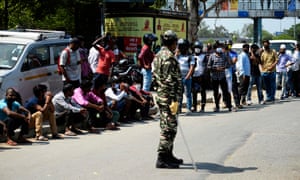
The Delhi state government announced the “special corona fee” in a public notice late on Monday.
Arvind Kejriwal, the state’s chief minister, said:
It was unfortunate that chaos was seen at some shops in Delhi.
If we come to know about violations of social distancing and other norms from any area, then we will have to seal the area and revoke the relaxations there.
Angela Merkel’s office has just released the criteria according to which regional interventions would be made in case of a rise in coronavirus cases.
If the number of new cases rises within a seven day period to more than 35 cases per 100,000 residents, the local authorities in that particular area will be required to revert back to the lockdown conditions imposed on April 20.
This would in short mean that all but essential shops in that area would have to close, as would schools, hairdressers, museums and zoos.
Spanish schools may need to operate at half-capacity if a coronavirus vaccine has not been found by the time classes resume in September, the country’s education minister said on Tuesday.
“Until we have a remedy or a vaccine, the only tool we have to fight the virus is confinement,” Isabel Celaá told the Spanish newspaper 20 Minutos.
We can’t jeopardise all the gains we’ve made. If we’ve got three million primary school children, each accompanied by an adult, turning up at school, you can imagine the huge movement that involves.
If they all turn up at once, we won’t be able to maintain the required distance.
Celaá said that meant that schools would probably have to operate “at half-capacity”, with some children attending physical classes and others continuing to study online.
Schools and universities have been closed since mid-March and the prime minister, Pedro Sánchez, will ask congress on Wednesday to extend the state of emergency until 24 May.
On Tuesday, figures from Spain’s labour ministry showed that the number of unemployed people rose by more than 282,000 in April. The country’s total number of unemployed people now stands at 3.8 million.
KLM has today resumed operations to a number of its European destinations, and is now running a daily flight from Amsterdam to Barcelona, Madrid, Rome, Milan, Budapest, Prague, Warsaw and Helsinki.
It has said from 11 May, travellers will be obliged to bring their own masks that cover their nose and mouth, and it expects to keep this measure in place until the end of August.
“This involves face protection in the broadest sense of the word,” a spokesperson for KLM told the broadcaster NOS. “A scarf is also fine if it is tight.”
Travellers will be checked at the gate. Anyone not wearing sufficient face covering, will get a mask from KLM. If that stock runs out, the traveller will not be allowed on the flight.
Some of KLM’s existing destinations already require face masks to be worn on board flights.
KLM said it hopes to increase the number of flights in May to about 15%. Before this week it was operating at around 10% of its normal schedule.
Ahead of a much anticipated meeting between Germany’s 16 state leaders and the federal government on Wednesday which will decide on the next steps in Germany’s relaxation of its lockdown rules, the health minister Jens Spahn has urged decision makers to take joint steps on a regional basis, rather than individual approaches on a local level.
He said this will give the public more confidence and trust in the relaxation measures.
Under its federal system, German states can largely decide individually how they are going to emerge from six weeks of shutdown.
Currently there are widely differing rules on everything from mouth-nose coverings to which type of shops are allowed to reopen.
Spahn said that rules on how to react to the virus would depend on how badly hit particular regions were, but had to be coordinated with other states and local authorities. He told broadcaster Deutschlandfunk.
If there was an outbreak say in a care home, or following a specific event… you could quickly react with restrictive measures on a local level in order to prevent the virus spreading so strongly.
If this succeeds, then there will every now and then be regions where you need to intervene more defiantly but in so doing, you also protect the rest of the country.
Overnight, Mecklenburg Vorpommern, the northern state which includes the Baltic Coast, decided that it will reopen to holiday makers from 25 May, giving Germans the first prospect of summer holidays again, albeit staycations.
Schleswig Holstein, which is home to the North Sea coast, has announced its plans to gradually reopen the border to Denmark.
As the country gets ready to breathe a collective sigh of relief, Berlin’s botanical gardens let visitors in today for the first time since mid-March.
Although the greenhouses will remain closed to the public, the outer gardens in all their spring glory are accessible, with the inevitable physical distancing rules applying.
State museums in Berlin are to announce their reopening plans – likely from the middle of the month – today, while some private galleries and museums have already opened their doors.
Some of the busiest traffic arteries in Paris will be reserved for cyclists in a bid to limit crowds on public transport when France begins lifting its coronavirus lockdown next week, the city’s mayor said.
“In total, 50km (30 miles) of lanes normally used by cars will be reserved for bicycles,” Anne Hidalgo told the Parisien newspaper.
She also said another 30 streets would be made pedestrian-only, “in particular around schools to avoid groups of people,” she said.
The mayor had already announced last week that the Rue de Rivoli, the main east-west thoroughfare through the heart of the French capital, would be for bikes only, starting 11 May.
Other streets will include the Boulevard Saint-Michel in the Left Bank’s Saint-Germain neighbourhood, and the express tunnel under the chaotic roundabout at the Arc de Triomphe.
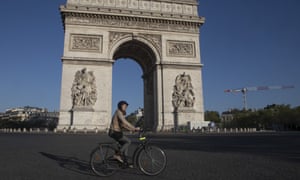
Many Paris suburbs have also announced plans for new bike lanes, hoping to reduce pressure on heavily used commuter trains and buses as well as the Paris metro, where many seats will now be off-limits to keep people apart.
Paris officials are bracing for the return of residents after an estimated 20 – 25% of its population of some 2.2 million fled to country homes or elsewhere before the nationwide stay-at-home orders came into effect on 17 March.
Health experts warn that the social distancing necessary to avoid a fresh surge in Covid-19 cases will be difficult in large cities, especially for people who rely on mass transport to get to work.
Hidalgo, who is running for re-election, has been pushing for years to reduce car use in the capital by reducing lanes and speed limits, and closing off dozens of streets completely.
She said some of the street closures could be made permanent even after the crisis has passed.
“I know that the majority of Parisians do not want to see a return of cars and pollution,” the mayor said.
The French government has unveiled a €20m ($22 million) package to spur cycling post-lockdown, including a 50 euro subsidy for bike repairs or tune-ups.
People aged over 70 and other vulnerable groups in Ireland stepped outdoors for the first time in weeks today after authorities eased advice on cocooning.
They may leave home for exercise as long as they avoid contact with other people, according to the new rule. “Historic moment: first man (and woman) off the cocoon,” said an Irish Times cartoon showing a couple stepping out their door. “Today is independence day for cocooners in Ireland. I now know how Nelson M felt,” said one Twitter user.
By 7am several elderly people had parked by the sea in Dun Laoghaire in south Dublin, rolling down their windows and gazing at the waves.
The cocooning was advisory, not mandatory, and some over-70s have been out walking and shopping in recent weeks. From Tuesday people can travel up to 5km from home to exercise, an extension of the previous 2km limit.
Other restrictions remain in place however, with a phased reopening due to start on 18 May. On Monday authorities reported 16 Covid-19 related deaths, bringing the total death toll to 1,319. The total number of confirmed cases of infection is 21,772.
The Irish Independent reported that health officials advised over-70s should keep cocooning until August but were overruled by the cabinet, reflecting wider tensions between ministers and scientific advisers. Simon Coveney, the foreign minister and tanaiste, denied the report.
Saudi Arabia has given private businesses a green light to cut salaries by 40% and terminate employment contracts, citing economic hardships caused by the pandemic.
The measures, which take effect immediately, allow for employees to be laid off after six months of reduced salaries – the effect of which is set to slash household incomes.
Like the rest of the Middle East, the Saudi economy has ground to a near halt over the last two months, as construction, retail, industry and most other sectors have flatlined. The announcement is unprecedented in the modern Saudi state, where vast oil wealth has built an affluent society for many of its citizens – less so for the migrant workforce that has built the country.
A safety net generated by decades of oil revenues has been part of the pact between Saudi citizens and its well-heeled leadership and such a crisis will be difficult to digest for many, particularly as mega projects such as a $500 billion new Red Sea city rumble on, and plans continue for the G20 summit in November.
An oil price at historic lows, partly a factor of the country’s heir to the throne, Crown Prince Mohammed bin Salman flooding global markets with crude at the same time worldwide demand had plunged, has led to a sharp fall in Saudi revenues.
The economic instability led the Saudi government to insist on Monday that its currency will remain pegged to the US dollar and that it had sufficient reserves to meet all economic and exchange demands.
The Kingdom has reported 1,645 new cases of coronavirus, with seven deaths.
Germany’s main public health advisory body, the Robert Koch Institute, has reported a continuing fall in the number of new coronavirus cases, with the country’s reproduction rate – or R rate – falling to 0.71, after creeping up to 1 a few days ago.
That means every person infected with the disease is passing it on to 0.71 persons on average. While last week between 700 and 1,600 new cases were being registered every day, on Monday that figure was down to 685.
There are 163,860 confirmed cases according to the RKI, and 6,831 registered deaths. Lothar Wieler, the RKI ‘s president, called it: “A very good piece of news”. He has rarely uttered anything so positive since this crisis began. But he insisted the number should not be allowed to rise, saying that keeping distance will be what he called “the new normal” for some time to come. He warned there was sure to be a second wave, possibly even a third.
“We know with great certainty that there will be a second wave,” he said. “The majority of scientists are sure about that, and many assume there will be a third wave.” But he said countries would be better prepared for future waves. Germany is currently carrying out on average 142,000 tests a day, Wieler said, and increasing that figure was important as Germany began to relax its lockdown.
Read the original article at The Guardian