Coronavirus live news: Covid-19 ‘taking different path in Africa’, says WHO
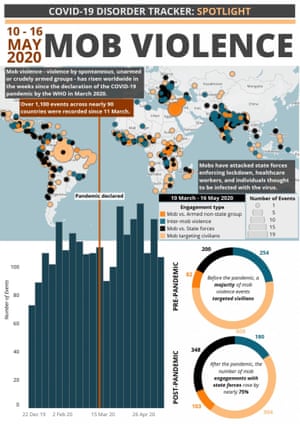
Mob violence has risen around the world since the start of the Covid-19 pandemic, according to the Armed Conflict Location & Event Data Project (ACLED).
ACLED, a US non-profit, collates information on all reported political violence and protest events across Africa, south Asia, south east Asia, the Middle East, central Asia and the Caucasus, Latin America and the Caribbean, and south eastern and eastern Europe and the Balkans.
It said it had recorded more than 1,100 events of mob violence – violence by spontaneous, unarmed or crudely armed groups – in nearly 90 countries since 11 March. The organisation is running a Covid-19 disorder tracker, which aims to detail the pandemic’s impact on political violence and protest around the world.
Mob violence has risen around the world since the start of the Covid-19 pandemic. Photograph: Armed Conflict Location & Event Data Project
Sixty-seven more deaths from Covid-19 have been announced by Sweden, the highest number reported on a Saturday since 18 April, taking the total death toll in the country to 3,992.
According to the latest update from Sweden’s public health authority, 379 more people have tested positive for coronavirus, taking the total number of infections to 33,188 since it reported its first confirmed case on 31 January. Of those, 4,971 people have recovered.
Sweden has eschewed the kinds of compulsory lockdown measures seen elsewhere in the world. That it has again recorded a high death rate on a Saturday, a day when its numbers generally drop due to delays in reporting, will be seen as a sign that it has left its society open to the virus even as other European countries are experience drops in death rates.
The governor of New York, Andrew Cuomo, has signed an order easing the US state’s ban on gathering in groups, allowing up to 10 people to assemble as long as they stay at least 6ft from each other or wear face masks if they must stand closer.
Cuomo signed the order on Friday night, the Associated Press reports, clearing the way for New Yorkers to gather together in time for the Memorial Day weekend.
People are seen practicing social distancing in white circles at the Madison Square park, New York City, on Friday. Photograph: Anadolu Agency/Getty Images
People in New York City were also given the all-clear to visit beaches this weekend, but they may not swim, the city’s mayor, Bill de Blasio, has said.
“I’ve been really clear about the beaches; they are closed for swimming,” de Blasio said Friday at his daily coronavirus briefing on Friday. “There will not be lifeguards. People are not supposed to go to the beach to swim.”
Memorial Day weekend usually marks the beginning of beach season in New York City, with lifeguards starting duty and swimming permitted in normal times.
The main reason the mayor has cited for the swimming ban is to curb the spread of the virus by keeping people off public transport.
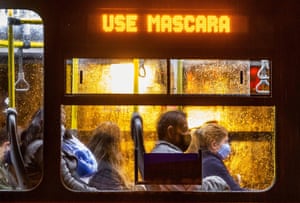
Commuters wearing face masks travel on a public bus with an electronic sign reading ‘Wear a face mask’, in Curitiba, Brazil. Photograph: Daniel Castellano/AFP/Getty Images
Fifty-nine more people lost their lives to Covid-19 in Iran in the past 24 hours, the health ministry has said, as the country began reopening businesses, religious and cultural sites on the eve of Eid al-Fitr.
Museums and historical sites are to reopen on Sunday to coincide with the celebrations that end Ramadan, the Muslim holy fasting month, President Hassan Rouhani said on state television, according to Reuters.
Saints’ shrines, some of which became flashpoints at the outset of the coronavirus epidemic in Iran, will reopen on Monday. All workers in the country will return to work from next Saturday.
The health ministry’s spokesman, Kianoush Jahanpour, said in his latest coronavirus update that the death toll from the virus in Iran had reached 7,359, and the total number of confirmed cases was 133,521, after 1,869 more people tested positive in the past 24 hours. So far, 104,072 have recovered, Jahanpour was quoted as saying by the Islamic Republic News Agency.
Rouhani said on Saturday that 88% of the people who died from Covid-19 in Iran had underlying illnesses.
The Chinese city of Wuhan conducted nearly 1.5 million tests for coronavirus on Friday.
The city where the pandemic began increased its testing total by just under 50% in 24 hours, according to the local health authority.
Officials took 1,470,950 nucleic acid tests for Covid-19 on Friday, compared with 1,000,729 the previous day.
The scaling up of testing to industrial levels followed a cluster of cases being discovered in the city two weeks ago
Wuhan came out of lockdown on 8 April, but after positive cases were confirmed on 9/10 May an expanded testing programme sought to identify asymptomatic patients – infected people who show no outward sign of illness but remain capable of transmitting the disease.
The Malaysian health ministry has confirmed another new cluster of coronavirus cases at a detention centre for undocumented migrants.
The Semenyih detention centre near the capital, Kuala Lumpur, which houses around 1,600 detainees, has reported 21 new cases of Covid-19.
It is the second detention centre to report an outbreak. Around 60 cases were reported among the 1,400 detainees at the Bukit Jalil centre earlier this week.
Malaysia has so far reported a total of 7,185 cases of Covid-19 and 115 deaths.
This month more than 2,000 foreign nationals were arrested and accused of not having permits to allow them to remain in the country. The migrants have since been housed in centres that are crowded, with dozens often packed in a single cell.
Refugees and other foreigners have been the victims of an uptick of hate speech in the country in recent weeks, accused of spreading disease, burdening the state and taking jobs as the economy plummets. Rohingya refugees in particular have been targets of harassment and threats.
The United Nations and human rights groups have called on Malaysia to stop the crackdown and criticised authorities for going after a vulnerable community during the pandemic.
Human Rights Watch has said the new Malaysian government, which came to power at the end of February, “has completely fallen down on the job when it comes to protecting the rights of Rohingya refugees”.
A social distancing marker at Indira Gandhi International (IGI) Airport in New Delhi, after the Indian government allowed domestic flights to resume from Monday. Photograph: Anushree Fadnavis/Reuters
Hallo this is Paul MacInnes, sitting in for Damien while he takes a deserved break.
A “car demo” called by the far-right Vox party in Spain to protest against the government’s handling of the pandemic led to some streets in Madrid and other cities filling with honking vehicles, Sam Jones reports from the Spanish capital.
Vox, the third largest party in the Spanish parliament, wants the Socialist-led coalition government to resign and it urged people to get in their cars and create caravans of stationary vehicles. In order to limit possible infections, participants were told to stay in their cars and wear the mandatory face masks.
Vox has accused the prime minister, Pedro Sánchez, of a draconian response to the virus, which has killed 28,628 people and infected 234,824. It says the government’s response has resulted in “unemployment and misery”.
Rocio Monasterio, the leader of the Madrid branch of Vox, at a protest against the coronavirus lockdown in the city. Photograph: Ballesteros/EPA
Vox were not the only ones out in the streets of Madrid on Saturday. Members of the Spanish Communist party gathered at the Puerta del Sol to call for a a social emergency plan to ameliorate the impact of the emergency on the poor.
Protesters wearing masks and obeying social distancing rules held up banners calling for “work, rights and and urgent social emergency plan,” as well as against the privatisation of the health service.
A protester at the Puerta del Sol in Madrid holds a flag of the Second Republic (the democratically elected government that was overthrown by Franco’s coup) during a demonstration calling for a social emergency plan. Photograph: Pierre-Philippe Marcou/AFP/Getty Images
Spain’s lockdown, ordered after a state of emergency was declared on 14 March, is gradually being lifted and by Monday all parts of the country will have moved to at least the second phase of the de-escalation.
The government’s latest two-week extension of the state of emergency was hard won, and nightly protests against the lockdown have spread from wealthy barrios of Madrid to other regions.
María Jesús Montero, the finance minister who serves as the government’s spokeswoman, said people had a right to protest, as long as their demonstrations did not risk spreading the coronavirus. She said on Friday:
The only things that the state of emergency limits its people’s freedom of movement and reunion.
Very often, some of the shouts you hear during these demonstrations are contradictory because people are out protesting. Some people shout ‘freedom’ when they’re actually exercising the right to criticise things and protest. But you can’t mix up freedom with the freedom to infect people.
Bangladesh has reported its biggest daily increase in coronavirus cases after 1,873 more people tested positive for the virus in the past 24 hours.
The south Asian country, which is still cleaning up after its worst cyclone in nearly two decades this week, now has a total 32,078 confirmed cases. Twenty more deaths over the past 24 hours took its total toll from Covid-19 to 452.
Dhaka, the capital, is by far the worst-affected area, with 13,093 cases, according to the latest data from the Institute of Epidemiology, Disease Control and Research (IEDCR).
France has announced it will bring in a “reciprocal” 14-day quarantine for all visitors from the UK on the same day the UK imposes quarantine on all those coming into the country from abroad, writes Kim Willsher, the Guardian’s Paris correspondent.
However, unlike in Britain, visitors will be asked to voluntarily self-quarantine at home. The French measure appears to be a tit-for-tat political move by Paris after the UK quarantine decision was announced without any apparent consultation.
In any case, France’s external borders have been closed since early April to all except those who have a “compelling” professional or family reason to enter, so the French quarantine will affect few people and, as a non-obligatory measure, will be hard to police.
From 8 June, anyone arriving in the UK by plane, ferry or train, including British nationals, will be required to give an address where they will remain for 14 days. There will be a £100 fine for anyone who does not fill in the form, and unannounced visits will be made to check those in quarantine are remaining isolated, the UK authorities announced last week. Fines of up to £1,000 could be given to those who do not self-isolate.
French Embassy UK (@FranceintheUK)
#quarantine « Les voyageurs en provenance du 🇬🇧, quelle que soit leur nationalité, seront invités à effectuer une quatorzaine lorsque la mesure britannique de quatorzaine, annoncée ce soir, entrera en vigueur.» #quarantaine#COVIDー19pic.twitter.com/U1ualAAK5q
Kenya is to take out a €188m (£165m) loan from the African Development Bank to support its efforts to contain its coronavirus pandemic, the bank reported on Saturday.
Poorer countries around the world are being forced to take on huge amounts of debt to finance their efforts against the spread of Covid-19. The AfDB said the money would help Kenya to “strengthen the national health system to effectively respond to the pandemic, build economic resilience and ensure quick recovery,” as well as support poorer people.
The bank’s acting director general for east Africa, Nnenna Nwabufo, said:
We are very pleased to join other development partners in supporting the government of Kenya’s efforts in mitigating the financial impact of the pandemic, especially in terms of the country’s expenditure in the health, social and economic sectors. The next step will focus on helping build resilience for post Covid-19.
On Saturday, Kenya’s ministry of health said on Twitter that 31 more people had tested positive for coronavirus, increasing the country’s number of confirmed cases to 1,192. Fifty people have died from Covid-19 in Kenya.
Ministry of Health (@MOH_Kenya)
We have recorded 31 new cases of coronavirus, the tally now at 1192; President Uhuru Kenyatta.#KomeshaCorona update.
The Philippines has reported 180 more cases of coronavirus, and six more deaths.
In a bulletin, the health ministry said total infections have risen to 13,777 and the death toll had reached 863. Eighty-five more patients have recovered, bringing total recoveries to 3,177.
World Health Organization Philippines (@WHOPhilippines)
Splits are already emerging in plans for the post-lockdown economic recovery in Europe.
Four EU countries calling themselves the “frugal four” presented their own proposals on Saturday, AFP reports. Restating their rejection of any jointly issued debt instruments, Austria, the Netherlands, Denmark and Sweden said they wanted help for badly affected countries to take the form of one-off loans, according to a proposal published by the office of the Austrian chancellor, Sebastian Kurz.
The money lent must be “directed towards activities that contribute most to the recovery such as research and innovation, enhanced resilience in the health sector and ensuring a green transition,” the proposal says.
This week the French president, Emmanuel Macron, and the German chancellor, Angela Merkel, proposed a €500bn fund to mend the economy.
But the frugal four insist there must be no mutualisation of debt, a process they believe would allow EU economies they see as less disciplined to get an undue benefit of cheaper funding on the back of their stronger northern peers.
The deputy health minister in Afghanistan survived an assassination attempt on Saturday as the country recorded its worst day yet in the coronavirus crisis while war rages on with full intensity, Akhtar Mohammad Makoii reports for the Guardian from Herat.
Wahid Majroh escaped unharmed when armed men opened fire on his vehicle as he was on the way back to Kabul early on Saturday. He has been spending most of his time visiting medical centres and briefing the media on coronavirus since the crisis began.
“This morning I went to Khost, Paktia and then Logar provinces. On the way back, around 500 metres away from provincial capital of Logar, unknown armed men tried to stop our vehicle and when we didn’t, they opened fire,” Majroh said at a press conference in Kabul.
He said he had gone to the remote provinces to “get assured that everyone gets medical treatment”. He added: “I’m a doctor, I don’t have any military and political goals, I don’t travel with security [guards], I don’t know who they [the perpetrators] were.”
Women receive a free food ration in Kandahar. Photograph: Muhammad Sadiq/EPA
Afghanistan reported 782 new coronavirus cases and 11 deaths in last 24 hours, taking the totals to 9,998 and 216 respectively. There have been 1,040 recoveries.
Kabul recorded 377 new cases, the biggest one-day rise yet, bringing the total to 3,460 with 29 deaths.
The western province of Herat also recorded its worst day after eight patients died of Covid-19 overnight and 150 new infections were detected. Herat borders Iran and recorded the first case of the virus in Afghanistan after thousands of Afghan migrants poured back from Iran in February and March.
Majroh said the “catastrophe” of coronavirus was spreading across the country, and people had two options for Eid, which is scheduled for Sunday: “You either stay at home and safe or go out to visit your relatives and friends, which causes everyone in your family [to get] infected.”
He said the ministry was concerned about lockdown breaches. “When people were heeding, daily number of infections was just about 250 or so a day, but now as the people continue to break the rules and we test more, the number is rising.”
Majroh said the ministry was preparing more hospital beds for Covid-19 patients. Early in the week he said beds had run out in most parts of the country.
Meanwhile, war rages on across the country. According to the office of the national security council, 576 civilians were killed or wounded in Taliban attacks in the month of Ramadan.
The 102-year-old car rental firm Hertz has filed for bankruptcy protection in the US after its business all but vanished during the coronavirus pandemic, Reuters reports.
Hertz said in a US court filing on Friday that it had voluntarily filed for Chapter 11 reorganisation. Its international operating regions including Europe, Australia and New Zealand were not included in the US proceedings.
The firm, whose largest shareholder is the billionaire investor Carl Icahn, is reeling from government orders restricting travel. A large portion of Hertz’s revenue comes from car rentals at airports, which have all but dried up.
With nearly $19bn (£15.6bn) of debt and roughly 38,000 employees worldwide as of the end of 2019, Hertz is among the largest companies to be undone by the pandemic.
The 54 countries of the African Union were reporting a total of 103,933 cases of coronavirus on Saturday morning, according the Africa Centres for Disease Control.
So far African nations have reported 3,183 deaths from Covid-19, and 41,473 people have recovered since the virus was first detected on the continent 14 weeks ago.
There had been apocalyptic forecasts for the potential impact of the pandemic in Africa. On Friday evening, after the 100,000th case was reached, the World Health Organization’s Africa office circulated a note saying that it now seemed clear that the pandemic “appears to be taking a different pathway in Africa.” The note continued:
Case numbers have not grown at the same exponential rate as in other regions and so far Africa has not experienced the high mortality seen in some parts of the world. Today, there are 3,100 confirmed deaths on the continent.
By comparison, when cases reached 100,000 in the World Health Organization (WHO) European region, deaths stood at more than 4,900. Early analysis by WHO suggests that Africa’s lower mortality rate may be the result of demography and other possible factors. Africa is the youngest continent demographically, with more than 60% of the population under the age of 25. Older adults have a significantly increased risk of developing a severe illness. In Europe nearly 95% of deaths occurred in those older than 60 years.
WHO also noted that African governments swiftly imposed restrictive measures on their populations in an attempt to contain the spread of the disease. However, it also said that despite “significant progress in testing”, rates of testing remain low in comparison to other regions.
It insisted that despite the relatively low number of cases, “the pandemic remains a major threat to the continent’s health systems”.
Now that countries are starting to ease their confinement measures, there is a possibility that cases could increase significantly, and it is critical that governments remain vigilant and ready to adjust measures in line with epidemiological data and proper risk assessment.