Coronavirus live news: Europe’s cases surge since lockdowns eased; 1,100 Qatar World Cup workers test positive
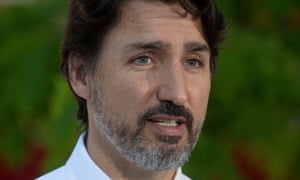
Canada’s emergency spending to help the country bridge the downturn caused by the Covid-19 pandemic was needed to lay the groundwork for a recovery, the prime minister, Justin Trudeau, has said in response to Fitch’s downgrade of its rating.
Fitch cut Canada’s rating from “AAA” to “AA+” on Wednesday, making it the first time since August 2004 that the ratings agency did not give Canada top marks.
Canada’s prime minister, Justin Trudeau. Photograph: Canadian Press/Rex/Shutterstock
Iraq has registered nearly 2,500 new coronavirus cases and over 100 deaths today, setting new records in a country whose health sector had been bracing itself for such a spike.
AFP reports that hospitals across the country have been overwhelmed over the last week by a jump in cases and deaths, following months of the virus spreading relatively slowly.
On Thursday, the health ministry said it had confirmed 2,437 new cases over the last day, bringing the total in the country to over 39,000 – of whom about half have recovered. Another 107 people died of coronavirus-related causes, pushing the total death toll to 1,437.
Iraqi policemen stand at a checkpoint during a curfew earlier this month to stop the spread of Covid-19 at the holy city of Karbala, south of Baghdad, Iraq. Photograph: Furqan Al Aaraji/EPA
Iraq had so far considered itself spared as the virus spread in other regional countries, including in neighbouring Iran where more than 10,000 have died.
But the Iraqi health sector has been worn down by years of war and poor investment and appears to be collapsing under the strain of the virus.
The Federal University of São Paulo (Unifesp) is in talks to test a potential coronavirus vaccine developed by Italian researchers, the dean of the Brazilian university told Reuters.
With the world’s worst outbreak outside the US, Brazil has become a key front in the global race for a vaccine, as clinical trials are likely to yield results faster in places where the virus is widespread.
“We are already in advanced discussions with Italy’s Lazzaro Spallanzani National Institute,” the Unifesp president, Soraya Smaili, said in an interview on Wednesday. “We expect to bring it here, the accord is already moving forward and we’ll be able to do a lot of studies with this vaccine.”
Passengers wearing face masks at the Se metro station in downtown São Paulo, Brazil. Photograph: Sebastião Moreira/EPA
The decline in the number of people in England estimated to have Covid-19 has levelled off, new figures from the Office for National Statistics (ONS) suggest.
The ONS said its estimates suggested the percentage testing positive has “clearly decreased over time” since the first measurement on 26 April and that “this downward trend has now flattened”.
An average of 51,000 people in private households had coronavirus at any given time between 8 June and 21 June, according to new ONS estimates. This was the equivalent of 0.09% of the population, or about one in 1,100 individuals.
The ONS, which publishes data on how many people at any one time are infected with Covid-19 based on swab results from households across the country, said:
Modelling of the trend over time suggests that the decline in the number of people in England testing positive has levelled off in recent weeks.
New modelling of the incidence rate trend over time suggests that incidence appears to have decreased between mid-May and early June, but has also since levelled off.
The figures look at community infections and do not include people staying in hospitals, care homes or other institutional settings.
The ONS figures also suggest that between 8 June and 21 June there were an estimated four new Covid-19 infections for every 10,000 individuals per week in private households in England – the equivalent of an estimated 22,000 new cases per week.
The Covid-19 pandemic is subsiding in Europe, but getting worse globally with the number of infections expected to reach 10m next week and the number of deaths 500,000, the head of the World Health Organization, Tedros Adhanom Ghebreyesus, has said.
Speaking via video conference with members of the European parliament’s health committee, Tedros said that once the pandemic was over, the world should not return to its previous state, but build a “new normal” that would be fairer, greener and help prevent climate change.
Tedros Adhanom Ghebreyesus, director general of the World Health Organization. Photograph: Salvatore di Nolfi/AP
Spain’s government has reached an agreement with unions and the country’s main employers’ association to extend national furlough schemes, known as ERTEs, by three months until 30 September, sources told Reuters on Thursday.
Originally due to expire on 30 June, the current system of public aid had been linked to Spain’s state of emergency over the coronavirus, which ended on 22 June.
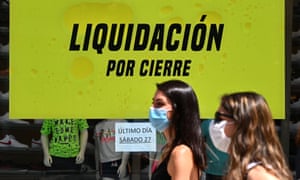
Women wearing masks walk by the window of a store offering a final sale before closing in Madrid. Photograph: Gabriel Bouys/AFP/Getty Images
The Peruvian government on Thursday said it had struck an agreement with the country’s private health clinics on the cost of Covid-19 care after President Martín Vizcarra warned on Wednesday they would be expropriated within 48 hours if negotiations did not progress.
For three weeks the clinics had wrangled with Vizcarra’s government over a fair rate for care. The haggling began amid reports of overcharging for the sickest patients, who require mechanical ventilators and intensive care.
Reuters reports that health minister, Víctor Zamora, said the agreement was finalised on Wednesday evening after a meeting with representatives of the Association of Private Clinics of Peru. He told RPP local radio:
The important thing here is people’s health. We cannot delay treatment.
Peru’s coronavirus outbreak is second only to Brazil’s in Latin America, with 264,689 confirmed cases and 8,586 deaths.
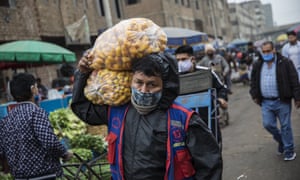
La Parada market in La Victoria district, in Lima, Peru. Photograph: Rodrigo Abd/AP
Tourism chiefs in Cambodia say they hope officials will drop a $3,000 (£2,400) coronavirus deposit scheme under which travellers have to make a downpayment for potential medical costs – including their funeral – arguing it is likely to deter potential visitors.
The government announced earlier this month that all foreigners entering the country must have an insurance package worth $50,000 and make a deposit of $3,000 in cash or by credit card. The deposit covers possible expenses in the event a person catches Covid-19, including healthcare, laundry services, meals and a funeral.
Chhay Sivlin, the president of the Cambodia Association of Travel Agents, said the deposit was introduced because insurance companies had previously refused to cover the cost of coronavirus treatment. “Our government has exhausted our resources and can no longer provide for any tourists tested positive for the disease,” she said.
Over 1,000 workers employed on projects for the 2022 World Cup in Qatar have tested positive for the coronavirus, and an engineer has died after contracting Covid-19, as preparations for the tournament have continued relentlessly despite the global pandemic.
The 51-year-old engineer, who died on 11 June, is the first reported coronavirus death among World Cup workers. He had worked on World Cup projects since October 2019 and had no underlying health issues, the “supreme committee”, the body organising the World Cup, said in a statement.
A source close to the organising committee also confirmed a report that around 1,100 World Cup workers have tested positive for coronavirus since the start of the outbreak.
Qatar has one of the highest rates of infection per capita in the world, with almost 92,000 cases, in a population of just 2.8 million. During May over a third of those tested were found to be positive. The number of deaths have remained low, with just 106 fatalities.
Despite the high infection rate, there has been almost no let up in the pace of construction at the new stadiums. Last week, the Education City stadium, the third of eight World Cup venues to be completed, was officially opened.
In mid-April the organising committee told the Guardian that eight workers employed on World Cup projects had tested positive, but until now the Qatari authorities, FIFA and FIFA’s human rights advisory board have refused to release any further figures.
Human rights groups have accused the Qatari authorities and FIFA of putting workers’ welfare at risk in the race to complete the stadiums.
Here are the key developments today:
Cases worldwide passed 9.4m on Thursday, with the WHO saying it expected global infections to pass 10m by the end of the week. At least 480,000 people have died so far.
Cases continue to surge in the Americas, with the US confirming its second-highest one-day total in the pandemic so far, with 34,700 new infections, according to Oxford University data project Our World in Data. Mexico confirmed its second-highest daily coronavirus death toll so far, with 947 fatalities on Wednesday.
Europe has seen a surge of Covid-19 cases since countries began easing restrictions, the WHO’s regional director for Europe, Hans Kluge, has told reporters. “Last week, Europe saw an increase in weekly cases for the first time in months,” he said, adding that more than two dozen countries in Europe had recorded resurgences of the deadly virus.
Israel is experiencing an alarming surge in new coronavirus cases, which has prompted the government to approve the reimposing of a controversial tracking system administered by the country’s domestic security agency, the Shin Bet.
The World Health Organization has warned that hospitals are facing a shortage in oxygen concentrators, which are needed to support the breathing of Covid-19 patients suffering from respiratory distress, as 1m new cases of coronavirus are confirmed worldwide per week.
Brothels in the Netherlands can reopen on 1 July after being shut for more than three months, the government announced on Wednesday.
Volunteers in the UK, Brazil and South Africa received their first doses of an experimental vaccine as part of a human trial run by Oxford University, as cases continue to rise and concerns grow over potential access to life-saving treatments.
China reported 19 newly confirmed cases of coronavirus amid mass testing in Beijing, where a recent outbreak appears to have been brought under control. Of the new cases it reported on Thursday, 13 were in Beijing and one in the neighbouring province of Hebei. Officials say the other five were brought by Chinese travellers from outside the country. No new deaths were reported.
Donald Trump told thousands of supporters at a rally in Oklahoma he wanted to slow down testing for Covid-19 – despite experts saying the opposite.
From masks to ‘miracle’ treatments, the Guardian’s Maanvi Singh looks back at how the US president has long been contradicting and defying science during the coronavirus outbreak and the impact that has had on the country’s handling of the pandemic.
From miracle cures to slowing testing: how Trump has defied science on coronavirus – video explainer
Officials in states across the US have reacted with alarm to the Trump administration’s plan to end federal support for some Covid-19 testing sites, warning it could cause further spread of a disease that is already surging back and calling the move “irresponsible”.
The White House confirmed on Wednesday it will no longer fund 13 testing sites, including seven in Texas, despite that state reporting record highs in the number of coronavirus cases.
Funding and support for the sites will end this month, even as Covid-19 cases surge across the US. The sites are in Texas, Illinois, New Jersey, Pennsylvania and Colorado.
Hospital admissions hit record highs in seven US states on Tuesday, including in Texas, which reported an all-time daily high of 5,489 new cases on Tuesday.
Four US congresspeople from Texas urged the government to reconsider defunding the testing sites in a letter to the Department of Health and Human Services and the Federal Emergency Management Agency (Fema).
Guardian analysis of coronavirus data, in combination with the University of Oxford’s coronavirus government response tracker, has identified that 10 of the 45 most badly-affected countries are also among those rated as having a “relaxed response” to the pandemic, underlining the mitigating impact of effective government public health policies. You can read the Guardian investigation here.
The countries include the US – which is experiencing its largest increase in coronavirus cases since April; Iran, Germany and Switzerland – two European countries where the R rate has risen above one this week […]
A country has been classed as being “relaxed” if its stringency index score is under 70 out of 100, according to the latest data from the University of Oxford’s tracker. The tracker assesses countries’ public information campaigns, containment measures and closures to give them a score out of 100 on their stringency index.
Germany’s reproduction rate of coronavirus jumped to almost three earlier this week, after an outbreak at an abattoir forced two states back into lockdown. This was after the county lowered its response to the pandemic, with its stringency score falling from 73 out of 100 at the start of May to 50.
More on the rise of cases in Israel.
With 532 new infections reported by the health ministry in the past 24 hours, Israel has seen the emergence of a number of hotspots including in the Sea of Galilee resort of Tiberias, as well as Tel Aviv and Jerusalem – the highest daily total in more than two months.
As of Thursday morning, the number of coronavirus cases had hit 22,139 since the beginning of the outbreak, with 49 in serious condition and 29 on ventilators, and 500 new cases being reported every day.
Cases also appeared to be rising in the occupied territories where the Palestinian Authority has announced the cancellation of Friday prayers in all mosques across the West Bank.
On Wednesday night, Israel’s parliament, the Knesset, voted to approve a bill authorising Shin Bet to track coronavirus cases and those in contact with them.
You can read the full story here:
The European healthcare regulator has recommended conditionally approving Gilead Sciences Inc’s antiviral treatment, remdesivir, for use in Covid-19 patients across the continent, just weeks after a speedy review.
Reuters reports that this approval means physicians can prescribe the Gilead drug, to be branded Veklury, in Europe once approved by the European Commission, which usually follows such recommendations.
Remdesivir has already been approved for emergency use in severely-ill patients in the US, India and South Korea, and has received full approval in Japan.
In April, the Guardian’s Sarah Bosely wrote that data from an early trial on more than 1,000 severely ill patients in 75 hospitals around the world show that patients put on the drug recovered 31% faster than similar patients who were given a placebo drug instead. Remdesivir cut recovery time from a median of 15 days to 11.
Scientists also suggested the drug could have an effect on survival. In the group on the drug, 8% died, compared with 11% among those given a placebo.
Remdesivir is not a cure for Covid-19 and these results must be confirmed by more data, but experts think it could potentially help those who are acutely ill, probably in combination with other drugs.
The coronavirus pandemic could see a rise in the use and trafficking of narcotics as well as increased risks for users, the UN drugs and crime agency (UNODC) has said.
The virus could lead to an overall increase in drug use with a shift towards cheaper products and injecting, both of which could mean greater danger for users, the agency said in its 2020 World Drug Report.
The Vienna-based agency said there were lessons to be learnt from what happened in the wake of the 2008 economic crisis.
The UNODC warned that drug consumption has already been rising at an “alarming” rate over the last decade.
It also warned that countries were more likely to further reduce drug-related budgets and to give less priority to anti-trafficking operations and international cooperation in the wake of the pandemic.
Rising unemployment and a lack of opportunities would increase the chances that poor and disadvantaged people “turn to illicit activities linked to drugs – either production or transport”, the report said.
UNODC executive director Ghada Waly said:
The Covid-19 crisis and economic downturn threaten to compound drug dangers further still, when our health and social systems have been brought to the brink and our societies are struggling to cope.
We need all governments to show greater solidarity and provide support, to developing countries most of all, to tackle illicit drug trafficking and offer evidence-based services for drug use disorders and related disease.
A cluster of new coronavirus cases has emerged at a warehouse in Bologna, Italy, used by express courier Bartolini, a local newspaper reported on Thursday.
The company uncovered 44 asymptomatic cases – including two drivers – after testing all workers at the warehouse following the diagnosis of two coronavirus cases among staff members, the Resto del Carlino daily said.
Bartolini has closed the warehouse although deliveries continue. It was expected to test all staff who have come into contact with those with the virus, the daily added.
On Wednesday 10 scientists in Italy had released a joint statement declaring the coronavirus emergency to be “over”.
That sparked a heated reaction from colleagues who warned a second wave was likely if people let down their guard.
The Ebola outbreak in eastern Democratic Republic of the Congo (DRC) has ended and leaders tackling Covid-19 should heed its example, writes Tedros Adhanom Ghebreyesus, director general of the World Health Organization, in the Guardian.
As Covid-19 poses a threat to every region of the world, the DRC holds lessons for countries of all incomes.
For example, its contact tracers should serve as a worldwide inspiration. They have used technology to overcome insecurity, swapping folders of forms for mobile phones to collect data on Ebola, to both help share information faster and ward off unwanted attention in areas where suspicions run high.
The Congolese people ended a devastating outbreak through an unshakeable commitment to science, data and community, and with international solidarity.