Coronavirus live news: Iran reaches new peak in transmission with record number of infections
Slovenia will from Friday lift coronavirus border restrictions for Austrians, a government spokesman said on Thursday, following a similar move by neighbouring Austria to lift border restrictions for Slovenians.
Slovenia had introduced border checks and travelling restrictions to prevent the spread of the virus, including obligatory quarantine for most people entering the country. Over the past weeks it has lifted restrictions for citizens from neighbouring Croatia and Hungary.
The decision on whether to lift restrictions for citizens from neighbouring Italy is also due, following the visit of Italian Foreign Minister Luigi di Maio in Ljubljana on Saturday.
Slovenia introduced lockdown in mid-March and started to gradually lift it from 20 April. In May it became the first European state to declare an end to its coronavirus epidemic but people are still obliged to keep social distance and wear face masks in indoor public spaces. The country has so far reported 1,477 coronavirus cases and 109 deaths.

Ireland hopes to be able to recommend the resumption of air travel with a select number of countries in a number of weeks, the prime minister Leo Varadkar said on Thursday, telling prospective holidaymakers “summer is not yet lost.”
Some European countries such as Germany, Spain and Austria plan to lift coronavirus-related border restrictions with neighbouring countries this month, something Ireland has been more cautious about as it slowly reopens its economy.
Ireland requires anyone entering the country to self-isolate for 14 days and foresees making its first step back to non-essential travel via so-called “air bridges” with other countries who share low levels of coronavirus infection.
Varadkar told parliament:
I hope that as the world returns to a new normality, we will see international air travel resume, in the first instance through air bridges with countries that have suppressed the virus to a similar extent as ours.
This however is some weeks away and it’s far too soon for anyone to book their holidays yet but summer is not yet lost.

Ireland has reported 1,659 deaths related to just over 25,000 confirmed cases of Covid-19. The number of cases, deaths and admissions to hospital have all been falling in recent weeks.
The government is due to review the 14-day quarantine for travellers on 18 June. Airlines, in particular Ryanair, have pushed back strongly against the rules, saying they are impossible to implement.
Varadkar also reiterated that he hopes to announce a speeding up of the reopening plan on Friday ahead of entering the second of five phases next week.
Carbon dioxide levels in the atmosphere have risen strongly to a new peak this year, despite the impact of the global effects of the coronavirus crisis, writes Fiona Harvey, the Guardian’s environment correspondent.
The concentration of CO2 in the atmosphere reached 417.2 parts per million in May, 2.4ppm higher than the peak of 414.8ppm in 2019, according to readings from the Mauna Loa observatory in the US.
Without worldwide lockdowns intended to slow the spread of Covid-19, the rise might have been 2.8ppm higher, according to Ralph Keeling, a professor at the Scripps Institution of Oceanography. He said it was likely the lockdowns had played a role, but that the difference was too small to show up against other factors causing year-to-year fluctuations.
“People may be surprised to hear that the response to the coronavirus outbreak hasn’t done more to influence CO2 levels,” he said. “But the buildup of CO2 is a bit like trash in a landfill. As we keep emitting, it keeps piling up. The crisis has slowed emissions, but not enough to show up perceptibly at Mauna Loa. What will matter much more is the trajectory we take coming out of this situation.”
Daily emissions of carbon dioxide fell by an average of about 17% around the world in early April, according to a comprehensive study last month. As lockdowns are eased, however, the fall in emissions for the year as a whole is only likely to be between 4% and 7% compared with 2019. That will make no appreciable difference to the world’s ability to meet the goals of the Paris agreement to keep global heating below the threshold of 2C, which scientists say is necessary to stave off catastrophic effects.
The World Health Organization’s director for Africa has said current statistics for the impact of the Covid-19 pandemic on the continent are broadly accurate, amid concerns that low levels of testing, poor infrastructure and a lack of cooperation from some governments may be disguising the true extent of the disease’s spread.
There are currently 162,622 confirmed cases in Africa, with 4,604 deaths.
Damien Gayle
(@damiengayle)Nearly 163,000 confirmed cases of coronavirus had been reported across Africa on Thursday morning, according to the @AfricaCDC. So far, more than 70,000 people who have tested positive for the virus have recovered, and about 4,600 have died. t.co/8k1lizups2 pic.twitter.com/5b71aYE6cl
Dr Matshidiso Moeti told reporters in the organisation’s weekly streamed press conference that officials would know if there were high numbers of cases of infection or deaths that were going undetected, though testing remained a challenge.
“We believe there is some underestimation of the cases, but we don’t believe it is a multiple fold underestimation such as that one day we will find that many, many African people died of Covid-19 that were never discovered,” she said.
One reason was that pre-existing systems designed to pick up signs of outbreaks of other respiratory diseases, such as influenza, would have been triggered and “that did not happen.”
Moeti said that reported numbers of cases in many countries were rising steeply but that this was most likely to be because of more testing, especially in Ghana, Ethiopia and Senegal.
“It’s increasing, but not to show we are discovering a huge number of previously undetected cases,” she said.
In South Africa, where testing has scaled up “hugely”, case numbers have soared since easing a strict lockdown four days ago.
South Africa has reported 38,000 cases, an increase of 17,000 in two weeks, and 792 deaths. The outbreak in and around Cape Town, the western city, is the worst on the continent.
Over in Greece infectious disease experts are expressing consternation over the dangers posed by tourism ahead of the country reopening to the world with the resumption of international air links on 15 June, writes Helena Smith in Athens.
Anxiety over the virus being imported by visitors was highlighted earlier this week when 12 of the 91 passengers aboard a Qatar Airways flight tested positive for coronavirus upon arrival in Athens. The airline has since said that no one was found to be infected when they boarded the plane in Doha.
Speaking on Skai TV today, professor Nikolaos Sypsas, a member of the scientific committee that advises the government, said tourism would be “the first candidate” for restrictive measures being reinstated in the event of a recurrence.
“With tourism comes imported cases. Despite the efforts underway to have the least possible danger, the risk remains.”
Greek authorities, enforcing emergency health protocols, suspended flights to and from Qatar and quarantined all those on board – for 14 days in the case of those who tested positive, and an initial seven days for those who tested negative. If found to be clear at the end of a week those cleared of the virus will be free to go.
“The incident has shown how complicated tourism is,” said professor Sypsas. As of 15 June blanket testing of plane passengers will be replaced by random ‘spot’ testing, he explained, because Greece simply didn’t have the capability of testing everyone flying in and the EU had decided against endorsing such a move.
“Playing with this virus is like playing with fire,” the expert lamented saying it was vital that countries were separated into categories of risk.
Both Albania and north Macedonia, Greece’s northern neighbours, had seen a rise in confirmed coronavirus cases as a result of relaxing precautionary measures, he noted.
“The biggest danger, as far as the epidemic is concerned, is complacency. The virus does not excuse any mistake, we’ve learned it from other countries.”

So far Greece has succeeded in keeping infection rates and confirmed coronavirus cases low.
But with tourism the heavy engine of their economy – generating one in five jobs and almost 25% of GDP – Greeks are now eager to reignite the sector. A tourist campaign promoting the pleasures of “the Greek summer” is to be unveiled by Athens’ centre right government this evening.
Outdoor cinemas, keeping to customary film launches on a Thursday, also open tonight as lockdown measures continue to be eased.

Iran is reluctantly confronting the possibility of a renewed political crisis as well as a health one after the latest figures showed the number of new coronavirus infections at a record high, writes Patrick Wintour, the Guardian’s diplomatic editor.
The government appeared to have brought the virus under control a month ago, but a second wave of the virus has steadily been gathering force, and according to data released by the health ministry there were 3,574 confirmed new infections in 24 hours – an increase of 440 on the previous day.
The previous daily record in Iran, recorded on 30 March, was 3,186. The country was one of the first in the Middle East to be gripped by the disease.
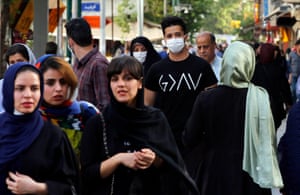
In spite of a steadily rising infection rate, authorities have been progressively lifting controls on shops, mosques, schools, offices and travel. The border with Turkey was also being opened for haulage traffic on Thursday.
In recent days government spokesmen have been increasingly critical of the public, accusing them of ignoring the continued restrictions, especially in workplaces. “If the rules are not obeyed,” the president, Hassan Rouhani, warned, “the government would be forced to restore the quarantine situation again, disrupting normal life and inflicting serious damage on the entire national economy.”
There was little immediate domestic coverage of the record infection figure.
Another 1.9 million people filed for unemployment benefits in the United States last week as the total number of claims passed 42m since the coronavirus pandemic hit, writes Dominic Rushe in New York.
The pace of layoffs has slowed dramatically from its peak of 6.6m at the start of April as states begin to relax quarantine orders, and last week was the ninth consecutive week of declines. But the scale of layoffs remains staggeringly high. In the worst week of the last recession “just” 665,000 people filed for unemployment.
Jason Reed, professor of finance at the University of Notre Dame’s Mendoza College of Business, said the numbers may be slowing down, but “this is unprecedented. The figures are so high that it’s hard to grasp the reality.”
On Friday the labour department will release May’s monthly jobs report. Economists are predicting unemployment will rise to close to 20% from 14.7% in April and some 8m more jobs will have been lost after a combined loss of 21.4m in March and April.
The official tally would mean one in five Americans in the workforce are now out of work. The layoffs have disproportionately hit African Americans, Latinos and those without a college education.
Spain wants to welcome British tourists back as soon as its airports reopen to foreign visitors on 1 July, but has warned much will depend on the UK’s 14-day coronavirus quarantine for those returning from abroad and on the British authorities rescinding advice on non-essential foreign travel, writes Sam Jones, the Guardian’s Madrid correspondent.
Spain’s tourism minister, María Reyes Maroto, said the country will begin hosting foreign visitors from 22 June, when the current state of emergency ends and land borders with France and Portugal reopen.
Two pilot schemes will also mean thousands of overseas holidaymakers, at least 6,000 of them German, begin arriving in the Balearic and Canary islands during the last two weeks of June.
Questionnaires and an app will be used to track the visitors and the information gathered will help the Spanish government and tourist sector prepare for the return of all foreign visitors from the beginning of July.
Maroto said Spain’s message to UK tourists – its largest single national visitor group – was simple: “As soon as possible, as soon as possible! We want British tourists to come back as soon as they can.”
But the minister said there needed to be greater clarity from the British government about when UK tourists would be able to fly abroad, and on whether they would need to self-isolate on return.
A vast database from a little-known company called Surgisphere has influenced rapid policy shifts as the world seeks treatments for Covid-19. But as researchers began to examine it more closely, they became increasingly concerned.
Melissa Davey, the Guardian’s Melbourne bureau chief, has written the latest instalment of our investigations into the factors driving coronavirus policy around the world.
Pakistan reported a record single-day spike in coronavirus-related deaths with 82 new fatalities and 4,688 cases that it says resulted from increased testing in the past 24 hours, the Associated Press reports.
Pakistan’s outbreak has grown steadily since the country’s first case in February. Since then, 1,770 people have died and 85,264 have tested positive.
As many as 901 patients were listed in critical condition at hospitals on Thursday. The country has barely 3,000 intensive care beds serving a population of 220 million.
On Thursday, Pakistan for the first time conducted over 20,000 tests in the past 24 hours. It has done more than 615,000 tests after increasing its testing capacity from only two labs in February.

Read the original article at The Guardian