Coronavirus live news: Italy extends state of emergency as WHO warns of ‘one big wave’
An urgent track and trace operation is under way in Berlin after a couple tested positive for coronavirus after returning from a holiday to visit friends in Manchester.
Fifty people who have had contact with the couple since their return are in quarantine, of whom 13 have so far tested positive for Covid-19.
The Turkish couple, a 50-year-old taxi driver and his 45-year-old wife, arrived home on a Ryanair flight on 16 July. They were not diagnosed until six days after their return.
The whole family is now infected, including the couple’s four children, aged nine to 21, and their grandmother.
Gudrun Widders, an official at the local health office in Berlin’s Spandau district, told the Bild newspaper that no one in the family has required hospital treatment.
French health authorities reported 725 new confirmed coronavirus cases on Tuesday, below the daily average of 924 over the past week but unlikely to alleviate fears of a second wave.
In a statement, authorities said “viral circulation is still sustained in France”, stressing the reproduction rate was steady at 1.3.
A reproduction rate, or ‘R’, of 1.3 means that 100 people with the virus infect, on average, 130 other people. A rate of less than 1 is needed to gradually contain the disease.
France also reported 14 new deaths from the virus, taking the total to 30,223, and twice the daily average deaths of seven seen over the past week.
The number of people in hospital with Covid-19 went down by 104 to 5,551, continuing a two-month downward trend.
It said the number of deaths had risen by 1,126 to 147,672.
The CDC reported its tally as of 4 pm ET on 27 July versus its previous report a day earlier. Its figures do not necessarily reflect cases reported by individual states.
Space Camp, an educational programme in the US attended by nearly 1 million people, including a dozen who went on to become astronauts or cosmonauts, said it is in danger of closing without a cash infusion because of the coronavirus pandemic.
Part of the state-owned US Space and Rocket Centre in Huntsville, Space Camp was shut down for weeks earlier this year and has been hampered by low attendance since reopening in June with limited capacity, officials said.
With staff numbers reduced and the normal flow of international students and school groups drying up because of the virus, leaders held a news conference announcing a Save Space Camp drive.
Officials hope to raise at least $1.5m in donations they said were needed to keep the museum open through October, the end of the fiscal year, and to reopen Space Camp in April.
“We are now struggling for our very survival,” said John Nerger, chair of a state board that oversees the centre.
Donors gave nearly $100,000 within a couple hours of the announcement.
Located near NASA’s Marshall Space Flight Centre, the museum features exhibits including an authentic Saturn V rocket, the Apollo 16 command module and a full-sized model of a space shuttle.
Space Camp students have access to that area, plus classes and mockups where they participate in simulated space missions.
Since opening in 1982, Space Camp has had almost 1 million youth and adult attendees, and it was the inspiration for a 1986 movie of the same name.
Ten people selected as astronauts and two who went on to become cosmonauts attended the camp, promoters said.
Italy’s prime minister, Giuseppe Conte, has extended the country’s state of emergency until October, meaning he will continue to have the power to impose a lockdown and other safety measures without needing the approval of parliament.
Conte told the Senate that the extension was “inevitable” despite the infection rate falling significantly.
Contagion has fallen, but the numbers show that the virus continues to circulate, giving rise to outbreaks at local level which have been identified and contained.
The international situation remains worrying and what is happening in countries close to us obliges us to be watchful…this way the country is more secure.
Italy on Tuesday reported 181 new infections, bringing the total to 246,488, and 11 further deaths.
Conte was attacked by opposition parties for extending the state of emergency.
Matteo Salvini, leader of the far-right League, told reporters: “Keeping Italians terrorised, distant from each other and locked up is an attack on our democracy and economy.”
Salvini, who refused to wear a mask during a conference at the Senate on Monday, said the “emergency seemed to be over” and so the state of emergency didn’t need to be extended.
Hi everyone, this is Jessica Murray taking over the coronavirus live blog for the next few hours.
Please do get in touch with any suggestions or story tips.
The Covid-19 pandemic will be “one big wave” not seasonal, the WHO warned. Cautioning northern hemisphere countries to not become complacent this summer, Dr Margaret Harris said we are still in that first wave, which will “go up and down a bit” as opposed to behaving like infuenza, which follows seasonal trends.
The number of Covid-19 cases doubled worldwide in the past six weeks. This serves as a reminder that the pandemic is still accelerating.
Twitter restricted Donald Trump Jr’s account after a post violated the site’s misinformation policy on Covid-19. Twitter confirmed it had taken the video down and while it had not suspended his account, it had “limited some account functionality” for 12 hours following the violation.
The Belarusian president Alexander Lukashenko said he had recovered from the coronavirus without any symptoms. He has previously provoked outrage after dismissing fears about the pandemic as a “psychosis” and suggesting remedies such as drinking vodka or taking saunas to battle the virus.
North Korea introduced tougher lockdown and quarantine measures after its first publicly confirmed case.
Chile’s government launched a five step coronavirus
prevention program to gradually reopen the country. The whole of Santiago, where most of the country’s cases are concentrated, had been under strict quarantine since 16 May — and some neighbourhoods were locked down from as early as March.
New York’s governor said there will be an investigation following social distancing violations at a Chainsmokers concert in the Hamptons last weekend. Andrew Cuomo said he was “appalled” at the “egregious” and “reckless” violations. See here.
Sixty-five migrants who were in a group of 94 people rescued at sea and taken to Malta on Monday have tested positive for Covid-19, Malta’s health ministry said on Tuesday.
It was the single largest cluster of positive cases detected on the Mediterranean island since the first case came to light there on 7 March.
The health ministry said 85 of the migrants had been tested so far, with nine awaiting an examination. It gave no further information about their condition. The nationalities of those infected were not given, but their dinghy was believed to have set sail from Libya.
“Migrants arriving by boat are immediately quarantined for 14 days and tested. The migrants who are positive will continue to be isolated and the rest will remain in quarantine and followed up,” the ministry said.
“This group arrived in Malta together and were in contact with very few other people before they were tested,” it added, playing down the likelihood of locals getting infected.
The migrants had issued a distress signal from their packed dinghy on Sunday but it took more than 30 hours for rescuers to reach them.
Non-governmental agencies have accused both Malta and Italy of deliberately slowing down rescue missions in an effort to dissuade people from putting to sea and seeking a better life in Europe.
The discovery that so many of the group had Covid-19 will bolster concerns in both countries that a recent increase in new arrivals will undermine local efforts to eliminate the disease.
French health authorities reported 14 new deaths from Covid-19 on Tuesday, taking the total to 30,223, a figure twice as high as the daily average increase of seven seen over the last week.
In a statement, authorities said the number of people in hospital for Covid-19 went down again, pursuing a two-month downward trend.
More than 150 Brazilian bishops have attacked what they called president Jair Bolsonaro’s sluggish, inept and negligent response to the coronavirus pandemic, as a prominent leftist theologian likened the country’s leader to the Antichrist.
In a withering letter leaked to the press this week, the Catholic leaders warned Brazil faced a “perfect storm” of an unprecedented health emergency, a devastating economic slump and a profound political crisis caused in large part by the country’s far-right president.
The bishops criticised what they called the Bolsonaro administration’s incompetent and anti-scientific response to the pandemic and said they were appalled by its “contempt for education, culture, health and diplomacy”.
“Socio-economic chaos” was on the horizon, the bishops warned, denouncing efforts “to normalize the scourge of thousands of Covid-19 deaths”.
Citing the New Testament’s Letter to the Romans, the bishops urged believers to resist “one of the most difficult moments in Brazilian history”:
Let us therefore cast off the works of darkness, and put on the armour of light.
The signatories include Claudio Hummes, the emeritus archbishop of São Paulo, Brazil’s worst-hit city, where more than 9,000 people have died. Nearly 90,000 deaths have been officially recorded nationwide, making Brazil the second worst-hit country in the world after the US.
In a separate intervention the prominenttheologian and philosopher Leonardo Boff also slammed Bolsonaro’s coronavirus response. ”The country is directionless and being governed by someone with the characteristics of the Antichrist,” said Boff, a longtime friend of Bolsonaro’s political nemesis, former left-wing president Luiz Inácio Lula da Silva.
Brazilian health workers urged the International Criminal Court on 27 July to investigate Bolsonaro’s government for crimes against humanity over its handling of the coronavirus pandemic. A dossier of evidence was handed to the Hague-based court by a group of unions that claim to represent more than one million healthcare staff in Brazil, which has the world’s highest virus death count after the United States. Photograph: Evaristo Sa/AFP/Getty Images
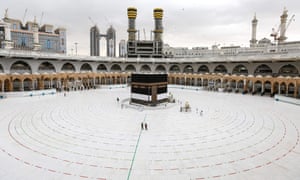
The Kaaba, Islam’s holiest shrine, at the centre of the Grand Mosque in the holy city of Mecca, ahead of the annual Hajj pilgrimage. Rings are laid in place around it to separate pilgrims as part of social distancing measures. Saudi Arabia begins on 29 July hosting the pilgrimage, dramatically downscaled this year amid the pandemic, having barred millions of international pilgrims for the first time in modern history. Photograph: AFP/Getty Images
The Italian prime minister Giuseppe Conte asked parliament on Tuesday to extend a state of emergency, which expands his government’s powers as it tackles the coronavirus health crisis.
Opposition parties objected that Conte was trying to keep too much power in his own hands despite a dramatic fall in the rate of contagion.
Conte announced a six-month state of emergency on 31 January, when the first two cases of coronavirus were confirmed in Rome. He told the Senate:
The virus continues to evolve and has not run its course. It would be incongruous to abruptly suspend such an effective measure.
However, he drew back from requesting an extension until the end of the year, saying he only wanted a renewal until October.
The state of emergency gives greater powers to both regional and central government, including making it easier for ministers to declare red zones should the disease flare up again, and to bolster hospital resources.
It would also cut bureaucracy as officials prepare schools to reopen in September after being shut for six months.
Italy has been one of the worst-affected countries in Europe, registering more than 35,000 deaths from around 246,500 cases. However, new infections have fallen sharply over the past three months and Conte’s critics said he needed to involve parliament in key decisions.
“I’m shocked. Conte is arguing in the Senate that without a state of emergency the government is unable to make normal decrees, bills, ordinances. This is a gross lie and a very dangerous assault on liberty,” tweeted Giorgia Meloni, head of the far-right Brothers of Italy party.
The Senate, where the coalition has only a paper-thin majority, is due to vote on the request on Tuesday evening.
Greece has reported a leap in coronavirus cases with public health officials confirming 52 new infections in the last 24 hours.
The increase brings the total number of cases to 4,279 in a country that, through enforcement of early lockdown measures, has managed to keep cases and casualties low.
Seven people were found to have the virus after being tested at land frontiers, airports and other entry points, according to the National Organisation of Public Health organisation, EODY.
The death toll has risen to 203, the state body announced adding that 66 or 32.5 % of the fatalities are women. The uptick – attributed in part to tourists – has prompted growing concern among officials.
Earlier on Tuesday Greece’s deputy civil protection minister, NikosHardalias, said mask wearing would become mandatory as of tomorrow in almost all indoor spaces where social distancing was difficult, including shops, banks, public offices and elevators. Churches will remain exempt.
Hardalias said:
The rise in infections in Athens and Thessaloniki proves the virus is still here. The requirement [of facial coverings] is for the collective good. The situation must not cause panic but neither complacency.
Spain reported 905 new cases of Covid-19 on Tuesday, with the regions of Catalonia, Aragon and Madrid accounting for most of them.
The cumulative total number of coronavirus cases stood at 280,610, up from 278, 782 on Monday, the country’s health ministry said. That is a rise of 1,828 from the previous day, and includes results from antibody tests on people who may already have recovered.
Community workers patrol near a beach in Barcelona, encouraging people to wear a face mask. Photograph: Xinhua/REX/Shutterstock
Chile’s government has today launched its five step coronavirus prevention program to gradually reopen the country.
The whole area of capital Santiago, where most of the country’s Covid-19 cases are concentrated, has been under strict quarantine since 16 May — and some neighbourhoods were locked down from as early as March.
Under these measures, residents can leave the house twice a week with police permission and only shops selling essential goods, such as supermarkets and pharmacies, are allowed to function.
On Tuesday, seven Santiago neighbourhoods will transfer to Step 2 — they will be allowed to leave their houses freely on weekdays, with local shops allowed to reopen. The quarantine remains in place on weekends and holidays, along with a nighttime curfew every day.
La Araucanía joins fellow southern regions Los Ríos and Aysén in Step 4 of the prevention program. Here, rates of infection are significantly lower than other parts of the country. Restaurants, cafés, shops and cinemas can reopen with up to 25% capacity, while bars, clubs and gyms remain shut and the curfew stays in place.
People walk in the street in Santiago after lockdown measures were relaxed. -Chilean health authorities announced the start of a first stage to reduce lockdown measures in seven communes in Santiago -several of them quarantined since March – as the numbers of coronavirus infections “continue to improve”. Photograph: Martin Bernetti/AFP/Getty Images
“Each step progresses according to risk of exposure of getting infected” said Paula Danza, the Ministry of Health’s sub secretary.
However, with the coldest month of August still to come, health professionals have voiced fears that the government is prematurely reopening the country.
Concerns include new outbreaks, repeating the mistakes made last April when quarantines were lifted and infection rates spiralled to 6000+ cases a day. By June, Chile had the highest Covid-19 infection rates per capita in the world, forcing the health minister Jamie Mañalich’s resignation.
On replacing Mañalich, the incumbent health minister Dr Enrique Paris pledged greater transparency over death toll numbers and stronger cooperation with academics and health professionals over Covid-19 prevention strategies.
On Tuesday Chile logged 1,876 new cases of coronavirus and 53 deaths, bringing the total to 349,800 cases, which includes 9,240 deaths.
New York’s governor says he is appalled by videos showing crowds standing close together at a Hamptons concert featuring electronic music duo The Chainsmokers over the weekend.
Andrew Cuomo said the state Department of Health will conduct an investigation into egregious social distancing violations.
“We have no tolerance for the illegal reckless endangerment of public health,” read the governor’s Monday night tweet.
The Saturday night concert called Safe & Sound was billed as a charity drive-in show where Goldman Sachs CEO David Solomon and Southampton Town Supervisor Jay Schneidermans band also performed.
Cuomo shared a video on Twitter, which has close to 7 million views, that showed crowds of people standing and swaying near the stage. The video shows attendees who appeared to be wearing masks, but many individuals were standing closer than 6 feet (2 meters).
Andrew Cuomo (@NYGovCuomo)
Videos from a concert held in Southampton on Saturday show egregious social distancing violations. I am appalled.
The Department of Health will conduct an investigation.
The governor’s criticism comes as he argues local governments largely in downstate New York have failed to enforce social distancing and mask rules.
State Health Commissioner Howard Zucker chided Schneiderman in a Monday letter and questioned how Southampton could have issued a permit for an event that posed a public health threat.
Schneiderman and the concert’s organisers, In the Know Experiences, didn’t immediately respond to the Associated Press’ requests for comment by email and phone Tuesday.