Coronavirus live news: Latin America and Caribbean exceed 2m cases as Brazil’s death toll passes 50,000
The United Nations has accused the Taliban and Afghan security forces of “deliberate” attacks against healthcare workers and facilities at a time when Afghanistan is grappling with the coronavirus epidemic.
The United Nations Assistance Mission in Afghanistan (Unama) said it had registered 12 such acts of violence between 11 March and 23 May against healthcare facilities and workers.
Unama attributed eight of the attacks to the Taliban and three to Afghan forces, AFP reports.
One attack, an assault on a Kabul maternity hospital on 12 May, still remained unclaimed. The assault killed 25 people, including 16 mothers, according to international charity Doctors Without Borders .
“At a time when an urgent humanitarian response was required to protect every life in Afghanistan, both the Taliban and Afghan national security forces carried out deliberate acts of violence that undermined healthcare operations,” the head of Unama, Deborah Lyons, said in a statement.
Hello, I’m Clea Skopeliti and I’ll be taking you through the next few hours. If you’ve got a news tip or story from your part of the world, please do get in touch with me by Twitter DM or email. Cheers!
Latin America and the Caribbean have surpassed 2 million cases, according to an AFP tally based on official figures.
Brazil is home to more than half of the infections. The virus is accelerating its spread in the region, with Mexico the second hardest-hit country there, followed by Peru and Chile.
Meanwhile Cyprus, the only country to say it will cover costs if travellers are diagnosed with Covid-19, has also relaxed restrictions on visitors.
The EU’s most easterly state announced that while spot tests will be conducted on arrivals, the majority will no longer be required to obtain negative coronavirus certificates 72 hours prior to heading to the island. Under the scheme, up to 15% of the estimated 1,500 passengers expected in the coming weeks to fly in daily will be randomly checked.
“The only thing they need to do to fly here is fill in an electronic form,” said deputy tourism minister Savvas Perdios adding that there was a growing sense among tour operators that some of the summer could be saved.
Like most Mediterranean nations, Cyprus is dependent on tourism and, as in Greece, is now forced to weigh allowing people in while avoiding virus outbreaks that could besmirch its record as a safe destination. The two nations had among the lowest infection and casualty rates in Europe.
But Perdios told the Guardian it would be a few weeks, yet, before the former colony resumed flights from Britain – with 1.3 million visitors its main market.
“The situation in the UK is improving all the time,” he said in a telephone interview from Nicosia, the island’s war-divided island. “The general consensus is in a few weeks from now flights will be possible … mid July, around the 15th, is a reasonable expectation, earlier than that not really.”
If permitted, passengers from the UK would still very likely have to carry immunity certificates or be subject to coronavirus tests upon arrival.
With Britons accounting for 30% of the island’s vital tourist sector, officials expect losses of around 70% compared to earnings last year. But for travellers it wasn’t all bad.
Perdios foresaw “very good deals” in the months ahead following talks with tour operators.
“Now that things are a little bit clearer and destinations are opening, tour operators feel that it’s possible to save a small part of the summer even at the last moment,” he said.
“I think now the wheel is turning, things are being put in motion and there are going to be very good deals, I am certain of that not only in Cyprus but [across] the Mediterranean. Rates, deals and packages are being finalised as we speak.”
The island’s airports began accepting commercial flights on 9 June, three months after suspending air links as efforts were stepped up to stem the spread of the highly contagious disease. As yet there had been no cases of foreign travellers testing positive for Covid-19, Perdios said.
The coronavirus death toll in the UK has risen by 43 to 42,632 as of 5pm on Saturday, figures from the Department of Health and Social Care show.
In total, 304,331 people have tested positive. There have been 7,890,145 tests, with 175,018 of those taking place on 20 June.
Department of Health and Social Care (@DHSCgovuk)
As of 9am 21 June, there have been 7,890,145 tests, with 175,018 tests on 20 June.
304,331 people have tested positive.
As of 5pm on 20 June, of those tested positive for coronavirus, across all settings, 42,632 have sadly died.
Saudi Arabia has today lifted its nationwide curfew which was imposed to limit the spread of coronavirus in March.
Saudi authorities have said that all economic and commercial activities will return to normal, but the current bans on international travel and religious pilgrimage will remain in place.
Some measures have already been relaxed, and tens of thousands of mosques opened last month.
However, the country is yet to comment on Hajj pilgrimage, which normally sees 2.5 million pilgrims travel to the city of Mecca, and is due to take place next month.
Countries including Malaysia and Indonesia have said they will not be allowing their nationals to attend.
There have been no new deaths of coronavirus patients in Scotland for the fifth day this month, according to the latest Scottish government figures.
A total of 2,472 patients in Scotland have died after testing positive for Covid-19, which shows no change since Saturday’s figures.
The Scottish Government’s daily update on coronavirus figures shows that 18,156 people have tested positive for the virus in Scotland, an increase of 26 from 18,130 the previous day. Of those who have tested positive, 518 were in hospital on Saturday night.
A total of 16 patients were in intensive care with either confirmed or suspected Covid-19, a rise of two in 24 hours.
However, it is important to note that weekend reporting figures are often lower than weekdays due to a lag in reporting.
Members of the public and railway staff wear face masks in Waverley Station on June 18, 2020 in Edinburgh, Scotland. First Minister Nicola Sturgeon announced phase 2 of lifting coronavirus restrictions, as of Monday it will be mandatory to wear face masks on all public transport, including taxis and private hire cars. Photograph: Jeff J Mitchell/Getty Images
Scotland is preparing to ease some lockdown measures on Monday, including reopening places of worship for private prayer with increased hygiene measures and social distancing.
Face coverings will also be made mandatory from Monday, with Scotland’s national railway ScotRail providing free masks at 18 of its busiest stations.
Iran has reported more than 100 new coronavirus deaths on Sunday for the third day running, health authorities said.
They stressed that the outbreak had not yet peaked in the country, which has seen the deadliest outbreak in the Middle East.
The country recorded its lowest single-day death toll in early May, before seeing a new rise in cases in recent weeks.
Health ministry spokeswoman Sima Sadat Lari said the 116 deaths reported on Sunday brought the country’s overall coronavirus death toll to 9,623. However, the health minister Said Namaki denied that the country was facing a second wave, saying that the peak had not yet passed.
“Even in provinces where we think the first coronavirus wave is behind us, we have not yet fully experienced the first wave,” he was quoted as saying by semi-official news agency ISNA.
Authorities recorded 2,368 new infections on Sunday, bringing the total number of confirmed cases of the virus to 204,952.
Pepsi was ordered to shut down one of its snack-making plants in Beijing after several employees tested positive for coronavirus and 87 close contacts were traced and quarantined.
It comes after 22 new cases were recorded in Beijing – the latest in a recent outbreak of coronavirus in the Chinese capital. More than 220 people have so far tested positive in this “second wave”, which is thought to have broken out in at the city’s Xinfadi wholesale market.
AFP news agency reports that the origins of the virus have been traced to the chopping boards used to handle imported salmon at the market. The market, which supplies more than 70% of Beijing’s fresh produce, has been closed.
People wear face masks to help curb the spread of coronavirus as they observe the partial solar eclipse at Olympic park on June 21, 2020 in Beijing, China. Photograph: Lintao Zhang/Getty Images
Pepsi is not the only company to be impacted by Beijing’s recent outbreak. China has also suspended poultry imports from a plant owned by American meat processor company Tyson Inc, after the company confirmed that coronavirus had been detected at its plant in Springdale in Arizona.
On Friday, officials announced a nationwide campaign to inspect all fresh products coming from “high-risk countries” following reports of new virus clusters at plants in Germany and the US.
A drive-in church service has taken place in Cornwall, UK.
Dozens of people arrived at a car park in Cornwall to sing and pray together, in a service organised by Reverend Matt Timms of Wave House church. Local council and police were supportive, Timms said, and people remained in their cars to ensure social distancing.
Places of worship remain closed for mass gatherings in the UK.
Timms said it was wonderful to hear people singing together and seeing one another after so long apart. He said during lockdown, people had been “craving community”, and he was delighted to “share a message of hope”.
I will try to find some photographs for you all!
Taiwan will allow business trips from foreign visitors, but only those from ‘low-risk’ countries, and subject to conditions.
In the UK, the health secretary Matt Hancock has said that the country is on track for the further easing of restrictions on 4 July. This is likely to include some changes to the 2m social distancing rules to enable businesses to open. He also apologised after a video surfaced of him momentarily breaching social distancing rules.
‘It’s because I’m human’: Matt Hancock apologises after breaching physical distancing rules – video
The former Bangladesh cricket captain Mashrafe Mortaza has tested positive for coronavirus, along with two other players.
The UK government has said it will change the law to enable greater scrutiny of certain foreign takeovers to ensure that they do not impinge on the country’s response to public health emergencies.
The changes, which will be introduced to the Enterprise Act on Monday, will allow the government to step in if a business involved in a pandemic response becomes the target of a takeover.
The business secretary, Alok Sharma, said: “These powers will send an important signal to those seeking to take advantage of those struggling as a result of the pandemic that the UK government is prepared to act where necessary to protect our national security.”
Two further areas of Beijing have increased their coronavirus risk level to high following a recent outbreak in the city, Chinese state media is reporting.
This means there are four high-risk areas, and 37 medium risk areas in the city.
More than 200 people have been infected with the virus in recent weeks, in an outbreak thought to have originated at a wholesale market in the city.
The Pope has said that the dramatic reduction in pollution during lockdown should trigger greater environment awareness as the measures are lifted.
At his Sunday address in St. Peter’s Square, Francis said the pandemic made many people reflect on their relationship with the environment.
“The lockdown has reduced pollution and revealed once more the beauty of so many places free from traffic and noise. Now, with the resumption of activities, we should all be more responsible for looking after our common home,” he said – using his phrase for the planet.
Nuns wearing a face mask, some holding Poland’s national flag (R) attend the Pope’s weekly Angelus prayer at St. Peter’s square in the Vatican on 21 June. Photograph: Andreas Solaro/AFP/Getty Images
The Roman Catholic Church is currently marking the fifth anniversary of Francis’ landmark encyclical “Laudato Si” (Praised Be) on the need to protect the environment.
The Vatican released a 225 page manual on Thursday in which is said that Catholics should disinvest from fossil fuel industries and closely monitor companies in sectors such as mining to prevent environmental damage.
Pollution has dropped all over the world, with many locations seeing wild animals reclaiming urban areas, and Venice’s dark canals running clear enough to see fish in the water.
Many cities have used the lockdown to introduce greater pedestrian areas and cycle routes.
Spain ended its state of emergency at midnight on Saturday, ending its travel restrictions on visitors from the EU, the Schengen zone countries, and the UK.
All passengers will have their temperature taken at the airport on arrival, submit information on whether they have had the virus, and provide contact details including where they are staying.
UK visitors will not have to quarantine on arrival.
The Spanish foreign minister said the country was “doing this out respect for the 400,000 British citizens who have a second residence in Spain and are dying to benefit from their homes in our country”.
You can get more information from my colleague Sam Jones in Madrid:
Thefirst minister of Wales has said the Welsh government is keen to bring the “stay local” coronavirus message to an end in two weeks’ time, but emphasised that it remained in place for now.
The Welsh government is hopeful people will be able to travel across Wales, rather than simply in their local area, in a fortnight’s time.
First minister Mark Drakeford warned this would mean communities who have not had many visitors would have to prepare to welcome people safely, with amenities such as car parks and public toilets needing to be reopened. He emphasised that ensuring this happened safely would take time, so the “stay local” message remained in place for now.
He reminded people that “coronavirus was not over”.
“Two more weeks, one last lap, we can do this together. Then provided everything remains as we hope it will, we will be able to make that part of the coronavirus crisis something behind us,” he said.
Mark Drakeford (@fmwales)
Coronavirus has not disappeared.
We’re preparing to open our tourism industry safely.
The next three weeks is an opportunity for local authorities and the tourism sector to prepare and put careful measures ready to welcome you back. pic.twitter.com/JVubOPZtST
Fiat Chrysler has agreed to the conditions necessary to receive a state-backed €6.3bn loan from Italy.
This means the company will not relocate or cut jobs, which will provide significant relief to the 55,000 people employed by Fiat Chrysler in Italy.
The company will also commit to investing €5.2bn in Italy on new and existing projects, and up to €1.2bn on its 1,400 or so foreign suppliers, said Sole 24 Ore, Italy’s financial newspaper.
The request for state support on such a large loan has proved controversial, particularly with the company’s corporate headquarters in Amsterdam, and the guarantee is yet to be signed off by the economy ministry.
Soybean companies in China have hit back against claims that the second outbreak of coronavirus ongoing in Beijing originated in the soybean section of a wholesale market in the city.
The Soybean Products Committee of China National Food Industry association said there has been no coronavirus contamination in soybean companies, Chinese state media platform Global Times is reporting.
More than 2 million people in Beijing have been tested for coronavirus in the past two weeks, Chinese state media Global Times is reporting.
It comes after a new wave of the virus broke out in the city, thought to have originated at a wholesale food market. More than 200 people have been infected in Beijing between 11-20 June, and state media said the “majority [were] related to Xinfadi market in Beijing’s Fengtai district”.
The report said that following the tests many were asked to quarantine at home, though it does not give any figures.
Beijing raised the emergency response to level 2 on 16 June. Schools were suspended and some employees have been told to work from home.
On Saturday, a team of 70 medical staff from the Hubei province arrived in Beijing by high-speed train to support the city in dealing with its new outbreak.
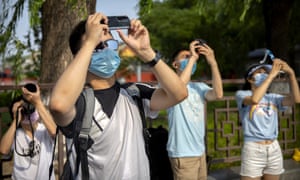
People wearing face masks to protect against coronavirus take photos of a partial solar eclipse near the Forbidden City in Beijing on Sunday. Photograph: Mark Schiefelbein/AP