The Czech Republic reported 82 new cases of the novel coronavirus by late afternoon on Friday, bringing its total since the start of the pandemic above 13,000, after a recent uptick in infections caused by local outbreaks.
The country of 10.7 million has reported 352 deaths from Covid-19, far fewer than its Western European neighbours. It was one of the first European countries to impose drastic lockdown measures to fight the pandemic in March, but has lifted many restrictions since May.
Since June 18, it has reported at least 100 new cases a day 14 times, most recently on Thursday when the total was 105. The largest spike came on June 28 when 305 new cases were reported.
The rise has largely been attributed to an outbreak in an eastern mining region, which prompted state coal miner OKD to close its mines in the area in early July.
Health officials have said the outbreak there was being contained but the government has come under criticism for slow action. Other smaller outbreaks have also been seen in two other local areas in the last week.
The World Health Organization reported a record increase in global coronavirus cases on Friday, with the total rising by 228,102 in 24 hours.
The biggest increases were from the United States, Brazil, India and South Africa, according to a daily report.
The previous WHO record for new cases was 212,326 on July 4. Deaths remained steady at about 5,000 a day.
Global coronavirus cases exceeded 12 million on Wednesday, according to a Reuters tally, marking another milestone in the spread of the disease that has killed more than 555,000 people in seven months.
Maria Van Kerkhove, technical lead on the Covid-19 pandemic at the WHO, said on Friday that airborne transmission of the new coronavirus had always been a concern but that droplets appeared to be the most common infection route.
“Aerosol transmission is one of the modes of transmission that we have been concerned about since the beginning, particularly in healthcare settings … where we know these droplets can be aerosolised – which means can stay in the air longer,” she told an online briefing from Geneva.
The WHO released new guidelines on the transmission of the coronavirus on Thursday that acknowledged some reports of airborne transmission but stopped short of confirming that it spreads through the air, a route that cannot be blocked by the social distancing now common around the world.
Mike Ryan, head of the World Health Organization’s emergencies programme, said on Friday that an outbreak of pneumonia in Kazakhstan, reported to be highly lethal, was “certainly on our radar”.
But he also said it was possible it might be Covid-19.
“The upward trajectory of Covid-19 in the country would suggest that many of these cases are in fact undiagnosed cases of Covid-19,” he told an online briefing from Geneva.
World Health Organization Director General Tedros Adhanom Ghebreyesus said on Friday he was confident a review announced a day earlier of the WHO’s handling of the coronavirus pandemic would not interfere with its response to the disease.
Tedros said the decision to start the inquiry “gives the responsibility actually to me, which is very important, so that we can have a balancing act, so the evaluation doesn’t affect the response”.
“We felt that starting it now can really help us to understand how … the whole response is happening,” he told an online briefing from Geneva.
The new coronavirus is likely spreading through the air to some degree, the top US infectious disease official said on Friday, one day after the World Health Organization urged further studies on the ways the virus is transmitted.
“Still some question about aerosol but likely some degree of aerosol,” Anthony Fauci, the head of the US National Institute of Allergy and Infectious Diseases, said by video during a panel session at a Covid-19 conference organized by the International AIDS Society.
Fauci on Thursday had said it was a “reasonable assumption” that airborne transmission was occurring even though there was not a lot of solid evidence behind it. The World Health Organisation urged more studies on the issue.
The number of cases in the United States has surged to more than 3 million as states that quickly reopened bars and restaurants have reported sharp increases.
Fauci said that to battle the global virus, there needed to be multiple vaccine candidates. Vaccine makers are aiming to have hundreds of millions of doses ready for early next year and as many as 1 billion in some cases, he said.
“The companies that we are dealing with are already in discussions to start gearing up to make hundreds of millions of doses and a couple of the companies are promising that they would have a billion doses within a year or so after,” Fauci said.
The United States has poured billions of dollars into vaccine efforts at Johnson & Johnson, Moderna, Novavax and AstraZeneca. J&J has said it is aiming for 1 billion doses. Pfizer and BioNTech are also pursuing a vaccine and have said they aim to have 1.2 billion doses by the end of 2021.
The number of coronavirus cases in the Czech Republic has climbed to more than 13,000, health ministry data showed on Friday, after a recent uptick in infections in local outbreaks in the central European country.
The country of 10.7 million has reported a total of 13,001 cases, as of Friday at 1530 GMT, since the outbreak began in March. Of those, 8,208 have recovered and 352 have died of the Covid-19 illness.
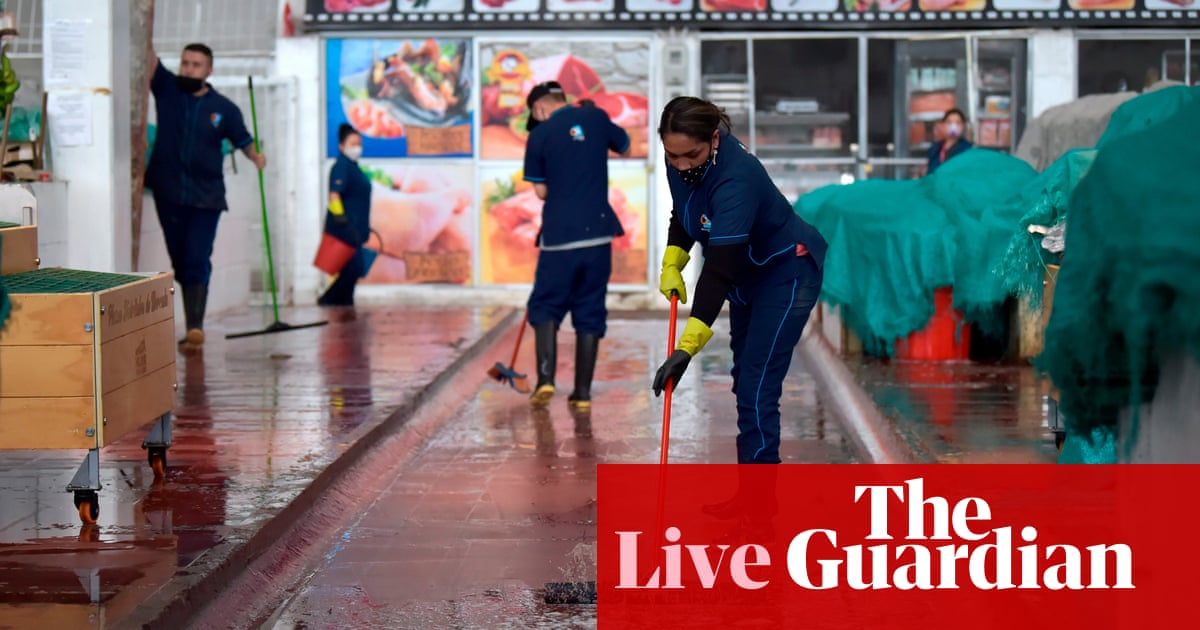
Bogotá, the capital of Colombia, will go back under a strict lockdown on Monday, though this time only certain neighbourhoods at a time will be expected to stay home.
In those neighbourhoods, which will rotate for two week periods, only businesses of primary need – such as supermarkets and pharmacies – will be permitted to open.
Colombia first went under a strict nationwide lockdown in late March, shortly after the first case of Covid-19 was confirmed in the South American nation on March 6th. That lockdown has since been slowly relaxed, with many businesses now open though mask-wearing in public remains compulsory.
But with cases nationwide steadily climbing, with over 5,000 new cases each day, city authorities are beginning to stymie the re-opening. 4714 people so far have died from the disease. Bogotá – a city of over 8m people – has been most affected, with 42,347 of the country’s 133,973 confirmed cases.
South America has emerged as one of the region’s most affected by the coronavirus pandemic, with Brazil, Peru and Chile all ravaged by the disease. In Brazil – where denialist president Jair Bolsonaro on Tuesday revealed that he tested positive for Covid-19 – over 1.76m have become infected while 69,000 people have died. Bolivia’s interim president, Jeanine Áñez, yesterday announced she had the disease, as did Venezuela’s second-most powerful politician, Diosdado Cabello.
Bogotá’s mayor, Claudia López, had been warning residents that a return to a strict lockdown would be necessary if cases continued to rise. With intensive care units in the city at 85% occupancy on Friday morning – and with two thirds of the 305 ventilators sent to alleviate the crisis not working – her administration got the green light from the national government to begin locking down the capital once more.
The rotating lockdowns are expected to last until August 23rd.
British prime minister Boris Johnson said stricter rules on wearing face coverings may be needed and that he would like to see them worn more frequently in shops in England, where – unlike in Scotland – they are optional.
“I do think we need to be stricter in insisting that people wear face coverings in confined places where they are meeting people that they don’t normally meet,” Johnson said in a pre-recorded question-and-answer session with the public.
“So that’s why it’s mandatory already on public transport, and we’re looking at ways of making sure that people really do observe when you do have face coverings in shops for instance where … there is a risk of transmission,” he added.
Iraqi lawmaker Ghida Kambash died on Friday after contracting the novel coronavirus, parliament announced, its first member to succumb to the virus as its spread ramps up across the country.
The 46-year-old was a three-time MP from Baquba, north-east of Baghdad, and helped pass laws on education reform and social welfare. She leaves behind four children.
Formula 1 racing is one of the sports that has managed to come back. As part of the deal there’s a rigorous testing regime. They’ve just confirmed that in the last week they tested 4,566 participants in the sport, and none of the tests have returned positive
They say that they are providing this aggregated information for the purposes of competition integrity and transparency. No specific details as to teams or individuals will be provided by the FIA or Formula 1, and the results will be made public every 7 days.
Read the original article at The Guardian