Coronavirus live news: soldiers sent to southern Italian town amid tension over new outbreak
Here is a video of clashes between residents near Naples as a cluster of Covid-19 cases puts five buildings in lockdown and the army being deployed to the area.
Clashes near Naples as cluster of Covid-19 cases puts five buildings in lockdown – video
A Florida official has announced the state is closing its bars after reporting a record-high level of new coronavirus cases.
Halsey Beshears,the head of Florida’s department of business and professional regulatinon, said the policy would be in effect “immediately.”
The announcement came less than an hour after the Florida department of health reported that the state confirmed 8,942 new cases of coronavirus yesterday, breaking a record set earlier this week.
The health department also reported a frightening rise in the rate of positive test results. On Thursday, 13.1% of test results come back positive, compared to 8.9% on Wednesday.
A South African high court has dismissed an attempt by tobacco makers to overturn a ban on sales of their products, saying the addictiveness of cigarettes did not qualify them as essential products.
Since 27 March, the government has imposed a tobacco sales ban as part of stringent measures to control the spread of coronavirus.
The Fair Trade Independent Tobacco Association (FITA) legally challenged the “irrational” ban, saying it had led to the mushrooming of an illicit cigarette market in the country.
But the request went up in smoke and three judges in the Gauteng high court ruled that cigarettes and related tobacco products do not, by their nature, fall into the same category as goods which are life-sustaining or necessary for basic functionality.
Tobacco and alcohol were among the products banned since the beginning of the lockdown, in an attempt to slow the spread of the virus.
When President Cyril Ramaphosa lifted the ban on alcohol sales on 1 June, he kept the moratorium on tobacco “due to the health risks associated with smoking”.
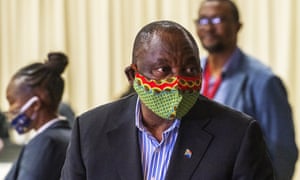
South African President Cyril Ramaphosa. Photograph: Jérôme Delay/AP
Paris’s Orly airport reopened on Friday after three months closure during the coronavirus pandemic, which was briefly disrupted by climate protesters storming the runway.
A plane operated by low-cost carrier Transavia took off for Porto, the first commercial flight since the airport came to a halt on 31 March.
Two firetrucks on either side of the plane shot arcs of water over the stationary aircraft in celebration, with the passengers inside waiting to taxi to the runway.
But hours later, Extinction Rebellion activists stormed the runway, lit flares and attached themselves to bicycles with locks around their necks. They were protesting against the bailing out of the aviation industry, which suffered huge losses with the grounding of air traffic during the Covid-19 pandemic.
Twenty-nine people were arrested including a journalist from ecological news website Reporterre, according to an Extinction Rebellion tweet.
About 8,000 passengers were expected on Friday, less than 10% of the daily pre-virus average of about 90,000. They will be on more than 70 flights, compared with the normal run of 600 a day.
Traffic is due to increase to 200 flights daily in July but it will depend much on whether Algeria, Morocco and Tunisia reopen their borders, as well as on whether the virus remains under control.
For nearly three months, all commercial flights from Paris have taken off from Charles de Gaulle airport.
Florida is reporting a record-high number of new coronavirus cases in a single day, after the state set its last record earlier this week.
The Florida department of health reported 8,942 new cases from yesterday, shattering the state’s previous single-day record of 5,506 cases, which was reported on Wednesday.
Florida has confirmed 122,960 coronavirus cases in total and the state has lost 3,366 residents to the virus so far.
The rate of positive test results has also increased, the Florida department of health reported. Thursday saw 13.1% of test results come back positive, up from 8.9% on Wednesday.
South-east Asian leaders have warned the virus pandemic has swept away years of economic gains and was hindering negotiations over the flashpoint South China Sea as they met online for a delayed summit.
Vietnam, the chair of the Association of Southeast Asian Nations (Asean), had wanted to use the summit to inject momentum into talks on a sprawling China-backed trade pact.
But the immediate focus for the 10-member bloc was the crippling cost of the coronavirus, which has ravaged the economies of tourism and export-reliant countries such as Thailand and Vietnam.
“It has swept away the successes of recent years … threatening the lives of millions of people,” Vietnam’s prime minister, Nguyễn Xuân Phúc, said in a sobering opening address.
He emphasised the “serious consequences” of the pandemic for economic development among Asean’s members.
Asean’s general secretary, Lim Jock Hoi, confirmed the bleak outlook, warning the region’s economy is expected to contract for the first time in 22 years.
Belgium has set up a new system to track mobile phones in order to limit crowding of seaside resorts and beaches that formally open for the summer season on Saturday.
Health authorities across Europe are concerned at the prospect of masses flocking to local beaches and risking the spread of the coronavirus, such as at the English resort of Bournemouth on Thursday.
Belgium’s coastal towns are not seeking to bar tourists from coming, but do want them to use common sense, such as rerouting to a less busy spot or choosing to shop later.
The 10 districts along the coast will detect mobile phones on beaches and the nearby dikes and seafronts and display the live information on a website, with codes from dark green for calm to orange for very busy.
A further 130 sensors in the towns will indicate to people the busy spots they should avoid. The website hopes to give an idea of how busy the resorts are likely to be in the coming days.
One town has put in beach markings to indicate 3 square metres. “We have implemented what we call ‘beach bubbles’, where one family or friends can be together in a safe way and to visualise the distance that they should be from one another,” Anthony Wittesaele, town councillor for tourism, told Reuters.
Swimming in the sea off Belgium is banned until the on-season, when lifeguards are patrolling. It was delayed from May until this Saturday and runs until mid-September.
A few more pictures from Mondragone in southern Italy, where the military was sent in to restore order after a coronavirus outbreak at an apartment complex illegally occupied by hundreds of migrant workers caused angry confrontations with residents.
The area has been sealed off and people will need to quarantine for two weeks, the regional president has said. Hundreds of tests have been carried out as part of efforts to contain the outbreak.
Soldiers secure a red zone, where new 49 cases of coronavirus infections were confirmed. Photograph: EPA
A woman delivers a cart with food for people in quarantine at a residential complex in Mondragone. Photograph: Ciro de Luca/Reuters
Medic takes a sample from a woman to test for Covid-19 at an apartment complex where dozens of cases have been registered among a community of Bulgarian farm workers. Photograph: Riccardo De Luca/AP
Health officials said 43,414 people had died in hospitals, care homes and the wider community after testing positive for coronavirus in the UK as of 5pm on Thursday, up by 186 from the day before.
The government figures do not include all deaths involving Covid-19 across the UK, which are thought to have passed 54,000.
The Department for Health and Social Care also said in the 24-hour period up to 9am on Friday, 165,665 tests were carried out or dispatched, with 1,006 positive results. Overall, a total of 8,911,226 tests have been carried out and 309,360 cases have been confirmed positive.
The figure for the number of people tested has been “temporarily paused to ensure consistent reporting” across all methods of testing.
Department of Health and Social Care (@DHSCgovuk)
As of 9am 26 June, there have been 8,911,226 tests, with 165,665 tests on 25 June.
309,360 people have tested positive.
As of 5pm on 25 June, of those tested positive for coronavirus, across all settings, 43,414 have sadly died.
The governor of Texas is shutting down bars and lowering restaurant capacity back down to 50%, as the state grapples with a surge in new coronavirus cases.
Before this morning’s announcement from its governor, Greg Abbott,restaurant capacity was capped at 75% and bars were allowed to operate at 50% capacity.
“At this time, it is clear that the rise in cases is largely driven by certain types of activities, including Texans congregating in bars,” Abbott said in a press release. “The actions in this executive order are essential to our mission to swiftly contain this virus and protect public health.”
For more on this and all the latest on the coronavirus crisis in the US, you can follow our dedicated US blog here: