Coronavirus live news: South Korea delays reopening 800 schools amid renewed outbreak; Iran sees jump in new infections
Damien Gayle back at the controls now. Feel free to send any comments, tips or suggestions for coverage to me, either via email to damien.gayle@theguardian.com, or via Twitter to @damiengayle.
But it seems one Sydney Roosters fan with a sense of humour had other ideas. A cardboard cutout of the under-fire Cummings appeared at Bankwest Stadium for the Roosters’ behind-closed-doors clash with South Sydney Rabbitohs, and did not go unnoticed by TV viewers.
Hello all. I am on the live blog while my colleague Damien gets some lunch. Please do share your thoughts, comments and news tips with me as they are always very useful.
We reported earlier that more than 200 schools in South Korea had been forced to close just days after they reopened. In fact, the planned reopening of more than 800 schools was postponed. We have deleted the earlier post. Luke Harding reports:
South Korea has postponed the planned reopening of more than 800 schools as it battles a renewed outbreak of the coronavirus, with cases now at their highest level for almost two months.
The country’s easing of lockdown measures has gone into reverse, with museums, parks and art galleries closed again on Friday for two weeks. Kindergarten pupils, and some primary and secondary school students were due back from Wednesday, in the last phase of school reopenings.
According to the education ministry, however, 838 schools out of 20,902 nationwide remain shut. They are located in areas hard hit by the latest wave of infections, including the capital Seoul and the cities of Bucheon and Gumi.
South Korea has been praised for its deft handling of the Covid crisis. It seemed to have brought the virus under control only to record 79 new cases this week, the highest daily figure for two months. The government has responded by bringing back lockdown measures in the Seoul metropolitan area, home to half of the country’s 51 million population.
Most of these cases have been linked to a distribution centre in Bucheon. The warehouse is run by the country’s biggest e-commerce firm Coupang. Health officials traced at least 82 infections to the facility, with the virus found on workers’ shoes and clothes. They are now testing all employees and visitors.
People in Turkey have held their first communal Friday prayers in 74 days after the government reopened some mosques as part of its plans to relax measures put in place to fight the coronavirus outbreak. Prayers were held in the courtyards of selected mosques, to minimize the risk of infection.
Authorities distributed masks at the entrance to the mosques, sprayed hand sanitizer and checked temperatures.
Worshippers were asked to bring their own prayer rugs, but some mosques offered disposable paper rugs which were placed 1.5 metres apart.
Healthcare professionals should closely monitor Covid-19 patients who are receiving malaria drug hydroxychloroquine, given the serious side-effects associated with the medicine, the European health regulator said on Friday.
Several EU countries have paused trials of the drug in patients infected by the new coronavirus over safety concerns, the European Medicines Agency said, adding the drug’s benefits have not been established for the illness.
The World Health Organization also suspended testing the drug in Covid-19 patients last week.
Monkeys mobbed an Indian health worker and took coronavirus test blood samples, spreading fears that the animals could spread the pandemic in the local area.
After making off with the three samples earlier this week in Meerut, near the capital New Delhi, the monkeys scampered up nearby trees and one then tried to chew its plunder.
The sample boxes were later recovered and had not been damaged, Meerut Medical college superintendent Dheeraj Raj told AFP on Friday, after footage of the encounter went viral on social media.
“They were still intact and we don’t think there is any risk of contamination or spread,” Raj said.
He added that the three people whose samples were stolen were retested for the virus.
Health authorities in South Africa say the country has a backlog of nearly 100,000 unprocessed coronavirus tests, as it and other countries on the continent face difficulties in obtaining essential supplies.
“This challenge is caused by the limited availability of test kits globally,” the health ministry said in a statement, seen by the Associated Press, which put the backlog at 96,480 as of Monday. Priority is given to processing tests from patients admitted to hospitals and health workers, it said.
South Africa has conducted more tests for the virus than any other country in Africa — more than 655,000 — and has the most confirmed cases with 27,403.
The shortages, especially in testing materials, have exposed how richer countries are sidelining African nations in the race to obtain crucial supplies. The continent relies almost entirely on imports for drugs and other medical items.
“We have to have Made in Africa products,” the director of the Africa Centers for Disease Control and Prevention, John Nkengasong, told reporters Thursday. “We cannot keep importing basic things.”
Across Africa slightly under 2 million tests for the virus have been conducted, Nkengasong said, far below the target of testing 13 million people — or 1% of the continent’s population of 1.3 billion.
Hello all. I am taking over the live blog while my colleague Damien gets some lunch. Please do share your thoughts, comments and news tips with me as they are always very useful.
Spain’s government will discuss with various political parties whether to seek another extension to a state of emergency over the coronavirus beyond 7 June, the government spokeswoman Maria Jesus Montero said on Friday, according to Reuters.
She added that the prime minister, Pedro Sanchez, would disclose during the weekend the government’s decision on such an extension, which has to be approved by parliament.
The state of emergency was first established in mid-March, imposing some of the toughest restrictions in Europe.
When the US Bureau of Labor Statistics released its monthly jobs report earlier this month, the unemployment numbers were jaw-dropping: the unemployment rate rose from 4.4% in March to 14.7% in April – a decade’s worth of job gains wiped out in mere weeks, writes Lauren Aratani for the Guardian US.
The jobs report also unveiled the grim reality of which communities have been hit hardest from the economic impacts of Covid-19. Hispanic Americans saw the highest unemployment rate of any racial group at 18.9%, over 4% more than the national unemployment rate of 14.7%.
People line up for food donations in the Bronx. Photograph: Johannes Eisele/AFP/Getty Images
Clara Lopez of Miami, Florida, worked for 17 years as a room attendant at the Fontainebleau Miami Beach hotel and was laid off at the end of March as things were starting to shut down. She has been trying to apply for unemployment insurance since 29 March, but has yet to have success. Florida, which has a 12.9% unemployment rate, continues to have a backlog of unemployment applications, meaning people like Lopez have been left with no unemployment insurance to pay essential bills.
“I have my light bill, my water bill, my car bill, my electric bill. As of now, I don’t even have one cent left to be able to pay for any of it,” Lopez said. Even though Lopez is able to buy groceries with food stamps, prices in supermarkets have gone up, meaning she is barely able to buy the groceries she needs.
The mass job losses hitting the community are a devastating blow in light of the gains that Hispanic Americans had made before the pandemic hit. In September, the Hispanic unemployment rate hit a historic low at 3.9% and hovered about 4% through February. Median household income had risen to $51,450 in 2018, another record high. Hispanic Americans were buying homes at a rate higher than any other race and had the highest labor force participation rate of any race.
The debate rages on about the merits and risks of hydroxychloroquine and chloroquine, after dozens of scientists signed an open letter raising concerns over a study that suggested the antiviral drugs had no benefit for Covid-19 patients.
The research, which was published in the Lancet on 22 May, concluded that treatment with hydroxychloroquine and chloroquine, an anti-malarial, could produce potentially serious side effects, particularly heart arrhythmia.
Within days of the research being published the World Health Organization suspended use of the drugs in its Solidarity trial, which has seen hundreds of hospitals across several countries enrol patients to test possible treatments for Covid-19.
“This impact has led many researchers around the world to scrutinise in detail the publication in question,” said the open letter, signed by a number of prominent scientists, French news agency AFP reports.
It added this scrutiny raised “both methodological and data integrity concerns”.
The authors list several issues with the study, including a lack of information about the countries and hospitals that contributed to the data, a lack of an ethics review and discrepancies in data for Australia, which did not match published national figures.
“Surgisphere [the data company] have since stated this was an error of classification of one hospital from Asia. This indicates the need for further error checking throughout the database,” the letter said.
Among the signatories are clinicians, statisticians and other researchers from around the world, from Harvard to Imperial College London.
Hydroxychloroquine, normally used to treat arthritis, is one of an array of drugs being tested as scientists look for potential treatments for coronavirus patients.
It has also become the most high profile, partly because of comments by Donald Trump, who announced this month he was taking the drug as a preventative measure against coronavirus.
About 5,500 more more people have tested positive for the coronavirus in Africa since Thursday, according to the World Health Organization’s regional office for the continent.
The latest update from the UN health agency’s Africa office showed that there were now 128,500 confirmed infections across the continent’s 54 countries, which between them account for about 1.3billion people. Of those who have tested positive so far, more than 53,000 have recovered and about 3,700 have died.
WHO African Region (@WHOAFRO)
Over 128,500 confirmed #COVID19 cases on the African continent – with more than 53,000 recoveries & 3,700 deaths. View country figures & more with the WHO African Region COVID-19 Dashboard: t.co/V0fkK7WnuGpic.twitter.com/H7aVNiWugS
On Thursday, Matshidiso Moeti, WHO regional Director for Africa, lauded the swift action taken by African governments to curb the spread of the coronavirus. But she called on member states to be cautious in easing containment measures. Moeti said:
These actions came at great social and economic cost, particularly for the most vulnerable and there is an understandable push to lift the measures as rapidly as they were implemented. However, WHO urges countries to follow a step by step approach.
We must all remain vigilant. As more countries begin to ease confinement measures, it is vital that effective testing and surveillance systems are in place to detect any spike in cases. Ending a lockdown is not an event, but a process, and it’s important to have a clear view of local conditions so informed decisions can be made about how to relax these measures.
Spain’s cabinet has approved a minimum basic income scheme, the deputy prime minister, Pablo Iglesias, announced. The €3bn scheme will provide monthly payments of between €462 and €1,015 to about 850,000 households struggling to buy food in the wake of the pandemic.
Global deaths from the coronavirus outbreak have passed 360,000, according to the Johns Hopkins Coronavirus Resource Center. The US remains the worst-affected nation, followed by the UK, Italy and France.
The carmaker Renault plans to eliminate about 14,600 jobs worldwide and lower production capacity by almost a fifth, as part of cost reductions aimed at outlasting the downturn that has rocked the global auto industry.
The Philippines has recorded its highest daily infection rate but will ease lockdowns. Residents in Manila will see their lockdown – one of the toughest and longest in the world – ease from Monday, despite the country reporting 539 infections on Thursday, its highest ever daily tally.
Iranrecorded its highest tally of new coronavirus infections since early April, with 2,819 more people testing positive in the past 24 hours. The increase in new infections comes as measures to restrict the spread of the disease are eased in Iran.
Life during the coronavirus lockdown has reinforced gender inequality across Europe, with the economic and social consequences of the crisis threatening to push women back into traditional roles in the home. Campaign groups are warning that the growth in equality over the past decades is in danger of being rolled back by the health crisis.
The Spanish cabinet has approved a €3bn minimum basic income scheme to help the poorest people in the country, who are among those hardest hit by the Covid-19 pandemic, writes Sam Jones, the Guardian’s Madrid correspondent.
The €3bn scheme, which will provide monthly payments of between €462 and €1,015 to around 850,000 households, comes as tens of thousands of Spanish families struggle to buy food in the wake of the pandemic and charities, foodbanks and neighbourhood associations report huge demand for help with basic items.
The monthly payments, which will be available to those under 65, will begin on 15 June.
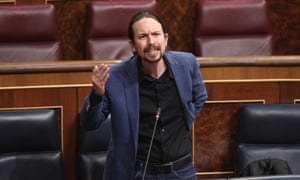
Speaking at a press conference on Friday morning, the deputy prime minister and Podemos leader, Pablo Iglesias, hailed the decision as “a historic day for our democracy”.
Pablo Iglesias, Spain’s deputy prime minister Photograph: Europa Press News/Europa Press/Getty Images
Iglesias said the scale of Spain’s socio-economic problems had been laid bare by Philip Alston, the UN rapporteur on human rights and extreme poverty, who visited the country in January. He said:
Even before the Covid-19 pandemic hit, we already had a very high poverty rate and were the European country with the third highest level of child poverty.
The pandemic has made things worse for many of our compatriots. And although we have mobilised resources to build a social shield to protect Spanish families from the economic impact of the crisis, it’s obvious that the situation has obliged us to speed up the implementation of this basic income.
Now more, than ever, he said, it was a “absolutely urgent necessity because thousands of Spanish families just can’t wait any longer”.
Iglesias thanked the neighbourhood associations, foodbanks, churches and NGOs that had stepped in to help people, but added: “They have been playing a role that needs to be played by the public authorities.”
Iran recorded its highest tally of new coronavirus infections since early April on Friday, with 2,819 more people testing positive in the past 24 hours, the health ministry reported.
Kianoush Jahanpour, the health ministry spokesman, said in his daily update that 50 more people had died from Covid-19 in the past 24 hours, pushing the total death toll from the outbreak to 7,677.
Out of 146,668 cases detected so far, 114,931 people have recovered.
Currently there are 2,547 people in a critical condition in hospital with the virus, he added, according to the Islamic Republic News Agency.
The increase in new infections comes as measures to restrict the spread of the disease are eased in Iran. The last time the health ministry reported a higher number of new infections was 2 April, when 2,875 new confirmed cases were recorded, according to data archived on the Worldometers website.
Women at a cafe in Tehran. Photograph: Anadolu Agency/Getty Images