Coronavirus live news: South Korea re-tightens lockdown restrictions after spike in cases
President Trump has broken his silence on the grim milestone of more than 100,000 American deaths, commenting on Twitter.
Donald J. Trump (@realDonaldTrump)
We have just reached a very sad milestone with the coronavirus pandemic deaths reaching 100,000. To all of the families & friends of those who have passed, I want to extend my heartfelt sympathy & love for everything that these great people stood for & represent. God be with you!
Joanna Mamombe, Netsai Marova and Cecilia Chimbiri say they were abducted by police at a Movement for Democratic Change (MDC) party protest in Zimbabwe’s capital Harare on 13 May.
The women, who are prominent members of the MDC’s youth wing, were found dumped on the side of a road two days later and taken to hospital, where they are still recovering from multiple injuries. Nelson Chamisa, the MDC leader, said they had been severely beaten and sexually assaulted.
Nelson Chamisa, leader of Zimbabwe opposition party the Movement for Democratic Change, addressing journalists were three of his colleagues were recovering. Photograph: Jekesai Njikizana/AFP via Getty Images
On Thursday, at bedside hearings, all three were charged with participating in a gathering with intent to promote public violence, breach of peace, and bigotry.
Zimbabwean news site NewsDay reports prosecutors alleged that the trio defied lockdown regulations by staging a demonstration that drew more than 50 people.
It was alleged that protesters carried placards saying “unlock us before we revolt,” which prosecutors described as “a visible representation that was threatening, intending to provoke the breach of peace or realising that there was a risk or possibility that a breach of peace may occur.”
Patrick Chinamasa, a spokesman for the ruling party, the Zanu PF, said it was up to Mamombe, Marova and Chimbiri to prove they were abducted.
“We find it abhorrent that to date neither the three lady complainants nor their family members or their friends have made a formal report to the police suggesting that they don’t want the truth to come out,” NewsDay quoted him as saying.
Coronavirus cases in Zimbabwe more than doubled to 132 over two days, the state broadcaster reported Wednesday, after 76 new infections were detected mainly among citizens returning from neighbouring South Africa and Botswana.
Almost 14 million people could go hungry in Latin America and the Caribbean this year, as a result of the socio-economic impact of the Covid-19 pandemic, the World Food Programme has said.
According to estimates published by the agency on Thursday, in 11 countries in the region where there are already nearly 4 million people facing food insecurity, an additional 10 million people could be pushed into poverty and hunger.
The worst affected country is likely to be Haiti, where the number of people facing severe food insecurity could rise from 700,000 to 1.6 million, WFP said. Also at particular risk are Venezuelan migrants living in Colombia, Ecuador and Peru.
Miguel Barreto, WFP regional director for Latin America and the Caribbean, said:
It is vital and urgent that we provide food assistance to the growing number of vulnerable people in the region, as well as those who depend on informal work. We still have time to prevent the COVID-19 pandemic from becoming a hunger pandemic.
Here are the key lines from our global coronavirus coverage so far on Thursday:
South Korea has tightened restrictions in the metropolitan area of Seoul after a spike in infections. Restrictions had been lifted across the country on 6 May after the outbreak appeared to be brought under control. However, officials have recorded the biggest spike in infections in nearly two months, prompting the closure of museums, parks and art galleries in the Seoul area for two weeks from Friday. Half of South Korea’s 51 million people live in the metropolitan area where restrictions are being tightened.
• US deaths pass 100,000. Data from Johns Hopkins University shows that the United States has recorded more than 100,000 deaths from Covid-19, moving past a sombre milestone even as many states relax mitigation measures to stop the spread of the novel coronavirus. The US has recorded more deaths from the disease than any other country in the pandemic, and almost three times as many as the second-ranking country, Britain.
• Trump silent on US death toll. Donald Trump remained silent on the death of more than 100,000 Americans from Covid-19 as the US mourned the milestone. The president made no comment on Twitter about the momentous day, but used the platform to attack tech companies for trying to censor him, a day after Twitter put a fact-check warning on one of his claims.
•The number of people infected by the coronavirus has exceeded 5.7 million, according to data compiled by the John Hopkins University. The US is home to to 29.8% of the 5,707,163 people with the disease around the world, the data shows, way ahead of Brazil (7.2%), Russia (6.6%), the UK (4.7%), Spain (4.1%) and Italy (4%). The true number of infections is likely to be much higher, however, given the vast number of unrecorded and asymptomatic cases.
• UN: Virus could push 14 million into hunger in Latin America. The UN World Food Program is warning that at least 14 million people could go hungry in Latin America as the coronavirus pandemic rages on. New projections released late on Wednesday estimate a startling four-fold increase in severe food insecurity.
• European investment slashed. Over a third of European foreign direct investment projects announced in 2019 have been either delayed or cancelled outright because of the coronavirus pandemic, an annual survey by professional services group EY found. Some 65% of the 6,412 projects in question are already in place or continuing “albeit with downgraded capacity and recruitment”, EY said. A further 25% were delayed and 10 percent cancelled, its Europe Attractiveness survey found.
• Ireland faces record recession: think tank. Ireland is facing its deepest ever recession as the coronavirus lockdown devastates jobs and strains the public finances, a think tank said Thursday. A report by Ireland’s Economic and Social Research Institute predicts the nation’s gross domestic product (GDP) will decline 12.4% this year. That was the “most likely” scenario under a government plan to lift the lockdown in August but with the economy struggling to return to pre-pandemic levels owing to physical distancing measures, ESRI said.
• Tory anger at Dominic Cummings builds. 61 Conservative MPs defied British PM Boris Johnson’s calls to “move on” from the Dominic Cummings crisis as a senior minister broke ranks to accuse the special adviser of inconsistencies in his account of his behaviour during lockdown. Former chancellor Sajid Javid also said the journey was not “necessary or justified” as the number of backbenchers calling for Cummings to resign or be sacked grew to 44, with more than 60 Tory MPs weighing in to criticise him. Two of those condemning Cummings are government whips.
• Hydroxychloroquine study raises concerns. Questions have been raised about a study published in the Lancet that prompted the World Health Organization to halt global trials of the drug hydroxychloroquine. The Lancet said the authors were “investigating urgently” an apparent discrepancy in the data. It comes amid scientists’ concerns that rigorous standards are falling by the wayside in the race to understand the virus.
There have been more than 159,000 excess deaths in Europe since since early March, during the height of the coronavirus epidemic, the head of the World Health Organization’s regional office for the continent has said.
In his weekly briefing coronavirus briefing, Hans Kluge, director of WHO Europe, said that 2 million people had been confirmed to have caught the coronavirus since it was first detected on the continent four months ago. About 175,000 had died of Covid-19.
“Perhaps a less reported, but equally alarming figure is that since early March, more than 159,000 excess deaths, coinciding with the pandemic, have been reported from 24 European countries,” Kluge said. “These are deaths above and beyond what we would have expected normally at this time of the year.”
Kluge said that across Europe, 94% of all Covid-19 deaths were of people aged 60 or over, and nearly six in ten were men. Nearly all – 97% – of those who died had at least one underlying condition, with cardiovascular disease being the most common, he said.
Despite the WHO saying that the worst affected region is now the Americas, Europe still accounts for 36% of the world’s confirmed cases of coronavirus, and half of all deaths.
With national economies badly affected by coronavirus lockdowns, Kluge called on governments to avoid cutting healthcare spending in the aftermath of the pandemic.
Manhunts have begun after hundreds of people, some with the coronavirus, fled quarantine centres in Zimbabwe and Malawi, the Associated Press reports.
In Malawi, more than 400 people recently repatriated from South Africa and elsewhere fled a centre at a stadium in Blantyre, jumping over a fence or strolling out the gate while police and health workers watched.
Police and health workers told reporters they were unable to stop them as they lacked adequate protective gear.
At least 46 escapees had tested positive for the virus. Some of those who fled told reporters they had bribed police.
And in Zimbabwe, police spokesman Paul Nyathi said officers were hunting down more than 100 people who escaped from centres where a 21-day quarantine is mandatory for those returning from abroad.
“They escape and sneak into the villages We are warning people to stop sheltering them. These escapees are becoming a serious danger to communities,” Nyathi said.
Afghanistan is in immediate need of masks and ventilators, health authorities said, as the number of confirmed infections passed 13,000 despite no tests being carried out in Kandahar for two weeks, Akhtar Mohammad Makoii reports from Herat.
The Afghan health ministry announced on Thursday that it has run out of facilities and equipment for Covid-19 patients. Wahid Majroh, deputy health minister said that the ministry had received nothing in the past 30 days.
“We need ventilators and NIV masks immediately, in some provinces we have run out of hospital beds for patients” Majroh said. “In the last 10 days, as people continue to break the lockdown regulations, the number of transmission has been rising and we are yet to reach the peak of the crisis”.
“In some cases patients wait in doorsteps of ICU for the death of another patient in ICU to go and fill the bed” Majroh said. He warned that tests are not possible for everyone and asked people with symptoms to quarantine themselves at home, and only go to medical centres if their condition worsened.
In Kandahar no suspected patient has been tested in nearly a fortnight, due to a problem in the testing process. The problem risks generating a huge backlog, since health officials send samples of suspected patients in nearby provinces such as Helmand to Kandahar. Majroh said he has instructed health services in Kandahar and nearby provinces to send samples to Kabul until the problem is solved.
“We have serious problem in Kandahar, the PCR machine is off and there is no flight toward Kandahar so our engineers can go and fix that,” Majroh said. “There will be a UN flight to Kandahar in coming days and our team will go with that.”
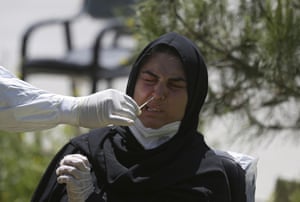
A lab technician pokes a woman up the nose with a test swab at the Afghan-Japan communicable disease hospital in Kabul. Photograph: Rahmat Gul/AP
On Thursday the heath ministry reported that it had tested 1,072 suspected patients of whom 580 were positive, taking the total number of confirmed infections to 13,036. Eight patients also died overnight, raising Afghanistan’s Covid-19 death toll to 235. There have been 1,209 recoveries. According to the health ministry 19 patients are in critical condition.
Majroh said 40% of confirmed cases were recorded in last 10 days and added that previously he was “warning that the flood [of coronavirus] will come, but now the flood has arrived and many people are sinking”. The health sector had its worst days during three days of Eid, he said.
Most of the new cases wee recorded in the capital, Kabul, where 322 out of 662 tests came back positive. Kabul is the country’s worst affected area by cases, with 5,093 infected patients so far, of whom 29 have died.
The western province of Herat recorded two deaths of Covid-19 and 139 new infections. Herat borders Iran and recorded the first case of the virus reported in the country after thousands of Afghan migrants poured back from Iran in February and March. The total number of infections in Herat is 2,105, with its 44 deaths making it region with the highest death toll.
Meanwhile, members of local police forces were killed in a Taliban attack in Parwan province, north of Kabul, as a ceasefire among Afghan forces and Taliban fighters ended on Wednesday.
A technical delegation of the Taliban is in Kabul “to work with a technical team of the government” on the release of prisoners of both sides, the Office of National Security Council said.
The president, Ashraf Ghani, announced Sunday that the government will release up to 2,000 Taliban prisoners as a “goodwill gesture” in response to the Taliban’s calling for a three-day ceasefire, the president also pledged to take further steps in the peace process.
Taliban confirmed the delegation on Thursday and said the team will work on “verification and identification of prisoners”.
AFP news agency (@AFP)
VIDEO: South Africa’s strict lockdown provides a number of challenges for its large immigrant community, who have been left with no source of income for weeks pic.twitter.com/7rbHJRT026
Millions of women worldwide are facing shortages of sanitary products, price hikes, and worsened stigma while managing periods during the coronavirus pandemic, a charity warned on Thursday, according to Reuters.
About three-quarters of health professionals in 30 countries surveyed by Plan International, from Kenya to Australia, reported supply shortages, while 58% complained of rising and prohibitive prices of sanitary products.
Around half the respondents cited reduced access to clean water to help manage periods, and a quarter worried about greater stigma or discriminative cultural practices linked to menstruation for women who were trapped at home by lockdowns.
“Periods don’t stop during a pandemic, but managing them safely and with dignity has become a whole lot harder,” Susanne Legena, chief executive officer of Plan International Australia, said in a statement to mark Menstrual Hygiene Day.
“In many countries, period products have become scarce and vulnerable girls and young women, in particular, are going without,” she said, urging governments to include menstrual hygiene in virus response plans and invest in water and sanitation services.
A British pilot who was critically ill with Covid-19 in Vietnam has awoken from a coma and is showing signs of improvement, yet his long-term outlook remains ominous, doctors have said, writes Chris Humphrey in Hanoi.
The man, 43, who works for Vietnam Airlines, had awoken from a coma and was capable of basic communication after doctors reduced his levels of sedative medication, Vietnamese state media announced on Wednesday.
The patient, referred to in Vietnam as Patient 91, developed a fever and cough on 17 March and was later admitted to Ho Chi Minh City Hospital for Tropical Diseases. Since then, he has spent more than two months on life support.
Tran Thanh Linh, the deputy head of Ho Chi Minh City-based Cho Ray hospital’s intensive care unit, told local media the man was able to perform simple gestures such as moving fingers and toes, yet breathing issues, organ damage and limb weaknesses remain.
The pilot is on an extracorporeal membrane oxygenation machine (ECMO), a form of life support used when a person’s heart or lungs are unable to fully function, and is being treated with antibiotics, according to a report posted on the government’s official news portal early in May.
Linh added that, by the end of this week, an official decision would be announced on whether or not doctors would gradually wean him off ECMO, or even stop the treatment altogether. His lungs are currently functioning at about 20-30%, an increase from 10% a few weeks ago.
Finland has seen no evidence of the coronavirus spreading faster since schools started to reopen in the middle of May, the top health official said on Thursday, Reuters reports.
“The time has been short, but so far we have seen no evidence,” Mika Salminen, director of health security at the Finnish Institute of Health and Welfare, told a news conference.
Finland started to reopen schools and daycare centres from 14 May following an almost two-month shutdown.
On Thursday, the country’s health authority reported that 51 more people had tested positive for coronavirus. The country has so far recorded 313 deaths from its outbreak.
Pupils get ready to start a lesson at the Lauttasaari primary school in Helsinki. Photograph: Jussi Nukari/Lehtikuva/AFP via Getty Images
Sixty-three more people have died from coronavirus in Iran in the past 24 hours, the country’s health ministry reports, bringing the country’s total death toll from the disease to 7,627.
In his daily update, Kianoush Jahanpour, the health ministry spokesman, said that 2,258 more people had tested positive for the virus, taking the country’s total cumulative caseload to 143,849 since the outbreak began in the country, the Islamic Republic News Agency reported.
Of those, 112,988 have survived and recovered, while 2,543 patients were in a critical condition in hospital.
The latest figures came as Iran reopened a number of border points with neighbouring countries that had been closed since before the start of spring in an effort to contain the spread of the coronavirus. Seventeen out of 31 border checkpoints had now reopened.
A woman sits at a cafe in Tehran on Tuesday. Photograph: Xinhua/REX/Shutterstock
The World Health Organization’s regional office for Africa is conducting its weekly coronavirus briefing. You can watch the live broadcast in the player on this tweet.
VIDEO: Doctors protest in Buenos Aires to demand more personal protective equipment and fair wages as coronavirus cases spike in Argentina’s capital. They say the government is not doing enough to keep them safe pic.twitter.com/7WdxKZo026
The number of confirmed coronavirus cases in Germany increased by 353 to 179,717, data from the Robert Koch Institute (RKI) for infectious diseases showed on Thursday, according to Reuters.
The reported death toll rose by 62 to 8,411, the tally showed.
Germany reached its peak in new cases at the end of March, according to data collected by the Worldometers website, recording 6,993 new cases on 27 March. Peak death toll was reached in early April.
In one of the rare expressions of empathy that Donald Trump has displayed during the course of the coronavirus pandemic, he talked earlier this month about the disease claiming so many lives it was “filling up Yankee Stadium with death”, writes Ed Pilkington, chief reporter for the Guardian US.
Now the death toll from Covid-19 stands at almost twice the capacity of the Yankees’ home stadium, and has reached another booming landmark: 100,000 deaths.
A country that prides itself on its exceptionalism can now without ambiguity claim that title for its experience of the virus. The United States stands head and shoulders at the top of the world league table of confirmed cases, as well as the total number of deaths.
There will be much to analyse in coming years about how the US responded to this contagion, including how many lives have been lost needlessly as a result of Trump’s maverick response.
Already one lesson of the pandemic is clear: America’s deep and brutal fault lines – of race, partisanship, gender, poverty and misinformation – rendered the country ill-prepared to meet the challenges of this disease. The ravages of Covid-19 have revealed the deep cracks in the glittering facade of the richest and most powerful nation on Earth.