Coronavirus live news: Spain and Italy report high increase in cases; Mykonos bans parties and festivities
As Australia wakes up, here are the main developments from the last few hours:
The number of coronavirus cases recorded around the world passed 22.2 million, according to the Johns Hopkins University tracker. Deaths from the virus stand at more than 782,000. The US and Brazil still lead the way in coronavirus deaths and cases.
Brazil’s coronavirus death toll topped 110,000 and close to another 50,000 cases were recorded. In the past 24 hours, a further 49,298 cases of Covid-19 were registered, the health ministry said, bringing the total since the pandemic began to 3,456,652. An additional 1,212 deaths fatalities took the Covid-19 death toll to 111,100, according to the data.
France’s Covid-19 infections reached a new post-lockdown peak as another 3,776 cases were recorded, bringing the country’s total to 225,043. The French president Emmanuel Macron again ruled out imposing another national lockdown. The health ministry said transmission of the virus was increasing particularly among young adults, and the virus was especially active in and around Paris and Marseille.
The UK government is set to drop Croatia from its travel corridor list on Thursday. It comes after imported Covid-19 infections from the country were identified. The announcement would give thousands of Britons just 30 hours to return home to avoid having to self-isolate for 14 days.
Iran surpassed 20,000 confirmed deaths from the coronavirus, the health ministry said, the highest death toll for any Middle East country. The announcement came as the Islamic Republic went ahead with university entrance exams for over 1 million students. Iran is also preparing for mass Shiite commemorations later this month.
Spain reported 3,715 new coronavirus infections in the past 24 hours, the health ministry said. According to Reuters it marks a new daily record since the country came out of a strict lockdown in late June. Cumulative cases, which include antibody tests on patients who may have already recovered, rose by 6,671 to 370,867, the ministry said.
Italy recorded 642 new infections in a day, hitting a new record since May when the country cautiously emerged from one of the longest lockdowns in the world after more than 30,000 Covid-related deaths. Seven more people have died with the virus. The overall tally of cases has now risen to 255,178. The death toll now stands at 35,412.
South Korea’s health ministry has warned that the country is facing a “desperately dangerous crisis” of spreading coronavirus, after the country reported its highest daily rise in cases since early March. On Wednesday, officials asked people in Seoul, the capital, to stay at home if they could, warning that testing, tracing and isolation measures were insufficient.
An entire class of Glasgow primary children and their teacher have been told to self-isolate after one pupil tested positive for coronavirus, our Scotland correspondent Libby Brooks reports.
It is one of a number of individual cases of coronavirus infection that has emerged at primary and secondary schools since Scotland’s children returned to full-time education last week.
Full story here:
The 25th edition of France’s Colmar Jazz Festival, scheduled for September, has been postponed until next year due to the coronavirus epidemic, the city said in a statement on Wednesday.
“Current progress in the health crisis does not allow us today, realistically, to consider staging concerts in September,” the statement says, adding that this edition of the festival will now take place in 2021.
Guitarists Sylvain Luc and Bireli Lagrene, American singer China Moses, daughter of Dee Dee Bridgewater, and French pianist Sebastian Troendle were to perform at this year’s festival in the city near the Rhine river border with Germany.
Attracting more than 5,000 people last year, the show had been due to run from 10 to 28 September.
Nevertheless, a concert by gypsy jazz guitarist Angelo Debarre will go ahead on 24 September at the nearby town of Selestat.
The Colmar Film Festival, slated for October, has also been cancelled for the same reason with city officials judging it to be “impossible to welcome film and television personalities in the friendly and festive conditions that make the festival famous.”
France has recorded over 225,000 cases of Covid-19 and over 30,000 deaths since the disease emerged at the end of 2019. A recent upsurge has seen new preventive measures reintroduced.
American Indians and Alaska Natives have been hit harder by Covid-19 than the white US population and have been more likely to become infected by coronavirus at a younger age, a US Centers for Disease Control and Prevention report showed on Wednesday.
The incidence of laboratory-confirmed Covid-19 cases among people identified as American Indians or Alaska Natives was 3.5 times that of non-Hispanic whites, making them one of the racial and ethnic minority groups at highest risk, according to the study based on data from 23 US states from 22 January to 3 July.
The data also showed that those testing positive for coronavirus tended to be younger than white non-Hispanic people with Covid-19. The researchers found that 12.9% of infections among American Indians or Alaska Natives were in people under age 18, compared to 4.3% among non-Hispanic whites.
The study added to a growing body of evidence that long-standing health and social inequities have resulted in increased risk for infection and death from Covid-19 among American Indian and Alaska Native populations, the CDC researchers said.
Other factors such as reliance on shared transportation, limited access to running water and household size could increase risk for virus transmission, the researchers added. “American Indian and Alaska Native people have suffered a disproportionate burden of Covid-19 illness during the pandemic,” CDC director Robert Redfield said in a statement.
The CDC said it has provided $200 million in funding to support tribes and tribal organizations in carrying out Covid-19 preparedness and response activities.
Bahrain announced it would end a protocol that required all those arriving in the country to self-isolate at home for 10 days regardless of the outcome of testing, its health ministry said in a statement.
Instead, in the new procedure beginning on Thursday, arrivals will be tested twice, both on arrival and 10 days later, but will be able to end their self-isolation if the first test is negative.
The ministry said this change comes as only 0.2% of those tested 10 days post-arrival had tested positive in the period between 1 July and 16 August.
Bahrain has recorded 3,482 coronavirus cases and 178 deaths.
France registered 3,776 new Covid-19 infections on Wednesday, marking another post-lockdown peak and bringing the total to 225,043, but president Emmanuel Macron again ruled out imposing another national lockdown.
“All the indicators keep going up and the transmission of the virus is getting stronger among all ages groups affected, young adults in particular”, the health ministry said in a statement.
It said the virus was especially active in and around Paris and Marseille, the country’s two biggest cities.
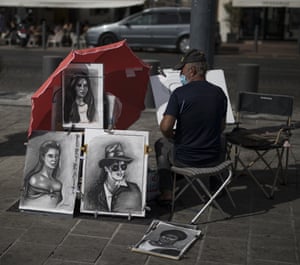
A street painter works in Marseille’s Old Port, southern France. Photograph: AP
Some medical experts are worried about the impact of Paris St Germain fans’ wild, mask-less celebrations on the Champs Elysees avenue in central Paris after their soccer club reached the Champions League final on Tuesday.
Paris municipal officials are also concerned about large gatherings of fans expected on Sunday, when Paris St Germain will play the final either against Olympique Lyonnais, another French club, or Germany’s Bayern Munich.
Despite the surge in infections, Macron told Paris Match magazine in an interview that “local strategies” were preferable to another national lockdown, which he said would cause considerable “collateral damage”.
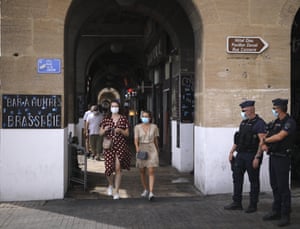
Riot police officers watch residents in Marseille. The French government is sending riot police to the region to help enforce mask requirements, as more and more French towns and neighbourhoods are imposing mask rules starting Monday to slow rising infections. Photograph: Daniel Cole/AP
The seven-day moving average of the case tally, which smooths out daily reporting irregularities, is now at 2,621, above the 2,500 threshold for the first time since 19 April, when France was enforcing one of Europe’s strictest lockdowns.
The number of people in hospital fell again by 17 to 4,806 and those in intensive care slipped by six to 374, reflecting the preponderance of younger people among the new cases who are more likely to be asymptomatic or not to fall seriously ill.
Both numbers had been on an uninterrupted downward trend since early April, but that trend has slowed in the past two weeks.
The number of deaths increased by 17 to 30,468, following an increase of 22 on Tuesday and of 19 on Monday.
French riot police officers helping to enforce the wearing face masks in Marseille. Photograph: AP
Croatia faces being removed from the UK’s travel corridor list, with imported Covid-19 infections from the country having been identified, the Guardian understands.
Ministers are likely to remove the country from the list after logging a recent surge in coronavirus cases. If the measures are formally signed off, it would mean people arriving from Croatia will have to quarantine for 14 days in Britain.
The transport secretary, Grant Shapps, met ministers on Wednesday afternoon to discuss plans.
An announcement could come as early as Thursday. If Croatia is removed the change could affect thousands of British holidaymakers in the country at the moment.
You can read the full story from my colleague Simon Murphy here:
The French health ministry reported 3,776 new confirmed coronavirus infections on Wednesday, bringing the total to 225,043, with the daily tally going beyond the 3,000 threshold for the third time in five days.
The seven-day moving average of the case count, which smoothes out daily reporting irregularities, is now at 2,621, going beyond the 2,500 threshold for the first time since April 19, when France was in the midst of a strict lockdown to contain the virus.
The French government is trying to contain growing virus infections but avoid shutting down the economy. Photograph: Michel Euler/AP
Zambia’s vice president Inonge Mutukwa on Wednesday tested positive for coronavirus, the presidency said in a statement, which also said her condition was stable and she was in self isolation at home.
“The vice president has some mild symptoms that are being managed appropriately … She is in high spirits and working virtually …” the statement said.
The number of coronavirus cases recorded around the world passed 22.2 million, according to the Johns Hopkins University tracker. Deaths from the virus stand at more than 782,000. The US and Brazil still lead the way in coronavirus deaths and cases.
Iran surpassed 20,000 confirmed deaths from the coronavirus, the health ministry said, the highest death toll for any Middle East country. The announcement came as the Islamic Republic went ahead with university entrance exams for over 1 million students. Iran is also preparing for mass Shiite commemorations later this month.
Spain reported 3,715 new coronavirus infections in the past 24 hours, the health ministry said. According to Reuters it marks a new daily record since the country came out of a strict lockdown in late June. Cumulative cases, which include antibody tests on patients who may have already recovered, rose by 6,671 to 370,867, the ministry said.
Italy recorded 642 new infections in a day, hitting a new record since May when the country cautiously emerged from one of the longest lockdowns in the world after more than 30,000 Covid-related deaths. Seven more people have died with the virus. The overall tally of cases has now risen to 255,178. The death toll now stands at 35,412.
South Korea’s health ministry has warned that the country is facing a “desperately dangerous crisis” of spreading coronavirus, after the country reported its highest daily rise in cases since early March. On Wednesday, officials asked people in Seoul, the capital, to stay at home if they could, warning that testing, tracing and isolation measures were insufficient.
The Pope has warned that the coronavirus pandemic is exacerbating inequalities between the rich and the poor, as he called for universal vaccine provision. “It would be sad if, for the vaccine for Covid-19, priority were to be given to the richest,” said Francis during his traditional Wednesday audience broadcast live from his private Vatican library.
Millions of women around the world have lost access to contraceptives and abortion services because of the coronavirus pandemic, leading to warnings of a baby boom. Across 37 countries, nearly 2 million fewer women received services between January and June than in the same period last year, Marie Stopes International says in a new report.
Global trade in goods suffered an unprecedented fall in the second quarter of 2020, as fear of the coronavirus pandemic shut down large parts of the world economy, according to the World Trade Organization. The WTO said on Wednesday that its goods trade barometer had hit a record low. The barometer reading of 84.5 was down 18.6 points from the same period last year.
Australia’s prime minister has hurriedly backtracked after announcing he would make a potential Covid-19 vaccine “mandatory”, saying instead it would be “encouraged”. Scott Morrison said the aim was to get 95% of the population to have the jab and that he was expecting that it would be compulsory except on medical grounds. But by the afternoon he had changed his language.
Strict coronavirus restrictions have imposed on Mykonos, the Greek island. The measures, which also cover the coastal area of Chalkidiki in northern Greece, include a complete ban on live parties and festivities, a limit of nine people in all public and private gatherings and compulsory mask wearing in closed and open spaces. They will come into effect from 21 August.
That’s it from me, Damien Gayle, for today. I will be back with you tomorrow.
Spain saw its overall number of cases rise by 6,671 on Wednesday, data from the country’s health ministry showed, boosting a cumulative caseload that already ranks as the highest in western Europe, writes Ashifa Kassam in Madrid.
The number of cases detected in the past 24 hours has climbed to 3,715 cases. This figure, however, has been described by ministry sources as an underestimation given the variances in reporting times between regions and the central government system.
Still, Wednesday’s 24-hour total was the highest announced by the ministry since the country eased out of a strict lockdown in late June.
In what the ministry has signalled as a more reliable indicator of the situation, the country has seen 63,965 new cases diagnosed in the last 14 days – amounting to an average of 4,569 cases a day. Around a third of these cases have been in Madrid, the epicentre of the country’s crisis in March and April.
In the past seven days, 131 people have lost their lives to Covid-19 across Spain.
In recent days, public health experts have warned that Spain is facing a pivotal moment in its ongoing battle against the virus. The country currently leads Europe with a 14-day rate of 131 new cases per 100,000 – compared to a rate of 43 in France and 10 in Italy.
Officials in the hard-hit regions of Madrid and Catalonia have responded to the surge with mass testing in hopes of ferreting out asymptomatic carriers of the virus. Across the country restrictions on nightlife and smoking in public have been rolled out in a bid to curtail transmission.
The government’s emergency health response chief, Fernando Simón, has sought to contrast the current situation with that of March and April, pointing to the fact that the majority of new cases being detected are among people under 65 years old.
The rise in cases can also be partly attributed to increased testing, he said. “We are detecting much of what is out there. I wouldn’t say 100% … but between 60% and 70%,” he recently told reporters, as compared to March and April when it is believed that less than 10% of cases were detected.
The Pope has warned that the coronavirus pandemic is exacerbating inequalities between the rich and the poor, as he called for universal vaccine provision, according to AFP.
“It would be sad if, for the vaccine for Covid-19, priority were to be given to the richest,” said Francis during his traditional Wednesday audience broadcast live from his private Vatican library.
“It would be sad if this vaccine were to become the property of this nation or another, rather than universal and for all.”
Reuters (@Reuters)
‘It would be sad if the rich are given priority for the COVID-19 vaccine,’ Pope Francis said at his weekly general audience t.co/LKkeotZBDppic.twitter.com/WKhBcx6UcY
August 19, 2020
Pharmaceutical companies are in a race to be the first to launch a vaccine against the disease, which has killed more than 782,000 people worldwide since its emergence at the end of December, according to a tally kept by Johns Hopkins University. Some governments have struck deals with companies, hoping to secure exclusive supplies of the vaccines when developed.
Francis also said it would be a “scandal” if governments doled out pandemic-related bail-out money to only select industries.
He said the criteria for companies to receive public aid should be if they “contribute to the inclusion of people who are normally excluded (from society), to helping the most needy, to the common good and to caring for the environment”.
“The pandemic is a crisis and one never exits from a crisis returning to the way it was before,” Francis said. “Either we leave better, or we leave worse. We have to leave better in order to tackle social injustices and environmental degradation.”
The pope’s audiences are still being held virtually from his official library inside the Vatican because of the pandemic instead of St. Peter’s Square, previously packed with tens of thousands of people.
Authorities in Norway have said they will impose a 10-day quarantine on all people arriving from the UK, Austria, Greece and Ireland from 22 August due to rising numbers of coronavirus cases in those countries, Reuters reports.
Similar restrictions will also be imposed on those coming from the Danish capital, Copenhagen, the Norwegian foreign ministry said in a statement.
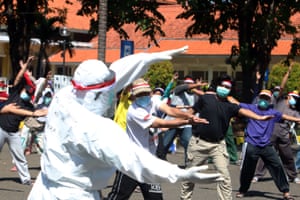
An instructor in protective gear leads coronavirus patients in Indonesia in an aerobics workout. Photograph: Budiono/Sijori Images/ZUMA Wire/REX/Shutterstock
The cumulative number of confirmed cases of coronavirus in India passed 2.8 million on Wednesday, after the country registered 56,565 cases in 24 hours.
According to official statistics, about 2 million of those who had contracted the virus have survived, while 53,849 have died – including 834 in the past 24 hours.
India is the third-worst affected country in the world by cases, and has the fourth-highest death toll from the coronavirus pandemic.