Coronavirus live news: Spain mandates face masks as Greece prepares to unveil tourism plans
The reality TV star Kim Kardashian West is the latest designer to capitalise on the coronavirus crisis by launching a line of face masks – and has sparked a race row in the process, writes Morwenna Ferrier, the Guardian’s acting joint fashion editor.
Launched over the weekend under the celebrity’s shapewear label, Skims, the non-medical seamless masks come in five skin tones and reportedly sold out in less than 30 minutes. There is now a waiting list for them.
But their runaway success came hand in hand with accusations of “casual racism”, according to some on social media, who pointed out that one of the masks was not the right nude shade for a black model. The Skims site has now changed the model and the mask she wears. Skims had not responded to the Guardian’s request for comment at time of publication.
𝒸𝒽𝒶𝓁𝓊𝓀𝓎𝒶
(@balenciogre)you’d think this family would know shades of black skin tones considering their kids are black too and you’d think by now they would know that this is not a black nude tone but go off kimberly with your profiteering on casual racism…… t.co/4aX2IfZaFQ
Police in Sri Lanka have arrested more than 60,000 people over the past two months for breaking a curfew imposed to contain the spread of coronavirus, Xinhua reports.
A 24-hour curfew has been in force in the capital, Colombo, and its outskirts since 20 March, while the rest of the country is under nighttime curfew. An end date to movement restrictions has not been specified.
According to a statement published on Wednesday by the Sri Lankan police, seen by Xinhua, China’s official news agency, 60,425 people had been arrested since the curfew was imposed, for infractions such as loitering on the roads, gathering and consuming alcohol at public grounds, travelling by vehicle on the roads and behaving in an unruly manner while intoxicated.
The epidemiology unit of Sri Lanka’s ministry of health on Wednesday reported four new cases of coronavirus, bringing the total in the country to 1,027. Of those, 584 patients have recovered and 434 were under medical care. Nine people have died from Covid-19.

With Greece about to unveil its much-awaited tourism plan, some are gearing up with a gusto for the season, writes Helena Smith, the Guardian’s Athens correspondent.
As the country gradually emerges into the post-lockdown age and restrictions are eased, beaches have been opened up. But some bathers – extending the notion of the “new normal” to the sea – are taking no chances.
Ioannis Alexopoulos
(@ioannisAlexopo3)Spotted on a beach at Mykonos this afternoon. #greece #mykonos pic.twitter.com/eGru6yMoWU
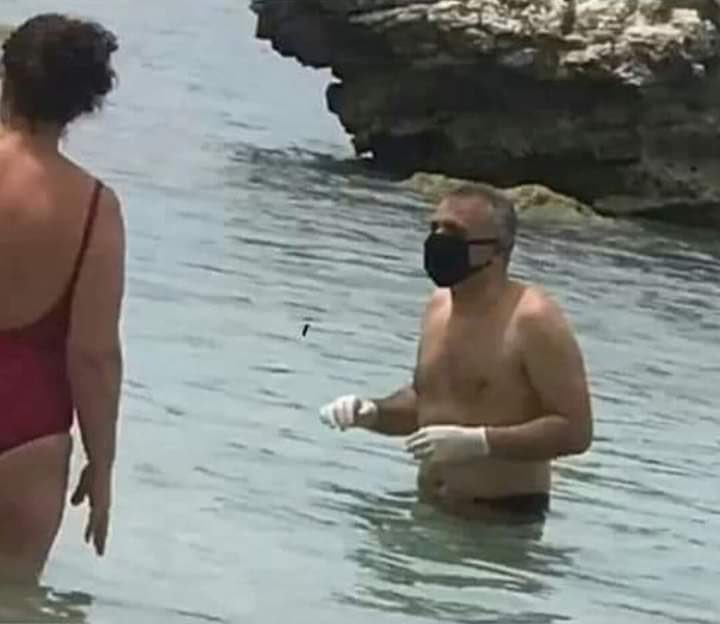
On Mykonos, one swimmer was snapped in masks and gloves as he had a paddle in the waters off the Cycladic isle – which is, like all Greek islands, still mercifully coronavirus-free. Hats off to Ioannis Alexopoulos.
In a rare success story Greece has virtually eradicated the virus after enforcing draconian measures to curb the spread of the virus early on.
Nigeria’s largest medical union has instructed its health staff in Lagos to end their hospital shifts at 6pm each day, 2-hours before the city-wide curfew, in response to rising reports of police harassment, writes Emmanuel Akinwotu, the Guardian’s West Africa correspondent.
There is an 8pm curfew in Lagos under its gradually easing lockdown measures, but in recent days reports have been rife of harassment and abuse by police officers to essential workers, after 8pm.
The Nigerian Medical Association president, Dr. Francis Faduyile, told The Guardian that authorities were policing the lockdown curfew indiscriminately.
“Yesterday a lot of senior doctors were stopped from going home after hours by police,” he said. “We should be asking them why they are doing this.”
“Doctors will stay at home after 6pm to prevent themselves from being embarrassed and molested by police officers,” he added.
Lagos’ lockdown curfew exempts essential workers, yet there is insufficient clarity between different agencies on who qualifies. Faduyile said the government needed to clarify to police that health workers were essential.
Yesterday videos and pictures showed police in different parts of Nigeria’s most populous city, mounting roadblocks after 8pm for hours before letting commuters go.
Security agencies policing the lockdowns in Nigeria have come under scrutiny amid reports of abuses.
Lagos is the most affected city in Nigeria’s Covid-19 outbreak, with 2,750 of Nigeria’s 6,400 infections. Cases in the country continue to rise, doubling in just over a fortnight, but test capacity has only marginally improved over that time.
Africa’s most populous country has administered just 37,000 tests, “a far cry from what is needed” Faduyile said, and low compared to other African countries. Neighbouring Ghana and South Africa have tested 170,000 and 475,000 respectively.
Compounding challenges with the availability of test kits, poor infrastructure had made it hard to distribute its limited supply, and to transport test samples around the country, Faduyile said.

The South Korean football club FC Seoul are facing penalties, including expulsion from their own stadium, for putting sex dolls in empty seats during a match last weekend, according to the Associated Press.
The K-League is one of the few football leagues operating during the coronavirus pandemic, with games being played in empty stadiums but FC Seoul’s attempts to increase the atmosphere at Seoul World Cup Stadium backfired after their 1-0 win over Gwangju on Sunday. The club expressed their sincere remorse as a public backlash intensified, but said they were assured by a supplier that they were using mannequins not sex dolls to mimic a home crowd.
About 25 mannequins were supplied by a local company and dressed in FC Seoul colours and wearing masks. The Yonhap news agency reported that fans posted suspicions about the life-size dolls on social media during the match and one banner showed the names of an adult toy manufacturer and of models who had inspired those dolls.
Read the original article at The Guardian