Coronavirus live news: Spain records lowest death toll in two months; Obama attacks Trump’s virus response
Egypt will bring forward the start of its curfew by four hours to 5pm and halt public transport during the six-day Eid holiday from 24 May as it seeks to curb the spread of Covid-19.
Shops, restaurants and parks will also be closed for the holiday at the end of the holy Muslim month of Ramadan, and restrictions on citizens’ movements will be extended for a further two weeks afterwards, the prime minister, Mostafa Madbouly, said.
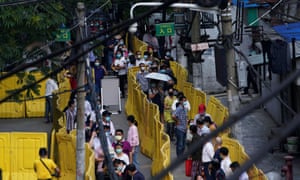
The city of Wuhan, where the coronavirus outbreak originated in China, conducted 222,675 nucleic acid tests on 16 May, the local health authority said, nearly doubling from a day earlier.
Wuhan kicked off a campaign on 14 May to look for asymptomatic carriers – people who are infected but show no outward sign of illness – after confirming last weekend its first cluster of Covid-19 infections since its release from lockdown on 8 April.
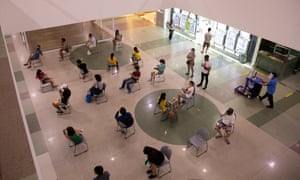
Residents line up for nucleic acid testings at a residential compound in Wuhan. Photograph: Aly Song/Reuters
The number of tests carried out on 16 May in the city of 11 million residents was more than the 186,400 tests conducted on 14-15 May, and was also the highest since the Wuhan Municipal Health Commission started publishing the data on 21 February.
Wuhan is conducting the testing on a voluntary basis.
No confirmed cases with symptoms were identified 14-16 May, though 28 new asymptomatic carriers were found, according to daily reports published by the Wuhan health authority.
Less than a year after passing a secularism law forcing certain members of religious minorities to uncover their heads and faces, Quebec is now debating whether to force everybody to put masks on.
Asked why not, Horacio Arruda, the province’s public health director, told reporters: “You need to have a good argument for infringing on individual rights for the sake of a collective right.”
But such arguments ring hollow to Nour Farhat, a Montreal lawyer whose dreams of being a Crown prosecutor were dashed after the Quebec government passed legislation last year barring certain public sector workers from wearing religious symbols at work.
The law – known as Bill 21 – mainly affects Muslim women working in education, law and other public sectors. Farhat said:
Bill 21 violates the rights of religious minorities without a real or urgent situation. And now that we’re in a real and urgent situation, the premier cares about violating people’s rights.
For them, it was always OK to violate the rights of religious minorities.
Bill 21 has always permitted masks for medical reasons, and government media representatives say their hesitancy on masks is not related to that law.
But head and face coverings carry a certain political weight in Quebec. Recent years have seen multiple instances of people trying to snatch hijabs from women’s heads in the province.
The growth of new coronavirus cases in Russia is stabilising, a top health official has said, as the daily tally fell under 10,000 for the third time this week.
The country has the world’s second highest number of infections at 281,752, topped only by the United States.
On Sunday, it announced new cases had dropped below 10,000 for the third day this week at 9,709.
The head of Russia’s public health watchdog, Anna Popova, said in an interview on Rossiya-1 television:
We’ve moved towards the level of stability that we’ve all been waiting for.
I would say that of today, we have halted the growth [in the number of cases].
For the last 10 or 11 days now, we haven’t seen additional growth or it’s been very small.
Stabilisation can be seen over the whole country. All the regions have managed to stabilise the situation.
The state watchdog Rospotrebnadzor announces daily virus numbers and is working to develop a viable vaccine at its Vector virus research centre in Siberia.
Popova said it was too early to say if Russians can make plans for summer travel, saying “we need to look at the next two or three weeks”.
Russia on Saturday announced the highest daily death rate at 119. It has confirmed a total of 2,631 deaths, 10 times fewer than Britain, France, Italy and Spain.
Critics have cast doubt on Russia’s low official mortality rate, accusing authorities of under-reporting deaths in order to play down the scale of the crisis.
Russian health officials say one of the reasons the count is lower is that only deaths directly caused by the virus are being included.
The deputy prime minister, Tatiana Golikova, denied any manipulation of numbers on Sunday, saying hospitals had a financial interest in identifying coronavirus cases since they get allocated more money to treat such patients.
“From the economic point of view, any hospital should have an interest in diagnosing more Covid cases,” she said.
Authorities say that since the virus came later to Russia, the country had more time to prepare hospital beds and launch wide-scale testing to slow its spread.
Madagascar has registered its first coronavirus death, of a 57-year-old medical worker who suffered from diabetes and high blood pressure, the national Covid-19 taskforce said.
Taskforce spokeswoman Hanta Danielle Vololontiana said in a televised statement that the man had died on Saturday night.
“A man died from Covid-19 in Madagascar … he is 57 years old and a member of the medical staff,” she said.
Ministers and officials from every nation will meet via video link on Monday for the annual world health assembly, which is expected to be dominated by efforts to stop rich countries monopolising drugs and future vaccines against Covid-19.
As some countries buy up drugs thought to be useful against the coronavirus, causing global shortages, and the Trump administration does deals with vaccine companies to supply America first, there is dismay among public health experts and campaigners who believe it is vital to pull together to end the pandemic.
While the US and China face off, the EU has taken the lead. The leaders of Italy, France, Germany and Norway, together with the European commission and council, called earlier this month for any innovative tools, therapeutics or vaccines to be shared equally and fairly.
“If we can develop a vaccine that is produced by the world, for the whole world, this will be a unique global public good of the 21st century,” they said in a statement.
The sole resolution before the assembly this year is an EU proposal for a voluntary patent pool. Drug and vaccine companies would then be under pressure to give up the monopoly that patents allow them on their inventions, which means they can charge high prices, so that all countries can make or buy affordable versions.
In the weeks of negotiations leading up to the meeting, which is scheduled to last for less than a day, there has been a dispute over the language of the resolution.
Countries with major pharmaceutical companies argue they need patents to guarantee sufficiently high prices in wealthy nations to recoup their research and development costs.
Even more fraught have been attempts to reinforce countries’ existing rights to break drug and vaccine company patent monopolies if they need to for the sake of public health.
A hard-fought battle over Aids drugs 20 years ago led to the World Trade Organization’s Doha declaration on trade-related intellectual property (Trips) in favour of access to medicines for all, but the US, which has some of the world’s biggest drug companies, has strongly opposed wording that would encourage the use of Trips.
Campaigners say the resolution expected to be passed by the world health assembly’s 198 member states is along the right lines, but too weakly worded.
Jamie Love of Knowledge Ecology International said:
In a global crisis like this, that has such a massive impact on everyone, you would expect the WHO governing body to have the backbone to say no monopolies in this pandemic.
It’s one thing for a country to use its economic clout to buy preferential access to drugs or vaccines. It’s another to prevent others from manufacturing and expanding global supply.
I’m going to step away from the blog for a little while. My colleague Jessica Murray will take the wheel in the meantime. If you would like to get in touch with her, you can do so by email here or on Twitter here.
Scientists in Hong Kong have established that face masks do reduce transmission of coronavirus (at least among hamsters). This just in from AFP:
Tests on hamsters reveal the widespread use of facemasks reduces transmission of the deadly coronavirus, a team of leading experts in Hong Kong said Sunday.
The research by the University of Hong Kong is some of the first to specifically investigate whether masks can stop symptomatic and asymptomatic COVID-19 carriers from infecting others.
Led by Professor Yuen Kwok-yung, one of the world’s top coronavirus experts, the team placed hamsters that were artificially infected with the disease next to healthy animals.
Surgical masks were placed between the two cages with air flow travelling from the infected animals to the healthy ones.
The researchers found non-contact transmission of the virus could be reduced by more than 60 percent when the masks were used.
Two thirds of the healthy hamsters were infected within a week if no masks were applied.
The infection rate plunged to just over 15 percent when surgical masks were put on the cage of the infected animals and by about 35 percent when placed on the cage with the healthy hamsters.
Those that did become infected were also found to have less of the virus within their bodies than those infected without a mask.
“It’s very clear that the effect of masking the infected, especially when they are asymptomatic – or symptomatic – it’s much more important than anything else,” Yuen told reporters.
Madagascar has reported the first death of a patient suffering from the novel coronavirus, nearly two months after the virus was first detected in the country.
The Indian ocean island, which has reported 304 cases, hit the headlines last month over a home-grown herbal concoction, a tonic drink derived from artemisia – a plant with proven efficacy in malaria treatment – and other indigenous herbs, that President Andry Rajoelina claimeds can cure people infected with the virus. The World Health Organisation has warned against “adopting a product that has not been taken through tests to see its efficacy”.
Yesterday Kenya’s President Uhuru Kenyatta announced that the country’s coronavirus measures would be extended and its borders with Tanzania and Somalia closed. “Among the positive cases that have been registered in the country this week, a total of 43 cases have recently crossed the border from neighbouring Somalia and Tanzania,” Kenyatta said in a televised address. Kenyatta also said the national 7pm-5am curfew would be extended until June 6, as would a ban on entering or exiting the cities of Nairobi, Mombasa, Kilifi, Kwale and Mandera. “A brutal and unforgiving enemy is at our wall. He is trying to gain entrance using every door and every window,” Kenyatta said. He also announced that truck drivers would be tested before entering Kenya, saying that border tests had identified 78 infected drivers, all turned back.
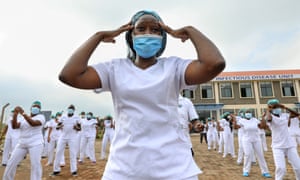
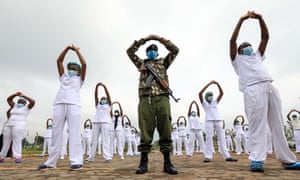
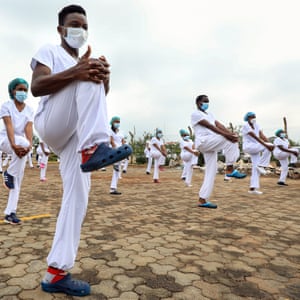
Today, some nurses have been doing Zumba:
Kenyan nurses, midwives and other frontline workers at the Infectious Disease Unit at the Kenyatta University Teaching, Referral and Research Hospital during a Zumba training session organised by the Nursing Council of Kenya to mark the end of Nurse’s Week in Nairobi, Kenya. Photograph: Daniel Irungu/EPA
A Kenyan police officer joins nurses, midwives and other frontline workers at the Infectious Disease Unit at the Kenyatta University Teaching, Referral and Research Hospital during a Zumba training session organised by the Nursing Council of Kenya to mark the end of Nurse’s Week in Nairobi, Kenya. Photograph: Daniel Irungu/EPA
Kenyan nurses, midwives and other frontline workers at the Infectious Disease Unit at the Kenyatta University Teaching, Referral and Research Hospital during a Zumba training session organised by the Nursing Council of Kenya to mark the end of Nurse’s Week in Nairobi, Kenya. Photograph: Daniel Irungu/EPA
Spain has recorded its lowest single-day death toll in two months. According to the latest figures from the health ministry, 87 people have died from Covid-19 in the past 24 hours, down from 102 the day before. The country has confirmed 231,350 cases of the virus using PCR tests, and reported 27,650 deaths.
Brazil’s health ministry announced 14,919 new cases, taking the country’s total to 233,142, ahead of Spain and Italy, making theirs the fourth largest outbreak in the world. Mainland China reported five new confirmed Covid-19 cases for May 16, down from eight the previous day, the National Health Commission has said in a statement. Two of the five confirmed cases were so-called imported infections, while three were locally transmitted in northeastern Chinese city of Jilin. Japan also confirmed five new cases.
The Greek government is poised to announce that restaurants and other eateries can now open on 25 May, one week ahead of schedule. Shopping malls and department stores will also be allowed to open tomorrow, two weeks ahead of schedule. By law staff and customers will be obliged to wear face coverings. Shopping malls have reopened in Thailand for the first time since their lockdown.
Four out of five merchants at a major fruit market in Peru have tested positive for coronavirus, revealing shocking levels of infection – and prompting fears that Latin America’s traditional trading centres may have helped spread Covid-19 across the region. Seventy-nine per cent of stall-holders in Lima’s wholesale fruit market tested positive for Covid-19, while spot tests at five other large fresh food markets in the city revealed at least half were carrying the virus.
China has asked trading firms and food processors to boost inventories of grains and oilseeds as a possible second wave of coronavirus cases and worsening infection rates elsewhere raise concerns about global supply lines. Both state-run and private grain traders as well as food producers were urged to procure higher volumes of soybeans, soyoil and corn during calls with China’s Ministry of Commerce in recent days, three trade sources told Reuters.
Barack Obama attacked the Trump administration’s response to the Covid-19 pandemic during a speech on Saturday. The comments are a rare rebuke of a sitting president from one of his predecessors, and come in the midst of a pandemic that has had devastating and disproportionate effects on communities of color in the United States.
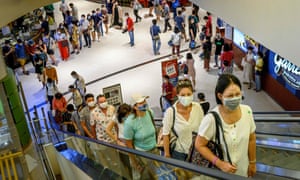
The Philippine government has called for vigilance against the coronavirus, a day after hordes of people trooped to shopping malls and ignored safety protocols, as authorities began loosening a two-month lockdown.
Photos and videos showing shoppers in some malls in the capital Manila violating physical distancing rules went viral on Saturday, drawing widespread public criticism and alarm, prompting the government to issue fresh health warnings.
“We advise the public not to be complacent and to follow health protocols set by authorities after we received reports of people who trooped to the malls with complete disregard of social/physical distancing measures,” presidential spokesman Harry Roque said. The government warned malls would be closed again if they do not strictly implement physical distancing and crowd control measures.
Shoppers maintain social distance as they queue to enter a store inside a shopping mall in Quezon City, Metro Manila, Philippines which has reopened after two months as lockdown restrictions ease. Photograph: Eloisa Lopez/Reuters
My colleague Jessica Glenza has factchecked some of the most commonly repeated claims that are being made about the coronavirus:
My colleague Sam Jones has filed this update from Spain:
Spain has recorded its lowest single-day death toll in two months.
According to the latest figures from the health ministry, 87 people have died from Covid-19 in the past 24 hours, down from 102 the day before. The country has confirmed 231,350 cases of the virus using PCR tests, and reported 27,650 deaths.
On Saturday the prime minister, Pedro Sánchez, announced that his Socialist-led coalition would be seeking a final, month-long extension of the state of emergency that underpins one of the strictest lockdowns in Europe.
“The path that we are taking is the only one possible,” said Sanchez. The government secured the current extension, which expires on 24 May, despite fierce opposition from the conservative People’s party and the far-right Vox party.
Both parties claim the state of emergency is excessive and no longer necessary, but the government says Spain’s hard-won gains against the virus must be safeguarded. Sánchez is likely to face another uphill struggle as he prepares to ask MPs to back the final extension in congress later this week.
Around 70% of the country will be in the second phase of de-escalation by Monday, meaning people can shop in small stores without an appointment, meet in groups of up to 10, and eat or drink in cafe and restaurant terraces, which are operating at 50% capacity. Despite some loosening of restrictions, the Madrid region and the Barcelona metropolitan area – two of the hardest-hit parts of Spain – remain in the first phase of the de-escalation.
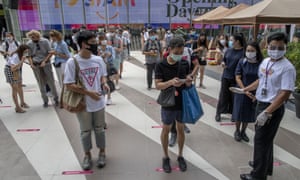
In Thailand shopping centres have been allowed to open today for the first time since their lockdown, and have had plenty of customers.
A Thai shopper goes through a sanitising gate before entering a shopping mall on the first day of reopening in Bangkok, Thailand. Photograph: Diego Azubel/EPA
People stand in line to enter the Siam Paragon shopping mall as it reopens after restrictions to halt the spread of Covid-19 in Bangkok. Photograph: Mladen Antonov/AFP via Getty Images
Patrons stand maintaining a physical distance at the entrance of the upmarket shopping mall Siam Paragon in Bangkok, Thailand. Photograph: Gemunu Amarasinghe/AP
If you’re spending the day at home (again), dreaming of summer, sand and sea, this European post-lockdown holiday update might come in handy:
A few updates from around the world:
Spain has declared 87 new deaths from coronavirus today, down from 102 yesterday (and the first time in two months that fewer than 100 deaths have been reported), and 652 new confirmed cases. They have now had 231,350 confirmed cases of Covid-19, and 27,650 deaths.
Mainland China reported five new confirmed Covid-19 cases for May 16, down from eight the previous day, the National Health Commission has said in a statement. Two of the five confirmed cases were so-called imported infections, while three were locally transmitted in northeastern Chinese city of Jilin. The number of confirmed cases in the mainland now stands at 82,947 and the death toll at 4,634.
In Indonesia there have been 489 new confirmed cases and 59 deaths. They have had 17,514 confirmed cases and 1,148 deaths overall.
Malaysia’s health ministry reported 22 new coronavirus cases on Sunday, bringing the cumulative total to 6,894. The country reported no new deaths, with total fatalities remaining at 113.
Meanwhile in France a drive-in mass has been held in Chalons-en-Champagne, near Reims:
The archbishop of Chalons-en-Champagne, Francois Touvet, celebrates France’s first ever drive-in mass in Chalons en Champagne, after the country began a gradual end to the nationwide coronavirus lockdown. Photograph: Gonzalo Fuentes/Reuters
Priests wearing face masks are preparing to celebrate France’s first ever drive-in mass in Chalons en Champagne, after the country began a gradual end to the nationwide coronavirus lockdown. Photograph: Gonzalo Fuentes/Reuters