Coronavirus live news: Trump wants to disband Covid-19 taskforce; Germany looks to reopen shops and restart amateur sport
India will begin flights on Thursday to bring home some 400,000 citizens stranded overseas by travel restrictions due to the coronavirus pandemic, prompting concerns that imported infections could fuel contagion in the country.
India’s coronavirus cases totaled 49,390 as of Wednesday, with 1,694 deaths, and there is still no sign of the curve in new cases flattening despite a stringent, weeks-long lockdown in the world’s second most populous country.
But responding to the distress among India’s huge diaspora, the government has asked national carrier Air India to provide aircraft to bring back Indians who want to return from the Middle East, Singapore, the United Kingdom and the United States.
The Indian Navy has also been asked to help by sending two ships to evacuate citizens from the Maldives, in the Indian Ocean.
Migrant workers, students and business people were left with no way home after India suspended air travel in March, just before entering a nationwide shutdown that remains in force until 17 May.
There have been numerous tales of hardship, both financial and emotional, from people desperate to see sick relatives and attend funerals or births, while others have lost their jobs and are running out of money stranded abroad.
“Priority will be given to workers in distress, elderly people, urgent medical cases, pregnant women, as well as to other people who are stranded in difficult situations,” the Indian consulate general in Dubai said.
The first round of evacuations would bring back around 200,000 people by the middle of May and then by mid-June a total of 350,000-400,000 would be flown back, a foreign ministry official said.
“By then, we are hopeful that foreign travel will be re-opened,” the official said.
Four of the ten flights that Air India will operate on Thursday will bring back people from Dubai, Abu Dhabi, Riyadh and Doha and all into the southern state of Kerala, according to a seven-day flight plan released by the government.
Nearly 300,000 have signed up for the flights from the Middle East for which Air India is charging a little less than a normal commercial fare.
Passengers will be screened at the departing airport and only those who are asymptomatic will be allowed to board. Once they land, they will be quarantined for two weeks, the government said.
China will not invite international experts to investigate the source of Covid-19 until after securing the “final victory” against the virus, Beijing’s UN ambassador in Geneva said.
China’s priority is first beating the pandemic – and countering the “absurd and ridiculous” politicisation of the coronavirus, Chen Xu told reporters in an online briefing.
The World Health Organization says it is waiting on an invitation from China to take part in its investigations into the animal origins of the virus, first reported in the city of Wuhan in December.
Asked when the WHO could expect an invitation, Chen replied:
The top priority, for the time being, is to focus on the fight against the pandemic until we win the final victory.
We need the right focus and allocation of our resources.
“It’s not that we are allergic to any kind of investigations, inquiries or evaluations,” he said, as they could aid international efforts to prepare for future public health emergencies. He added:
We need to race with time to save lives as much as we can.
For whether or how the invitation will take place, we need to have the right priority setting at this moment, and on the other hand, we need the right atmosphere.
A host of celebrities and scientists including Madonna, Robert de Niro and a clutch of Nobel Prize winners have called for radical change in the world rather than “a return to normal” after the coronavirus lockdowns.
Hollywood stars Cate Blanchett, Jane Fonda, Marion Cotillard and Monica Bellucci also added their names to the open letter published in the French daily Le Monde pleading for an end to unbridled consumerism and a “radical transformation” of economies to help save the planet.
“We believe it is unthinkable to ‘go back to normal’,” said the letter which was also signed by Nobel laureates for medicine, chemistry and physics as well as peace prize winner Muhammad Yunus.
They said the pandemic was a tragedy but it was a chance for humanity to “examine what is essential”.
“Adjustments are not enough. The problem is systemic,” the letter added. It said:
The ongoing ecological catastrophe is a meta-crisis. Unlike a pandemic… a global ecological collapse will have immeasurable consequences.
The 200 signatories said it was time for leaders “to leave behind the unsustainable logic that still prevails and to undertake a profound overhaul of our goals, values, and economies.
The pursuit of consumerism and an obsession with productivity have led us to deny the value of life itself: that of plants, that of animals, and that of a great number of human beings.
Pollution, climate change, and the destruction of our remaining natural zones has brought the world to a breaking point.
Professor Salim Abdool Karim, the South African government’s chief adviser, has been talking to foreign journalists this morning about the country’s much-praised effort to tackle the threat posed by the pandemic.
Karim said South Africa had been on a similar trajectory to the UK for three weeks before its epidemic “took a different turn”.
President Cyril Ramaphosa moved rapidly and decisively to impose one of the strictest lockdowns in the world in late March.
Authorities also rolled out a very proactive screening and testing programme which has meant the country of 56 million has suffered just 148 deaths and has just over 7,000 confirmed cases.
“We put 30,000 community health workers on the ground and decided to actively go out and look for outbreaks, and stem the tide before cases reached hospitals,” he said.
A women gets tested by a health care professional during a local government mass testing deployment in the high density Alexandra township. Photograph: Kim Ludbrook/EPA
The biggest challenges for South Africa have been in crowded, poor townships where around a third of the population live and where social distancing measures are impractical.
Karim, a globally respected epidemiologist, said he expected to see continuing outbreaks in prisons, hospitals, pharmacies, bakeries and “all over” because of the “nature of South African society” but that health authorities would “deal with it and resolve the problems” when they came up.
The peak of the outbreak in South Africa will come between July and early September, Karim said, with different mathematical models suggesting different timescales.
The relatively low number of cases across Africa have prompted speculation that populations were less vulnerable to Covid-19 for some so far unclear reason.
This was unlikely, Karim said though the lower proportion of elderly might mean lower fatality rates. “I don’t know of any special characteristic that we have [in South Africa]. There’s no way we can escape this”.
The total confirmed cases of Covid-19 across Africa are now approaching 50,000, with nearly 2,000 deaths – though there is plenty of evidence that large numbers of victims are going uncounted in many countries.
Turkish Airlines plans a gradual resumption of flights from June and will take four months to return to near full operation, a draft plan seen by Reuters showed, as the economy reopens following a slowdown in coronavirus cases.
The flag carrier, which flew to 126 countries before the coronavirus outbreak but was forced to shut down all international passenger flights, will fly to just 19 countries next month, the April-dated plan proposed.
It plans to gradually build up the number of destinations to 99 countries in September, according to the plan, which the company told Reuters may be subject to change in line with developments.
A repatriation flight carrying Turkish citizens arrives at OrduâGiresun Airport in Ordu, Turkey. Photograph: Anadolu Agency/Anadolu Agency via Getty Images
Turkish Airlines, which carried more than 74 million passengers last year, has suspended passenger flights until 28 May after borders were shut down to stem the spread of Covid-19.
It plans to resume 60% of domestic flights in June, according to the draft plan.
Ankara has launched efforts to gradually revive the economy from late May after the spread of the virus slowed over the past two weeks. Turkey has about 130,000 confirmed coronavirus cases, the highest total outside western Europe, the United States and Russia.
Fake news laws and political interference along with growing financial pressures has left many independent media groups in developing countries fighting to survive during the pandemic.
News outlets around the world have faced measures to muzzle critical reporting in an environment that has already seen dozens of journalists harassed, arrested and censored by governments, according to editors and press freedom groups.
Press freedom group Reporters Without Borders, which has launched a dedicated tracker to record the impact of coronavirus on journalism, has reported abuses in more than a dozen countries, including Iran, Egypt and Brazil.
In the group’s annual global report on press freedom last week, secretary general Christophe Deloire said the pandemic had given countries the chance “to take advantage of the fact that politics are on hold, the public is stunned and protests are out of the question, in order to impose measures that would be impossible in normal times”.
Ibiza welcomes more than three million visitors during the summer months, pumping billions into its economy.
Close to 75% of the island’s 147,000-plus population get their income from tourism, directly and indirectly – besides the fabled nightclub scene, there’s the hotels, Airbnbs, restaurants, bars, shops, taxis, and other businesses that exist because of the pull of the clubs.
As clubs on the White Isle start to cancel their events, workers who survive on summer income are facing disaster. Pete Tong and others explain what happens next.
The coronavirus death toll in Iran rose by 78 in the past 24 hours to 6,418, health ministry spokesman Kianush Jahanpur said.
The total number of diagnosed cases of new coronavirus in Iran, one of the countries hardest hit by the outbreak in the Middle East, has reached 101,650, he said.
A genetic analysis of samples from more than 7,500 people infected with Covid-19 suggests the virus spread quickly around the world late last year and is adapting to its human hosts.
A study by scientists at University College London’s (UCL) Genetics Institute found almost 200 recurrent genetic mutations of the coronavirus – SARS-CoV-2 – which the researchers said showed how it may be evolving as it spreads in people.
Francois Balloux, a UCL professor who co-led the research, said results showed that a large proportion of the global genetic diversity of SARS-CoV-2 is found in all of the hardest-hit countries. That suggests that the virus was already being transmitted extensively around the globe from early on in the epidemic.
Balloux said:
All viruses naturally mutate. Mutations in themselves are not a bad thing and there is nothing to suggest SARS-CoV-2 is mutating faster or slower than expected.
So far we cannot say whether SARS-CoV-2 is becoming more or less lethal and contagious.
Balloux said the 198 small genetic changes, or mutations, that the study identified appeared to have independently occurred more than once.
These may hold clues to how the virus is adapting and help in efforts to develop drugs and vaccines. Ballouz explained:
A major challenge to defeating viruses is that a vaccine or drug might no longer be effective if the virus has mutated.
If we focus our efforts on parts of the virus that are less likely to mutate, we have a better chance of developing drugs that will be effective in the long run.
The UCL team’s findings, published on Wednesday in the journal Infection, Genetics and Evolution, confirm that the virus emerged in late 2019, Balloux said, before quickly spreading across the globe.
The study was not able to confirm the exact starting point or location.
Twitter said it would tackle the spread of damaging conspiracy theories linking mobile phone technology and coronavirus with a prompt to direct people searching for 5G to British government-verified information.
The theory, which has spread on social media, has resulted in attacks on mobile telecoms masts and abuse directed at engineers in Britain.
Scientists, phone companies and the government have said it is completely untrue.
Twitter said the search prompt would inform users that the government had seen no link between 5G and Covid-19, and include a link to a government website with credible, factual and verified information in relation to 5G.
Katy Minshall, Twitter UK’s head of government, public policy and philanthropy, said the move was the latest step in its focus on connecting people with authoritative information regarding Covid-19.
“Our partnerships throughout this pandemic have allowed us to take proactive steps in bringing people the information most relevant and useful for them,” she said.
A burned down mobile phone mast in London. According to reports, at least 20 mobile phone masts across Britain are believed to have been vandalised. Photograph: Facundo Arrizabalaga/EPA
Facebook and Google have also taken steps to counter misinformation about Covid-19 on their platforms. However, the tech companies have been criticised for not doing enough to counter misinformation.
Representatives from all three were questioned by lawmakers last Thursday about the steps they had taken.
The chairman of the UK parliament’s digital and media committee, Julian Knight, said the position they had adopted was “deeply unhelpful and failed in clarifying what they are doing to tackle the threat posed by record levels of misinformation and disinformation online about Covid-19, some of it deadly”.
The lead US airport security agency is weighing the possibility of requiring masks or face coverings for passengers who pass through checkpoints, Reuters reports.
The move is part of a broader rethinking of how to limit the spread of the Covid-19 during air travel, an effort that could bring some of the most significant changes to the industry since the 11 September 2001 attacks.
Travellers passing through US Transportation Security Administration (TSA) checkpoints will see other changes, including additional barriers to protect security officers, more extensive cleaning regimes and upgraded screening equipment to speed travellers through lines faster, according to current and former US officials and industry experts familiar with the plans.
TSA officers are allowed to wear masks at checkpoints but are not required to do so. The agency is considering such a requirement, sources said.
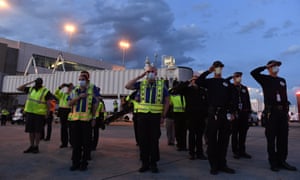
TSA agents and Denver paramedics salute as the casket carrying the body of retired paramedic Paul Cary arrives at Denver International Airport. Photograph: Helen H Richardson/AP
News of potential changes came as the Senate Commerce Committee was set to hold a hearing Wednesday on the state of the aviation industry.
The number of US air travellers plunged by 95% in March as lockdowns went into effect across the country.
But with restrictions ending in some states, US officials, airports and airlines are grappling with how air travel must change to operate more safely.
Nearly every major US airline said in the past week they will require passengers to wear face masks onboard flights. The San Diego international airport and San Francisco international airport already require face coverings.
Russian soldiers and medical workers providing coronavirus assistance in Italy will start returning to Russia from Thursday, the Interfax news agency cited defence minister Sergei Shoigu as saying on Wednesday.
Russia began sending doctors, nurses and medical equipment to disease-stricken Italy in late March in a goodwill operation that Moscow dubbed “From Russia with love”.
Despite a decade-old financial crisis that decimated its hospitals, Greece appears to have handled the coronavirus pandemic well, with a far lower death toll than many other European nations.
Dr Yota Lourida, head of the Covid-19 clinic at Sotiria hospital in Athens, explains how her department dealt with the crisis, and the steps taken by the country to mitigate against potentially catastrophic outcomes.
Inside a Greek coronavirus ward: how debt-ridden nation is beating the disease – video