Coronavirus live news: WHO says 190,000 could die in Africa as UN chief warns of ‘tsunami’ of hate worldwide
The Foreign Office has paid tribute to the British Gurkhas who rescued 109 UK nationals and 28 other nationals stranded in remote parts of Nepal.
Disclosing details of the mission, which took place last month, the government said they travelled more than 4,000 miles through the Himalayas to 13 different districts, negotiating river crossings and landslides, to reach the tourists scattered across dozens of mountainous towns, villages and national parks.
In some instances, the soldiers had to set up camp on the side of the road overnight to reach the tourists.
One, Sgt Prakash Gurung, drove nine and a half hours solo to Manang in the north-west of the country. The journey was almost aborted due to a landslide.
“I stepped up to volunteer because I thought it was a part of my job. Helping people in dire situations gives me a sense of satisfaction. The gratitude people expressed in messages has encouraged me to do more of this sort of work,” said Gurung, who is based in a barracks in Folkestone, Kent.
The UK ambassador in Nepal, Nicola Pollitt, said 700 British travellers were brought home with the help of the Gurkas.
Here is the map the embassy put together ahead of the rescue operation:
NicolaPollitt
(@NicolaPollittUK)My team at @UKinNepal and @Gurkha_Brigade still working hard to help bring you back from remote regions. Over 2000 messages to our email address over the last week. Doing our best to get you on a flight to UK. Stay in touch here for updates. pic.twitter.com/4nKzxDQ6k4
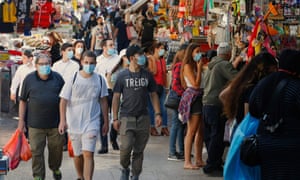
Israel’s weekly confirmed coronavirus cases have dropped below 500 for the first time following a strict 8-week lockdown that is now being lifted in stages, reports the Guardian’s Jerusalem correspondent.
The Health Ministry said the total number of confirmed cases stood at around 16,300, with 42 new infections during the past 24 hours. In total, 240 people have died.
In recent days, Israel has reported less than 50 new cases a day, with recovers vastly overtaking new infections. Hospitals have begun to close coronavirus wards, although they have been kept on standby in anticipation of a possible second wave of infections.
Restrictions have also been reduced, with malls, gyms, hairdressers and some school classes reopening this week. Preschools are due to open on Sunday, with class-size limits.
The Italian province of Bolzano-Alto Adige, located in the northern part of the country, which enjoys a high degree of autonomy in running its affairs, voted overnight to speed up the reopening of activities in phase two of the coronavirus emergency. Shops will reopen on Saturday and hairdressers, bars, restaurants and museums on Monday.
Last Monday, Italy, which has endured Europe’s longest lockdown, entered what the government has described as phase two of its coronavirus emergency.
Italians are now able to travel within regions to visit relatives, provided they wear masks, but schools, hairdressers, gyms and many other commercial activities will stay closed. Cafes and restaurants will offer takeaways only and all travel between regions will be banned except for work, health or emergency situations. Restrictions on funerals have been relaxed, with a maximum of 15 mourners allowed to attend, but masses and weddings will have to wait.
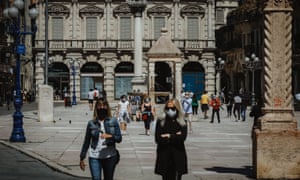
Millions of people were overcome with feelings of anger and disappointment as their hopes were dashed by what many described as a “false reopening”. Expectations had been high for a quick return to normality, especially in the south, where there have been fewer Covid-19 cases than in the north. The mood is sombre, not only because the virus, despite its slackening, continues to claim lives, but also because people are on edge after having been forced to stay at home for more than 50 days.
According to the latest decree introduced by the central government, bars, hairdressers and restaurants should fully reopen on 1 June; museums and retailers from 18 May. Factories already geared towards exports and public construction projects resumed activity last Monday.
Several regions, including Calabria and Sicily, are working on a plan to speed up the reopening before the date set by the central government. In the Italian autonomous province of Bolzano-Alto Adige, the nationwide rules will still apply for the closure of schools and universities and, so far, the ban on sporting events.
A little bit more on those German export figures from the Guardian’s Berlin bureau chief, Philip Oltermann.
German exports have suffered the biggest collapse since reunification, as the country is starting to feel the effect of a slowdown in both the Chinese and European economy.
In March, German companies exported goods worth €108.9bn, the country’s statistics office announced today – an 11.8% decline from February, the most severe drop since records began in 1990.
Compared with March 2019, exports were down 7.9% year on year.
“Germany’s exports in March were being ground down by two millstones”, said Andreas Scheuerle, an expert for Germany’s saving banks finance group. “German exporters did not just feel the weakness of the Chinese market, but also the increasingly strong collapse of the European single market.”
Hello, I’m Frances Perraudin, taking over from Alexandra Topping for the rest of the day. You can contact me with comments and tips on frances.perraudin@theguardian.com and on Twitter @fperraudin.
The World Bank has approved $400m in help for Afghanistan to help the war-torn country fight coronavirus.
The number of infections continue to surge amid intensified war across the country, while the health minister has also been infected.
Henry Kerali, World Bank country director for Afghanistan, said:
This assistance will help Afghanistan maintain its reform momentum throughout a difficult period and provide vital financial support to the government to manage revenue shortfalls arising from coronavirus impacts.
Yesterday, the government confirmed that Ferozuddin Feroz, the country’s health minister, has been infected to Covid-19. The minister is in stable condition and isolated at home.
The ministry has recorded 215 new infections and three of Covid-19 overnight, pushing the total number of infections to 3,778 and death toll to 109. There have so far been 472 recoveries.
Akhtar Mohammad Makoii
(@akhtar_makoii)Total infections: 3,778
New infections: 215
May7: 171
May6: 168
May5: 330
May4: 190
May3: 235
May2: 179
May1: 164
Apr30: 232
Apr29:110
Ap28: 125
Ap27: 172
Ap26: 68
Ap25: 133
Ap24: 95
Ap23: 83
Ap22:51
Ap21:66
Ap20:30Death toll: 109
Afghanistan’s struggle with a shortage of diagnostic testing equipment known as “RNA extraction kits”, which scientists use to isolate the RNA (ribonucleic acid) in samples of the novel coronavirus, has been given a lifeline after it received equipment from the WHO. Heath ministry has so far tested around 15,000 suspected patients.
Most of new cases confirmed in western province of Herat, which borders Iran, one of the world’s worst affected countries. 57 new cases confirmed in Herat.
Thousands of Afghans have returned home from neighbouring Iran since the beginning of the year, fanning out across the country without being tested or quarantined. The number of new infections slowed down in Kandahar compared with recent days as 17 new cases were reported in the province.
Concerns are high in the capital, Kabul, which has so far been the country’s worst affected area as one-third of 500 random coronavirus tests in came back positive, health officials said last week.
Wahid Majroh, the deputy health minister, has warned that the threat of the virus is at its “highest level”.
Despite a government-authorised lockdown in several provinces, streets are still crowded, which raises fears of a surge in number of death and infections among experts.
An outbreak of coronavirus in the top-security Tehran prison housing most of Iran’s political prisoners has been confirmed by a jailed British-Iranian dual national, Anoosheh Ashoori. Although there have been rumours of an outbreak before, it is the first time the outbreak has been so directly confirmed.
Ashoori said inmate Loghman Roozchang showed symptoms of the disease very soon after returning from furlough this week. He and two of his brothers convicted of embezzlement had been placed in Hall 2 of Wing 4 of the prison on their return as part of a supposed 14-day quarantine.
But he was taken away on Tuesday to hospital and his brother on Thursday confirmed that he had been tested positive. The three brothers Yadollah, Loghman and Anvar are serving sentences of between 20 to 23 years.
Early in Iran’s outbreak in April tens of thousands of prisoners were released on furlough, including as many as half of the political or security prisoners, but with the official figures, until this week, showing a decline in new infections, prisoners have started to be instructed to return to jail.
The 66-year-old Ashoori was never released, since his conviction was longer than five years, although in practice this rule has been frequently overridden by the authorities.
Campaigners for Ashoori’s release say there is no logic to the quarantine in Hall 2 since the 14-day period is widely ignored and newly arrived prisoners are put in alongside those that have been in the hall for a few days. The campaigners say prisoners are also moving between halls so making the quarantine a largely symbolic exercise designed to satisfy the World Health Organization, the UN body that advises national governments on how to defeat the infection.
Nazanin Zaghari-Ratcliffe, the best-known of the jailed British-Iranian dual nationals, had been kept in Evin for four years but was released on furlough in April and has spent the time on release at her parent’s home on a tag in Tehran. She is waiting to hear if she will be granted clemency or instead returned to jail. Her husband Richard Ratcliffe has asked the UK ambassador to Tehran to visit her in an act of solidarity.
Tehran itself was hit by 5.1 earthquake on Thursday night, leading to civilians to rush into the streets for safety. Two are reported dead.
The end to the strict lockdown in France does not mean an end to form-filling.
Anyone travelling more than 100km after Monday will need to have an “imperative” professional or personal reason and carry sworn declarations to that effect. To enforce the regulations, extra police and gendarmes will be posted on major roads, motorways, service stations and popular holiday destinations.
We now have more details on what those “imperative” reasons might be.
- Work. If your journey is more than 100km you may – it’s not clear entirely yet – need an attestation from your employer stating the journey is necessary. There are obvious exceptions to the 100km rule including transport workers.
- Family emergency. If you need to travel more than 100km to take urgent care of a child or sick relative. Just visiting a family member is not allowed. People can travel to funerals, but there is a limit on gatherings to 10 people.
- Moving house. Only if this cannot be postponed and you face being homeless ie, your current lease is ending.
- Returning home. Foreign nationals have the right to return to their home country. French people who fled the lockdown to second homes can return to their main residence even if it’s over 100km but journeys in the opposite direction will not be allowed.
- Medical appointments, legal and administrative procedures.
The 100km limit is the total length of the journey as the crow flies from your home address but you can travel between departments whatever its colour on the coronavirus map. The government has helpfully put online a tool that allows people to calculate the distance. As well as the declarations and attestations you will need something proving your principal address like an utility bill or rental contract.
You can read my colleague Andrew Roth’s report on Russia becoming Europe’s coronavirus hot spot below.
Here’s an excerpt:
Russia has the highest growth rate of infections in Europe and as of Thursday has the fifth highest number of cases in the world, surpassing Germany and France. Mikhail Mishustin, the Russian prime minister, and two other cabinet members have fallen ill.
Putin’s approval ratings have dropped to their nominal lowest in 20 years, the independent Levada Centre said, and the IMF has forecast that the country’s economy will contract by 5.5% this year. Russia’s official death toll has remained mercifully low for the number of cases, although medics are dying at worrying rates.
In discussions with his subordinates, Putin at times has looked deeply bored. As his health minister discussed regional payouts on Wednesday, the president distractedly rolled a pen back and forth across his desk, lost in a moment of reverie broadcast nationwide.
“Putin not only doesn’t control the situation but he cannot even plan how to change the agenda,” said Nikolay Petrov, a senior research fellow at the British thinktank Chatham House. “He cannot adjust … I think partly Putin’s lack of activism is connected to the fact that he is out of his normal position.”
[…]
The Kremlin’s desire to carry out its political programme has appeared at odds with its response to the epidemic. Putin held off on cancelling the symbolic vote until late March and the Victory Day parade until mid-April, with thousands of soldiers being sent into quarantine as a preventive measure.
“It appears the Kremlin was too focused on the constitutional and political reforms and not the epidemic,” said Petrov. “The epidemic came later to Russia and it was possible to be better prepared.”
One thing is clear: this is not the time to hold a public vote that could backfire over the Kremlin’s response to the epidemic. Analysts have suggested that it could be cancelled entirely, or delayed until the autumn when political conditions are more favourable.
Over in Greece this morning news has broken that a former health minister, and respected heart surgeon, has succumbed to coronavirus, writes Helena Smith in Athens.
Dimitris Kremastinos, 78, was admitted to a hospital in Athens two weeks ago where he was described as having waged an intense battle against the virus.
Tributes poured in for the British-trained doctor politician, with Greek prime minister Kyriakos Mitsotakis saying the world of science had lost a respected figure who had worked “with dignity, responsibility and efficacy.”
Kremastinos, an MP until last year, had been health minister under the late socialist leader Andreas Papandreou. As the most high-profile casualty of the virus in Greece his death was announced by the current health minister Vassilis Kikilias.
Greece has recorded one of the lowest infection rates in Europe to date, after enforcing draconian lockdown measures early on. A total of 2,678 confirmed cases of coronavirus have been recorded and 148 deaths with health ministry officials saying the country, which hopes to open up to tourists in July, has almost “flattened the curve.”
Read the original article at The Guardian