Coronavirus live news: WHO says pandemic still accelerating; 624 Romania patients discharge themselves from hospital
Greek authorities say they are ready to re-impose public and travel restrictions next week, warning that safety guidance for the coronavirus is being frequently flouted, the Associated Press reports.
Stelios Petsas, the government spokesman, said authorities were “determined to protect the majority from the frivolous few,” adding that the government was likely to announce new restrictions if needed on Monday.
Greece, which imposed strict lockdown measures, has kept infection rates low. But cases have crept up since restrictions were lifted and international travel resumed in recent weeks.
Petsas said authorities were focused on the rising number of cases in nearby, Balkan countries and tourists who travelled to Greece over the land border with Bulgaria, at the single crossing point that has been opened to non-essential travel.
Members of the communist-affiliated trade union PAME attend a demonstration against government plans to regulate street protests, in front of the parliament building in Athens. Photograph: Alkis Konstantinidis/Reuters
The PGA Tour has deployed its first Covid-19 threeball after confirming a trio of players who returned positive tests would remain in the field for the Workday Charity Open, writes Ewan Murray for the Guardian’s sports desk.
The Tour has cited guidelines from the Centers for Disease Control and Prevention (CDC) as key to allowing Dylan Frittelli, Denny McCarthy and Nick Watney to play in Ohio but the move is known to have raised eyebrows among fellow competitors. Late on Wednesday evening, just hours before round one was due to get under way, Frittelli, McCarthy and Watney were removed from their existing tee groupings and placed together.
In a statement, the Tour confirmed:
Dylan Frittelli, Denny McCarthy and Nick Watney will follow the symptom-based model, as they have continued to return positive tests but meet the CDC guidelines for return to work.
The Tour’s medical advisers and the CDC have indicated that PCR tests have shown a possibility of detecting viral RNA even after the infectious virus is no longer present. This would potentially become a persistent positive test result, despite the individual not being contagious.
Out of an abundance of caution, however, any player or caddie who meets the above criteria but continues to return a positive Covid-19 test will either compete as a single in competition or be grouped with players under the same situation, and he will also have no access to indoor facilities on site.
Officials in South Africa were trying to calm fears over the coronavirus outbreak after the country’s most-populated province said it was ready to bury more than a million people, AFP reports.
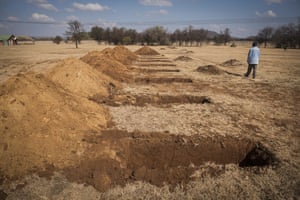
Excavators have this week sprung into action to dig long rows of graves in cemeteries throughout Gauteng, which includes the cities of Johannesburg and the capital Pretoria, for possible mass burials. After inspecting cemeteries in Pretoria, the provincial head of health, Bandile Masuku, said on Wednesday that Gauteng was preparing over 1.5m graves.
“All our municipalities have been putting up capacity and acquiring more in terms of the land that they’ll need for burial,” Masuku said.
His announcement triggered a wave of anxiety in the province, which has so far recorded 75,015 coronavirus cases and 478 deaths, overtaking the Western Cape province as the centre of the virus in South Africa.
A worker walks past freshly-dug graves at the Honingnestkrans cemetery, north of Pretoria, South Africa. Photograph: Shiraaz Mohamed/AP
Authorities have since been scrambling to ease public fears that the province could see such an explosion in coronavirus-related deaths.
“The province does not have over a million already open, dug graves,” the provincial health department said in a statement released on Thursday.
“The [figure of] over a million graves refers to the collective capacity municipalities can take,” it said.
After the easing of a strict lockdown imposed in late March, the tally of coronavirus contaminations and deaths has begun to rise. More than 8,800 cases and 100 deaths were recorded on Wednesday. With more than 220,000 total infections and 3,600 deaths, South Africa is the most-affected country on the continent.
“The storm that we have consistently warned South Africans about is now arriving,” the health minister, Zweli Mkhize, told parliament on Wednesday.
“We are now at a point where it’s our fathers, mothers, brothers, sisters, close friends and comrades that are infected,” he said.
Despite field hospitals deployed by the military or NGOs, “bed capacity is still expected to be breached or overwhelmed in all the provinces”, Mkhize said.
Hundreds of coronavirus patients in Romania have discharged themselves from hospital after a court ruling that mandatory admittance of those with no or mild symptoms was a breach of human rights, according to AFP.
A total of 624 patients, who tested positive for the virus, had asked to leave hospital and now risked transmitting the disease in their communities, the health minister, Nelu Tataru, said on television on Wednesday evening.
Tataru also said that more than half of 50,000 people, undergoing mandatory self-isolation after returning from abroad, had left their homes in defiance of doctors’ recommendations.
His announcements come as Romania, one of the EU’s poorest members, reported 614 new infections on Thursday, the biggest daily increase since the pandemic started.
The total number of infections in the country of some 20 million people reached 30,789, while 1,834 people have died.
Romania had so far escaped the brunt of the health crisis while enforcing a two-months lockdown until mid-May and strict mandatory quarantine rules.
But in a decision, which came into force last week, the Constitutional court ruled that hospitalising and quarantining people without or with just mild Covid-19 symptoms violated fundamental rights and so could not be imposed by a government decree.
Trying to reverse the consequences of the court ruling, the liberal government has proposed new legislation to more clearly spell out when people must be hospitalised or quarantine themselves at home. Lawmakers are scheduled to vote on the legislation later Thursday.
Health authorities in Denmark have recommended that people wear face masks in certain circumstances due to the coronavirus pandemic, AFP reports.
“Masks can be used to protect others in certain situations, when other tools to prevent the spread are not enough,” the deputy director of the Danish health authority, Helene Probst, said in a statement.
Situations in which the wearing of face masks is now recommended include hospital visits for virus testing, transport from a risk area to an airport and when caring for relatives with Covid-19.
“Our most important recommendation is that if you are infected or could be infected with Covid-19 you should isolate yourself,” Probst added.
However, the health authority maintains that the most effective measures in curbing the spread are still isolating those infected, social distancing and scrupulous hygiene routines.
Denmark, which was one of the first countries in Europe to impose semi-confinement and also the first to reopen its schools, has received praise for its management of the crisis.
Its strict coronavirus laws include a provision for mandatory vaccinations and prosecutions for people who refuse to be tested for the virus.
The NGO Médecins Sans Frontières is warning that the health system in El Salvador is in the brink of collapse as a result of added pressure from the coronavirus pandemic.
In a press release on Thursday, the international health organisation said an increasing number of people of people in the country were dying from Covid-19 and other illnesses at home before they could receive medical care.
Luis Romero Pineda, MSF project coordinator in El Salvador, said increasing numbers of people were dying before ambulances could reach them. “Admitting patients to hospitals has also become more difficult,” he said. “Worryingly, community leaders are reporting deaths in their communities, some of them related to the suspension of primary health care.”
Medics visit residents during a health day in the municipality of Soyapango, El Salvador, on Wednesday. Photograph: Rodrigo Sura/EPA
The Salvadorian government declared a state of emergency on 20 March, suspending primary care services and imposing an absolute lockdown. Movement restrictions have since been lifted but outpatient consultations at hospitals and health units remain suspended, MSF said.
“In many instances the patient had already died when we arrived at their house,” said Angel Sermeño, MSF’s medical activity manager in El Salvador. “In 2019, this happened to [our teams] 11 times from January to June. In the same period this year, it has happened 37 times – 18 times in June alone.”
Wendy, a doctor working for MSF’s ambulance service, said that some patients die while waiting to be transferred to a hospital. “We have to wait for authorisation from the public health system to be able to move patients to a care centre, since we cannot transfer the patient from [their] home without prior coordination and authorisation from the public health system,” she said.
The coronavirus pandemic is being used as a pretext for a crackdown on human rights and environment activists in Cambodia, two leading watchdogs have said, according to AFP.
Rights activists, labour leaders and journalists have all faced increased violence, intimidation, detention and judicial harassment in the southeast Asian nation since a crackdown was launched ahead of the July 2018 general election, a new report said.
“Since March 2020, the novel coronavirus pandemic provided the government with a set of additional arguments and tools to further crack down on dissent in Cambodia,” said the report by the International Federation for Human Rights (FIDH) and the World Organisation Against Torture (OMCT).
A new law drawn up in the context of Covid-19 and promulgated on 29 April allows the government to declare a state of emergency whenever Cambodia faces “danger” and “a great risk” such as a pandemic.
The law’s terms are “ill-defined” and give the government sweeping powers to restrict movement, rights to freedom of expression and association as soon as the state deems a situation “dangerous”, the report said.
Cambodia has not released updated statistics on its coronavirus outbreak since 28 June, according to the Worldometers website, which tallies official data from around the world. So far the country has reported 141 cases of coronavirus and no deaths.
Cambodia’s law on the State of Emergency “risks violating the right to privacy, silencing free speech and criminalising peaceful assembly,” the UN Special Rapporteur on human rights in Cambodia said on 17 April.
Rights group Human Rights Watch last month also accused authorities of using the pandemic as a pretext to arrest opposition supporters and critics who had questioned the government’s handling of the coronavirus.
“The accusations of fake news linked to the pandemic have increased in recent months. More than 40 people have been arrested since the beginning of the pandemic for posts related to posts on Covid-19,” said Hugo Gabbero, who coordinated the FIDH and OMCT report.
“The accusation of fake news silences all criticism, particularly through arrests which create ripple effect of fear through the rest of civil society,” Gabbero told AFP.
He asked the international community to apply pressure to the Cambodian government to ensure the law isn’t applied.
The Guardian’s video team has prepared this video report of the protests taking place in Belgrade over the past two nights.
Serbian protesters clash with police over government handling of coronavirus – video report
Tunisia has moved the UK from its amber list to its green list, despite a large disparity in coronavirus infection rates between the two countries, writes Simon Speakerman Cordall, a journalist in Tunis.
Tunisia has three lists, green amber and red, which determine restrictions upon movement once in Tunisia or, in the case of the red list, whether entry will be granted at all.
Public sector workers shout slogans in a protest demanding better work conditions next to the government palace in Tunis. Photograph: Mohamed Messara/EPA
Travellers from countries on the amber list are required to present the results of a coronavirus test upon entry and are subject to quarantine thereafter. Those on the green list are allowed free entry and movement.
Tunisia has long been a favourite of British holidaymakers, with tourism making up an estimated 8% of the country’s GDP and supporting 400,000 jobs.
TAP news agency (@TapNewsAgency)
#Tunisia: #UK and #Jordan, on Wednesday, were added to the green list of countries classified by the Health Ministry according to the #COVID19 risk level, while #Australia turns to orange from green. #TAP_En pic.twitter.com/PbclfgGJxx
July 8, 2020
Nicolás Maduro has warned Venezuela is witnessing the “real outbreak” of coronavirus amid growing fears over the impact Covid-19 could have on the economically devastated country, writes Tom Phillips, the Guardian’s Latin America correspondent.
Speaking on Wednesday, Maduro admitted the “dreadful pandemic” was making increasing inroads into Venezuela.
“[This is] the outbreak of the pandemic in Venezuela, the real outbreak,” Maduro said according to the news agency EFE. “Before we had seen the pandemic’s arrival – now we are seeing the outbreak.”
Venezuela’s official Covid-19 figures have so far been far lower than those of other countries in the region. While Brazil has recorded more than 68,000 deaths, Venezuela has officially suffered just 75. Venezuela has registered 8,010 confirmed cases while in Brazil there have been at least 1.7 million.
People in Maracaibo, Zulia state, Venezuela, in a photograph taken last week. Photograph: Luis Bravo/AFP/Getty Images
But many doubt the accuracy of the Venezuelan government’s numbers. Juan Pablo Guanipa, a prominent opposition politician who has played a leading role in efforts to force Maduro from power, told the Guardian he believed the true situation was far worse than his authoritarian regime was admitting.
“I’m certain these figures bear no relation to reality. The reality is utterly overwhelming,” Guanipa said.
Guanipa is from the western state of Zulia, which appears to be one of the worst affected parts of Venezuela. 1661 of Venezuela’s 8,010 officially confirmed cases have been recorded there.
On Thursday, Reuters reported that the state’s pro-Maduro governor, Omar Prieto, had been taken to a private clinic with breathing difficulties.
Guanipa said he had heard reports of at least six doctors and one nurse who had died in Zulia, and said the university hospital in the capital, Maracaibo, had “totally collapsed”.
Muhammad Lila (@MuhammadLila)
The hospital at the heart of Italy’s #Covid19 outbreak no longer has any coronavirus patients.
It comes 137 days after the first patient was admitted.
The head of the ER Department at Papa Giovanni XXIII Hospital isn’t mincing words:
Gatherings of more than 10 people have been banned in Belgrade, the Serbian capital, after two nights of violence on the streets as police cracked down on protests against coronavirus restrictions, the Associated Press reports.
Serbia’s government crisis team said following the clashes, where social distancing was barely observed and only a minority of people wore face masks, that the restriction is intended to prevent the further spread of the virus following the clashes.
In addition to limiting gatherings, businesses in closed spaces, such as cafes, shopping malls or shops, have been ordered to operate shorter hours.
“The health system in Belgrade is close to breaking up,” the prime minister, Ana Brnabić, said. “That is why I can’t understand what we saw last night and the night before.”
Serbian protesters clash with police over government handling of coronavirus – video report
The US embassy said in a statement that it was “deeply concerned” by the violence.
“We condemn all violence, including what appeared to us to be coordinated attacks on police seemingly intended to provoke overreactions as well as what appeared to be the use of excessive force by police,” it said.
Videos that appeared on social networks appeared to show police severely beating up protesters. One piece of footage purported to show a protester being hit and kicked by several officers and dumped to the side of the road, seemingly unconscious, so that police vehicles could pass. The authenticity of the video could not be independently verified.
Anonymous (@YourAnonCentral)
Dozens of police in Serbia brutally beat a single protestor and then drag his limp body to the curb to allow police vehicles to pass. (📹@suzedjevice) pic.twitter.com/Ry2cbG5L8Q
July 8, 2020
The clashes followed an announcement earlier this week from the president, Aleksandar Vučić, that further lockdown measures were likely as the outbreak in the country has intensified.
According to Reuters, the demonstrations were at first driven by anger and frustration over economically-stifling measures to contain the pandemic but evolved quickly into anti-government rallies with participants demanding Vučić’s resignation. There is a perception in the country that authorities were dishonest about the true scale of the coronavirus outbreak in order to ease restrictions enough to allow an election in which Vučić was reelected, according to social media posts.
Serbia, a country of 7 million, has so far reported 17,076 confirmed cases of Covid-19 and 341 deaths. Health authorities say hospitals are running at full capacity and staff are exhausted. The number of new infections rose to 357 on Wednesday from 299 on Tuesday.
As Covid-19 cases continue to surge in states throughout the US, another 1.3 million Americans filed for unemployment last week, highlighting the grim reality that any type of economic recovery may be far off, writes Lauren Aratani for Guardian US.
While the number of new unemployment filings has decreased significantly since it peaked in April at 6 million people filing in one week, it has remained above a million each week since forced shutdowns began.
Last week nearly 100,000 fewer people filed for unemployment compared to the week before, continuing a 15-week decrease in the number of new filings.
Most states began to experiment with different reopening plans in May and June, allowing businesses to reopen, often under strict guidelines. Last week the Department of Labor’s monthly jobs report revealed 4.8 million jobs came back in June, the highest number since the pandemic began. The unemployment rate was 11.1%, down from its peak of 13.3% in May.
Here’s a roundup of the key global coronavirus developments so far:
Five million people in Melbourne, Australia, have begun a new lockdown, with residents told to stay at home for six weeks as the city grapples with a resurgence of cases. The state of Victoria announced a further 165 new cases and has been effectively sealed off in an effort to preserve the rest of Australia’s success in curbing the virus.
World Health Organization director-general Tedros Adhanom Ghebreyesus has said a divided planet cannot conquer the pandemic. “Together is the solution unless we want to give the advantage to the enemy, to the virus that has taken the world hostage,” he said at the agency’s Geneva headquarters.
Serbian president Aleksandar Vucic accused “criminal hooligans” of driving violence in protests that have erupted in Belgrade and other cities over his government’s handling of the pandemic. The interior minister Nebojsa Stefanovic said 10 officers were injured during a second night of clashes in the capital.
The pandemic has killed at least 549,701 people worldwide as of 11am GMT on Thursday, according to an AFP tally based on official sources. More than 12 million cases have been registered in 196 countries and territories. The US is the hardest-hit country with 132,309 deaths, followed by Brazil on 67,964, Britain on 44,517, Italy on 34,914 and Mexico on 32,796 fatalities.
The WHO says it has launched an independent pandemic response panel headed by the former New Zealand prime minister Helen Clark and former Liberian president Ellen Johnson Sirleaf, to provide understanding on its handling of the crisis.
The UN chief Antonio Guterres had urged world leaders to favour clean energy solutions as they pour money into their virus-hit economies. Governments should exit coal, stop subsidising other fossil fuels, and pressure polluting industries to clean up their act in exchange for bailing them out, the UN secretary general told an International Energy Agency conference by video link.
Bulgaria has banned football fans from stadiums and shut clubs and bars just weeks after they had reopened, as the country reported a daily record of 240 new infections.
The UK’s death toll from confirmed cases of Covid-19 rose to 44,602 on Thursday, up 85 on the previous day, the government said.
The World Health Organization, which faced fierce US criticism over its handling of the coronavirus crisis, launched an independent panel on Thursday to review its response to the pandemic.
The Independent panel for Pandemic Preparedness and Response will be headed by the former New Zealand prime minister Helen Clark and former Liberian president Ellen Johnson Sirleaf.
“Through you, the world will understand the truth of what happened and also the solutions to build our future better as one humanity,” World Health Organization chief Tedros Adhanom Ghebreyesus said at the UN agency’s headquarters in Geneva.
Hello everyone. I am looking after the Guardian’s live feed while my colleague Damien Gayle takes a lunch break. Please get in touch via any of the channels below to share with me news tips, comments and more.
Peter Beaumont, senior reporter on the Guardian’s global development desk, has written his take on the World Health Organization’s press conference earlier:
The World Health Organization has announced an “independent” and “honest” review of how nations and the UN global health body handled the flawed international response to the coronavirus pandemic.
Dr Tedros Adhanom Ghebreyesus, the head of the WHO, gave details of the review during a downbeat press conference in which he painted a grim picture of the escalating trajectory of the pandemic.
“We know that when countries take a comprehensive approach based on fundamental public health measures … the Covid-19 outbreak can be brought under control,” Tedros said. “But in most of the world the virus is not under control. It is getting worse … more than 544,000 lives have been lost. The pandemic is still accelerating. The total number of cases has doubled in the last six weeks.”
The review panel will be co-chaired by Helen Clark, the former prime minister of New Zealand, and Ellen Johnson Sirleaf, the Nobel peace prize laureate and former president of Liberia.
As global confirmed cases approach 12 million, the WHO has found itself in the crosshairs of the Trump administration, which has announced its withdrawal from the body as it fends off what critics have described as its own botched response to the pandemic