Coronavirus news live: South Africa reverses decision to open schools; sharp rise in Iran’s infection rate
Just 232 new cases of coronavirus were reported by Sweden on Monday, the lowest number of new infections reported by the public health department since 27 March.
Eight more people have been recorded as dying of the virus, according to the latest update, which puts the total death toll at 4,403 and the cumulative case load at 37,814.
Sweden generally reports comparatively few deaths and new infections on a Monday, given delays in reporting over the weekend. But even taking that into account it is clear there has been a fall in the spread and mortality of its Covid-19 outbreak.

Observers have kept a keen eye on developments in the country, which chose not to impose the kinds of strict, mandatory lockdown measures used in attempts to contain the spread of the virus elsewhere in Europe.
Its approach, mostly based on voluntary social distancing and basic hygiene, has been criticised by some as a dangerous experiment, but also touted as a model for responding to the outbreak by the World Health Organization.
Critics leaped on figures last week that showed Sweden had the highest number of Covid-19 deaths in Europe per capita over a seven-day-period. However, its death rate from the outbreak remains well below other badly affected European countries that did impose strict containment measures, such as France, Italy, Spain and the UK.
Dozens of fireworks displays erupted simultaneously across Japan on Monday to cheer up the public, urge the gods to end the pandemic and provide practice for struggling pyrotechnic artisans.

Fireworks explode over the Okunitama shinto shrine in Fuchu in the western suburbs of Tokyo on June 1, 2020. Photograph: Charly Triballeau/AFP/Getty Images
More than 160 manufacturers launched their displays at precisely 8:00 pm (1100 GMT) at secret locations across the country for a five-minute display called “Cheer up Hanabi” (fireworks).
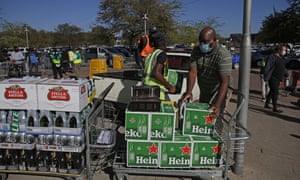
Many South Africans spent their Monday morning lining up outside liquor stores, as alcohol sales were allowed again after a two-month ban because of the coronavirus outbreak.
But while South Africa with the continent’s most developed economy and the highest number of confirmed cases of Covid-19 relaxed its strict lockdown, the reopening of most school classes was delayed and there was debate about how churches could safely resume services, the Associated Press reports.
The government postponed the planned opening of two grades for another week so that some under-prepared schools could get ready to resume classes for grades 7 and 12, the final years of elementary school and high school.
Places of worship were allowed to open from Monday with limits on the number of people in congregations, yet many religious groups said they would refuse the opportunity as they were concerned about the danger of allowing people to gather in an enclosed building.
South Africa has reported over 32,000 Covid-19 cases and more than 600 people have died, with warnings the peak is not expected until August or September.
The relaxation of the alcohol ban came as a relief to many, who chose restocking their liquor cabinets instead of going straight to work on the day much of the country’s economy also reopened.
In the township of Macassar, near Cape Town, people left home at 4.30am, residents said, to secure places in lines at liquor stores. The stores were set to open at 9am for the first time since 26 March.
Some walked with plastic crates to carry the bottles of beer and wine that they planned to buy, according to the report.
Cheers rose in a Johannesburg supermarket when screens were removed from wine racks to allow sales to begin.
Shelves of popular brands of alcohol were emptied in two hours at one liquor shop in an affluent suburb of Johannesburg.
Alcohol is only allowed to be sold from Monday to Thursday between 9am and 5pm, under the new relaxed measures.
Cross-country and local train services have resumed in Ukraine, AFP reports.
With the number of new cases falling in recent weeks, the country has been gradually easing restrictions, allowing the Kiev subway, shopping malls, outdoor cafes, beauty salons, dental clinics and parks to reopen.
On Monday, about 40 long-distance train services and more than 200 suburban routes reopened, with passengers required to wear face masks and follow social distancing rules, the French news agency cited officials as saying.

Passengers would have their temperatures taken and train cars would be disinfected after each trip, the national railway operator said in a statement. Ticket sales would also be limited to half of the usual seats to prevent crowding.
Ukraine had recorded 24,012 coronavirus cases and 718 deaths as of Monday, fewer than in many countries but enough to raise concerns for its under-funded healthcare system.
Germany recorded 333 confirmed new infections and 11 new deaths linked to Covid-19, the country’s disease control body said on Monday, writes Philip Oltermann, the Guardian’s Berlin bureau chief.
According to the Robert Koch Institute, Germany has recorded a total of 181,815 people infected with the virus since the outbreak of the pandemic, and 8,511 deaths.
The reproduction number (R), indicating how many new cases one infected person generates on average,rose to 1.04 on Sunday, staying above the critical threshold of one for the second row in a day.
The Robert Koch Institute has warned that the R was more likely to fluctuate while the overall number of new infections was low, and the latest rise might be linked to an outbreak of the virus in the city of Göttingen, in Lower Saxony.
At least 36 people were tested positive and more than 150 put into quarantine after health authorities in the city linked an outbreak to a number of private parties and an illegally opened shisha bar.
Greece has taken another step towards normality today lifting lockdown restrictions on hotels, open-air cinemas, golf courses and public swimming pools, writes Helena Smith, the Guardian’s Athens correspondent. The measures come as the country prepares to “welcome the world,” according to a new travel advisory released by the Greek foreign ministry at the weekend.
All air links into Athens and Thessaloniki, Greece’s northern metropolis, will resume as of 15 June which effectively means the nation will be re-opening to all foreign visitors after months of pandemic-enforced closure although regulations will be strict and ultimately dependent on points of departure: mandatory Covid-19 testing, and one or two- week periods of quarantine, will be required if passengers fly in from airports deemed by Europe’s aviation safety agency, EASA, to be in “high risk” coronavirus transmission areas.
After enforcing strict lockdown measures early on, Greece has managed to contain the virus relatively well, recording less than 3,000 confirmed coronavirus cases and a death toll of 175.
In a nation so dependent on tourism, arrivals are now eagerly awaited with Greek media reports suggesting hotels are already receiving bookings. As preparations get underway the owners of open-air cinemas – a quintessential delight of any Greek summer – were also getting in the mood this morning.

At the Cine Thision, Athens’ oldest outdoors cinema within view of the Acropolis, Michalis Maniakis who oversees the family-run business with his uncle, Thomas, expressed confidence even if the venerable institutions will only be able to operate at 40 % capacity thanks to the virus.
“We got through ten years of economic crisis, we’ll get through coronavirus too,” he said. “The summer is around the corner and the heat will pick up. There’ll be lots of long perfect nights to watch movies.”
Primary school children also went back to class today.
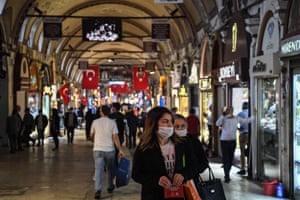
Istanbul’s 550-year-old Grand Bazaar reopened its doors on Monday for the first time in more than two months as cities across Turkey prepared to ease restrictions imposed to control the Covid-19 crisis, writes Bethan McKernan in the Turkish capital.
Cafes, restaurants, public buildings, sports facilities, childcare centres, parks and beaches have been allowed to reopen from today, although in Istanbul at least torrential rain kept public spaces empty.
An intercity travel ban was also lifted Monday, with cross-country rail travel and some domestic flights resuming. International flights are scheduled to restart from 10 June.
Turkey currently has the tenth worst coronavirus outbreak in the world by number of cases, at 163,942, but has recorded a much lower death rate than other badly-hit countries, which reached 4,540 on Sunday.
People over 60 and under the age of 18 are still subject to a curfew until further notice.
Some schools in parts of Catalonia are reopening today as the region eases out of lockdown, but attendance will be voluntary, writes Sam Jones, the Guardian’s Madrid correspondent.
In nurseries and primary schools, priority is being given to the children of parents who cannot work from home, while secondary schools will be resuming with groups of no more than 15 pupils. Most Spanish children will not return to school until September.
As of Monday, almost 70% of Spain is in the third and penultimate stage of the de-escalation. While much of Catalonia is in the third stage, the Barcelona metropolitan area remains in the second phase, as does the Madrid region. Both areas have been hit hard by Covid-19, which has killed 27,127 people in Spain and infected 239,479.
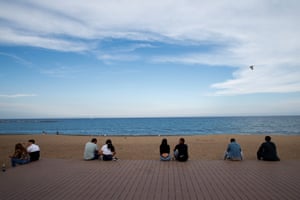
The Balearic island of Formentera is now in the final phase, as are the Canary island of La Gomera, El Hierro and La Graciosa.
Cultural institutions are also coming out of lockdown this week. Bilbao’s Guggenheim museum, which reopened on Monday, has cut visitor capacity to one third, and visitors will have their temperatures taken on the way in.
Madrid’s famous trio of art museums – the Prado, the Reina Sofía and the Thyssen – are due to open again on Saturday.
On Sunday, the prime minister, Pedro Sánchez, announced that his Socialist-led coalition government would be seeking congress’s approval for a sixth and final extension of the state of emergency, which has been in force since 14 March.
If granted, the extension will run until 21 June.
Read the original article at The Guardian