European and US stock markets fall amid Covid-19 and trade fears – business live
Money has poured out of equities today, and oil too, in favour of bonds (safer than shares) and the US dollar.
This has pushed the pound down nearly one cent, to $1.243.
Michael Brown (@MrMBrown)
Worrying virus numbers + month/quarter end rebalancing + Biden leading the polls + Another front in the trade war =
Stocks ⬇️ Oil ⬇️ Gold ⬇️
USD ⬆️ Bonds ⬆️
June 24, 2020
The travel sector bore the brunt of today’s selloff, with cruise operator Carnival down 8.7% and holiday firm TUI shedding 8.8%.
That highlights the anxiety about a fresh wave of coronavirus outbreaks that could force governments to slam on the brakes, and impose lockdown measures again.
Oof! A late sell-off has left the FTSE 100 languishing deeper in the red at the close of trading.
The blue-chip index of leading shares closed 3.1% lower at 6,123, a loss of 196 points. That wipes out the last 10 day’s gains, as fears of a new wave of Covid-19 cases sweeps the markets.
The FTSE 100 over the last three months Photograph: Refinitiv
Airline group IAG was the worst performer, ending the day down 8.5%. Medical equipment maker Smith & Nephew lost 7.4%, hotel group Whitbread shed 7% and DIY chain Kingfisher fell 6%.
The other European markets did just as badly, with the Stoxx 600 down 2.8%.
David Madden of CMC Markets sums up the day:
Equity markets are deep in the red this afternoon as health concerns are weighing on sentiment. Yesterday’s update from Dr Anthony Fauci, a health advisor to the US government, spooked traders as he described the increase in Covid-19 cases in some US states as ’disturbing’. The statement comes as certain US states, such as California, have seen an increase in the infection rate, which is a result of loosening lockdown restrictions. The medical expert wasn’t extremely pessimistic as he added there might not be a need for a total lockdown. As of 4 July, the UK will relax its social distancing policy from 2 metres to 1 metre, in addition to that, there some lockdown restrictions will be eased too. This should provide assistance to the UK economy, but there are worries we will see an increase in the infection rate in the months ahead.
Earlier today it was announced the US are considering introducing tariffs on $3.1 billion worth of goods from the EU and the UK. It would appear that President Trump is picking a trade fight with Europe in an effort to distract US citizens from the domestic health situation.
The IMF now predicts the global economy will contract by 4.9% in 2020. In April, the body projected a 3% fall in global growth. The negative revision to the outlook wasn’t a shock since the organisation recently said its forecast will be reduced.
It’s the same picture in London, where the FTSE 100 is now down 2.7% or 171 points at 6,148.
That’s still the lowest since 16 June (the last time the market really soared), and would be the worst day since June 11.
IG (@IGcom)
The top 5 UK shares traded by IG clients today: Lloyds Banking Group PLC -2.92% International Consolidated Airlines Group SA (LSE) -8.3% Barclays PLC -3.73% UK Oil & Gas PLC -5.26% Rolls-Royce Holdings PLC -3.55%https://t.co/W2NVKEw31Q
June 24, 2020
The selloff is accelerating, knocking almost 2% off the US Dow Jones industrial average after an hour’s trading.
Yes, whatever Dave Portnoy may have told you, stocks can go down as well as up….
Even the Nasdaq is being dragged down by today’s sell-off.
The tech-focused index is down 1% today — a rare sight, given it has surged by 30% this quarter and is actually up 11% this year despite the pandemic.
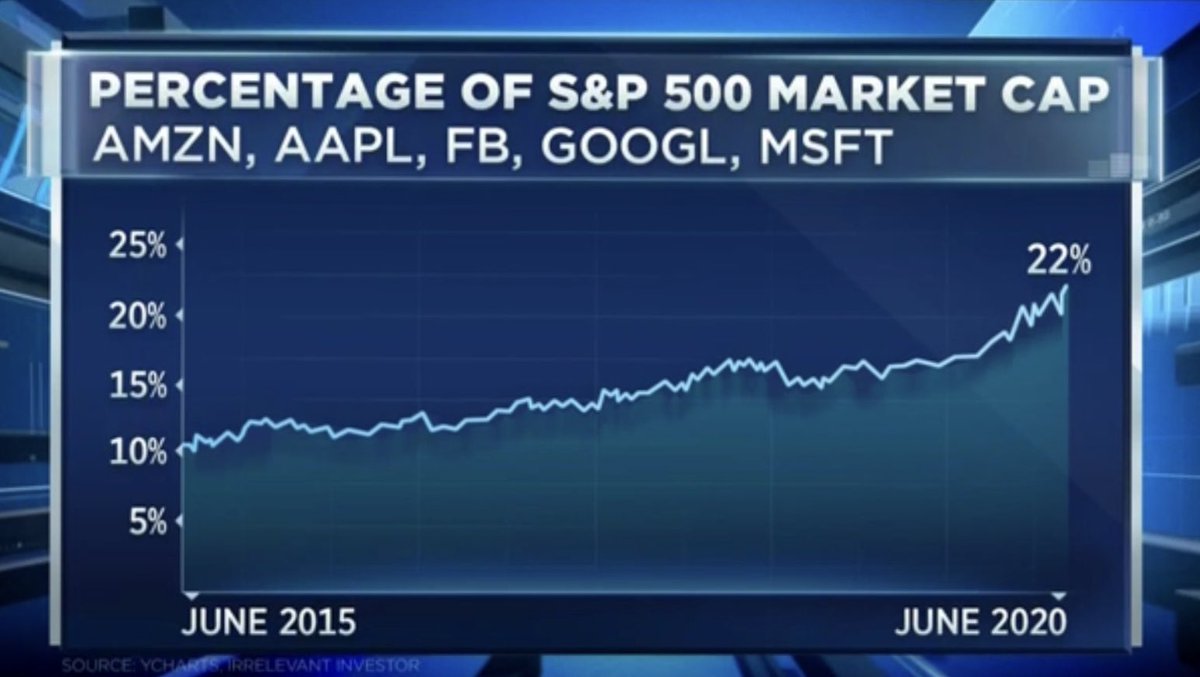
The tech giants are feeling a little pressure, with Microsoft down 0.8% and Apple losing 0.5%. They’ve been a major factor behind the recent rally, and make up a surprisingly large share of the overall market.
Francisco Olivera (@FrancoOlivera)
Amazon, Apple, Facebook, Alphabet & Microsoft as % of S&P 500 market cap H/T @CNBC pic.twitter.com/FU7HmdTWE3
June 23, 2020
SentimenTrader (@sentimentrader)
NASDAQ’s rally has pushed it *16% above its 200 dma*, while only 45% of NASDAQ members are above their 200 dma!
There is only 1 other time this happened (big NASDAQ rally on weak breadth):
In another sign of the crazy times we’re living in, Austria has been swamped with demand for a new 100-year old bond.
Bids for the €2bn bond totalled €17.7bn, Reuters says, meaning Austria will only have to pay 0.88% interest per year on the debt.
It highlights the demand for safe-haven assets, and the sheer amount of money sloshing around the system following the latest central bank interventions.
Mohamed A. El-Erian (@elerianm)
Good morning.
Starting today with another item to add to my list of once unlikely/unthinkable becoming reality:
A more than 10-times over-subscribed 100 year bond issued at less than 1%.
This is what happened this morning with #Austria’s ultra-long bond issuance.#markets pic.twitter.com/D9axSajQUP
June 24, 2020
Every sector of the Dow Jones industrial average is in the red in early trading.
Basic materials, energy, industrials and banks are the worst hit sectors.
Chemicals firm Dow Inc is down 2.8%, followed by aircraft maker Boeing (-2.6%),and oil giant Exxon (-2.2%).
An unprecedented economic and health crisis requires unprecedented government intervention – and here’s the result:
Gerard Lyons (@DrGerardLyons)
I thought this was an interesting chart from today’s #IMF latest economic projections: public debt reaching an all-time high, largely as a result of generous & one might say welcome fiscal measures across the globe, @IMFNews @netwealth @Policy_Exchange pic.twitter.com/rJTweyx18p
June 24, 2020
The jump in Covid-19 cases, and the threat of a new US-EU trade war (see here) are both weighing on the minds of investors today.
Christopher Smart, Chief Global Strategist at Barings, explains:
“U.S. markets that seemed impervious to the rising number of cases in Florida, Texas and Arizona, seem ready to pause now that governors of those states have issued fresh warnings to their citizens to wear masks. Public health officials testifying this week have also warned that much work remains to be done and the overall rise in U.S. cases stands in stark contrast to a much better record in Europe at keeping contagion under control. Still, as long as the base case remains that extensive lockdowns are behind us and vaccine options are on the horizon, risk assets will find buyers.
“Yet familiar worries around trade friction have also re-appeared. Not only does the US-China deal look tenuous as Beijing remains behind on its promised purchases and the election campaign heats up, but reports have emerged that Washington is considering broad new tariffs against European luxury amid longstanding concerns about aircraft subsidies. Clearly, there is still much about the post-COVID world that looks a lot like the pre-COVID world!”
The US stock market has followed Europe into the red at the start of trading.
The Dow Jones industrial average has lost 256 points, or almost 1%, to 25,899, as sentiment is dented by the jump in Covid-19 cases in several US states including Arkansas, California and Texas.
This hasn’t helped the mood in the City, either, where the FTSE 100 is currently down 125 points of 2% at 6195. On track for its worst day in nearly two weeks.
The IMF’s forecasts certainly don’t sound like a V-shaped recovery.
Indeed, the Fund is emphasising just how uncertain the future is:
A high degree of uncertainty surrounds this forecast, with both upside and downside risks to the outlook. On the upside, better news on vaccines and treatments, and additional policy support can lead to a quicker resumption of economic activity.
On the downside, further waves of infections can reverse increased mobility and spending, and rapidly tighten financial conditions, triggering debt distress.
Geopolitical and trade tensions could damage fragile global relationships at a time when trade is projected to collapse by around 12 percent.
IMF (@IMFNews)
The #COVID19 pandemic has had a more negative impact on activity in the first half of 2020 than anticipated. Global growth is now projected at –4.9% in 2020, 1.9 percentage points below our April 2020 #WEO. Read the latest report t.co/WpXSzg9YxApic.twitter.com/G7vvQXiGBn
June 24, 2020
Thanasis Koukakis (@nasoskook)
IMF’s Economic Counsellor @GitaGopinath did not respond whether global growth will have a V shape or a W shape and stressed that there is great uncertainty pic.twitter.com/Qzt69sRoMD
June 24, 2020
The IMF has now slashed its GDP forecast for 2020 twice in two months:
Newsflash: The International Monetary Fund has slashed its growth forecasts, after concluding that the coronavirus is having an even worse impact than previously thought.
In its new World Economic Outlook, the Fund predicts global output will shrink by 4.9% this year, worse than the 3.0% decline expected in April.
The Fund now expects US GDP to fall by 8.0%, with the eurozone and the UK both contracting by 10.2%. Those are (obviously) desperately deep slumps.
Disappointingly, the IMF has also cut its growth forecast for 2021. It now only expects world GDP to rise by 5.4%, down from 5.8% two months ago.
This will wipe a staggering $12tn (or £9.6tn) off global output over 2020 and 2021.
The Fund says:
There is a broad-based aggregate demand shock, compounding near-term supply disruptions due to lockdowns.
Here’s the full story:
More jobs news: Britain’s largest steelmaker, Tata Steel, could be close to agreeing a government loan to 8,000 jobs….
Ouch! The UK airport industry fears that 20,000 jobs are at risk across the country, as operators struggle to restart after the lockdown.
The Airport Operators Association (AOA), which represents more than 50 airports, said future passenger numbers at UK airports were expected to be significantly lower, and analysis of its members suggested up to 20,000 jobs were at risk.
Up to 110,000 jobs could be lost in industries supported by airports, AOA warned.
The UK government has now outlined how pubs, restaurants, hairdressers and hotels can reopen next month.
They’ll be encouraged to keep the noise down, to prevent customer having to shout or get too close. Bars and eateries should use table service where possible, with a single staff member serving a table, while hotels should clean particularly often and close communal rooms (so no more fighting over the TV remote).
Plus, customer details need to be kept for several weeks to aid the test-and-trace system. More here: