Gavin Williamson backs Ofqual; last-minute U-turn on BTec results – as it happened
We’re going to close this blog down now. Thanks for reading and commenting. Here’s a summary of the day’s events.
The education secretary finally backed Ofqual a day after declining to do so. Gavin Williamson bowed to pressure to back Sally Collier’s leadership of the beleaguered exams regulator for England after the exams fiasco.
The exam results algorithm was unlawful, the shadow attorney general claimed. Charlie Falconer, who was attorney general under Tony Blair and is now a Labour frontbencher in the Lords, argued that ministers and Ofqual would have been aware of at least three breaches of the law in the standardisation formula used.
About 15,000 pupils who were turned down by their first-choice university based on their algorithmic grades now meet the conditions of their offers. The figures from Ucas (the Universities and Colleges Admissions Service) show the scale of the problem now facing universities.
Schools and colleges were told not to issue BTEC results to students tomorrow. In a last-minute U-turn, the exam board Pearson asking them not to publish any results for the vocational qualifications so they could recalculate the final grades.
Support for Scottish independence has reached a record high of 55%, according to a poll. The results of the 2014 independence referendum were reversed, the polling company Panelbase found.
Sheffield University halted proposals to cut salaries and promotions for staff due to financial concerns related to coronavirus. That came after the institution found that more students planned to go there than expected, boosted by the government lifting its cap on intake numbers.
Aberdeen will stay under lockdown conditions after Scotland’s first minister, Nicola Sturgeon, defied calls to ease them. She said it was not yet safe to lift the restrictions that have been in place since the start of the month, despite the city council’s co-leaders calling for them to be lifted from Saturday.
A senior government adviser accused ministers of passing on the blame for failures during the pandemic. Jeremy Farrar, a member of Sage and director of the Wellcome Trust, called for the government to change tack and “listen, learn, reform & invest in a public health”.
Rail fares are set to rise again, despite the crisis caused by the pandemic. Fares will go up by another 1.6% in January, adding about £100 to the cost of many annual season tickets after an unexpected jump in inflation last month. Campaigners called on the government to abolish annual fare rises when passenger numbers have plummeted because of Covid-19.
An official Covid-19 survey is to be expanded to test 150,000 people per fortnight in England, the health secretary has claimed. Matt Hancock, whose promises on testing have gone unfulfilled in the past, said the Office for National Statistics survey that currently tests about 28,000 people in that period will also collect data from Wales, Scotland and Northern Ireland.
That’s it from me. If you’d like to continue following our coronavirus coverage, my colleague Lucy Campbell is running our global live blog:
For some young people to find out less than a day in advance that they will not be receiving their grades tomorrow is utterly disgraceful.
Gavin Williamson and the Department for Education should have had a grip of this situation days ago. It’s appalling that thousands of young people should face further confusion and uncertainty because of the government’s incompetence.
This repeated chaos is simply no way to run a country. The government must urgently set a clear deadline for every young person to receive their grades.
Approximately 15,000 A-level students who were originally rejected by their firm choice university will now meet the conditions of their offer, following the U-turn on grading, the body responsible for university admissions has said.
Ucas (the Universities and Colleges Admissions Service) said it had received the results from the four largest awarding bodies for the 160,000 students who received upgraded A-level grades in England.
Around 100,000 of those students were already placed at their first-choice university on results day last Thursday.
Of the remaining 60,000, around one in four (approximately 15,000) will now meet the A-level offer conditions of their original first-choice. Some 90% of these students made their original firm choice at a higher tariff institution. Clare Marchant, Ucas’ chief executive, said:
We have rapidly produced this initial analysis to provide the education sector with insight into the overall picture and to enable support to be directed quickly to the students that need it the most.
We are all focused on supporting the 15,000 students who now meet their conditions of entry and may want to make a different decision and take up a place at their original first-choice university.
Schools and colleges have been told not to issue BTEC results to students tomorrow following a last-minute U-turn on grading.
On Wednesday – with less than 24 hours to go until results day – exam board Pearson wrote to schools and colleges asking them not to publish any results for the vocational qualifications so they could recalculate the final grades. A spokeswoman for Pearson said:
Following Ofqual’s announcement that A-level and GCSE students are to receive centre-assessed grades, we will be applying the same principles for students receiving BTEC results this summer.
We will be regrading BTECs to address concerns about unfairness in relation to A-levels and GCSEs and ensure no BTEC student is disadvantaged.
We know this could cause additional uncertainty for students and we are sorry about this. Our priority is to ensure fair outcomes for BTEC students and we will work around the clock to provide revised grades as soon as we can.
Forcing Oldham into a tighter lockdown would not only “cripple” the local economy but fuel racial tensions, the council’s deputy leader has warned the government.
Officials from the Cabinet Office toured Oldham on Wednesday, led by local politicians and health experts desperate to avoid a “Leicester-style” lockdown.
Arooj Shah, Oldham’s deputy leader, told the Guardian racism was on the increase the district after it was singled out as an infection hotspot three weeks ago, with the Pakistani community particularly badly hit.
For those who have prejudices it is a really handy excuse. That’s why the step the government takes cannot be a blunt tool of lockdown for places like Oldham. Not only will it cripple our economy but the social impact will be absolutely huge and the blame will lie at the door of the government.
Residents of Birmingham must pull together to tackle an “extremely concerning” rise in Covid-19 cases, the leader of the city’s council has said.
Cllr Ian Ward said the rise in cases was “not currently on the scale seen elsewhere in the country”. But he added that people in the city, many of whom had stories of tragedy relating to their family and friends since the onset of Covid-19, had to remain focussed.
We’ve all made sacrifices over the past five months to tackle its devastating impact, and that is what was helping bring the issue under control here in Birmingham.
Most people are still doing the right things – the basics such as handwashing, wearing face coverings in the appropriate places and keeping two metres apart wherever possible.
We all need to keep doing this. I understand that lockdown fatigue has inevitably set in for some and that the easing of restrictions means it is easy to take your eye off the ball.
But we have to remain focused. If we are forced to go back to the dark days of spring, it will be because we haven’t collectively done our bit for the greater good of the city.
A further lockdown could set the city’s “already-fragile” economy back, causing further job uncertainty, the council leader warned.
A local lockdown could also mean some of those freedoms and liberties that we have begun to enjoy again are ripped from our grasp.
Going into the next stage of restrictions will also probably mean an end to households meeting indoors, severely restricting our ability to socialise as we would like to.
There is a risk this could all happen again if we don’t push back against the rise in Birmingham’s coronavirus cases.
Ultimately, there is a role for everyone here. Now is the time to step up and all do our bit for Birmingham, like never before.
The revelation that Ofqual, not the education secretary, took the decision to scrap plans to calculate exam results using an algorithm is evidence of thegovernment’s “stark incompetence”, the shadow universities minister Emma Hardy has said.
Parents and young people across the country who have been coping with the consequences of this government’s chaotic handling of results will be astonished that they cannot be clear about this. The government must build the trust of parents ahead of schools reopening, but this latest blunder will make that even harder.
The focus and priority for the secretary of state must be on students and not his own career.
The UK risks an exodus of talent from its creative sector, leading arts organisations and industry bodies have warned, as they call on the chancellor to extend financial support for freelancers until 2021.
Indoor live performances in England were given the green light from 15 August as part of the easing of Covid-19 restrictions. However, professional body the Incorporated Society of Musicians, and performing arts union Equity, fear venues will struggle to reopen because smaller audiences mean less profit from ticket sales.
They are asking for the Treasury’s self-employment income support scheme (SEISS), which in its second round will award individual grants of up to £6,570, to run until spring 2021 – far beyond its current cut-off date of 19 October.
The Brit School, UK Theatre, the Society of London Theatre, the Glyndebourne Tour Orchestra and the London Symphony Orchestra are among the high profile signatories to the letter sent to the chancellor, Rishi Sunak.
Dr Simon Hyde, the general secretary of the Headmasters’ and Headmistresses’ Conference (HMC), which represents 296 leading private schools, has called for a public inquiry into the “shambles” of the 2020 exams, which were cancelled because of the pandemic.
It is vital that lessons are learnt to avoid making the same mistakes next year. We are worried about the effect of this mess on students taking their A-levels and GCSEs in 2021; they must return to school knowing that there is a sensible and ethical system in place if their exams have to be cancelled.
In particular, we need to understand why important decisions were taken once exams were cancelled to try and use statistics to predict every individual student’s grade in every subject, and how much emphasis was put on fairness for every young person.
There are fundamental questions about the trust put in teachers and how their centre assessed grades were used.
Ofqual’s exam results algorithm was unlawful, the shadow attorney general has said, as Gavin Williamson finally gave his backing to the beleaguered regulator.
Jessica Elgot and Richard Adams write that the education secretary, who has previously pointed the finger at Ofqual over the exams fiasco, issued a statement earlier saying he had full confidence in the regulator. He admitted it had ultimately been Ofqual’s decision to make U-turn on results produced by its algorithm in favour of teacher-assessed grades.
Meanwhile, Charlie Falconer, who was attorney general under Tony Blair and is now a Labour frontbencher in the Lords, argued that ministers and Ofqual would have been aware of at least three breaches of the law in the standardisation formula used.
In a letter to Williamson and Ofqual’s chief regulator, Sally Collier, Lord Falconer said the saga “should never have come down to this, so late on, when Ofqual and the SoS [the secretary of state, Williamson] have been fully in the knowledge that the standardisation formula that was being used was unlawful”.
Falconer said Williamson’s claim to have only become aware of the issues around the algorithm at the weekend was extremely concerning, citing an education select committee report that had raised concerns in early June.
He said Williamson should now confirm when exactly the Department for Education was made aware of concerns about the algorithm and publish any legal advice it had received about the formula.
Falconer said the formula breached equality legislation and the 2009 act under which Ofqual was established.
Teenagers are being scapegoated, Scotland’s children’s commissioner has warned, amid growing concerns that house parties present significant infections risks to young people. Bruce Adamson has told the Guardian:
Young people have been really amazing at sticking to the rules, and made huge sacrifices both in their education and socially, but I’m now worried that there does seem to be scapegoating going on with some very mixed messages.
I worry that some statements from politicians seem to be apportioning blame or suggesting that young people are putting others at risk.
The warning comes as teachers and parents raise their own concerns about lack of consistency in distancing guidance for pupils in and out of schools, which returned full-time last week.
Following evidence that recent clusters in Glasgow and Lanarkshire were linked via a social gathering in a house where social distancing was not observed, Scotland’s national clinical director Jason Leitch warned on Monday that “unregulated” house parties were a “real concern”.
Sturgeon also went on to warn young people about the need to maintain social distancing whilst outside school, despite this no longer being required in the classroom.
Adamson said it was important to give “clear and consistent messaging”, noting confusion around wearing of face masks and physical distancing on public transport, shops and classrooms.
We have to be careful this doesn’t become accusatory and be aware of the impact on young people. Young people have said they feel the focus on house parties is unfair when it is often adults who are meeting up in that way.
Asked about these comments at her daily briefing, Sturgeon said:
I do fundamentally disagree with the idea that we are trying to scapegoat anybody. This is an infectious virus, it’s nobody’s fault.
But I’ve also got a responsibility to the nation to point out what we understand from the evidence are the higher risk areas for transmission. And we know that one of those is indoor social gatherings. Young people do like gathering together, it’s not blaming them for that to point out it is a risk.
Sturgeon said the “impact on young people has been immense and we need to try for their sakes to get as much normality as possible”. That, she said, is why she is so determined to keep schools open even if it means sacrifices from other parts of the community.
But I don’t do them any favours if I don’t point out where they are at greatest risk and try to minimise that, and explain the differences [for example in distancing at home and school].
The leaders of the four main churches on the island of Ireland today urged worshippers to wear face masks during religious services.
A joint statement by the Roman Catholic, Church of Ireland, Presbyterian Church of Ireland and the Methodist Church in Ireland said it has become “increasingly clear that the wearing of face coverings, in conjunction with hand-washing etc, is likely to reduce the spread of coronavirus, thus helping to protect others”.
Ireland’s top clerics said wearing masks in churches was “one way in which we can evidence protection for the most vulnerable, support for our health workers, and practical love for our neighbours”.
They said they understood that some people in both Northern Ireland and the Irish Republic were exempt from wearing face masks because of health reasons they hoped the majority of worshippers would do so. The church leaders added that they hoped that parishioners would start wearing face coverings from this Sunday 30 August.
The government said 41,397 people have died in the UK within 28 days of testing positive for Covid-19, as of 5pm on Tuesday; an increase of 16 on the day before.
Separate figures published by the UK’s statistics agencies show there have now been 57,000 deaths registered in the UK where Covid-19 was mentioned on the death certificate.
The government also said that as of 9am on Wednesday, there had been a further 812 lab-confirmed cases of coronavirus. Overall, 321,098 cases have been confirmed.
Sheffield University has halted proposals to cut salaries and promotions for staff due to financial concerns related to coronavirus after the institution found that more students planned to go there than expected, boosted by the government lifting its cap on intake numbers.
In an email to staff, the human resources department said that a recently-launched consultation on cost reductions would be closed. They said the pandemic had not “put students off going” and the government lifting the cap on how many people they could accept meant their intake could be higher.
They noted that other cost-saving measures had also helped, including voluntary redundancies resulting in “£12m in staff salary savings for 2020-21”.
The measures that were being proposed included pay freezes, pausing incremental pay progression, cancelling or deferring promotions and a reduction in pay.
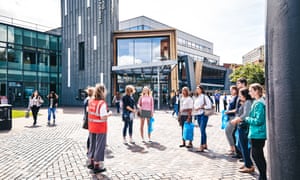
Sheffield University says the pandemic has not put students off going to university. Photograph: Lee Brown/The Guardian
A new Covid test centre is ready to start rapid testing of inbound passengers arriving at Heathrow airport’s terminal 2, as soon as the government gives it the go-ahead. Arrivals would find out results within 24 hours of being tested, replacing the need for a 14-day quarantine.
More than 13,000 passenger tests a day can be carried out in the facility, launched by aviation services firm Swissport and the Collinson Group, which runs airport lounges.
A second test centre will be ready at terminal 5 by the end of August, and operators say both centres are scalable according to demand.
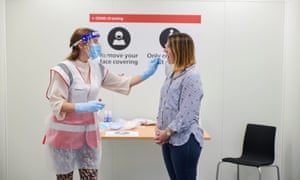
A handout photo issued by Heathrow airport of the new coronavirus testing facility inside its terminal 2 building. Photograph: LHR Airports Limited/PA
The proposed pilot scheme would use a two-test model, which has been used successfully in Iceland: this involves a first test taken at the facility on arrival in the UK, and a confirmatory test a few days later.
These are PCR swab tests, used to directly detect antigens, indicating the presence of the virus, rather than tests of the body’s immune response, or antibodies. The optional tests will cost £150 each, but this could be reduced if the scheme was scaled up.
A local lockdown would not be the “right solution” for Oldham in Greater Manchester – potentially making the situation “considerably worse” in other ways, its council leader has told a virtual press conference today.
As we reported today, ministers are expected to decide on Thursday whether to order the closure of the town’s bars, restaurants and gyms in the first local lockdown in England since hospitality businesses reopened last month.
Oldham’s mayor, Labour councillor Sean Fielding, said in a press conference a little earlier:
We’ve had communication from government that it’s something that is genuinely being considered.
It’s almost a frustration that the plans that we want to get on with delivering on, in order to bring the infection rate down in the way that we need to, we’re not running at full capacity with those because so much of our time has been spent having arguments with government and others about how we are opposed to local lockdown and we think that it’s the wrong thing.
So, it is very real. It is a very real threat for Oldham, make no mistake at all, but we are resisting it strongly for all of the reasons that I’ve set out today.
The town has the highest coronavirus infection rate in England despite restrictions on social visits imposed three weeks ago.
The Guardian’s northern editor, Helen Pidd, also picks up on comments from the Mayor of Greater Manchester, Andy Burnham
Helen Pidd (@helenpidd)
Andy Burnham says he will be writing to @MattHancock today to ask him to release Wigan from the enhanced restrictions but keep them in place in the other nine boroughs – banning gatherings in homes and gardens. But he opposes extra measures in Oldham.
August 19, 2020
Support for Scottish independence has reached a record high of 55%, according to a new poll.
Coming after previous polling had already suggested that the case for independence was being buoyed by perceptions that the Scottish government has been more competent than the UK government in Westminster, the latest research is based on the responses of 1,011 people across Scotland between 12 and 18 August.
The results of the 2014 independence referendum – when 55% of Scots voted to stay in the United Kingdom – were reversed, the polling company Panelbase found.
Pro-independence organisation Business for Scotland commissioned the poll, with chief executive Gordon MacIntyre-Kemp hailing the results as a “huge landmark” showing the “writing is very definitely on the wall for the union”.
The polling also comes at a time when the prime minister is attempting to enjoy a relaxing holiday in Scotland, as the Guardian’s Scotland editor, Severin Carrell, points out on twitter.
Severin Carrell (@severincarrell)
It’s almost as if all the UK’s polling companies knew @BorisJohnson was on holiday in Scotland this week #justacoincidence #indyref2 pic.twitter.com/K4WSCgMeZW