Hong Kong dragged deeper into recession by Covid-19 pandemic – business live
Norwegian Air’s future is looking more secure this morning after investors backed an emergency rescue package.
My colleague Julia Kollewe explains:
The embattled carrier Norwegian Air will push ahead with its rescue plan and unlock government aid after winning support from shareholders, bondholders and aircraft lessors for a 10bn kroner (£770m) debt-for-equity swap.
After a weekend of frantic talks, the airline’s shareholders gathered at an emergency meeting in Oslo on Monday morning and voted 95% in favour of all proposals, including a 400m kroner share issue.
The plan will hand majority ownership to the airline’s creditors – bondholders and lessors – and leave shareholders with 5.2% of the company but there was no alternative, Norwegian’s chief executive, Jacob Schram, said.
Hong Kong’s lurch deeper into recession hasn’t brightened the mood in the markets.
The main European indices are all sharply lower still, as investors worry about the escalating tensions between the US and China – and the threat of a new trade war.
European stock markets, May 04 2020 Photograph: Refinitiv
Britain’s FTSE 100 has recovered some ground, but that’s partly because the pound has dropped against the US dollar (down almost one cent to $1.242). That boosts multinationals.
The FTSE 250, which is more focused on the UK, is down 1.3%.
[Reminder: European markets missed out on Friday’s sell-off because they were closed for May Day].
The Tate & Lyle sugar factory, Silvertown, East London. Photograph: David Levene/The Guardian
Back in the UK, sugar and starch producer Tate & Lyle has reported that sales were affected by the Covid-19 lock down.
Sales of Tate & Lyle’s bulk sweeteners slumped by 26% in April, due to bars, cinemas, restaurants and sporting venues all shutting down.
Volumes of the rather-unappetising sounding “industrial starch” fell 9% — due to “reduced demand for paper and packaging following the closure of schools, offices and a general decline in economic activity”.
But sales of ‘food and beverage’ products to consumers jumped 18% as people stocked up on staples (such as golden syrup and granulated sugar).
Tate & Lyle says:
Earlier in the month, demand was strong for ingredients used in packaged and shelf-stable foods as consumers in North America and Europe filled their pantries for consumption at home.
ING analyst Iris Pang fears that Hong Kong’s recession will last longer than the Covid-19 pandemic.
She suspects that the pro-democracy protests that gripped Hong Kong last year — and badly damaged its tourism and retail sectors — will return as the lockdown measures are eased.
Last Friday, riot police clashed with demonstrators for the first time in several months – using pepper spray to disperse them from a shopping mall.
Pang writes that such scenes could become more common again this year:
Consumption contracted 10.3% YoY as opportunities for shopping and travel were severely curtailed during the Covid-19 outbreak. Investment contracted even more, by 13.9% YoY, as construction projects were delayed because outdoor work was prohibited.
Even though the government spent money and imports dropped in 1Q20, this has not stopped the economy from contracting for three quarters in a row.
Unlike other economies which may return to normal after Covid-19 subsides, Hong Kong has more challenges ahead. Pro-democracy protesters have returned to the streets and will affect shopping and catering businesses, as they did in the second half of 2019. It is expected that protests will become more violent and will increasingly hurt the retail sector. Unemployment has already gone up in retail and catering, and the protests mean that it will take longer for the unemployed to find another job in the same industry. This will lengthen the job search time and will therefore increase the unemployment rate.
ING Economics
(@ING_Economics)Protesters are returning to the streets of Hong Kong and trade tensions are heating up again, suggesting the recession will continue here after Covid-19 subsides, says @Iris_Pang_Chinat.co/BizPEl4uu1
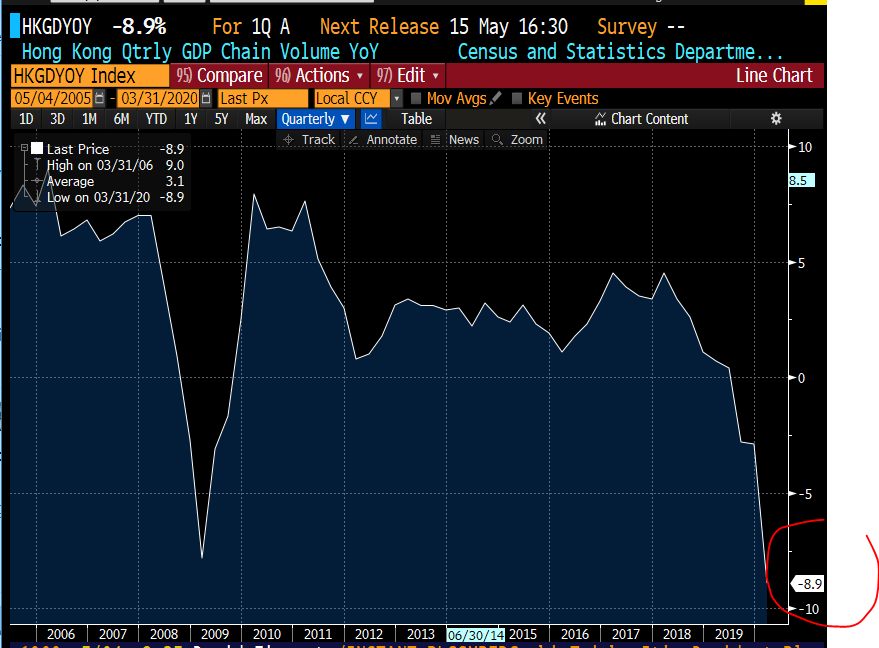
This chart shows that Hong Kong’s economy has shrunk faster than in the global financial crisis of 2008, or after the Asia financial crisis a decade earlier:
David Skilling
(@dskilling)Hong Kong has done very well in controlling Covid-19 (just 4 deaths), but there are economic costs. Q1 GDP down by 5.3% qoq, 8.9% in year to Q1, sharper than the Asian financial crisis, SARS, & the GFC. 4th consecutive quarter of GDP contraction. #smalleconomies pic.twitter.com/VFURqhXbEv
Here’s Bloomberg’s take on Hong Kong’s dire growth figures:
Hong Kong’s downturn is now the worst on record, extending the first recession seen in a decade as the coronavirus outbreak further battered an economy already weakened by political unrest.
The city’s economy contracted 8.9% in the first quarter from year-ago levels, according to advance government data. The decline surpasses the previous record of -8.3% in the third quarter of 1998 and a 7.8% contraction in the first quarter of 2009, the two worst quarterly readings in data back to 1974, according to the Census and Statistics Department Hong Kong.
The latest decline also marks the third straight quarterly contraction for Hong Kong, the longest such stretch since the aftermath of the global financial crisis in 2009.
Bloomberg
(@business)BREAKING: Hong Kong’s downturn is now its worst on record, with the economy shrinking 8.9% in the first quarter t.co/csA0fXhPhB pic.twitter.com/QatYfOB164
Hong Kong appears to have suffered its worst economic slump on record:
Ezra Cheung
(@ezracheungtoto)#BREAKING: Hong Kong sees the greatest decline in GDP on record since 1974 since the #coronavirus hits the city, with a decrease of 8.9% in the first quarter of 2020. Hong Kong govt forecasts that local exports will remain “under notable pressure” due to the pandemic.
Jerome Taylor
(@JeromeTaylor)Breaking: Hong Kong economy shrinks ‘record’ 8.9% in first quarter on-year: govt — @AFP
Newsflash: Hong Kong’s recession has deepened as the Covid-19 pandemic hits its economy.
Hong Kong’s GDP shrank by 5.3% in the first quarter of 2020, official figures show. That’s a very sharp contraction, extending its economic downturn.
On an annual basis, the City state’s economy is now 8.9% smaller than a year ago – due to coronavirus shutdowns, last year’s pro-democracy protests, and the US-China trade war (which may be flaring up again…)
Trinh Nguyen
(@Trinhnomics)The big dip 📉📉
Hong Kong GDP-8.9%YoY (don’t forget it was the only economy in contraction in 2019 in Asia) pic.twitter.com/wN9wqq4kzD
David Ingles
(@DavidInglesTV)Hong Kong registers record economic contraction in 1Q and the sixth quarterly contraction in the last eight quarters. Gaaaaaaaa pic.twitter.com/gyRTH0IB5j
David Ingles
(@DavidInglesTV)Hong Kong GDP… oh man.
In a statement, Hong Kong’s government said the pandemic had caused a “severe contraction” in global economy activity. It now fears the economy will shrink by 7% this year, and predicted that exports will remain under “notable pressure” in the near term.
Yolande Chee
(@YolandeChee)Hong Kong Q1 GDP much weaker than expected at -8.9% y/y. Third consecutive quarter of negative growth. Government revises 2020 forecast to -4% to -7%. Says local economic activity will remain subdued in the near term if the threat of pandemic continues.
France, Germany and the Netherland’s manufacturing sectors also slumped last month, according to Markit’s new survey of purchasing managers.
They confirm the message from the ‘flash’ PMIs two weeks ago – activity contracted in April even faster than after the financial crisis:
IHS Markit PMI™
(@IHSMarkitPMI)🇩🇪 Germany #PMI data for April emulates that seen for lockdown countries, with output levels collapsing at an even quicker rate than during financial crisis. Read more at t.co/cawrdpv5CL pic.twitter.com/DIPtpAWHWX
LiveSquawk
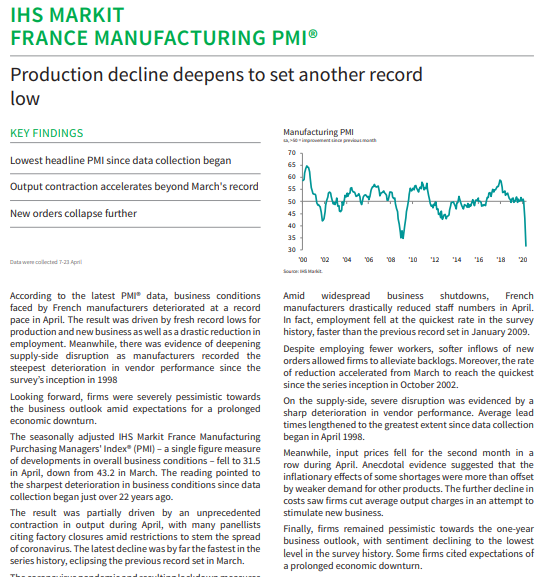
(@LiveSquawk)French Markit Manufacturing PMI – April Report #PMI t.co/ketE1MrGRQ pic.twitter.com/3C8CXFecO8
IHS Markit PMI™
(@IHSMarkitPMI)Dutch manufacturing output contracted at a survey record rate in April amid the #COVID-19 pandemic, with the PMI down to a near 11-year low of 41.3 in April (50.5 – March). New business also declined at the quickest pace on record. More here: t.co/hdm5PrnSU9 pic.twitter.com/yICez6lSfa
This has dragged the final Eurozone Manufacturing PMI down to 33.4, slightly worse than the flash reading of 33.6– showing an extremely steep contraction (a reading of 50 would show activity was flat).
Italy’s factory sector also had a torrid April:
Forex Desk
(@ForexDesk_org)Italy April manufacturing PMI 31.1 vs 30.0 expected t.co/IWNGT1GNMp | t.co/VOmsi4fwOp #forex #trading pic.twitter.com/6N0fpzmk1l
Ouch. Spain’s factory sector has suffered an ‘unprecedented’ slump last month.
Output, new orders and purchasing activity all fell at a record pace last month, according the latest Spanish manufacturing PMI survey.
Daniel Lacalle
(@dlacalle_IA)Spain Manufacturing PMI plummets in April.
Record contractions in output, new orders and
purchasing. Severe job cuts signalled as confidence sinks to series-low. pic.twitter.com/8H3UVP64YP
Companies badly affected by the Covid-19 pandemic are leading the fallers on the London stock market today.
Travel firms are having a bad morning, with Intercontinental Hotels are down 6.5%, cruise operator Carnival down 65% and budget airline easyJet down 5%.
Jet engine maker Rolls-Royce are down 6.6%. That reflects rising concerns over the airline industry, after billionaire investor Warren Buffett revealed he’s sold all his share in America’s four largest US airlines.
Top risers this morning include online grocer Ocado (+3.6%) and takeaway chain Just Eat (+2.1%), who are both in demand during the lockdown.
China’s Global Times, the state-controlled tabloid, has hit back at Washington’s claims in an editorial today.
It accuses US Secretary of State Mike Pompeo of “bluffing” and trying to “fool” the American public, by claiming that COVID-19 originated in a laboratory in Wuhan. More here.
European stock markets have opened in the red, as traders respond to the latest US criticism of China.
The Europe-wide Stoxx 600 index has dropped by 2.6%, with France’s CAC and Germany’s DAX both shedding 3%.
Investors are scrambling to sell stocks having been on holiday last Friday (when the threat of a new US-China trade war emerged).
In London, the FTSE 100 has dipped by 40 points, or 0.7%, to 5722. That’s an eight-day low, meaning last week’s brisk rally has been wiped out.
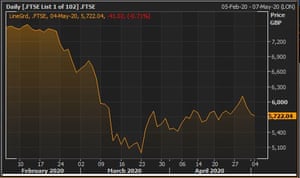
The FTSE 100 since the Covid-19 pandemic began Photograph: Refinitiv
The Covid-19 pandemic has had a devastating impact on factory output across Asia, new data shows.
Data firm Markit has reported that manufacturing activity in India, Taiwan and South Korea slumped alarmingly last month, as the world economy lurched into recession:
Uday Tharar
(@udaytharar)India’s Manufacturing PMI fell to 27.4 in April from 51.8 in March.
This is the sharpest contraction recorded since the survey began 15 years ago. pic.twitter.com/HOy2n31P9M
IHS Markit PMI™
(@IHSMarkitPMI)The #COVID-19 pandemic led to a substantial deterioration in the health of #Taiwan‘s manufacturing sector in April, according to #PMI data. Output and new orders both fell at the quickest rates since the global financial crisis. t.co/goIGOeDKy2 pic.twitter.com/Dv6N3ZWAmB
IHS Markit PMI™
(@IHSMarkitPMI)South #Korea‘s manufacturing downturn worsened at the start of the second quarter, according to the latest #PMI survey. Export demand plummets amid lockdowns in key foreign markets. More here: t.co/tOKDeXJrPh pic.twitter.com/fxNUwGbOTy
Worries about the global economy are weighing on the oil price this morning.
US crude has dropped by 6% to $18.60 per barrel, while Brent crude is 1% lower at $26.19.
The Trump administration is “turbocharging” an initiative to remove global industrial supply chains from China, according to Reuters this morning.
They cite “officials familiar with U.S. planning”, who say Washington wants US companies to move their supply chains away from China.
Here’s a flavour:
“We’ve been working on [reducing the reliance of our supply chains in China] over the last few years but we are now turbo-charging that initiative,” Keith Krach, undersecretary for Economic Growth, Energy and the Environment at the U.S. State Department told Reuters.
“I think it is essential to understand where the critical areas are and where critical bottlenecks exist,” Krach said, adding that the matter was key to U.S. security and one the government could announce new action on soon.
The threat of a new US-China trade war has knocked Asia-Pacific markets.
Hong Kong’s Hang Seng index slumped by almost 4%, after Donald Trump declared that new tariffs would be the ‘ultimate punishment’ for China.
South Korea’s Kospi 200 shed 3% and India’s Sensex is down 5% (mainland China and Japan are both closed).
AFP news agency
(@AFP)Asian markets suffer steep losses, tracking a selloff in New York after Donald Trump sparks fears of a renewed trade war with China over its role in the #coronavirus pandemic t.co/wnCaunCHpf pic.twitter.com/3Alq29WKEH
Jim Reid of Deutsche Bank says the Covid-19 ‘blame game’ is worrying the markets:
Given it’s a US election year this issue isn’t likely to go away, especially as Joe Biden has suggested that Mr Trump is weak on China. However, on Thursday night and Friday it became a more immediate topic as the Washington Post reported that the US had held preliminary discussions to punish China for its role in the virus outbreak that included the possibility of the US cancelling its debt obligations with China.
There was an immediate denial from Larry Kudlow who confirmed that the full faith and credit of US debt obligations is ‘sacrosanct’. Nevertheless, the risk of a cold war between the two nations seems to be building.
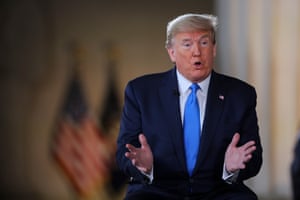
United States President Donald Trump holding a Virtual Town Hall on Fox News at the Lincoln Memorial Photograph: Oliver Contreras/EPA
Good morning, and welcome to our rolling coverage of the world economy, the financial markets, the eurozone and business.
Investors are jittery today after the White House intensified its criticism of China over the Covid-19 pandemic, fuelling fears of a new breakdown in relations between the two powers.
Overnight, Donald Trump repeated his claim that the virus emerged from the Wuhan Institute of Virology (something previously denied by China) and that Beijing couldn’t “put out the fire”.
He told Fox News:
“I think they made a horrible mistake and they didn’t want to admit it…
“My opinion is they made a mistake. They tried to cover it, they tried to put it out. It’s like a fire.
Trump also suggested that new tariffs on China could be the ‘ultimate punishment for Beijing, as a penalty for bungling the coronavirus outbreak.
RANsquawk
(@RANsquawk)– US President Trump said tariffs would be the ultimate punishment on China and warned that that if China doesn’t buy US goods, the US will end the trade deal
Hours earlier, US secretary of state, Mike Pompeo, said there was “enormous evidence” the coronavirus outbreak originated in the laboratory — without providing the proof to back up the claim.
China seems likely to be a key issue in the US presidential election – especially as the president can’t boast about the soaring stock market or the strongest economy in history.
Stephen Innes, chief global markets strategist at AxiCorp, writes:
The US media is pointing to the growing possibility that China will be the focal point of the 2020 election campaign. Polls conducted by President Trump’s campaign suggest that China will be an ongoing issue, according to Republican sources cited by Politico.
The Democrats are examining a harder line on China to boost their chances. Either way, China will be in the US spotlight and not in a pleasant way.
Fears of a new US-China trade war are overshadowing hopes that the global economy could tiptoe its way towards more normal conditions in the coming weeks.
Britain’s FTSE 100 is expected to drop by 40 points, or over 0.5%, adding to Thursday and Friday’s losses. There will be deeper sharper losses in continental Europe, where traders are playing catch-up after Friday’s May Day holidays.
David Buik
(@truemagic68)Though Beijing & Tokyo are closed today, investors realise “The world has an economic problem to face” plus Sino/US jingoistic rhetoric to consider- Suggested European opening calls – FTSE 100 -32 at 5723, DAX -115 at 10491, CAC 40 -36 at 4536, DJIA futures -175 at 23555
Most countries have continues to report a slowdown in new cases and deaths from Covid-19 – with the global death toll now standing at over 247,000. Italy is starting to lift its lockdown today, but there is public disappointment and anger that travel is still restricted and some shops aren’t allowed to open.
The agenda
- 9am BST: Eurozone manufacturing PMI for April: likely to confirm the worst downturn on record
- 9.30am BST: Hong Kong GDP for Q1 2020: likely to show another contraction
- 3pm BST: US factory orders: expected to fall around 10%
Read the original article at The Guardian