Hong Kong tensions end winning streak for global stock markets – business live
Global stock markets ended their winning streak as attention was turned back to rising tensions between the US and China over Hong Kong. It came after China approved plans for a new controversial security law that will tighten its grip on the semi-autonomous territory
Italy’s Q1 GDP was revised lower from -4.8% to -5.4%, compared to a year earlier. That was worse than economists expected
Twitter shares suffered amid a growing rift between the social media platform and the White House
The Spanish government approved a form of universal basic income that will guarantee up to €1,015 (£916) per household per month, in an attempt to help the country’s poorest
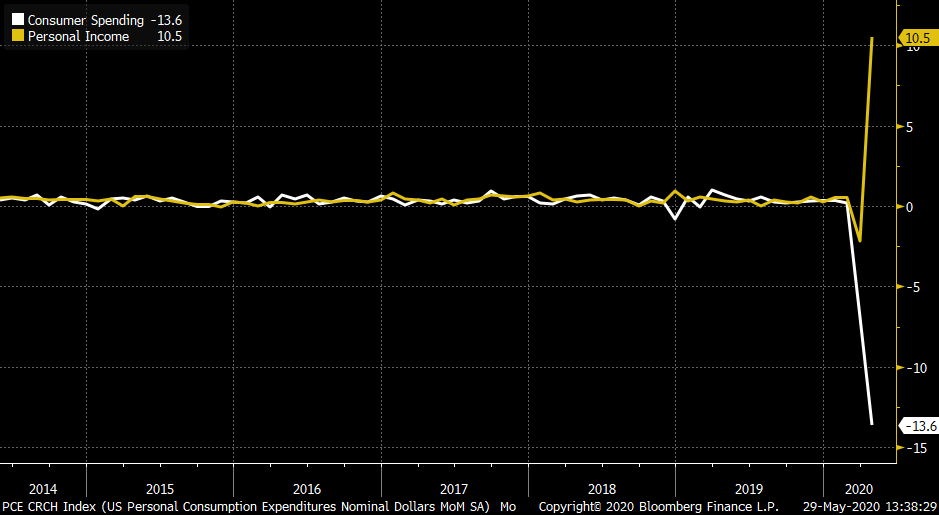
US data showed a sharp drop in spending and a record high rate of saving among consumers in April, as the coronavirus and resulting lockdown took hold
Oil output by OPEC members fell to its lowest level since 2002 in May, after members including Saudi Arabia embarked on a major supply cut meant to help offset a dramatic drop in demand during the Covid-19 outbreak
That’s all from us today. We’ll be back on Monday morning. In the meantime, stay safe -KM
Oil output by OPEC members fell to its lowest level since 2002 in May, after members including Saudi Arabia embarked on a major supply cut meant to help offset a dramatic drop in demand during the Covid-19 outbreak.
The oil cartel produced 24.77 million barrels per day this month, Reuters has reported. That marks a 5.91 million bpd decline compared to April.
However, that’s still higher than the original agreement, which was meant to see members slash supply by a record 9.7 million bpd by 1 May.
Oil prices have been trading lower this session, with Brent crude down more than 2% at around $34.58 per barrel.
There’s been no reprieve for equity investors today, with Wall Street extending global declines at the open:
S&P 500 is down -0.33%
Dow is down -0.54%
Nasdaq is down -0.1%
The focus on renewed trade tensions between the US and China feels strangely familiar, but it’s important to remember how the pandemic has put this in a completely different context.
Neil MacKinnon, Global Macro Strategist at VTB Capital explains:
From the perspective of the financial markets, these uncertainties manifest themselves at an awkward time, when the global economy is struggling to recover from the COVID-19 pandemic and the global recession is the worst this side of WW2.
China’s key role in the global economy is widely-documented, and during the last financial crisis it played an important role through its mega-fiscal policy stimulus back then in preventing a much deeper downturn in the global economy.
As a reflection of increasing US-China tensions, CNY has depreciated, with the USD moving closer to the 7.20 level. Normally, for equity market investors a lower CNY=lower equity markets.
Slippage in the CNY is seen as hurting the competitiveness of China’s Asian trading partners at a time when world trade is still in contraction. A depreciation in CNY also exports disinflation to the global economy at a time when a slump in global demand heightens disinflationary forces.
Equity market investors are alert to the negative effects on corporate pricing power and earnings at a time when US corporate profits have slumped.
Dataflash: US data has shown a sharp drop in spending and an increase in savings among consumers in April, as the coronavirus and resulting lockdown took hold.
Figures from the US Bureau of Economic Analysis show that personal spending last month fell by -13.6%, worse than consensus estimates for a -12.6% contraction and nearly double the -6.9% drop in March.
Meanwhile, the US personal saving rate reached 33% more than double the March rate of 12.7%. CNBC is reporting that is the highest rate since records began in the 1960s.
But worth noting that overall personal income increased, thanks in part to government assistance programmes that have helped bolster earnings for workers across the US during the lockdown.
The April estimate for personal income and outlays was impacted by the response to the spread of COVID-19, as federal economic recovery payments were distributed, and governments continued with “stay-at-home” orders.
Time to check in with stock markets.
With just over an hour until the US open, we’re still looking at a sea of red across European indices, with the FTSE 100 currently the worst performer.
The FTSE 100 has logged the largest drop among its European peers. Photograph: Tail1/Refinitiv
While pharma firms and supermarkets like Ocado and Morrisons make the top slots on London’s blue chip index, it is still being dragged down by travel and leisure. Cruise ship owner Carnival currently the worst performer after falling nearly 8%.
British Airways is proposing to outsource work being done by at least 450 employees it is making redundant, my colleague Jasper Jolly writes.
The Labour party said the proposals were “disturbing news” and called for the government to scrutinise the plans, revealed by the Guardian.
The airline, owned by International Airlines Group (IAG), is also considering closing its operation at Heathrow’s Terminal 3 completely and shrinking its footprint at Terminal 5, the Guardian understands.
Among the thousands of job cuts, the proposals include plans to make at least 450 workers at Heathrow redundant before outsourcing the work they did, according to a person with knowledge of the proposals.
BA has said job cuts are necessary because passenger numbers are expected to be significantly lower for as long as four years, meaning demand will be lower.
The Spanish government has approved a form of universal basic income that will guarantee up to €1,015 (£916) per household per month, in an attempt to help the country’s poorest.
The creation of a national minimum income, which has been trailed by the left-leaning government in recent days, has now been approved by cabinet under emergency measures.
Spain’s deputy prime minister has said the income scheme will grant each individual living alone €462 per month, with higher payouts per additional family members up to €1,015.
Those who earn less will receive a top up of earnings so that they get at least the minimum amount every month.
The programme aims to reach around 2.5 million people, and is expected to cost the state around €3bn per year
But while the scheme has been approved by the cabinet the FT explains (£) that Spain’s parliament now has four weeks to back the measure. If the policy fails to get parliamentary backing, it would mean withdrawing the benefits after funds have already started being distributed to households.
Currently, potential recipients receive around €310 a month on average.
Twitter shares are down 0.9% in pre-market trading amid a growing rift between the social media platform and the White House.
Donald Trump signed signed an executive order overnight that aims to remove Twitter’s protections against civil claims in cases where it acts as an “editor” rather than a publisher. (That came after the company applied a fact-checking label to the president’s tweets for the first time.)
Since then, Twitter has hidden one of Donald Trump’s tweets behind a warning that it “glorifies violence”, further escalating the row with the US president.
That tweet, posted on Thursday night Washington time, warned people in Minneapolis protesting against the killing of a black man, George Floyd, by a white police officer that he would send the military to intervene if there was “any difficulty”.
Now, it has emerged that Twitter chief executive Jack Dorsey was informed by staff in advance of the decision to tag the tweet as glorifying violence.
A Twitter spokeswoman told Reuters:
The decision was made jointly by teams within Twitter, and our CEO Jack Dorsey was informed of the plan before the Tweet was labelled.
All that glitters is…silver?
The drop across global stock markets has pushed up safe havens assets including gold which is now trading higher by 0.4% at $1,725 per ounce
But silver prices have also come into focus, as the lesser precious metal looks set for its largest monthly gain since June 2016 after rising nearly 0.3% to $17.47 per ounce.
Silver prices are rising. Photograph: Tail1/Refinitiv
Stephen Innes, chief global markets strategist at AxiCorp, says:
With gold struggling to make new highs, the market prefers silver, which has lagged gold considerably in this year’s rally, and positioning does not seem to be a factor. Even the typical fast money momentum traders are avoiding selling silver these days.
Naeem Aslam, chief market analyst at AvaTrade, says tensions between the US and China over Hong Kong are driving the drop in US futures. But aside from geopolitical tensions, carmakers and tech stocks will also take centre stage on Wall Street today.
Renault’s stock, a French car maker, is going to be the primary focus among investors. The company has announced to lay off 14,600 jobs worldwide, nearly 4,600 job losses in France, and reduce its production capacity by nearly a fifth. The strategy is designed to stop the cash bleed under the current circumstances. There is no denying that the automobile industry has been hit hard, and the bigger question is whether we will see a similar reaction from other carmakers such as BMW and Mercedes-Benz.
He warns that Twitter shares are likely to suffer “another dismal price action” during the Friday trading session.
The stock plunged over four percent yesterday after Twitter decided to fact check Trump’s tweets. Under the current law, social platform companies such as Twitter and Facebook are protected for their user’s posts.
However, Trump signed an executive order and called for a new law. Trump calls it freedom of speech, and this threatens the liability shield that companies like Twitter currently enjoy.
The new law is likely to be challenged in court, and the outcome of that will determine the future of freedom of speech and also for Twitter. But one thing is for certain, the stock is likely to remain highly volatile because it jumped over one percent in the U.S. after-market session yesterday.
Futures are pointing to a drop across major US indices at the start of trading today:
S&P 500 futures are down 0.5%
Dow Jones futures are down 0.6%
Nasdaq futures are down 0.5%
Eurozone inflation has tumbled to its lowest level since June 2016.
Flash estimates from Eurostat showing that the annual rate of inflation increased just 0.1% year-on-year in May, as a jump in food costs were offset by a sharp drop in fuel demand and energy prices.
Energy prices dragged down eurozone inflation in May. Photograph: Eurostat
The figure was in line with a Reuters poll of economists but lower than the 0.3% annual rise recorded for April.
On a month-on-month basis, eurozone consumer prices declined by 0.1% between April and May.
UK lenders have granted around 1.5 million payment holidays on credit cards and personal loans for customers impacted by the Covid-19 outbreak and lockdown.
877,800 credit card customers have been granted a freeze, representing around 1.7% of the total 51 million accounts run by its members
608,000 personal loan customers have been put on a payment holiday, which is around 6.8% of the 9 million accounts run by UK Finance members
It’s worth noting that interest is usually being charged during the payment holidays, even if principle payments are frozen.
Discount retailer B&M has fared relatively well during lockdown.
The company has reported exceptionally strong demand for DIY and gardening tools that helped push underlying UK sales up 22.7% over the last eight weeks.
Overall, UK like-for-like sales growth accelerated from 6.6% in the final quarter of its 2019-20 year, which benefited from a strong grocery performance in March, Reuters reports.
The company said customers were visiting its stores less frequently during the lockdown but their average spend had been much higher than usual.
The final reading of Italy’s Q1 economic growth has been revised lower from -4.8% to -5.4%, compared to a year earlier.
That is worse than economists had expected, having forecasted no change from preliminary estimates, according to a Reuters poll.
It’s the latest snapshot of the impact that coronavirus has had on Italy, which was the first country to be thrust into lockdown in Europe.
Also worth nothing that earlier this morning, France’s INSEE official statistics agency predicted that French gross GDP could fall by as much as 20% in the second quarter compared to the previous three months.
France – which is the eurozone’s second largest economy, contracted -5.3% in the first quarter, having been revised from -5.8% in its preliminary reading.
*Note: this post has been updated to reflect the revised French GDP for Q1 in the last par.