Inflation falls in UK, eurozone and Canada amid Covid-19 lockdowns as global trade tumbles – business live

My colleague Joanna Partridge has travelled to Bushey, near Watford, to meet some of the McDonalds customers keen to buy fast food again:
An hour after reopening for the first time in 8 weeks, a queue of cars containing customers hungry for Big Macs and Happy Meals has formed outside the McDonald’s drive-through in Bushey, east of Watford.
A McDonald’s employee in a high-vis jacket is marshalling the queue of vehicles as the line stretches beyond the restaurant’s waiting area onto the A41. Ruby Hibbitt, 18, and her housemate Paige Bush, 19, had been told by a friend that the restaurant was open and had got straight in the car to buy lunch.
They’d both been dreaming of a burger and diet coke, they said.


Fast food chain McDonald’s has taken another step towards normality by resuming drive-through services at nearly 40 restaurants in the UK and Ireland.
All the UK restaurants are in the South East of England – including in Luton, Peterborough, Chelmsford, Ipswich, Watford, Medway, Harrow and West Sutton. Six sites in Dublin are also reopening.
McDonalds says it expects high demand. It has introduced new safe working measures to prevent Covid-19 spreading, but warns that sites could close again if necessary to protect staff.
McDonald’s UK
(@McDonaldsUK)We are reopening 39 Drive Thru lanes across the UK and ROI. These Drive Thru pilot restaurants were all chosen as they are close to one of our distribution centres as we continue to prepare our supply chain for reopening. pic.twitter.com/HqvctFo63k
World trade volumes are likely to “fall precipitously” in the first half of 2020 as the Covid-19 pandemic batters the global economy.
That’s the latest warning from the World Trade Organisation, which says its goods barometer is now “flashing red” as trade volumes fall.
This index of trade volumes has slumped to 87.6, the lowest since it was launched in July 2016 – and some way below the 100 points baseline.
The WTO warns that there is “no sign of the trade decline bottoming out yet”.
Today’s figures are consistent with the WTO’s April forecast that world merchandise trade could decline by between 13% and 32% in 2020, depending on how long the pandemic lasts – and how effective governments are at combating it.

Shipments of new cars have fallen particularly dramatically, the WTO adds, although technology products are holding up better.
The automotive products index (79.7) was weakest of all, due to collapsing car production and sales in major economies. The sharp decline in the forward-looking export orders index (83.3) suggests that trade weakness will persist in the short-run.
Declines in the container shipping (88.5) and air freight (88.0) indices reflect weak demand for traded goods as well as supply-side constraints arising from efforts to suppress COVID-19. Only the indices for electronic components (94.0) and agricultural raw materials (95.7) show signs of stability, although they too remain below trend.
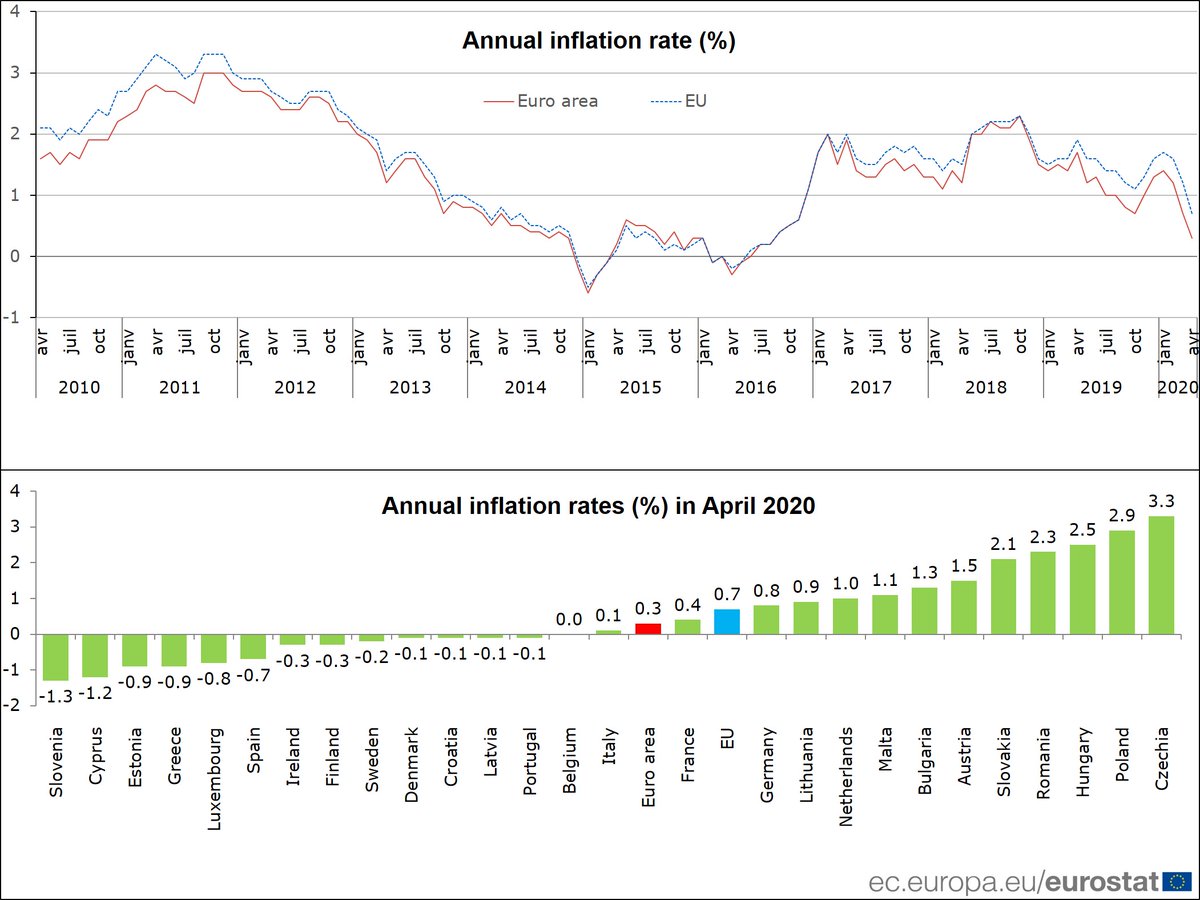
Newsflash: Inflation across the eurozone has slumped to its lowest level in almost four years – just like in the UK.
Consumer prices in the euro area only rose by 0.3% annually in April, Eurostat reports. That’s the lowest reading since August 2016, down from 0.7% in March.
It says:
In April 2020, a month marked by COVID-19 containment measures in all countries, the euro area annual inflation rate was 0.3%, down from 0.7% in March. A year earlier, the rate was 1.7%.
As in Britain, lower energy prices pulled CPI down – thanks to the glut of crude oil caused by the pandemic and the price war between Saudi Arabia and Russia.
But, eurostat also found that food, alcohol and tobacco prices rose last month:
In April, the highest contribution to the annual euro area inflation rate came from food, alcohol & tobacco (+0.67 percentage points, pp), followed by services (+0.52 pp), non-energy industrial goods (+0.09 pp) and energy (-0.97 pp).
EU_Eurostat
(@EU_Eurostat)Euro area annual #inflation down to 0.3% in April (0.7% in March) t.co/gPzBf1Ixg1 pic.twitter.com/onkUQjK5tu
Looking ahead… Tom Stevenson, investment director at Fidelity Personal Investing, warns that inflation could spike once the pandemic is over
He points out that the huge stimulus measures launched by central banks and governments could ultimately push up the cost of living:
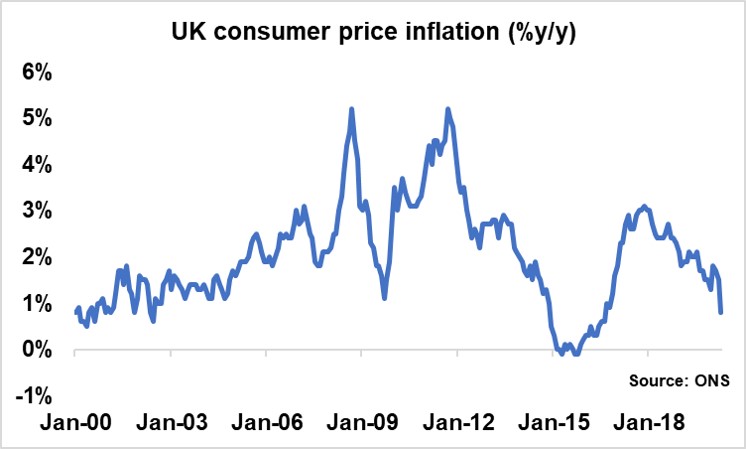
“The drop in inflation to its lowest level since 2016 reflects a fall in petrol costs as well as the impact of lower end demand on factory gate prices.
“In the short term, disinflationary pressures will mount as the economy slows under lockdown, consumers become more cautious and companies start to prepare for life beyond furlough support by reducing their workforces. Further out, there is a growing fear that monetary and fiscal policy choices could lead to higher inflation, perhaps significantly so.
“Investors have started to prepare for a more inflationary environment by adding to their holdings of gold, the traditional hedge against rising prices. The precious metal is trading close to a seven-year high.”
But in the short-term, the trend is clearly downward:
Rupert Seggins
(@Rupert_Seggins)Nice summary of today’s UK price inflation figure for April. t.co/zWFvqDUTV4 pic.twitter.com/YtcobFEPoe

High street chain Marks & Spencer has outlined how the lockdown will hurt its business – and it’s an alarming picture.
Under M&S’s Covid-19 scenario, the current government guidelines continue for a period of at least four months – resulting in a 70% drop in clothing and home sales in April-July, and a 20% drop in food sales (compared to previous forecasts).
M&S has already been hit by the pandemic, telling shareholders:
The Covid-19 crisis started to have an impact on the business in the first week of March with reductions in UK Clothing & Home sales which declined by 6.2% and 26.9% the week after.
With the onset of lockdown, the effect on sales, colleagues and customers in both businesses has been dramatic. Clothing sales at the low point dropped to 16% of their level a year ago
The firm also reported that costs and stock write downs for Covid-19 have cost £212.8m. This helped to push pre-tax profits down by a fifth in the last financial year, to £67.2m from £84.2m.
Retailers are expected to slash prices in the months ahead, to shift the huge stockpiles of unsold clothes which they’ve not been able to sell. That would continue the drop in clothing prices seen in April’s inflation report, keeping the cost of living lower.
Read the original article at The Guardian