Markets lifted by Covid-19 vaccine hopes and Fed’s stimulus pledge – business live
Here are the key points from Moderna’s announcement, of “Positive Interim Phase 1 Data for its mRNA Vaccine (mRNA-1273)” (which is online here).
After two doses all participants evaluated to date across the 25 µg and 100 µg dose cohorts seroconverted with binding antibody levels at or above levels seen in convalescent sera
mRNA-1273 elicited neutralizing antibody titer levels in all eight initial participants across the 25 µg and 100 µg dose cohorts, reaching or exceeding neutralizing antibody titers generally seen in convalescent sera
mRNA-1273 was generally safe and well tolerated
mRNA-1273 provided full protection against viral replication in the lungs in a mouse challenge model
Anticipated dose for Phase 3 study between 25 µg and 100 µg; expected to start in July
Important to remember that this is only an early stage trial, but clearly it’s raising hopes in the markets:
Moderna’s closely watched early-stage human trial for a coronavirus vaccine produced Covid-19 antibodies in all 45 participants, the biotech company announced Monday, sending the company’s shares surging as much as 30% in premarket trading.
Each participant received a 25 microgram, 100 mcg or 250 mcg dose, with 15 people in each dose group. Study participants received two doses of the potential vaccine via intramuscular injection in the upper arm approximately 28 days apart. Data on a second dose was not available for the 250 mcg group, the company said.
At day 43, or two weeks following the second dose, levels of binding antibodies in the 25 mcg group were at the levels generally seen in blood samples from people who recovered from the disease, the company said. Antibodies in the 100 mcg had antibodies that “significantly exceeded levels” in recovered patients.
Optimism that a vaccine to combat Covid-19 will soon be produced is also driving the markets higher today.
Boston-based biotech company Moderna has just reported positive results from the first human trial of its experimental Covid-19 vaccine
The vaccine candidate, known as mRNA-1273, produced Covid-19 antibodies in all 45 participants, including at low doses, at similar or higher levels to people who had actually contracted the virus.
Moderna says this is “positive interim clinical data”. It also reports that mRNA-1273 was “generally safe and well tolerated” by human triallists.
It also found that mRNA-1273 provided full protection against viral replication in the lungs in a mouse challenge model.
“These interim Phase 1 data, while early, demonstrate that vaccination with mRNA-1273 elicits an immune response of the magnitude caused by natural infection starting with a dose as low as 25 µg.
“When combined with the success in preventing viral replication in the lungs of a pre-clinical challenge model at a dose that elicited similar levels of neutralizing antibodies, these data substantiate our belief that mRNA-1273 has the potential to prevent COVID-19 disease and advance our ability to select a dose for pivotal trials.
Stéphane Bancel, Moderna’s chief executive, has told the Financial Times he was “thrilled”, and that he could not have expected better data.
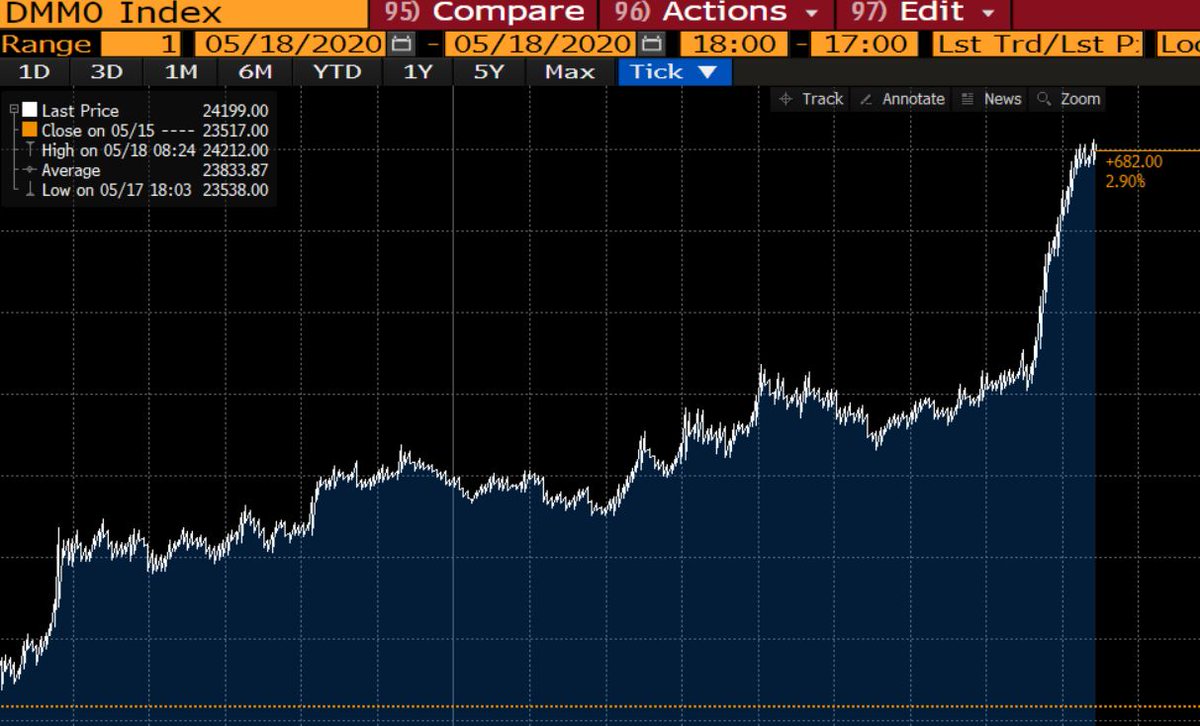
Investors are excited too. The FTSE 100 is now up 3%, or over 170 points, to 5971, while the Dow is up 560 points in pre-market trading.
Joe Weisenthal (@TheStalwart)
The CEO of Moderna — which is one of the companies racing to develop a COVID-19 vaccine — said that data from its Phase 1 trial could not have been any better t.co/vJe6YjWs2tpic.twitter.com/X2QSBKWR9W
The Dow Jones is now on track to jump back over 24,000 points when Wall Street opens in two hours, a gain of around 300 points.
That would be its highest level in nearly a week, helped by Jerome Powell’s pledge that the Fed can take more measures to help the US economy recover.
Some analysts are now wondering whether the Dow can climb back to its record highs of 29,568 hit in February, and beyond, as Marketwatch reports:
Paul Schatz, the president of Heritage Capital, said the Dow could hit 30,000 points by 2021 and 40,000 by 2023 as the U.S. economy recovers over the longer term.
“To bet against the U.S. economy and consumer over the long-term is a loser’s game,” Schatz said in a first quarter note to clients.
“I firmly believe we will see Dow 30,000 in 2021 with Dow 40,000 coming by 2023. Once we get over this massive hurdle, there will be too many things working in favor to derail that train when it gets going.”
The odds of Britain introducing negative interest rates to combat the coranavirus downturn seem to be rising.
Reuters has spotted that interest rate futures contracts from December 2020 have dropped into negative territory, a sign that more traders are betting that UK interest rates would fall below zero this year.
Bank rate is already at a record low, just 0.1%. In comparison, the eurozone’s headline rates is zero, with commercial banks being charged negative interest rates on their bank deposits at the ECB.
The Bank of England’s chief economist, Andy Haldane, has fuelled speculation of further cuts. In an interview with the Sunday Telegraph, Haldane suggested that pushing interest rates below zero and buying riskier assets couldn’t be ruled out.
As Haldane put it:
“The economy is weaker than a year ago and we are now at the effective lower bound, so in that sense it’s something we’ll need to look at – are looking at – with somewhat greater immediacy.
“How could we not be?”
Haldane also warned that Britain faces a return to unemployment levels seen in the 1980s recession, unless policymakers succeed in “reabsorbing” people into good jobs quickly.
Despite the latest tides of economic gloom, the mood in the markets remains solidly upbeat.
European markets are holding onto their earlier gains, with the Stoxx 600 up 2% today.
In London, the FTSE 100 is still pushing back towards the 6,000 mark – up 127 points at 5927. That means its recovered from last Thursday’s wobble, when anxiety about the global economy sparked a selloff.
Fawad Razaqzada of Think Markets says:
It has been a very optimistic start to the new week with stocks, crude oil, copper, gold and silver all pushing higher this morning with the dollar index being flat. Sentiment has been boosted as many European countries including Spain, Italy and the UK reported the lowest number of Covid-19 related deaths for two months at the weekend and as several countries ease lockdown restrictions.
Also providing a positive backdrop for risk is ongoing expectations for further policy stimulus, which explains why noninterest-bearish precious metals are rising along with stocks, as long-term government bond yields get depressed. These expectations were encouraged by comments from Federal Reserve Chair Jay Powell when he suggested that the central bank was ‘not out of ammunition’ and could do more if needed.
The Bundesbank. Photograph: imagebroker / Alamy/Alamy
Germany will plunge much deeper into recession this quarter as its Covid-19 lockdown continue to bite, the Bundesbank has warned.
In its latest monthly report, Germany’s central bank predicts a severe drop in GDP in the April-June quarter, even though some lockdown measures are easing.
It says:
“German economic output declined massively in the first quarter of 2020 due to the coronavirus pandemic and the measures taken to curb it,”
As the containment measures continued in April and there should still be substantial restrictions despite easing, experts expect economic output to be significantly lower in the second quarter.
The Bundesbank also points out that a wide swathe of Germany’s economy has been hurt.
Many consumer-related service sectors are affected, which severely restrict or even have to shut down their business activities. This included the hospitality industry, large parts of the stationary retail trade, travel service providers, other leisure and culture-related services and passenger transport.
The manufacturing sector is also affected by the restrictions in Germany. Declining demand from abroad and disruptions in the global supply and value chains also caused downward pressure here.
We learned on Friday that German’s economy shrank by 2.2% in the first quarter of 2020, its biggest drop since 2009.
UK property firm Intu has been forced to ask for a ‘standstill agreement’ from its lenders, after being badly hurt by the coronavirus crisis.
Intu told shareholders this morning that it will probably breach the commitments, or covenants, on its loans.
It is now seeking relief from financial covenant testing, debt amortisation and facility maturity payments, possibly until 31 December 2021.
The company, which owns Lakeside in Essex and the Trafford Centre in Manchester, has suffered a slump in rental payments as many tenants shut down during the lockdown. It was already suffering from problems on the high street – even before Covid-19 struck.
Intu explains:
Significant market uncertainty remains regarding the impact of Covid-19 on the operations of intu’s centres which, with the exception of essential stores, remain semi-closed until at least 1 June 2020. Additionally, at this time, the speed of recovery once the UK comes out of lockdown remains unclear.
The resulting impact on rental collections and valuations at the end of June is likely to result in breaches of covenants or material liquidity requirements if any such breaches are to be cured in accordance with the financing documents at that time.
Ryanair chief Michael O’Leary has also hit out at the UK government for mishandling the crisis, saying its plan to make overseas visitors quarantine themselves is “idiotic and unimplementable”.
Here’s the full story:
Budget airline Ryanair has stern words for rivals who have taken financial support from governments to keep afloat through the lockdown.
In its latest financial results, Ryanair predicts a price war from operators who have taken billions of euros in help.
It warns:
When Group airlines return to scheduled flying from July, the competitive landscape in Europe will be distorted by unprecedented quantums of State Aid (in breach of EU rules) under which over €30bn has been gifted to the Lufthansa Group, Air France-KLM, Alitalia, SAS and Norwegian among others.
We therefore expect that traffic on reduced flight schedules will be subject to significant price discounting, and below cost selling, from these flag carriers with huge State Aid war chests.
Shocking stuff. But keep reading the statement, and you see that Ryanair has tapped the UK’s Covid Corporate Financing Facility (CCFF), under which the government helps companies to keep borrowing:
Ryanair’s balance sheet is one of the strongest in the industry with a current cash balance of €4.1bn (Ryanair recently raised £600m under the UK’s CCFF) and 330 unencumbered B737s (77% of owned fleet).
Bloomberg TV (@BloombergTV)
Ryanair CEO Michael O’Leary says German and French bailouts distort the airline market. He made the comments after Europe’s biggest low-cost carrier boosted its liquidity with a 600 million-pound loan backed by the U.K. government t.co/64rs1adtVApic.twitter.com/BZM6BSA325
Ryanair has moxie. Airline reports profit of 1 billion Euros for year to the end of March, complains bitterly about “unprecedented quantums of State Aid” on offer to its rivals and then reveals it has raised £600 million using an emergency support scheme backed by UK government pic.twitter.com/SkrQX8nyWq
Crude oil storage tanks at the Cushing oil hub in Cushing, Oklahoma. Photograph: Dronebase Dronebase/Reuters
What a difference a month makes.
Four weeks ago, there was panic in the energy markets as the US oil price plunged below zero. With demand slumping, traders feared that a supply glut would overwhelm the system.
As the contract for oil delivery in May ticked towards maturity, US producers found they actually had to pay people to take the crude away.
At the time, some commentators predicted that June’s oil contract would also hit zero. But recent supply cuts seem to have helped, as have recent moves to ease lockdowns.
So a barrel of US oil for delivery next month is now worth $31, up from $15 at the end of last month.
Wall Street is expected to open higher today, helped by Jerome Powell’s latest commitment to take further action to protect America’s economy through the slump.
Several European countries have lifted their ban on short-selling shares, in another sign that the panic created by Covid-19 has eased.
France, Italy, Spain, Belgium, Austria and Greece are all scrapping restrictions that prevented traders from selling shares they didn’t own (hoping to buy them back cheaper).
These bans were introduced in March, in an attempt to stem the alarming plunge in across stock markets.
RANsquawk (@RANsquawk)
– France, Spain, Italy and Belgium have lifted short-selling bans as expected
– Austria’s ban will be lifted at midnight local time
French markets watchdog AMF says the markets are calmer now, although relatively edgy:
“Markets have partly reduced their losses, trading volumes and volatility have returned to levels that are still high compared to mid-February, however this reflects market participants’ uncertainties in the current context
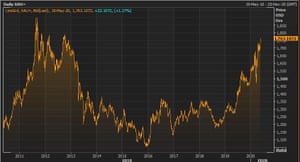
The gold price has hit its highest level since 2012, amid predictions that the coronavirus outbreak will drive inflation up.
Gold bullion is up 1.2% this morning at $1,760 per ounce for the first time since October 2012.
It’s now jumped by over 15% since the market crash in March, driven by concerns that the huge stimulus measures from governments and central banks will be inflationary.
The gold price over the last decade Photograph: Refinitiv
Gold has emerged as a clear winner from the economic turmoil created by the pandemic.
There has been more energy about gold bulls today and prices have driven up to above $1760, the highest since Oct 2012. The peak in that month of $1795 is the next target for bulls.
Some economists argue that the pandemic will actually be deflationary – as demand will crumble as unemployment rises and firms go bust.
But goldbugs point to the massive expansion in the money supply, arguing that precious metals are the best protection against an inflationary glut.
Chronos Caerus (@ChronosCaerus)
Gold prices spikes to levels last seen in 2012 on concerns over the weekend about;
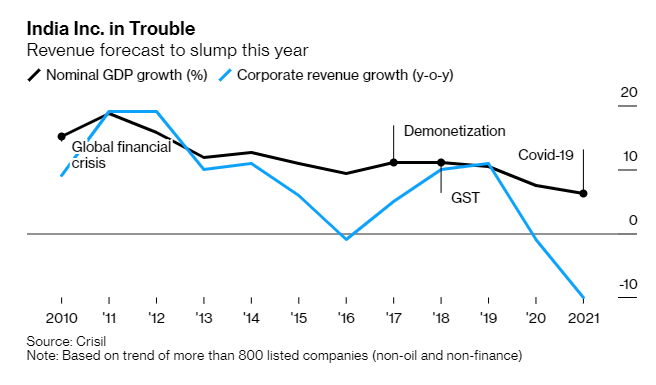
The Covid-19 crisis will drag India into an unprecedented recession, Goldman Sachs has warned.
Goldman’s economists reckon India’s GDP will shrink at an annualised rate of 45% in the current quarter. It had previously predicted a 20% tumble, but has revised its forecasts after India extended its tough lockdown until the end of May.
Growth is expected to rebound sharply in Q3 (by an annualised rate of 20%), but India’s economy is still expected to shrink by 5% during the year.
European markets are a tranquil sea of green this morning, with the main indices up around 2%.
That’s a solid recovery from last week’s dips, which sent stocks to a three-week low.
European stock markets in early trading Photograph: Refinitiv
Investors seem to be more hopeful about the global economic prospects, as governments try to lift lockdown restrictions.
But, the long-term damage of the crisis is unknown, as Barclays economist Christian Keller put it to clients (via Reuters):
“The economies of Europe and the U.S. likely bottomed out in April and are slowly starting to come back to life.
“However, incoming data from most economies highlight the depth of the contraction, raising risks of longer-term scarring that might undermine the recovery.”
The European Central Bank’s chief economist has warned that the eurozone economy might not recover from the Covid-19 slump until 2022.
Philip Lane told Spanish newspaper El Pais that the coronavirus is having a ‘terrible’ impact, and sounded notably cautious about the future, saying:
In March the pandemic and the measures to contain it had already led to a substantial contraction of activity. This situation got worse again in April, where we saw a deep fall in activity everywhere. Now the picture is changing: some countries are beginning to loosen their lockdowns. How this will develop in the future depends a lot on how quickly the restrictions on economic activity can be eased, but also on how we adapt to living with the virus.
The speed at which the economy bounces back will then hinge on whether consumers are more reluctant to consume and businesses hold back on investment. From today’s perspective, it looks in any case unlikely that economic activity will return to its pre-crisis level before 2021, if not later.
This crisis is truly unprecedented, which makes it harder to predict the precise shape the recovery will take. What we know for sure is that the steepest fall will be in the first half of the year, and these terrible economic conditions should recover little by little, week by week, month by month.
A wave of optimism has lifted Britain’s FTSE 100 by 128 points, or 2.2%, in early trading in London.
Travel companies are also being lifted, with British Airways parent company IAG (5%) and cruise operator Carnival (+5%).
Oil companies are also higher, lifted by rising crude prices — another sign that the markets are less pessimistic as some lockdown measures are lifted.
Jim Reid of Deutsche Bank says the success of these moves will be crucial:
It does feel like we’re in the middle of a phoney war at the moment with all of us waiting to see how efficiently the various economies are able to re-open given all the social distancing that will be required
Good morning, and welcome to our rolling coverage of the world economy, the financial markets, the eurozone and business.
The economic cost of the coronavirus continues to mount. Overnight, Japan has followed Germany, France and Italy into recession as its Covid-19 lockdown hit economic growth.
Japan’s GDP shrank by 0.9% in January-March, the second quarterly contraction in a row.
Tom Learmouth, Japan economist for Capital Economics, says:
“The sharp fall in output in the first quarter suggests the spread of the virus had already dealt a significant blow to economic activity in March.”
Economists predict a much sharper contraction this quarter, helping to drag the world economy into its worst slump in decades.
America’s top central banker, Federal Reserve chair Jerome Powell has voiced his own concerns. He predicted that the US economy could shrink by 20% or 30% during the pandemic, with the recovery taking until late 2021.
But crucially for investors – Powell also told CBS’s “60 Minutes” that the Fed was certainly “not out of ammunition by a long shot” – and could expand its lending programmes if needed.
Here’s the key part of the interview, with CBS’s Scott Pelley:
PELLEY: Has the Fed done all it can do?
POWELL: Well, there’s a lot more we can do. We’ve done what we can as we go. But I will say that we’re not out of ammunition by a long shot. No, there’s really no limit to what we can do with these lending programs that we have. So there’s a lot more we can do to support the economy, and we’re committed to doing everything we can as long as we need to.
PELLEY: What would the Fed’s next steps be, potentially?
POWELL: Well, to begin, the one thing we can certainly do is we can enlarge our existing lending programs. We can start new lending programs if need be. We can do that. There are things we can do in monetary policy. There are a number of dimensions where we can move to make policy even more accommodative. Through forward guidance, we can change our asset purchase strategy. There are just a lot of things that we can do.
That’s just the excuse investors need to look through the current economic gloom.
Stocks have jumped in Asia-Pacific markets overnight, with Japan’s Nikkei up 0.5% and Australia’s S&P/ASX gaining 1%. European markets are also heading for a strong morning – with the FTSE 100 jumping 2% at the start of trading.
Traders are also watching Italy closely, where shops, restaurants and hair salons are reopening. The Italian government says it’s taking a “calculated risk” to put the country back on its feet. It’s a key test of whether consumers will return to the shops…and whether a second wave of Covid-19 infections can be avoided.
The agenda
11am BST: Bundesbank publishes monthly report on German economy