Markets rally as US unemployment rate falls to 11.1% – as it happened
Finally, the London stock market has posted its highest closing level in a week, lifted by the US jobs report.
The FTSE 100 closed 82 points higher at 6240, a gain of 1.3%
Travel stocks and banks were among the big gainers, with airline group IAG rallying by 5.7%, and both Royal Bank of Scotland and HSBC up 4.5%.
Hotel operator Whitbread gained 4.2%, while Primark owner ABF rose 4.1% after it reported solid Primark sales since stores reopened.
David Madden of CMC Markets says strong US jobs report lifted the already bullish mood in the City.
Stocks were pushing higher this morning on the back of the news that Pfizer and BioNTech saw positive results from their drug trial that they are hoping will be a vaccine for Covid-19. The news encouraged traders to buy into the market, but the results have yet to be reviewed by a medical journal.
In June, the US added a record 4.8 million jobs, which smashed the 3 million consensus estimate. The May reading of 2.5 million was revised up to 2.69 million. The unemployment rate fell from 13.3% to 11.1%, while the consensus estimate was 12.3% Yearly average earnings dropped from 6.6% to 5% – this is probably because a large number of lower income workers re-entered the work force. The labour participation rate increased to 61.5% from 60.5%. The US labour market still has a long way to go but it is clearly heading in the right direction. The jobs data spurred on the buying of stocks as the recovery is on traders’ minds.
But as we covered earlier, the US labor market is still much weaker than a few months ago.
Shane Balkham, Chief Investment Officer at Beaufort Investment, says it’s too early to celebrate:
It it remains too difficult to call this trend with any real confidence as we continue to see-saw between lockdown tightening and lockdown loosening. Instead, it’s the revision to these numbers in the next set of data that will prove most revealing. The path to normalisation will be volatile until a vaccine is found, and in the meantime, investors will have to become accustomed to a tentative strategy of ‘two steps forwards, one step back.’”
Here’s our latest news story on the jump in US employment, and the fears that a new wave of Covid-10 infections.
We’ll be back in the morning….GW
Here’s our news story on Primark’s lost sales during the pandemic:
A former top UK civil servant has called for the government to consider a wealth tax, as part of its strategy for addressing the debt mountain built up under the pandemic.
Our economics correspondent Richard Partington has the details:
The UK government’s response to the coronavirus and the dramatic rise in public borrowing during the crisis should include a wealth tax on the richest in society, a former head of the civil service has said.
Sir Gus O’Donnell, who served as cabinet secretary under David Cameron, Gordon Brown and Tony Blair, said the Conservative government could prove it was serious about fighting inequality and levelling-up Britain by increasing taxes on wealth.
Describing the response to the coronavirus crisis as a “clear burning platform” for such a move, he said: “Covid has created a situation where we’re moving to a world where debt and deficit levels will be at levels we haven’t seen for decades.”..
More here:
Donald Trump’s economic adviser has told Bloomberg TV that any future stimulus programme probably won’t include more generous unemployment benefits.
Currently, Americans out of work get a $600-per-month payment, on top of the basic help, under the $2.2 trillion CARES Act. But, that provision ends at the end of July – and Larry Kudlow suggests that it won’t be extended.
He said “the moment has passed” for such help, adding:
“The shape of any kind of package is still up in the air,”
“Re-employment benefits probably will help fill the bill.
Democrats on Capital Hill have been pushing for this scheme to be extended in states with high unemployment. Some Republicans, though, argue for increased payments for people who find work (ie, re-employment benefits).
President Donald Trump has claimed that the $600 benefit risks giving Americans “a disincentive to work.” He told Fox News this week:
“You’d make more money if you don’t go to work.
Notably, the disparity between earnings for US black workers and their white colleagues has widened since the pandemic started.
The White unemployment rate fell by 2.3 percentage points in June to 10.1% from 12.4%, while the rate for Black Americans dropped by 1.4 points to 15.4% from 16.8%.
At 5.3 percentage points, the gap is now the widest since May 2015.
President Donald Trump just held a brief press conference, saying the US economy is ‘roaring back’ with its biggest jump in new jobs ever.
Trump hailed June’s jobs report as a sign that his administration is doing a grand job (despite the deeply worrying spike in Covid-19 cases).
He also cheered the recent recovery in the stock market, and even claimed that shares would fall to ‘nothing’ with the wrong president in charge.
David Charter (@DavidCharter)
President Trump on the economic comeback: ‘The only thing that can kill it is a bad president who wants to raise taxes…your stock market will go down to nothing…this is not luck, it is talent’
July 2, 2020
Trump says:
These are historic numbers at a time when a lot of people would have wilted. We didn’t wilt, and our country didn’t wilt, and I’m very honoured to be your president.
Alas, he didn’t take questions, although that’s rather the point of a press conference.
Daniel Dale (@ddale8)
Trump: “It’s all coming back. It’s coming back faster, bigger and better than we ever thought possible. These are the numbers. These are not numbers made up by me. These are numbers.”
July 2, 2020
Our US politics liveblog had all the details:
Boom! The New York stock exchange has opened higher, as investors welcome the jump in US employment last month.
Stocks are rallying, as Wall Street ignore the jump in Covid-19 cases that is forcing some Independence Day celebrations to be cancelled.
Here’s the early action:
Dow: up 366 points or 1.4% at 26,601
S&P 500: up 36 points or 1.1% at 3,152
Nasdaq: up 114 points or 1.1% at 10,269 – record high
Evangelos Assimakos, Investment Director at Rathbone Investment Management, says traders need to bear in mind the challenges ahead, and the risk of many more infections.
“The fall in the unemployment rate in the US to 11.1% reflects overall an improving, albeit slow, trend in the economy as lockdown continues to gradually lift.
However, with a jobless rate still over 10%, the US labour market faces a long road ahead to unravel the colossal damage wrought by the pandemic. Furthermore, these figures may be somewhat deceiving – in some states recovery has stalled because spikes in the virus have surfaced again causing a fresh wave of shutdowns and keeping layoffs elevated.
Ultimately, we find ourselves in a whipsaw market as the climate remains fragile and the world’s governments seek to balance protecting public health and helping their economies recover.”
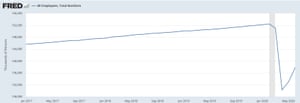
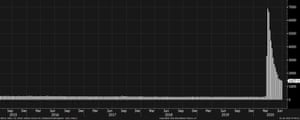
Here’s a reminder of the jobs devastation caused by Covid-19:
The US Non-Farm Payroll – the number of Americans in work Photograph: FRED
The weekly US Initial Claims – the number of people filing new claims for jobless support each week Photograph: Bloomberg
Jed Kolko of jobs site Indeed.com has spotted that underlying unemployment in the US has risen. That’s a sign of the permanent damage being caused by the virus (more details here).
Jed Kolko (@JedKolko)
Core unemployment jumped in June to 5.9% from 5.0% in May. It’s rising at an accelerating rate.
Core unemployment removes temporary layoffs and adds the marginally attached. pic.twitter.com/9JJy00qkgr
July 2, 2020
Jed Kolko (@JedKolko)
While the headline rate fell in June thanks to fewer temporary layoffs, the core unemployment rate is climbing.
Economists and investors agree that June’s US unemployment report is better than expected, showing that businesses returned to work as the Covid-19 lockdown was eased.
But they also warn that the worrying spikes in coronavirus cases since firms reopened could derail the recover. Here’s some reaction:
Richard Flynn, UK Managing Director at Charles Schwab:
“Today’s upbeat U.S. jobs report will build upon the market’s positive momentum from last month’s data. However, even if the number is trending lower, continued jobless claims over the past few weeks suggest that many job losses may become permanent as businesses struggle to reopen and unused resources and skills become outdated. It’s also possible that a labour market recovery may be further endangered by the latest spike in infection rates in various states.
A second wave of deaths could in turn lead to a second wave of decline for the economy, corporate earnings and the stock market.
Robert Alster, Head of Investment Services at wealth manager Close Brothers Asset Management
“US unemployment remains at historic high levels. But the data does appear to be improving, driven by the gradual reopening of the economy. However, the consequences of throwing open the shutters so eagerly are already being seen, with multiple states now battling a second wave of infections. As they beat a retreat to a more economically and socially restrictive framework, the reality of the situation is starting to bite even the most gung-ho of state Governors.
Josh Lipsky of the Atlantic Council:
“Today’s jobs report shows progress is being made, but American workers need a rescue plan. Otherwise, these gains can easily evaporate. Prolonged double-digit unemployment will leave scars on the US labor force that could take decades to heal. Congress can help by immediately eliminating the uncertainty millions of families are facing from the looming fiscal cliff at the end of this month.
“But an extension of the unemployment supplement and more aid to states won’t be enough. Without long-term thinking, the US will suffer rolling waves of recovery and recession.
“During the Spanish Flu, cities that reopened too soon suffered worse long-term economic consequences compared to those that stayed closed. Today, we are forgetting the lessons of history on a dangerous scale. Taken together, the combined GDP of California, Florida, and Texas make it the 3rd largest economy in the world. We may have to shut down the engine again as these states experience an explosive growth of COVID cases. The entire global economy relies on America getting this right.”