Outbreak at M&S sandwich supplier; trial of new contact-tracing app starts – as it happened
Thanks for joining us today, we’re now going to close our UK-focused live blog. You can visit our global blog with my colleague Jessica Murray for further updates.
A Covid-19 outbreak has been confirmed at a sandwich factory in Northampton which supplies Marks & Spencers after almost 300 people tested positive for the virus. The East Midlands town, where the site which employs more than 2,000 people is located, had already been identified as potentially facing a local lockdown (see 5.12pm). Earlier today, the World Health Organization downplayed the danger of coronavirus entering the food chain.
The number of people waiting longer than 18 weeks for routine hospital treatment in England was more than 1.85 million in June – the highest since records began in August 2007. NHS England said this was likely to be a consequence of the coronavirus outbreak, with A&E attendances at hospitals in England down 30% last month compared with a year ago. More than half a million patients in England had been waiting more than six weeks for a key diagnostic test in June 2020.
The Royal College of Surgeons of England’s president, Professor Neil Mortensen, said the new data on record NHS waiting times showed that coronavirus has effectively caused a “wrecking ball” to strike targets (4.07pm).
Boris Johnson said the government will be “absolutely ruthless” in deciding whether to impose a requirement on people arriving in the UK from France to quarantine for 14 days (see 4.19pm).
Public Health England did not issue any Covid-19 testing or case updates today due to technical difficulties.
Public Health England (@PHE_uk)
Owing to technical difficulties with data processing, the England and UK cases and tests data is not expected to be updated today.
The #COVID19 data dashboard is available here: t.co/XhspoyTG79
August 13, 2020
The UK is not at the beginning of a second coronavirus wave, and is still trying to end the first, data suggests (see 1.15pm).
A further 13 people who tested positive for coronavirus have died in hospital in England, bringing the total number of confirmed reported deaths in hospitals to 29,444, NHS England said.
In case you missed it, here are the statements from Greencore and Northamptonshire county council in relation to the Covid-19 outbreak at the sandwich factory.
A Greencore spokesperson said:
As a result of the rising number of Covid-19 cases in the Northampton area, we took the decision to start proactively testing all of the colleagues at our Northampton site. We can confirm that a significant number of colleagues have tested positive for the virus and are now self-isolating.
We are liaising closely with PHE East Midlands, Northamptonshire county council and Northampton borough council, who are fully supportive of the controls that we have on site. In each case we have immediately conducted contact tracing and instructed potentially affected colleagues to self-isolate.
All of Greencore’s sites have wide-ranging social-distancing measures, stringent hygiene procedures and regular temperature checking in place, and we are doing everything that we can to keep our people safe. As ever, the health and well-being of our colleagues is our number one priority.”
Lucy Wightman, Northamptonshire county council’s director of public health, said:
We are working with colleagues at Greencore in Northampton after the discovery of an outbreak of Covid-19 in the workplace. Public Health England Midlands have been providing support to colleagues at Greencore in managing the outbreak.
This has been supplemented by support from the local Infection Prevention and Control team and Northampton borough council’s environmental health colleagues. It is evident that Greencore has highly effective measures in place and they continue to work extremely hard to exceed the requirements needed to be Covid-19 secure within the workplace.
Northampton borough has been experiencing a high number of cases over the last four weeks and residents and employees have been asked to ‘act now’ to follow additional measures, to avoid a local lockdown or further government intervention.
Businesses and workplaces have worked alongside Northampton borough council and Public Health Northamptonshire to ensure they play a pivotal role in helping employees to understand the risks associated with car sharing, house sharing and sharing crowded areas during breaks or commuting to and from work. They have worked tirelessly in the main to ensure that they are compliant and that workplace procedures are adhered to at all times.
Individuals must now understand their role in acting responsibly outside of the work environment, to ensure that they protect themselves, their colleagues and those that they socially interact with, especially family and friends. The guidance in the workplace is just as important as outside of work.
If individuals do not take responsibility for following the guidance that we have issued, then further intervention and a possible local lockdown will follow. Everyone must be meticulous in following the guidance, especially in social environments where no markers or visual prompts tell you to stay apart, it must become part of our normal and we must all take our individual responsibility seriously.
No Covid-19 updates today due to technical difficulties, says Public Health England.
Public Health England (@PHE_uk)
Owing to technical difficulties with data processing, the England and UK cases and tests data is not expected to be updated today.
The #COVID19 data dashboard is available here: t.co/XhspoyTG79
August 13, 2020
Earlier today, the World Health Organization downplayed the danger of coronavirus entering the food chain by latching on to packaging.
The WHO head of emergencies programme, Dr Mike Ryan, told a briefing:
People should not fear food, food packaging or delivery of food. There is no evidence the food chain is participating in transmission of this virus.
A banana distribution centre in Coventry is also working with public health officials to contain a coronavirus outbreak, Sky News reported.
All staff at Fyffes Group Limited, at Cross Point Business Park, are to be tested as a precaution after 10 members of staff tested positive for the virus.
The management at the company are working with public health officials at Coventry city council, Public Health England Midlands and the Health and Safety Executive.
The sandwich factory in the East Midlands where almost 300 people have tested positive for coronavirus (see 3.21pm) supplies Marks & Spencer.
Northampton, where the site which employs more than 2,000 people is located, had already been identified as potentially facing a local lockdown.
The Financial Times reported in May that Dublin-based Greencore also supplies Co-op, Sainsbury’s and Tesco, along with cafes and other food outlets.
One of those to test positive was the Bakers’ Union’s branch secretary for the factory, Nicolae Macari. He said he tested positive on 4 August, along with his mother and father – who also work at Greencore – and his wife. He told the BBC:
When suddenly three or four people are pulled out of a line because they have tested positive, people are terrified.
The company spokeswoman told the BBC that Greencore had “highly effective measures in place and they continue to work extremely hard to exceed the requirements needed to be Covid-19 secure within the workplace”.
She suggested the outbreak was “about how people behave outside of Greencore, not at work”.
Production is said to be continuing as usual as the plant, with no apparent concerns about the products.
In 2014, Greencore sought to recruit hundreds of staff for the factory from Hungary due to what it described as “very low unemployment” in Northampton, meaning few local people had applied for the positions locally.
However, there was speculation that the lack of local interest was down to low pay and unattractive working conditions.
Earlier this year, it was announced Marks & Spencer had poached a new finance chief, Eoin Tonge, from Greencore. He was reportedly paid a joining fee worth up to £2.5m in shares after giving up his right to Greencore stocks.
Sandwich sales slumped as people began staying at home and not going into work in March as food-to-go shops closed, but sales have since begun to recover.
In May, Greencore revenues were about 40% lower than a year earlier after sales of fresh meals initially dropped 70% but later recovered to 40%.
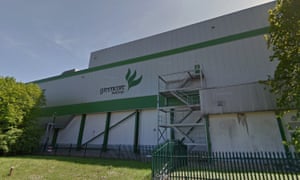
Google Maps screengrab of the Greencore sandwich factory in Northampton. Photograph: google maps
The number of people waiting longer than 18 weeks for routine hospital treatment in England was more than 1.85 million in June – the highest since records began in August 2007. NHS England said this was likely to be a consequence of the coronavirus outbreak, with A&E attendances at hospitals in England down 30% last month compared with a year ago. More than half a million patients in England had been waiting more than six weeks for a key diagnostic test in June 2020.
The Royal College of Surgeons of England’s president, Professor Neil Mortensen, said the new data on record NHS waiting times showed that coronavirus has effectively caused a “wrecking ball” to strike targets (4.07pm).
Boris Johnson said the government will be “absolutely ruthless” in deciding whether to impose a requirement on people arriving in the UK from France to quarantine for 14 days (see 4.19pm).
The UK is not at the beginning of a second coronavirus wave, and is still trying to end the first, data suggests (see 1.15pm).
A further 13 people who tested positive for coronavirus have died in hospital in England, bringing the total number of confirmed reported deaths in hospitals to 29,444, NHS England said.
An outbreak of Covid-19 has been confirmed at a sandwich factory in Northampton after 79 people returned positive NHS tests and a further 213 tested positive through the company’s private testing.
The competition watchdog has been forced to abandon some of the remedies it was considering to mend the funeral sector because the coronavirus pandemic allegedly made them unsafe to implement.
The Competition and Markets Authority (CMA) said it would require funeral directors and crematoria to be more upfront with their pricing, but could not take some of the more radical measures that it had considered, such as price caps.
Martin Coleman, who chaired the CMA’s inquiry panel, said:
Given the inherently distressing circumstances in which people arrange a funeral, we want to make sure they can be confident that they are not being overcharged and that their loved one is cared for properly – this is what our investigation has focused on.
The CMA said it struggled to obtain the right data from overstretched funeral directors and crematoria, and therefore could not forecast the impact of price controls on their businesses.
It said the pandemic had created “insurmountable obstacles”, but planned to consider if it needed to carry out another investigation when conditions were more stable. The industry has been waiting 17 months to hear the CMA’s findings.
Insurance company Royal London had been pushing for funeral help for low-income families, and for information on pricing to be available in hospitals and care homes. It said:
It’s disappointing that the CMA’s investigation hasn’t resulted in the change we had hoped but it is encouraging to see that funeral directors will have to be more upfront with the pricing and services they offer.
While there has been change in the market since it was put under scrutiny by the CMA, there is more work to be done, particularly for low-income families who fall into funeral poverty.”
The outcome was positive news for the owners of funeral provider Dignity, where shares jumped more than 60% on the news at one point, after they had been performing poorly.
The CMA also said people in the UK were typically being overcharged by at least £400 – and possibly a lot more – when they paid for a funeral. However, it recognised this figure was “likely to underestimate the customer detriment per funeral significantly”.
Boris Johnson has said the government will be “absolutely ruthless” in deciding whether to impose a requirement on people arriving in the UK from France to quarantine for 14 days.
His statement comes after the Guardian learned Netherlands and Malta were set to be removed from England’s travel corridor list but that ministers were still mulling over a decision on the UK’s nearest easterly neighbour.
The prime minister told reporters during a visit to Northern Ireland that officials would be looking at the latest coronavirus figures later today.
We have got to be absolutely ruthless about this, even with our closest and dearest friends and partners. I think everybody understands that.
We will be looking at the data a bit later on this afternoon – looking exactly where France and other countries are getting to. We can’t be remotely complacent about our own situation.
Everybody understands that in a pandemic you don’t allow our population to be reinfected or the disease to come back in.
That is why the quarantine measures are very important and we have to apply them in very strict way.
Boris Johnson, no longer shaking hands with people at hospitals, fist bumps a paramedic at the Northern Ireland Ambulance Service HQ during his visit to Belfast. Photograph: Brian Lawless/PA
The Royal College of Surgeons of England’s president, Professor Neil Mortensen, has said the new data on record NHS waiting times (see 10.34am) showed that the responses to coronavirus have effectively caused a “wrecking ball” to strike targets. He added:
By law 92% of patients are supposed to be seen within 18 weeks, but today’s figures show the worst ever performance on record, with only half of patients getting treatment within this legal timeframe.
In June most planned surgery was suspended while the country rallied to flatten the first peak of coronavirus, so these record waits are understandable. Nevertheless, each of these numbers represents another patient waiting in need, potentially in pain, for hospital treatment.
Long waits have a knock-on effect on patients’ families, their jobs and the wider economy. It is a real crisis.
The looming crisis facing cities in the wake of the Covid-19 pandemic has been underlined by new data which shows that the number of people on London’s West End shopping streets is still only a third of normal levels.
The figures came as the mayor of London, Sadiq Khan, warned that the capital faced an “existential threat” from the pandemic.
Eight weeks after all shops were allowed to reopen in England following a three-month lockdown, footfall in London’s West End remains 63% down on 2019 levels, according to the latest data from New West End Company, which represents 600 businesses across Oxford Street, Bond Street, Regent Street and Mayfair.
One in 10 Londoners are employed in the West End, and without a boost to consumer confidence, the capital’s premier shopping area is facing job losses of 50,000 and more than £5bn in annual sales, the NWEC warned.
Footfall had been rising slowly in the West End since the reopening of non-essential shops on 15 June, but has now plateaued. Research carried out on behalf of NWEC reveals that the majority of UK consumers are anxious about going on public transport.
The West End is also usually a prime destination for overseas tourists, but only a small fraction of the usual tourist numbers are in London this year.