Oxford vaccine results ‘major breakthrough’ in fight against Covid, says UK government – as it happened
That’s all from me for today.
Coverage continues on our global coronavirus live blog.

Cutout photos of fans in the stands for the Brighton & Hove Albion v Newcastle United match taking place behind closed doors today.
Photograph: Reuters
Speaking at a webinar organised by the Science Media Centre, Prof Adrian Hill, director of the Jenner Institute for Vaccine Research at Oxford University, said the early success of the Oxford vaccine was good news for other teams trying to develop a Covid-19 vaccine around the world. He said:
The good news is that these vaccines that are in development – 23 of them now – fall into groups. If our vaccine works it is much more likely that another adenoviral vaccine would work as well …
It is perhaps a little scientifically unlikely that one vaccine would be perfect and all the others would fail, so if one worked well, similar vaccines have a good chance of working.
He also said was very unlikely that any immunity to Covid-19 provided by the vaccine would only be short-term. He explained:
Making the assumption that if natural infection doesn’t give you immunity for very long, therefore a vaccine won’t give you immunity for very long – that doesn’t follow.
What matters is the type of vaccine technology you are using.
The other upbeat response is that there aren’t really vaccines out there that just last for a few months – by and large vaccines last for some years, or at least a year and then you might need a top-up. [Immunity] is not going to disappear very quickly.
At the webinar Prof Andrew Pollard, of the Oxford Vaccine Group, said it was impossible to say yet how many shots of the vaccine each age group would need to be given to gain and then maintain levels of coronavirus immunity. He said:
We have seen encouraging response with one dose.
But in the small subgroup that you see in the Lancet paper, there are better responses with two doses – that is not totally unexpected.
We know that human populations are completely naive to this virus and so you need quite a heavy lift in order to get a really good immune response from this vaccine, which is what we are trying to achieve with the two-dose schedule.
And Prof Sarah Gilbert, professor of vaccinology at Oxford University, told the webinar why scientists were trying to stimulate both antibodies and a T-cell response through a Covid-19 vaccine. She said:
Antibodies are in fluids in the body and they can encounter viruses when they first come into the body.
Antibodies can bind on to the outside of the virus to stop them infecting cells – so that’s what we mean by neutralising antibodies.
It sees the virus, attaches to it as soon as it comes into the body and stops it causing any infection.
T-cells can recognise which cells have the virus inside them and destroy them to prevent further spread of the virus in the body.
The two systems working together are completely complementary, first of all stopping infection coming in, and if [the virus] does get past the antibodies, [T-cells] destroy the cells that the virus has taken over.
Pascal Soriot, CEO of AstraZeneca, which is working with Oxford University on its coronavirus vaccine, has said the firm will start mass-producing it before it has been approved for use, so as to be sure that if it does get approved, it can be distributed quickly. He told reporters:
The only way to be ready to distribute the vaccine shortly after we get the results is to manufacture in parallel to doing the clinical development. So we’re basically starting the manufacturing process in parallel to running the clinical trials.
The question of when we’ll be able to distribute is a function of mostly, in fact, the infection rate in the community – therefore how quickly we can show efficacy. And then it will be in the hands of the regulators to review the data in their various geographies.
Our hope is that we can actually start delivering the vaccine before the end of the year, and how early before the end of the year depends really on infection rates in the community.
Labour’s Angela Eagle says people are less likely to cooperate with test and trace in poor areas than in rich areas. She asks Hancock to reconsider the case for improving sick pay for people asked to self-isolate.
Hancock says he will consider this. But he says the main reason for people not self-isolating is because people do not get a test in the first place. He wants to increase the uptake of testing, he says.
In the Commons Hancock tells MPs that he wants every person in the NHS to get a flu vaccine this winter, unless there is a very good reason why they should not have to have one.
My colleague Peter Walker points out that, in his lengthy reply to Jonathan Ashworth, Matt Hancock forgot to address Ashworth’s very first question. (See 4.52pm.)
Peter Walker
(@peterwalker99)In the Commons, Matt Hancock has answered every one of a long list of questions on coronavirus from Labour’s Jon Ashworth…. apart from why chief nurse Ruth May was dropped from a No 10 briefing for not being 100% onside with the Cummings mantra. Odd he should forget that.
July 20, 2020
Hancock say the long-term effects of coronavirus can be very debilitating for a minority of patients. Without naming them, he says at least one MP is in this category.
Hancock says the advice telling people to shield is being withdrawn at the end of this month because the level of incidence is so low as to make that safe. He says staying at home all the time can be bad for people’s health too.
Jeremy Hunt, the chair of the Commons health select committee, praises Hancock for his stamina over the last few months, and says that his decision to set the 100,000 tests per day target was a turning point.
He asks what can be done to get more people tested.
About 1,700 a day are being infected by the virus and about 400 a day are going into NHS test and trace, which is about a quarter, so as we think about how to prevent a second wave, could [Hancock] give the house some details as to how we’re going to bridge that gap so that we can hopefully go into our Christmas holiday with the same cautious optimism that we’re going into our summer one.
Hancock welcomes what Hunt said about the 100,000 tests per day target, and jokes about how pleased he was to hear the PM set 500,000 tests a day as a target in his speech on Friday.
He accepts there is a problem with asymptomatic people not getting tested, and he says he wants people with even mild symptoms to request a test.
The main cause of the gap is people who are asymptomatic and therefore don’t know that they’ve got the virus and don’t come forward for testing, so we’re going to ramp up our communications to people – if in doubt, if you think you might have the symptoms, to come forward and get a test and of course ramp up our asymptomatic testing of high-risk groups.
Hancock is replying to Ashworth.
He welcomes Ashworth’s offer to stand shoulder to shoulder with the government against the anti-vaccine movement.
He says the government implemented the Sage advice on lockdown. Labour supported the government at the time.
More data has been provided to local authorities, he says. The department was providing postcode data, now it will provide details of individuals who have tested positive provided data protection agreements have been signed.
Hancock says he has learnt that things work best when the private sector and the public sector work together. He claims that Ashworth is refusing to accept that because he has been playing to his political base (ie by criticising the private sector).
Jonathan Ashworth, the shadow health secretary, is responding to Matt Hancock.
He asks Hancock to confirm that the chief nursing officer was dropped from the No 10 press conference because she was minded to criticise Dominic Cummings.
This claim was revived at a Commons committee this afternoon. My colleague Rajeev Syal has the story.
Hancock says the preliminary results of the SNG001 trial are encouraging. (See 4.44pm.) But the data needs to be peer reviewed, he says.
He says the government will support a large-scale trial. But these preliminary results are positive.
Hancock is now speaking about the search for a vaccine.
He says the Oxford report published today is very encouraging.
The UK is putting more money into the global search for a vaccine than any other country, he says.
We’re working to ensure that whoever’s vaccine is approved first, the whole world can have access.
We reject narrow nationalism, we support a global effort because this virus respects no borders and we are all on the same side.
Matt Hancock, the health secretary, is making a statement to MPs about coronavirus.
Largely he has been summarising some of the announcements made by the prime minister on Friday.
I have already quoted one academic claiming that the results of the trial of interferon beta drug SNG001, that is said to have had remarkable success reducing the risk of people getting severely ill from coronavirus (see 11.04am), need to be treated with some caution. (See 12.13am.) The Science Media Centre has now contacted another four academics for comment, and three of them are also sceptical. You can read all the comments here.
This afternoon the updated Public Health England dashboard also records a further 11 UK coronavirus deaths, taking the total 45,312.
Confusingly, this is the figure that the Department of Health and Social Care is refusing to publish on its own website now after it emerged at the end of last week that the PHE total for England includes people who tested positive for coronavirus and who subsequently died – even if their death was not related to coronavirus.
It is unusual for one government body to reject statistics produced by another government body quite as bluntly as this, and the spat will be seen as fresh evidence that Public Health England’s days are numbered. There have already been plenty of reports saying ministers want to reorganise it after the crisis is over because of the way it is perceived to have mishandled issues like testing.
The headline death toll (45,312) is, of course, an understatement because it only includes people who tested positive for coronavirus. The true figure for all UK deaths attributed to coronavirus has passed 55,000.
Scotland, Wales and Northern Ireland have not recorded any coronavirus deaths today (see 2.24pm, 2.28pm and 2.30pm) and England has only recorded six (see 2.22pm.) Even allowing for the fact that recorded deaths are normally lower on a Monday than on other days of the week (because of the weekend, when people just as likely to die, but less likely to fill in paperwork), this is good news. The England figure seems to be the lowest since March.
But that does not mean the virus is being eliminated. According to the figures on the Public Health England dashboard, which has just had its daily update, the number of cases in the UK has been rising gradually this month.
Here is one graph.
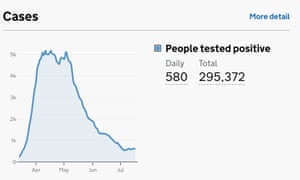
Coronavirus cases in UK Photograph: PHE
And here is a chart with more detail. According to this graph, the seven-day rolling average for the number of new cases per day was 628.3 on Friday last week. Two weeks ago, on Sunday 5 July, the seven-day average was 546.1.
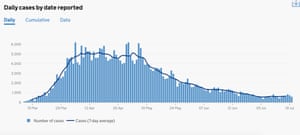
Coronavirus cases in UK Photograph: PHE
The UK is to immediately suspend its extradition treaty with Hong Kong and also bar the export of riot control equipment following Beijing’s imposition of a sweeping national security law on the territory, Dominic Raab has announced. My colleague Peter Walker has the full story here.
Read the original article at The Guardian