Stocks shrug off US unrest, China tensions amid easing of Covid-19 lockdowns – as it happened
Global oil prices climbed to three month highs on Tuesday ahead of talks between the Opec oil cartel and its allies over plans to extend an historic oil supply deal and shore up market prices, our energy correspondent Jillian Ambrose writes.
Oil ministers from the world’s most powerful oil producing countries will join a video call on Thursday to discuss plans to keep cutting 9.7 million barrels of oil a day through the summer.
The record oil production curbs were put in place from April to help steady the oversupplied market after the impact of the coronavirus lockdown slashed global oil demand to 25 year lows.
The original oil supply deal, the largest agreement ever struck between the group of oil giants, helped double the global oil price which fell to 21-year lows of about $16 a barrel last month.
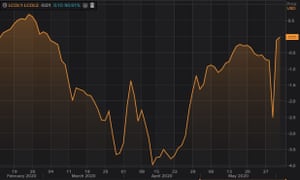
The price of Brent crude, the international oil price benchmark, rose by almost $1 to $39.29 a barrel on Tuesday while US oil, or the West Texas Intermediate (WTI) crude, climbed by 88 cents, to $36.32 a barrel.
Oil traders believe a deal to extend the production cuts has the support of most Opec and non-Opec countries, and is likely following Thursday’s virtual meeting.
Iraq’s acting oil minister Ali Abdul Ameer Allawi said on Twitter that the country plans to deepen its planned oil production cuts, and remains committed to the so-called Opec+ deal despite falling short of its quota last month.
French flight crew have accused Ryanair of blackmailing them into taking pay cuts or losing their jobs.
The Irish airline, which has warned it may cut up to 3,000 jobs in Europe, told staff in France it was imposing 20% salary cuts for flight crew and 10% for attendants. Those who are already on legal minimum wages will have their hours reduced.
Staff unions have accused the company of “redundancy blackmail” and acting like cowboys.
According to confidential documents seen by French media, Ryanair wrote to staff proposing wage cuts take effect from 1 July 2020. The lower wages would be progressively increased over the five years so flight crew would be paid their full current salaries by July 2025.
The loss of salary works out at an average 12% over five years for the pilots. Ryanair also proposed to pay new pilots and co-pilots the lower wages.
The Syndicat National des Pilots de Ligne said it had been given a maximum of five days to respond to the ultimatum. If not, it said the company warned it would have “no choice” but to lay off 29% of its pilots and 27% of co-pilots in France.
Bank of England governor Andrew Bailey is set to be interviewed within weeks as part of the investigation into the potential regulatory shortfalls linked to the demise of London Capital & Finance.

We already knew Bailey would be questioned, but this confirms the timeline.
In an update released by Dame Elizabeth Gloster, who is conducting the independent investigation, she confirmed that “senior employee interviews (including, for the avoidance of doubt, Mr Andrew Bailey)“ would “take place during the first half of June 2020.”
However, it was part of a wider notice that the report would not be completed until 30 September. It was originally expected within 12 months of Gloster’s appointment by the government, which would have been 10 July.
The beleaguered investment company collapsed in early 2019, owing money to thousands of customers who had bought controversial mini-bonds from LC&F.
The firm promised stellar returns to investors of up to 8% a year, but t little of the money went into safe interest-bearing investments, and was instead funnelled into speculative property developments, oil exploration in the Faroe Islands and even a helicopter bought for a company controlled by LC&F.
Some customers claim they were misled, including by the Financial Conduct Authority, over whether their investments were protected by the regulator. The City regulator’s enforcement team was also warned three years ago about the company but failed to act.
Time for a quick market update. European stock markets have all extended their gains after a positive start at the open.
Germany is leading the pack, up 3.9% at around 12,030 points. That pushes it to levels not seen since early March, when stock markets started to react to the pandemic’s migration to Europe.

Here’s how the rest of Europe is looking:

Heavily indebted shopping centre owner Intu Properties is forecasting it will receive over a third (37%) less rental income this year than last from the retailers which rent space in its centres, my colleague Joanna Partridge writes.
The owner of Manchester’s Trafford Centre and Lakeside in Essex thinks it will collect £310m in rent in 2020, compared with £492m in 2020.
Intu also predicts it will end 2020 with just £24m cash, having started with £82m, although this is also dependent on its lenders waiving some covenants.
Despite this forecast, the company’s shares rose by 93% at one point on Tuesday morning, to almost 11p, although they are still trading 90% lower than they did a year ago
P&O Cruises has scrapped all sailings until 15 October due to coronavirus, writing off the summer season, our transport correspondent Gwyn Topham writes.
The leading British cruise line, part of the Carnival group, had previously announced a pause in operations until the end of July, as the battered industry looks to find ways of operating in a post-pandemic world.
P&O said it was working with public health bodies in the UK and US to enhance health and safety protocols.
P&O Cruises president Paul Ludlow said:
As a business our operational focus is not “when can we resume sailing?” but is instead “how can we develop a comprehensive restart protocol that will keep everyone on board, our crew and guests, safe and well and still give our guests an amazing holiday?
The cruise line said it would give cancelled passengers a voucher worth 125% of the original booking, and “wanted to apologise once again to those guests who wait for refunds, particularly at a time of financial constraints”.
P&O is the first in the worldwide group to extend its operational “pause” into autumn, with most still suspended as far as mid- July.
All lines are searching for ways to ensure safe passage on ships and restore public confidence. Cruises were notorious for outbreaks of bugs such as norovirus, even before the current pandemic saw passengers isolated in cabins offshore.
Global factory production fell for the fourth straight month, but PMI data showed there was a softer contraction in output in May compared to a month earlier.
That reading came in at 42.4 in May, up from 39.6 in April.
The declines in output were widespread across the sector, with substantial drops across the consumer, intermediate and investment goods sub-industries, the report said.
IHS Markit PMI™
(@IHSMarkitPMI)Global manufacturing output fell for a fourth successive months in May, according to #PMI. While further easing of lockdown measures should help producers globally, weak demand hints that recoveries could be frustratingly subdued in months ahead. Read more t.co/lyagXQGQup pic.twitter.com/Xe2P1h1vI3
It’s worth noting that China was the only country to report any output in May, and even then production was low.
Still, most countries, aside from Japan and Australia, saw a smaller rate of decline over the month.

Read the original article at The Guardian