UK builders suffer worst slump on record amid Covid-19 lockdown – business live

Overnight, Airbnb has set out plans to make 1,900 staff redundant – around a quarter of its global workforce – as it forecast that its revenues in 2020 will be half the $4.8bn it earned in 2019.
Co-founder and chief executive Brian Chesky described coronavirus as “the most harrowing crisis of our lifetime” telling staff that
“We don’t know exactly when travel will return. When travel does return, it will look different.”
Airbnb has staff in 24 countries, with its headquarters in San Francisco and its European head office in Dublin, where it employs around 500 people. Some of the deepest cuts are likely to be in newer areas of the business such as Airbnb ‘Luxe’, which offers upmarket homes and dedicated trip designers.
Chesky explained:
“People will want options that are closer to home, safer, and more affordable,”
It said there are signs of a mild recovery in some locations, with evidence growing that travellers in Europe are booking properties in their own countries this summer rather than flying abroad to Spain or Italy.
It told the Financial Times that bookings by Danish users planning stays in their own country was at around 90% of April 2019 levels, while in the Netherlands domestic bookings were approaching 80% of last year.
Airbnb joins airlines and travel operators around the world axing staff as the global tourism industry is at a standstill. British Airways said it is cutting 12,000 staff while Virgin Atlantic said yesterday it will shed 3,000 jobs and mothball its Gatwick operations.
The collapse in Airbnb’s revenue has also thwarted plans by the company for a projected $40bn-plus stock market flotation this year, which would also have earned many of its staff large payouts, as early entrants into the company were partly remunerated with stock options.
Europe will experience a recession this year of a depth unmatched since the Great Depression and the UK will be one of the hardest hit, the European Commission has just warned.
Economic forecasts published by the Commission on Wednesday suggest that the UK will experience an 8.3% contraction by the end of the year, with investment down by 14% and a doubling of unemployment.
In terms of the drop in GDP – the total value of goods and services produced in a country in a year – only Italy, Greece, Spain and Croatia among the EU member states will endure a bigger shrinking of the economy.
The commission said that the coming recession will be of historic proportion. The EU economy is forecast to contract by 7.5% in 2020 and grow by around 6% in 2021. But countries will be impacted and find they are able to recover to greater and lesser degrees.
Valdis Dombrovskis, commissioner for the economy, said:
“At this stage, we can only tentatively map out the scale and gravity of the coronavirus shock to our economies.
“While the immediate fallout will be far more severe for the global economy than the financial crisis, the depth of the impact will depend on the evolution of the pandemic, our ability to safely restart economic activity and to rebound thereafter. “This is a symmetric shock: all EU countries are affected and all are expected to have a recession this year.”
The UK’s GDP is predicted to bounce back by 6% by the end of 2021, according to the commission’s predictions, although this presumes the continuation of the status quo between Britain and the EU in its trading relationship.
mehreenkhn
(@MehreenKhn)Eurozone heading for its worst GDP contraction on record at 7.75% this year according to @EU_Commission forecasts. In order of magnitude for 2020:
🇬🇷 -9.7%
🇮🇹 -9.5%
🇪🇸 -9.4%
🇫🇷 -8.2%
🇮🇪 -7.9%
🇱🇹 -7.9%
🇨🇾-7.4%
🇧🇪 -7.2%
🇱🇻 -7%
🇸🇮 -7%
🇪🇪 -6.9%
🇵🇹 -6.8%
🇳🇱 -6.8%
🇸🇰 -6.7%
🇩🇪 -6.5%
mehreenkhn
(@MehreenKhn)🇫🇮 -6.3%
🇲🇹 -5.8%
🇦🇹 -5.5%
🇱🇺 -5.4%Non-euro:
🇭🇷 -9.1%
🇬🇧 -8.3%
🇧🇬 -7.2%
🇭🇺 -7%
🇸🇪 -6.1%
🇷🇴 -6%
🇩🇰 -5.9%
🇵🇱 -4.3%
Despite this morning’s torrent of bad news, the UK stock market has nudged higher – with the blue-chip FTSE 100 and the smaller FTSE 250 index both up 0.5%.
That’ll please those investors who piled into shares last month, on hopes that the worst of the market slump is over.
My colleague Patrick Collinson explains:
Small investors poured into the stock market in April in the hope of picking up bargains, with record inflows into funds according to data provider Calastone.
A net £2.6bn was invested in equity funds in the UK in April, the highest monthly figure on record and six times more than a typical month, it said.
Most of the buying took place in the middle of the month as evidence began to emerge that the outbreak was beginning to slow down in some of the worst-hit European countries. By the end of the month, inflows slowed to a trickle, said Calastone.

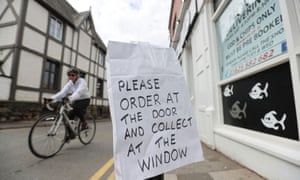
About 70% of the country’s 10,500 fish and chips shops have reopened as owners find new ways of doing business under lockdown.
Six weeks ago 80% closed their doors as they moved to protect staff and customers from the spread of coronavirus, according to the National Fish Fryers Federation.
But now chippies are using innovative ideas such as online or app-based ordering systems which give customers a time slot to pick up their freshly-fried dinners and help maintain physical distancing.
Virgin Money is delaying its company wide rebrand– which will involve snuffing out the Clydesdale and Yorkshire bank names – due to Covid-19.
But the bank’s chief executive insisted the project has not been derailed due bad press linked to Richard Branson’s poorly-received attempts to tap government rescue money to save his Virgin Atlantic airline.
David Duffy told journalists:
“Effectively we are continuing with the implementation of the our rebranding. We think it’s a great consumer brand and we’re delivering for our customers in a really customer-oriented way, which is in the DNA of that brand. So absolutely no changes to make in terms of that.
And all airlines I think are suffering from the same level of difficulty, so I’m not concerned about that.”
The bank currently pays around £11-12m per year in license fees to use the Virgin name. However, Virgin Money’s CFO Ian Smith said there were “various provisions on both sides for amending that as necessary.”
The comments came as Virgin Money reported a 97% fall in statutory pre-tax profit in the first half of the year, pushing it to a £7m loss compared to a £274m profit a year earlier. The slump was driven by loan loss provisions worth more than £230m, the bulk of which was linked to Covid-19.
Read the original article at The Guardian