UK car sales almost wiped out in April amid Covid-19 lockdown – business live
Back in the UK, fast food chain McDonalds is taking its first step towards reopening from the lockdown, by naming the 15 restaurants that will start offering deliveries next week.
They all appear to be in the South, with two in Chelmsford, while Luton-based burger and nugget lovers are spoiled with three stores.
McDonald’s UK
(@McDonaldsUK)We are pleased to confirm the 15 restaurants we will open for McDelivery only from 13th May. pic.twitter.com/WkGsAjg83M
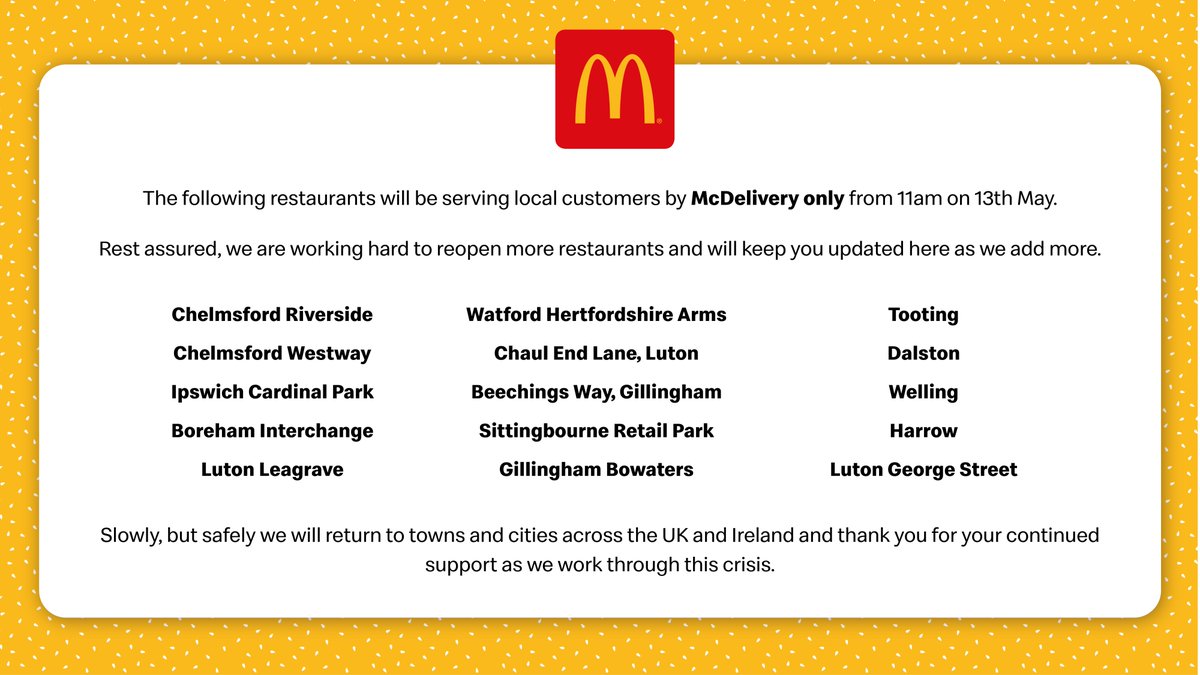
McDonald’s UK
(@McDonaldsUK)Following our operational test, we have reviewed our limited menu and will add the Vegetable Deluxe to the menu and Veggie Dippers to both our main menu and Happy Meal.
The euro is sliding after Germany’s constitutional court issued a long-awaited ruling on the legality of the European Central Bank’s massive asset-purchase programme.
The judges in Karlsruhe appear to have dropped quite a bombshell — instructing the Bundesbank that it must drop out of the Public Sector Purchase Programme unless the ECB proves, within three months, that the PSPP is needed.
The ECB has already bought billions of euros of government bonds under the programme, which was created by former president Mario Draghi during the debt crisis.
The court has considered a claim that PSPP was illegal as it amounted to the direct financing of eurozone governments. They concluded that the ECB needs to prove that the programme is justified, through “a proportionality assessment”.
“The Bundesbank may thus no longer participate in the implementation and execution of the ECB decisions at issue, unless the ECB Governing Council adopts a new decision that demonstrates…the PSPP are not disproportionate to the economic and fiscal policy effects.
Significantly, though, the ruling does not apply to the ECB’s new €750bn stimulus programme — the pandemic emergency purchasing programme (PEPP).
But it does still raise serious questions about the future of the ECB’s money-printing programmes, especially if the ECB doesn’t address these concerns.
The euro has dropped by three-quarters of a cent in response, to $1.0833, amid concerns that the PEPP could be challenged next.

David Madden of CMC Markets says:
The ruling means the Bundesbank- the German central bank – can’t participate in the ECB’s stimulus scheme beyond three months, unless the ECB can come up with a new arrangement.
Today’s news mean the ECB’s pandemic stimulus package could face legal challenges too.
Luis Garicano
(@lugaricano).@ECB has been weakened: the cover provided by Luxembourg Court is gone. ECB no longer has “broad discretion” to do “whatever it takes” with limited judicial review (see 73, Weiss). It now has to motivate its actions–to judges who show no knowledge of econ pic.twitter.com/YBHRy8JaBR
SEBASTIEN COCHARD
(@SebCochard_11)-End of Central Bank independence: German Government & Bundestag invited to inquiry ECB
-Risk of unwinding of 2019 policies (maintaining stable PSPP holdings & relaunch in November)
-Implicit strict limits put on PEPP: capital keys, 33%, no holding until maturity =No monetisation t.co/xKGDvKCWhm
Vitor Constâncio
(@VMRConstancio)This is the big risk. New court cases will come immediately in Germany against PEPP. The Court insists in the ridiculous distinction between monetary policy and economic policy and wants proportionality in its effects. Can a German economist explain what this means? t.co/2J5kdGX8Y6

Hugo Boss, the German fashion house known for its sharp suits, has warned that things will get worse before they get better.
It expects sales in the second quarter to fall by at least 50% following a 17% decline in the first quarter as it had to shut its stores because of the covid-19 pandemic, but hopes for a recovery from the summer.
All of its own stores and concessions have reopened in China since the end of March and sales in April were “only” 15%-20% lower than a year earlier. Hugo Boss has also been producing 200,000 reusable face masks to be donated to public institutions.
There is obviously less demand for smart suits when people aren’t going to the office … meanwhile, the Berlin-based meal kit delivery firm HelloFresh is thriving. It delivered 111.3m meal kits in the first three months of the year as the Covid-19 lockdowns boosted demand for its pre-portioned ingredients and easy-to-cook recipes.
HelloFresh now expects revenues to grow by 40% to 55% this year, rather than the previously estimated 22% to 27%.
Dominik Richter, the chief executive who co-founded the firm in 2011, says:
“On top of our already very strong first two months of the year, our meals have attracted significant additional demand in the second half of March, as the global pandemic hit all of our markets in short order.”
We also have confirmation that Britain’s economy suffered a painful slump last month, as the Covid-19 lockdown suppressed activity.
Data firm Markit has reported that its ‘composite PMI’ index, which tracks activity across the private sector, fell to just 13.8 last month from 36 in March.
Any reading below 50 shows a contraction, and this is the worst on record (going back to 1998) – by a long way!

The service sector was particularly grim, as Markit explains, with most firms reporting a drop in business activity — either due to business closures, shutdowns among clients or shrinking sales due to a slump in non-essential spending.
New work, backlogs and employment across the service economy also slumped at a record pace.
Neil Wilson
(@marketsneil)09:30:08
U.K. (APR) MARKIT COMPOSITE PMI ACTUAL: 13.8 VS 12.9 PREVIOUS; EST 12.9
09:30:03
UK MARKIT (APR) SERVICES PMI ACTUAL: 13.4 VS 12.3 PREVIOUS; EST 12.3
Tim Moore, economics director at IHS Markit, says the reports shows Britain is entering its worst recession in many decades.
“April’s PMI data highlights that the downturn in the UK economy during the second quarter of 2020 will be far deeper and more widespread than anything seen in living memory.
Historical comparisons of the PMI with GDP indicate that the April survey reading is consistent with the economy falling at a quarterly rate of approximately 7%, but we expect the actual decline in GDP could be even greater, in part because the PMI excludes the vast majority of the self-employed and the retail sector.
Just one-in-five service providers managed to avoid a drop in business activity since March, and those hardest hit by social distancing measures and travel restrictions often reported complete stoppages of business operations.”
Read the original article at The Guardian