UK car sales weakest since 1971; US service sector strengthens – as it happened
Time for a recap.
Stock market have posted fresh gains today, as a raft of mildly upbeat data cheered investors.
China’s stock market led the charge, jumping over 5% to a fresh five-year high. It was lifted by signs that factories and services companies returned to growth, and by growing speculation that Beijing could launch fresh stimulus measures.
This has fed through to Europe and the US too. Britain’s FTSE 100 is up 1.7% today at 6264, a gain of 107 points. America’s Nasdaq has hit yet another record high.
Housebuilders are among the top risers in London, after the latest Construction PMI report showed the sector expanded last month.
Barratt, one of Britain’s largest home-builders, reported that its order book was looking decent. Housebuilders were also boosted by reports that the UK government could launch a six-month stamp duty holiday to encourage house purchases.
The US economy has picked up too, according to the latest survey of American service sector companies. The ISM reported the best growth figures since Covid-19 hit the US, thanks to rising business activity and new orders.
Gregory Daco (@GregDaco)
The @ISM non-manufacturing index surged to 57.1 in June, from 45.4 in May.
Business Activity 66.0 (+25pt) New Orders 61.6 (+19.7pt) Employment 43.1 (+11.3pt) Supplier Deliveries 57 Backlogs 51.9
> Businesses surprised by speed of rebound, but cautious about phase 2 of recovery pic.twitter.com/xqOSkLQTcl
July 6, 2020
UK car sales also recovered last month, and were only a third lower than a year ago. But so far this year, auto registrations have halved, with many people embracing working-from-home rather than commuting.
That trend has hit sandwich firm Pret A Manger, who are closing 30 stores and cutting perhaps 1,000 staff.
Back in the UK, the number of female CEOs running our largest listed companies has risen back to, er, six.
Yes, six, out of 100 FTSE-100 firms.
That’s because Aviva have appointed a new boss, as my colleague Rupert Neate explains:
Insurance firm Aviva has appointed Amanda Blanc as its chief executive, replacing Maurice Tulloch, who has stepped down to support his family cope with a serious health crisis.
Blanc, who has held several senior positions in the insurance industry, indicated she would slim down Aviva’s portfolio of businesses to rebuild the company into “the leader in our industry again”.
Her appointment means there are six female chief executives heading FTSE 100 companies. The others are: Emma Walmsley at the pharmaceutical company GlakoSmithKline; Liv Garfield at the water company Severn Trent; Carolyn McCall at the broadcaster ITV; Alison Brittain at the hospitality company Whitbread; and Alison Rose at Royal Bank of Scotland.
Economists are hailing the pick-up in growth across America’s services company last month, following the April lockdown.
Dr Thomas Kevin Swift (@DrTKSwift)
The ISM reported that the NMI for non-manufacturing rose 11.7 points to 57.1, a gain well above expectations and follows two months of contraction. The gain was led by strong #business activity/#production, new #orders, #exports, and inventories. A good report for the #economy. pic.twitter.com/ZLexfkWoyL
July 6, 2020
Dan Zeiger (@ZeigerDan)
A chart-form look at the June Non-Manufacturing @ISM® Report On Business® (clockwise, from top left) NMI® and Business Activity, New Orders and Employment indexes indicates the degree and speed of the turnaround from April’s historic lows. t.co/S1bVseQoLa #ISMROB #economy pic.twitter.com/lCXshCpBab
July 6, 2020
However, there is a caveat. This pick-up in growth is absolutely consistent with the rise in Covid-19 cases in many US states recently. Unlocking the economy means more visit to shops and bars, and thus more chance to spread the virus.
Just in: Two economic surveys have both shown that America’s economy is recovering from the shock of the Covid-19 pandemic.
The Institute of Supply Management’s monthly healthcheck shows that US services companies returned to growth last month. Purchasing managers across the country reported that new business improved, helping to boost activity.
This lifted the ISM’s service sector PMI index up to 57.1 for June, up from May’s 45.4. That’s the best reading since the crisis began in February, and back over the 50-point mark showing whether the sector expanded or contracted.
That’s much stronger than expected, suggesting the service sector expanded robustly last month as shops, restaurants, bars and other consumer-focused companies reopened.
David Madden (@dmadden_CMC)
US ISM non-manufacturing (June): 57.1 vs 50.1 expected, prior 45.4
July 6, 2020
LiveSquawk (@LiveSquawk)
US ISM Non-Manufacturing PMI At Highest Since Feb 2020 – Non-Manufacturing Business Activity Index At Highest Since Feb 2011
July 6, 2020
Of course, this only means the economy improved month-on-month, from a pretty low ebb…..
Michael Brown (@MrMBrown)
The ISM non-mfg PMI being at its highest since February does not indicate output being back at the levels it was in February.
July 6, 2020
IHS Markit’s rival PMI survey has also just been released, and shows that the contraction in US business activity contraction slowed in June. Companies reported a rise in export business, helping new orders to expand for the first time this year.
Markit says:
The loosening of lockdown measures also led to the broad stabilization of new orders, while export sales rose for the first time so far in 2020. As a result, the rate of job shedding softened markedly as some firms highlighted the hiring of new employees to help fulfil new business inflows. Excess capacity also eased as backlogs fell only fractionally. Although business confidence was historically muted, it signalled renewed optimism as hopes of stronger demand drove sentiment higher.
This lifted its US services PMI to 47.9 for June, up from the rather grim 37.5 recorded in May. That suggests a small contraction, so slightly less upbeat than the ISM survey.
IHS Markit PMI™ (@IHSMarkitPMI)
🇺🇸 US Services #PMI up to 47.9 in June (37.5 – May) to signal a far slower fall in business activity at services companies as new work volumes eased their decline and business confidence strengthened. Read more: t.co/a1TTTNmdzVpic.twitter.com/4obKWnPptx
July 6, 2020
Boom! The tech-focused Nasdaq index has hit another record high, as the New York stock exchange opens for business.
Hopes of an economic upturn are boosting shares, following encouraging data from China, Europe and the US in recent days. That’s helping traders to look through the latest surge in Covid-19 cases, now rising by one million per week.
The surge in Chinese stocks overnight, which has lifted Europe, has now fed through to the US:
Dow Jones industrial average: up 363 points or 1.4% at 26,191
S&P 500: up 42 points or 1.36% at 3,172
Nasdaq: up 154 points or 1.5% at 10,361
MarketWatch (@MarketWatch)
Dow surges 370 points, Nasdaq touches a record intraday high as U.S. stock market follows China’s rally on Monday t.co/LkNpQEzP9C
July 6, 2020
Mixing accountancy with auditing has never seemed a very bright idea.
There’s an inevitable conflict of interest if you’re selling lucrative business consultancy services to a client, while your colleague is vigorously interrogating their annual accounts. Even if everyone scrupulously sticks to the rules, all the time, it still doesn’t look when things turn sour.
And today, the UK financial regulator has told the Big Four accountancy firms to fully separate their auditing divisions from the rest of their operations by June 2024. It’s part of a broader effort to overhaul the accounting profession following several corporate collapses.
Global stock markets are showing strong gains today, as signs of economic recovery let investors blot out the rising Covid-19 death toll.
European stocks are all sharply higher, with the FTSE 100 up 104 points or 1.7%.
Photograph: Refinitiv
That follows the surge in share prices in China, which jumped by 5.6% today to a new five-year high.
Joshua Mahony, senior market analyst at IG, explains:
“European markets have taken their lead from China, with the world’s second largest economy seeing a huge uptick in market speculation leading to a whopping 5.6% rise in the CSI 300.
“With China the first into this crisis, where their economy goes, many will hope to follow. Chinese experiences are no different to those elsewhere around the world, with easy monetary policies and government spending on the rise.
“Thus, despite the significant fears over how the virus will continue to hold back the global economic picture, investors will hope the worldwide stimulus efforts could bring a huge recovery in time.
“The role of stimulus is likely to remain integral to this recovery, with a slower than expected rebound in German factory orders highlighting that the economic recovery is unlikely to mimic the sharp market momentum seen in recent months.
Housebuilders are still leading the rally in London, thanks to Barratt Developments reporting a jump in orders this morning.
Rolls-Royce are also surging, up 7%, after reports that it could close its final salary pension scheme early to shore up its finances.
The jet engine maker has also confirmed rumours that it is “reviewing potential options” to strengthen its balance sheet, having seen revenues slump this year. Those rumours knocked its shares by 10% on Friday, making it a turbulent time for investors.
As well as closing stores, Pret a Manger is also planning to shake up its operations in an attempt to plug its falling sales.
My colleague Rebecca Smithers explains:
In recent weeks, Pret has launched a retail coffee offering with Amazon, broadened its delivery and digital footprint in partnership with Deliveroo, Just Eat and Uber Eats, and launched click and collect trials in five shops in London. Sales from these channels have grown 480% year on year and represent more than 8% of total UK sales.
Pret will launch further innovations over the coming weeks, including an evening delivery menu to be trialled from seven shops and a new hub kitchen in north London.
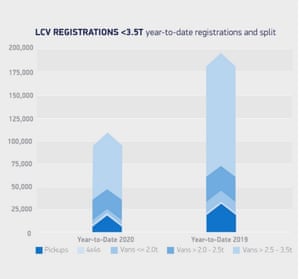
Demand for vans remained weak in June, despite the pick-up in the construction sector.
Sales of UK new light commercial vehicle (LCV) market declined -24.8% year-on-year in June, as lockdown measures eased and businesses began to return to work, according to the latest figures released today by the Society of Motor Manufacturers and Traders.
That’s an improvement on May, when registrations tumbled by -74.1%. But it means that total va sales in 2020 are down 44% compared to 2019, with just 108,876 new vans joining the roads.
That’s 87,500 less than a year ago, broadly matching the slump in car sales (see earlier).
This drop in new vehicles sounds like good news for the environment (although it could mean that some older, more polluting vans are still trundling around).
UK van sales in 2020 Photograph: SMMT
A Pret a Manger in New Cavendish Street, London Photograph: Hannah McKay/Reuters
UK sandwich chain Pret a Manger has announced plans to shut 30 stores, and to cut jobs across the business, after suffering a slump in sales.
Pret reported that takings are down 74% year-on-year, after being extremely badly hit by the pandemic. Understandably, Pret’s stores in city centres and transport links across the UK have been particularly hurt by the lockdown.
Many office workers who would normally nip to Pret for a lunchtime BLT or a crayfish and avocado salad, or grab a coffee and croissant at the railway station or underground, are now fending for themselves at home.
The FT reports that more than 1,000 jobs cut be at risk:
Pano Christou, Pret’s chief executive, said on Monday that the chain faced a “significant restructuring of the business” and that job losses “could be 1,000 plus” unless it reached sales of 50 per cent to 60 per cent of pre-coronavirus levels by September.
Sales are roughly 25 per cent of normal levels and the company is burning through more than £20m in cash a month. Pret has been acutely affected by the coronavirus crisis as its business model — to cater convenient food to commuters and office workers — has come under siege from the mass change in working patterns.
Most of its target consumers are working from home with few expecting to return to city centre offices before the end of the summer.
alicemhancock (@alicemhancock)
NEW: Pret announces job losses “could be 1,000 plus” as it confirms closure of 30 stores t.co/Mj4o0ki3dK
July 6, 2020
In another boost, retail spending across the eurozone have jumped at their fastest pace ever.
Retail sales surged by 17.8% in May compared with the previous month, data firm Eurostat reports.
That’s the best result on record, following 10.6% falls in March and a 12.1% tumble in April.
It confirms that European shoppers did return to the high street once lockdown measures were lifted. However, sales volumes in May were still 5% lower than the previous year, showing that the economy is still badly bruised.
Oliver Rakau (@OliverRakau)
The 17.8% m/m surge in eurozone retail sales in May is certainly encouraging. It is also broad-based leaving it 7% below January. But as I noted for Germany, on-going strength in food & online sales suggests a lackluster recovery in restaurants & high street sales at this stage. pic.twitter.com/SBP2qiDIDv
July 6, 2020
Economists are encouraged to hear that UK construction has returned to growth last month.
Tim Moore, economics director at IHS Markit, says there was a ‘steep rebound’ in building output last month.
House building led the way with the fastest rise in activity for nearly five years, while commercial and civil engineering also joined in the recovery from the low point seen in April.
As the first major part of the UK economy to begin a phased return to work, the strong rebound in construction activity provides hope to other sectors that have suffered through the lockdown period.
Duncan Brock, group director at the Chartered Institute of Procurement & Supply, says builders have been scrambling to get hold of parts and raw materials.
“As business confidence improved to its largest extent since February, companies were buying up materials and laying the groundwork for a stronger summer’s end. This resulted in the highest input price inflation since the start of the year as supply chains creaked under the strain of increased shortages.
Building performance is dependent on other sectors recovering at a similar pace, and as businesses were opening up, some fell short of their usual delivery capacity.
Noble Francis, economics director of the Construction Products Association, agrees that June was a ‘considerable improvement’, from the low base in April and May.
He also points out that some building sites are still shuttered.
Noble Francis (@NobleFrancis)
The rise in infrastructure activity in June was slower than in housing & commercial but more infrastructure activity had continued throughout lockdown as social distancing & other safety measures are often easier to enact on large infrastructure sites. #ukconstruction pic.twitter.com/zCWPwnL7cQ
July 6, 2020
Max Jones, relationship director in Lloyds Bank Commercial Banking’s infrastructure and construction team, says the government’s infrastructure spending plans could lift the sector.
“Firms remain mindful of how cyclical construction is, generally tracking the ups and downs of the wider economy. The Prime Minister’s speech last week will have pleased those hoping for a recovery driven by schemes spread evenly across the country, rather than focused on a few megaprojects. Yet shovels need to hit the ground to ameliorate short-term liquidity challenges that are prevalent in an industry which continues to operate on wafer-thin margins.
“There’s undoubtedly still plenty of road left to travel in construction’s recovery, with many now facing the challenge of taking the stabilisers off as they move away from using the Chancellor’s furlough scheme and going it solo once again. The pledges to invest in motorways, schools and trainlines have provided a shot in the arm to a beleaguered sector, but until they boost activity levels, Britain’s builders will remain cautious.”
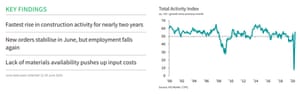
Newsflash: Britain’s building sector has started growing again, after activity slumped during the lockdown.
Data firm Markit has just reported that activity in the sector rose at the fastest rate in almost two years in June.
Markit’s construction PMI, which measures activity in the sector, rebounded to 55.3 in June, up from 28.9 in May. Any reading over 50 shows growth, so this shows that some of the business lost during the lockdown is now being clawed back.
Housebuilders led the recovery, with the biggest jump in activity since 2015. This will bolster optimism that home construction is picking up (reminder, Barratt reported a jump in orders this morning, alongside a drop in sales).
Markit says:
Higher levels of business activity were overwhelmingly linked to the reopening of the UK construction supply chain following stoppages and business closures during the early stages of the coronavirus disease 2019 (COVID-19) pandemic.
Residential building was the best-performing area of construction activity in June. Around 46% of survey respondents noted an increase in housing activity, while only 27% experienced a reduction. The latest expansion of residential construction work was the steepest for just under five years.
However, firms did also report problems accessing materials (speak to a builder, and they’ll tell you that plaster is in very short supply). And they also kept cutting jobs, suggesting uncertainty about the outlook.
UK construction PMI Photograph: IHS Markit
More to follow….
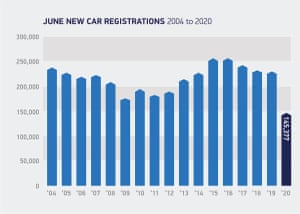
This chart shows how car sales in June were much weaker than usual (although still much better than the 20.4k sold in May)
UK car sales in June Photograph: SMMT
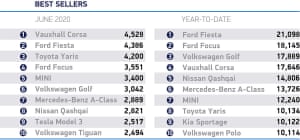
Elon Musk’s Tesla Model 3 had been the best-selling car in the UK in April and May.
While traditional showrooms were closed, Tesla pressed on with delivering models that had been on order for months, or possibly years.
But in June, the Model 3 slipped to 9th — with the Vauxhall Corsa and Ford Fiesta back on top.