UK coronavirus live: Boris Johnson sets new target of 200,000 tests a day during first PMQs with Keir Starmer
Ian Blackford, the SNP leader at Westminster, also mentions the figures showing the UK with the highest death figures for Europe. Some estimates show the numbers could be even higher.
Will the PM follow the best scientific advice in relaxing the lockdown?
Johnson says he will. He says it would be a mistake to introduce measures that would allow a second peak.
Blackford welcomes Johnson’s comment, but says the Scottish secretary, Alister Jack, has been politicising this issue.
Will the PM agree to ensure the devolved administrations agree what is being planned?
Johnson says he wants the widest possible support for what he is announcing.
A total of 2,795 people have died in Scotland with confirmed or suspected coronavirus, according to the National Records of Scotland (NRS).
Of these:
– 59% took place in care homes
– 37% in hospitals
– 4% in homes or non-institutional settings
The percentage of deaths in care homes has increased for the second week in a row, up from 52% the previous week, but the number of deaths in care homes has gone down from 339 to 310.
There were 523 deaths relating to Covid-19 registered between 27 April and 3 May, a decrease of 135 on those registered between 20-26 April.
The figures are announced weekly and account for all deaths registered in Scotland where Covid-19 was mentioned on the death certificate. They differ from the lab-confirmed coronavirus deaths announced daily by the Scottish government because they include suspected or probable cases of Covid-19.
Starmer asks if the PM will come to the Commons on Monday to present his plan.
Johnson says there will be a statement to the Commons on Monday.
(He does not say he will give it.)
He says he wants to introduce some of these measures on Monday. And he says the announcement is on Sunday so he can have the most up-to-date data before taking the final decision.
- Johnson says he wants some lockdown easing measures to come into force from Monday.
Starmer says Johnson has admitted there was a capacity problem.
He cites a survey about doctors having to buy their own PPE.
This will get worse when people return to work.
Can the PM assure people they won’t be asked to return to work until a plan is in place?
Johnson says he can.
He says the PPE shortages have been “enraging”.
There have been no national “stock outs” of any PPE item, he says.
- Johnson confirms he will set out details of his plan to start relaxing the lockdown on Sunday.
Starmer welcomes the PM’s decision to set a deadline for the 200,000 a day target.
Why was contract tracing abandoned in mid March?
Johnson says the difficulty in mid March is that the testing capacity could not meet demand. But now there will be a team in place that can trace hundreds of thousands of cases across the country.
To put it in a nutshell, it is easier to do this now, he says.
Starmer says the testing numbers have fallen back since last week, when the government hit its 100,000 a day target.
What was so special about that day?
Johnson says Starmer was right to pay tribute to the work done on this last week.
He says the ambition is to get testing up to 200,000 a day by the end of this month, and then go even higher.
Starmer says the government publishes comparative death figures every day. So it can’s argue they don’t count.
He says the government has been too late on issues like testing and PPE.
Why has it taken so long to improve the situation in care homes?
Johnson says there has been a “palpable improvement” in care homes.
Sir Keir Starmer starts by saying it is good to see the PM back in his place.
Last week the PM talks about the “apparent success” of the government’s approach. But death numbers are the highest in Europe, and the second highest in the world. That’s not a success.
How on earth did it come to this?
Johnson cites Prof David Spiegelhalter wrote about comparing death rates in a Guardian article.
He says of course there will be a time to look at what went wrong.
- Johnson hints that public inquiry will have to take place.
Johnson says the government is supporting tourism in Devon. The priority is to suppress this disease, he says. He says that will help tourism everywhere.
Boris Johnson starts by paying tribute to the 107 NHS workers and 29 care workers who have died.
And he pays tribute to the staff who looked after him at St Thomas’s hospital.
Sir Lindsay Hoyle, the Speaker, opens PMQs by talking about VE day on Friday. There will be a wreath-laying ceremony in the Commons, he says.
And he says the whole country will welcome Boris Johnson back.
These are from the Spectator’s James Forsyth.
James Forsyth
(@JGForsyth)Normally, when a new leader of the opposition first faces the PM across the despatch box he is hit with a wall of noise. The government whips get MPs to do everything they can to throw the new boy off his stride. But that can’t happen today
James Forsyth
(@JGForsyth)The almost empty chamber is going to be a particular challenge for Boris Johnson. As a performer, he has always fed off the audience’s reaction. But with most MPs watching on Zoom, it’ll be very hard for him to judge how his lines are going down
From the Labour adviser Damian McBride
Damian McBride
(@DPMcBride)By my reckoning, Keir Starmer v Boris Johnson will be the twelfth different ‘match-up’ for PMQs in the five years since the 2015 election, with seven different representatives for the Tories in that time, and eight for Labour.
Here is the “call list” (pdf) of MPs down to ask a question at PMQs.
A businesswoman has told the PA news agency she is too scared to return to work when lockdown measures are eased after being spat on during her commute.
Jenny Pattinson, who is mixed race, said she was shaken and angry after the incident, which police were unable to investigate further as the CCTV footage had been overwritten.
The 41-year-old, from Ascot, Berkshire, now does not feel safe in public without her husband, and will continue to work from home for a while once the lockdown is lifted. She told PA that racist behaviour and comments are “just a day-to-day reality for Chinese people and the pandemic has made it a lot worse”. She said:
It’s escalated, it’s immediately more threatening.
I’m a professional woman, I’m 41 years old, I work in the City of London. I’ve worked hard to get to where I’ve got to, I was born here.
But I feel scared now. Even if lockdown lifts, I’m not going to be going back to work straight away because I feel quite scared without being with my husband, to be honest with you.
And that’s a feeling I have not experienced since when I used to get bullied at school, racist bullying when I was a kid, feeling that scared.
Pattinson, whose has a Chinese mother and Scottish father, said she had also noticed other commuters avoiding her on the train before lockdown was imposed.
Her mother, who is in her 70s, was sworn at and called “filthy” on a flight in March, while her cousin, a frontline hospital worker, has also received abuse.
Asked what she thinks will happen when lockdown measures are eased, she said:
I think it’ll be much worse. I’ve seen what’s on social media as well, the vitriol. Sometimes people have commented on news articles that are reporting about this virus, and just the amount of racism, the level of racism, the amount of stereotyping that’s going on is absolutely horrific.
Just seeing those things just make me feel more concerned and more worried and more scared actually, for myself and for my family members and friends.
Pattinson said it is sad that there has been no high-level condemnation from the UK government, especially after comments from the US president Donald Trump about Covid-19 being a “Chinese virus”. She urged Boris Johnson to speak out, adding:
I think there needs to be somebody standing up and saying this isn’t right.
PMQs is about to start.
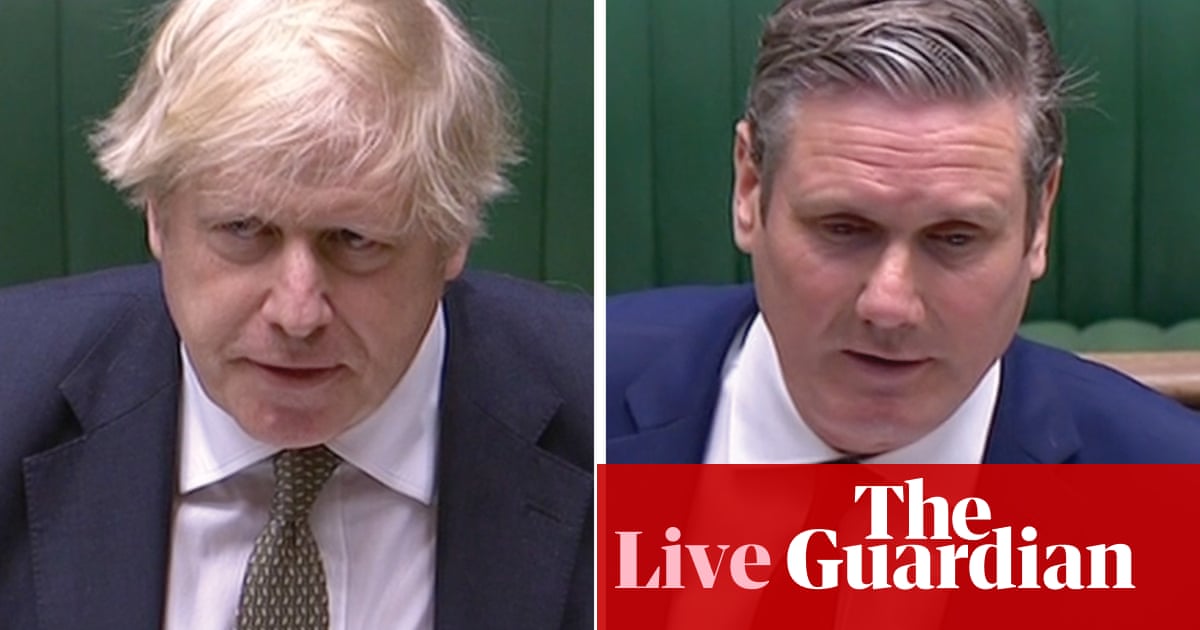
It will be the first time Boris Johnson has faced Sir Keir Starmer across the despatch box.
Inan article for City AM, the mayor of London, Sadiq Khan, has said that if social distancing rules remain in place, tube trains in the capital will only be able to run at 20% normal capacity, at most. And double decker buses could end up carrying just 15 passengers, he says.
Here is an extract.
It’s an inescapable fact that no mass transport system of the scale we have in London can operate at full capacity while maintaining social distancing at all times. Even with Tube ridership standing at just five per cent at the moment, there are times when passengers struggle to keep their distance.
This means that if the social distancing requirements remain in place, the total carrying capacity of the Tube will have to be reduced to between 13 to 20 per cent of pre-crisis levels – even with close to 100 per cent of trains running. We will also need to have a fundamentally different approach to operating stations, with strict queuing systems to limit the number of people who can access the network at any one time. Certain major stations where TfL and National Rail services interchange are likely to present the biggest challenge.
Likewise, there will need to be big changes to how we run the bus network. The carrying capacity of double decker buses could be reduced from 85 passengers to just 15. During the lockdown, we have been encouraging social distance queuing at some of our 21,500 bus stops by putting markings on the pavement. But this system will not be possible to maintain when passenger numbers start to increase. We are looking at possible solutions and have already started working with London boroughs to widen pavement space in key locations to alleviate the pressure. However, it will still be impossible to maintain social distance if passenger numbers increase even modestly.
One consequence of this, Khan argues, is that in London “everyone who can work from home will have to be told to continue to do so for the foreseeable future.”
Read the original article at The Guardian