UK coronavirus live: Boris Johnson suggests social distancing will change; death toll rises by 173
With pressure growing on Boris Johnson’s government to reduce the 2 metre social distancing rule to 1 metre in schools in England, the education secretary Gavin Williamson will lead this afternoon’s press conference.
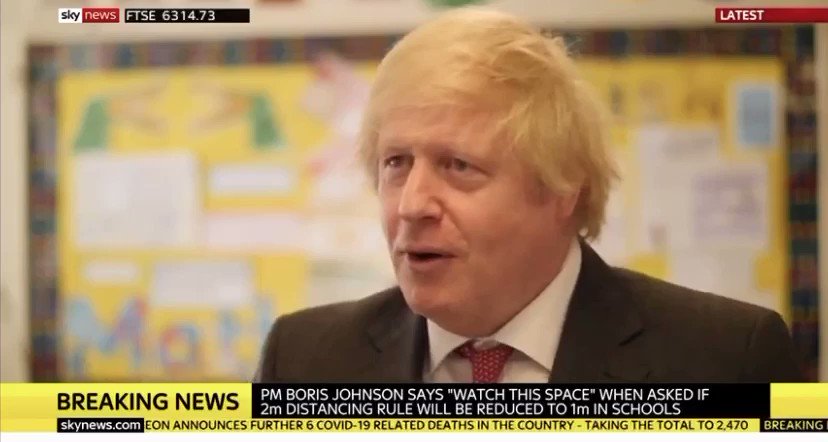
Today the prime minister said “watch this space” as he reaffirmed there would be further changes to the 2 metre distancing rule in schools “as the science allows”, and as a result of the coronavirus transmission rate reducing. Johnson said he wants children of all ages in England to return to school on a five-day-week basis in September.
Boris Johnson says ‘watch this space’ on 1-metre social distancing in schools – video
My colleague Niamh McIntyre reports that the ONS has found that black men in England and Wales are three times more likely to die from Covid-19 than white men.
The study, which covered deaths in hospitals and in the community between 2 March and 15 May, found black men had the highest mortality rate from the disease. Among black men of all ages the death rate was 256 per 100,000 people, compared with 87 deaths per 100,000 for white men.
When comparing death rates for younger males between nine and 64 years of age, the discrepancy was even starker, with black males more than four times more likely to die than their white counterparts.
When researchers adjusted for population density, socio-demographic factors and region, they found black men were still twice as likely to die as white men, while for black women the risk was 1.4 times higher.
The full story is here.
UCL is to dename spaces and buildings named after two prominent eugenists, Francis Galton and Karl Pearson.
Victorian scientist Francis Galton coined the term eugenics and endowed UCL with his personal collection and archive along with a bequest for the country’s first professorial Chair of Eugenics. Karl Pearson was the first holder of this chair.
The university will contextualise the decision to dename buildings and spaces with plaques or signs that communicate this decision and the reasons underlying it, linked where appropriate to other contextual material elsewhere in UCL or online.
The university said it made the the move as one step in a range of actions aimed at acknowledging and addressing UCL’s historical links with the eugenics movement. It follows a series of recommendations made by members of the Inquiry into the History of Eugenics at UCL, which reported earlier this year.
UCL’s president & provost Prof Michael Arthur said acknowledging and addressing the university’s “problematic history” was important, as was making conscious decisions not to “celebrate these ideas or the figures behind them”.
He said:
This is an important first step for UCL as we acknowledge and address the university’s historical links with the eugenics movement.
This problematic history has, and continues, to cause significant concern for many in our community and has a profound impact on the sense of belonging that we want all of our staff and students to have.
Although UCL is a very different place than it was in the 19th century, any suggestion that we celebrate these ideas or the figures behind them creates an unwelcoming environment for many in our community. I would like to pay tribute to members of our community who have campaigned tirelessly on this issue – particularly our students union.
I am also clear that this decision is just one step in a journey and we need to go much further by listening to our community and taking practical and targeted steps to address racism and inequality.
The rate of spread of the coronavirus infection across the UK is shrinking, new figures published by the government show.
For the UK as a whole, the current growth rate is minus 4% to minus 2% and the estimate of the reproduction number, referred to as R, remains at 0.7 to 0.9.
Until the figures were published for the first time today, the government had only been giving details of the R value of the disease – the average number of people an infected person is likely to pass it on to.
R estimates do not indicate how quickly an epidemic is changing and different diseases with the same R can result in epidemics that grow at very different speeds.
Neither measure – R or growth rate – is better than the other but each provides information that is useful in monitoring the spread of a disease, and experts say each should be considered alongside other measures of the spread of disease.
For the NHS England region, the R value is 0.7 to 0.9, and the growth rate is minus 4% to minus 1%. The R values and growth rate for the following regions are:
– East of England: 0.7-0.9, minus 6% to minus 1% – London: 0.7-1.0, minus 5% to plus 1% – Midlands: 0.8-1.0, minus 4% to 0% – North East and Yorkshire: 0.7-0.9, minus 5% to minus 1% – North West: 0.7-1.0, minus 4% to 0% – South East: 0.7-0.9, minus 5% to minus 1% – South West: 0.6-0.9, minus 6% to 0%
It is most likely that the estimates are somewhere towards the middle of this range.
Last week, the South West of England had the highest R value range at 0.8 to 1.1, while the East of England had the lowest at 0.7 to 0.9.
London, the Midlands, the North West and the South East have R values of 0.8 to 1.0, and the North East and Yorkshire are at 0.7 to 1.0.
Figures this week show the R value in the South West has dropped below 1.0, meaning it no longer has the highest value.
The DHSC said 42,461 people had died in hospitals, care homes and the wider community after testing positive for coronavirus in the UK as of 5pm on Thursday. That is a rise of 173 from 42,288 the day before.
The government figures do not include all deaths involving Covid-19 across the UK, which is thought to have passed 53,000.
The DHSC also said in the 24-hour period up to 9am on Friday, 169,600 tests were carried out or dispatched, with 1,346 positive results.
Overall, a total of 7,433,114 tests have been carried out and 301,815 cases have been confirmed positive.
The figure for the number of people tested has been “temporarily paused to ensure consistent reporting” across all methods of testing.
Department of Health and Social Care (@DHSCgovuk)
As of 9am 19 June, there have been 7,433,114 tests, with 169,600 tests on 18 June.
301,815 people have tested positive.
As of 5pm on 18 June, of those tested positive for coronavirus, across all settings, 42,461 have sadly died.
The former Labour education secretary, Ed Balls, has said the UK government needs to get children in England back into school and blames the delay, in part, on problems with the track and trace system.
Speaking to the BBC’s World at One, Balls said it is “very hard to persuade parents that children are safe…unless you get the track and trace system really working, build the confidence…”
He added:
My advice to the secretary of state is this is time for some leadership… Too many head teachers and teachers at the moment are not feeling that they understand the plan going forward.
Balls urged the education secretary, GavinWilliamson, to come up with two plans: one based on re-opening schools with social distancing measures in place and a second based on forming “bubbles” of full classes.
While he welcomed today’s funding announcement from the government, Balls warned against further delays in schools reopening:
The divides are going to grow…there’s only so much you can do with remote learning. We need to get our children back into school.
NHS England said a further 46 people in hospitals have died, bringing the total number of confirmed reported deaths in that setting in England to 28, 221.
There has been one further death of someone who has tested positive for Covid-19 in Northern Ireland, bringing the total number of deaths recorded by the Department of Health to 544 – a toll that primarily focuses on fatalities within hospitals.
There were also three new confirmed cases of the virus announced on Friday, taking the total there to 4,866. Full details here.
Public Health Wales said a further four people had died after testing positive for Covid-19, taking the total number of deaths in Wales to 1,475. The total number of cases there increased by 31 to 15,001.
Public Health Wales (@PublicHealthW)
The latest number of confirmed cases of Coronavirus in Wales has been updated.
Good afternoon everyone! I’m Lucy Campbell, back from lunch. Please continue to get in touch as I work to share any news tips, comments or suggestions for our coverage. Your thoughts are always welcome.
Among those welcoming the decision to lower the UK alert level is a welcome development is Professor Costas Milas at the University of Liverpool, who has also just co-authored new research based on pooled information from Covid-19 deaths in more than 20 countries and which finds that early and stringent action is crucial to saving lives.
He tells us: “At the same time, face masks can potentially replace the costly, in economic terms, national lockdown without significantly heightening the epidemic peak.”
“In other words, making face masks compulsory can potentially be an effective alternative to a future national lockdown should a second spike of the virus occur occur. In my view, this will also justify a move from two metres social distancing down to 1metre.”
A large number of schools in Northern Ireland will not be able to return to full-capacity teaching in September, the Education Minister has said.
Peter Weir’s comments come amid concern expressed by some school leaders at the suggestion from Stormont that most pupils will be returning to full-time education in the autumn.
Weir said he anticipated that children would only return to the classroom on a part-time basis “in quite a large number of schools”.
In a separate development, Weir confirmed that the executive would be providing the 12 million required to continue financial support for families eligible for free school meals over the summer.
On Thursday, First Minister Arlene Foster said the powersharing executive’s decision to reduce the social distancing measure to one metre for pupils would allow attendance patterns in schools to return to “close to normality”.
“What you’ve got to look at is the overall incidence in the country as a whole and there is no question it is coming down,” said the prime minister, when speaking to broadcasters at a school in Hemel Hempstead.
“A couple of weeks ago I was saying it would be one in 1,000 (who have Covid-19), probably now it is one in 2,000, perhaps a bit less – one in 1,760 or so.
“So it is really diminishing among us all and that’s the most important thing. That will allow us, as the alert level comes down, to start making some progress, as I’ve said, on our plan and on social distancing measures.”
“So when we go forward to July 4, which is the next big stage in the plan, we hope there will be more guidance out very, very shortly that will help people, help businesses, help hospitality to prepare for that and how to implement social distancing in a safe way, while also enabling people to go back to shops, hospitality, restaurants and everything else.”
Boris Johnson joins a socially distanced lesson during a visit to Bovingdon Primary School, in Hemel Hempstead, Hertfordshire. Photograph: Reuters
The competition watchdog has launched an investigation into suspected price gouging by four pharmacies and convenience stores for overcharging shoppers for hand sanitiser during the coronavirus pandemic.
Stocks of hand sanitiser were among the first items the British public cleared off the shelves as the pandemic took hold in the UK. The Competition and Markets Authority, which announced the investigations, has previously identified hand sanitiser as the product with the biggest price hike.
“The investigations relate to suspected charging of excessive and unfair prices for hand sanitiser products during the coronavirus pandemic,” the CMA said.
“This investigation is at an early stage and no assumptions should be made that competition law has been infringed. The CMA has not reached a view on whether there is sufficient evidence of an infringement of competition law for it to issue a statement of objections to any of the parties under investigation.”
A public health notice advising passengers to use hand sanitiser as London Southend airport prepares for the reintroduction of passenger flights. Photograph: John Keeble/Getty Images
The Foreign Office has been urged by a cross-party group of British MPs to intervene to secure the safety of three prominent Gulf human rights activists thought to be at risk from the coronavirus outbreak in prisons.
The signatories include Peter Bottomley, the father of the house, and Caroline Lucas, the Green party MP.
Brendan O’Hara MP, the chair of the all-party group on democracy and human rights in the Gulf, said: “With Brexit fast approaching, it is paramount that human rights are at the centre of UK foreign policy. The government has too often turned a blind eye to the plight of imprisoned human rights defenders in the Gulf and with Covid-19 now posing an unprecedented imminent threat to their lives, it is time to take a stand and call for their immediate release.”
The family of one of the three activists, Loujain al-Hathloul, a women’s rights campaigner in Saudi Arabia, say they have not heard from her for a month. She has been held in Saudi Arabia’s maximum security al-Ha’ir prison complex near Riyadh for more than two years.
After a dip in cases in Saudi Arabia at the beginning of June, the number of new daily cases this week reached record levels of 4,919. Total deaths are 1,139.
Concern is also being expressed for Ahmed Mansoor, who was handed a 10-year sentence by the United Arab Emirates for “insulting the rank and reputation of the UAE and their symbols” and “disseminating false information to damage the United Arab Emirates’ reputation abroad”.
Despite successive hunger strikes, he has been held in solitary confinement and is said to have neither a bed nor access to water.
The third activist for which concern has been expressed is Abduljalil al-Singace, who was sentenced to life imprisonment in Bahrain for criticising the government.
As people of Bangladeshi heritage grapple with trauma as data shows they are dying at twice the rate of white people, the Guardian’s Nazia Parveen has written this piece after speaking to experts and people in the community.
Saidul Haque Saeed, a community worker in Birmingham, told her the blame lay firmly on decades of inequality within clinical commissioning, where the health needs of smaller population groups have consistently and historically not been met.
He said:
What Covid-19 has done is to lay this inequality, this postcode lottery in health, bare overnight. This deadly disease has been able to carve its way quite easily through those communities where there has been inaction and ignorance of their health needs. The problem of years of a community’s health needs not being met are now coming to roost.
Boris Johnson said it was “absolutely” his intention that children of all ages should be able to return to school by the autumn on a five-day-a-week basis.
The prime minister told broadcasters during a visit to a Hertfordshire school: “Let me be very clear – I want a world in which, as far as possible, provided we can make classrooms safe and I think we can, I want every child, every pupil, every student, back in September. I’m sure we can get it done.”
He added:
We have to start thinking of a world in which we are less apprehensive about this disease.
Yes it has been a horrible shock for the country and for the world, and I think the British people have worked incredibly hard to drive it down.
But we are starting to make some real progress with test and trace, with treatments for the disease, and I hope, as we go forward into the autumn, people will be much, much more confident.”
This is Ben Quinn picking up the liveblog again now.
This is breaking from Sky News
Sky News Breaking (@SkyNewsBreak)
Prime Minister Boris Johnson says “watch this space” when asked if the two-metre social distancing rule will be reduced to one-metre in schools
Nicola Sturgeon has insisted the Scottish public needs to keep socially distancing by 2 metres as she adopted a new “stay safe” slogan and a five-stage acronym, FACTS, designed to drum home the steps people should take as the lockdown eases in Scotland.
The first minister is continuing to enforce the strictest lockdown measures in the UK, Sturgeon urged people to remember FACTS. Tapping the side of her temple during today’s coronavirus briefing, she said:
Get that into your head and just remember that.
She said the letters stood for face coverings in enclosed spaces; avoid crowded places; clean hands and surfaces regularly; 2-metre distancing; and self-isolate and book a test if you have symptoms.
The SNP (@theSNP)
NS: “And those measures are:
·Face coverings in enclosed spaces ·Avoid crowded places ·Clean hands and surfaces regularly ·Two metre distancing; and ·Self isolate and book a test…if you have symptoms.”
She confirmed people faced being fined if they failed to wear face coverings on all public transport from Monday, including taxis, buses, trains and ferries, but was unable to immediately give the details.
Pressed on how that would be policed if ScotRail staff would not be issuing fines, Sturegon said the police could be involved.
Rules will be enforced if they have to be enforced.