UK coronavirus live: close to 2,000 new Covid cases recorded – highest daily total since May – as it happened
Tony Abbott, the controversial Australian former prime minister, has been appointed as a UK trade envoy, the Department for International Trade has announced. That means Boris Johnson has ignored the multiple calls for Abbott not to be offered this job, which will be part-time and unpaid.
Abbott is one of 16 people who have been appointed as advisers to the Board of Trade. Seven of them are ministers. The other nine include Abbott, the former Conservative MEP Daniel Hannan (described by some as the godfather of Brexit) and the former Labour trade secretary Patricia Hewitt.
Describing what the advisers will do, DIT said:
Board members and advisers will meet quarterly and use their influence to help Britain make a stronger case for free trade on the international stage, helping the government forge a stronger global consensus for free trade at a time of increased protectionism.
The board will engage extensively with industry, communities, farmers and consumer groups across the UK, to ensure a range of voices are heard as the UK develops its independent trade policy. The board will also encourage more businesses across the UK regions and nations to boost their international trade.
The new advisers to the board are announced at an important time for UK trade policy and as negotiations with the US, Japan, Australia and New Zealand enter their crucial latter stages – although advisers to the Board will have no direct role in striking trade deals.
The board will represent a range of views to help in its advisory function, promoting free and fair trade and advising on UK trade policy to the International Trade Secretary.

In his interview with Sky News in Solihull Boris Johnson was also asked about the concerns raised about the haulage industry about possible border chaos when the Brexit transition period ends next year. He restated his willingness to see the UK leave the transition period without a trade deal with the EU if necessary, and claimed the country would “prosper mightily” with or without a deal. He said:
We’re ready for any eventuality, of course. But we must make sure that people understand that at the end of the year, whatever happens, we are leaving the EU, and leaving the transition period, the implementation period. That is it.
That’s why it is vital that people who have questions, who have queries about what they need to do, get on to our websites, look at what they need to do to prepare, and certainly we will help them.
But we will get through this. It’s absolutely vital that our partners understand that the UK is going to do what we need to do. If we have to have an Australia-style deal, an Australia-style solution, then that is what we will achieve, and we will prosper mightily one way or the other.
They could, of course, be sensible and give us a Canada-style solution, which after all they’ve given Canada, and I hope very much hope that they will, but we’re ready for either eventuality.
The claim that the UK will “prosper mightily” if it ends up with no trade deal with the EU is not one shared by most economists. In November 2018, when Theresa May was prime minister, the Treasury published a paper (pdf) looking at the economic impact of various Brexit outcomes, including no deal, and that said no deal could lead to GDP being almost 10% lower than otherwise over the long term (defined as 15 years). Johnson’s administration does not accept this analysis, but it has failed to publish its own impact assessment of no deal (or “an Australian-style solution”, as Johnson calls it – Australia does not have a free trade deal with the EU).

Key figures in Scotland’s nightclub and music sector are calling for specific funding and a “roadmap out of lockdown” to prevent a “complete wipe-out” of jobs and halt the rise of illegal raves which increase the likelihood of coronavirus transmission.
The head of the TRNSMT festival Geoff Ellis and Glasgow’s SubClub say they hope the “freedom to dance” campaign will support regulated venues which are struggling after months of lockdown restrictions.
A survey of the Night-Time Industries Association Scotland suggests 83% of firms could shed a total of 75,000 jobs when the furlough scheme ends next month. Police are clamping down on illegal raves, including a massive house party that attracted more than 300 revellers in Midlothian last weekend.
Meanwhile Brian d’Souza, the producer and DJ who performs as Aunite Flo and was the winner of the coveted Scottish Album of the Year title, is demanding the Scottish government reverse restrictions on the playing of background music in bars and restaurants, and also allow live events to return.
He said the music ban was having a “devastating effect” on the hospitality industry and on musicians who are losing out on royalties while at the same time unable to take part in live events.
On Friday afternoon, 159 new cases of coronavirus were confirmed in Scotland, with 73 of them in Greater Glasgow and Clyde, where the indoor gathering restrictions are in place across three local council areas. Meanwhile, Lanarkshire’s public health director warned that residents could be facing similar restrictions after a rise in cases there.
The government has updated its daily coronavirus dashboard. And here are the main points.
- The UK has recorded 1,940 new cases of coronavirus, which is the highest daily total since 30 May (2,445). Daily case numbers have been rising steadily for two months now. In part this has been attributed to the fact that more people are being tested. However it is now clear that the proportion of people testing positive is also increasing.

- The UK has recorded 10 more deaths, taking its daily headline total to 41,537. But this tally only records people who have died within 28 days of a coronavirus test, and so it significantly understates the true number of coronavirus deaths in the UK. Taking into account all deaths where coronavirus was mentioned on the death certificate, there have been more than 57,300 deaths in the UK.
- A further 124 patients have been admitted to hospital. Although case numbers have been rising significantly in the last two months, the hospital admission figures have been broadly stable.
Boris Johnson has defended Tony Abbott, the former Australian prime minister notorious for his reactionary views, who is expected to be made a UK trade envoy.
In an interview with Sky News in Solihull, where he was visiting an HS2 construction site, it was put to Johnson that Abbott’s misogynist, homophobic and climate change-denying views made him the wrong choice. Johnson replied:
There’s going to be an announcement in due course about the composition of the Board of Trade.
I obviously don’t agree with those sentiments at all, but then I don’t agree with everyone who serves the government in an unpaid capacity on hundreds of boards across the country, and I can’t be expected to do so.
What I would say about Tony Abbott is this is a guy who was elected by the people of the great, liberal, democratic nation of Australia. You’ve been to Australia – it’s an amazing country, it’s a freedom-loving country, it’s a liberal country. There you go. I think that speaks for itself.
(The interviewer subsequently pointed out that Johnson was wrong on at least one point; she had not been to Australia.)


The latest official published R figure for the UK is between 0.9 and 1.1, with the number of new infections somewhere between shrinking by 1% and growing by 2% every day, the latest update from the government reveals.
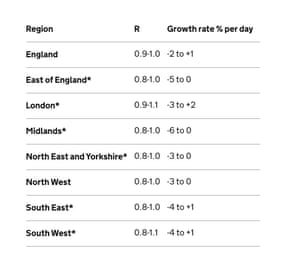
For England alone, R is estimated to be between 0.9 and 1, with a growth rate between -2% and +1%.
Only the south-west of England and London have R values that might be above one. However the team that produced these Government Office for Science figures warn that low numbers of deaths or clustered outbreaks mean these R values should be viewed with caution.
Once again, with the figures based on data gathered over preceding weeks, the team also point out that official figures may be out of date. They say:
These estimates represent the transmission of Covid-19 from several weeks ago due to a time delay between someone being infected and needing healthcare. Sage [the government’s Scientific Advisory Group for Emergencies] does not have confidence that R is currently below 1 in England.
According to the latest figures, R in Scotland is currently between 0.9 and 1.4 while the growth rate for Scotland is estimated as being between -1% and +8%. In Northern Ireland, R is currently between 1.1 and 1.6. Earlier this week Wales revealed its R number to be between 0.5 and 0.9.
Here are the figures for the English regions, from today’s news release.

Around 27,100 people in the community in England had Covid-19 during the week from 19 to 25 August, equating to around 1 in 2,000 individuals, with around 2,000 new cases a day, the latest data from the Office for National Statistics reveals. (See 12.40pm.)
The team behind the work – which is based on sampling of households – said that, once again, the data suggests the infection rate in England is still levelling off, with no clear sign of a rise or fall, following rise in the rate in July.
However researchers behind the Covid-19 symptom study app say their data, based on swab testing of people reporting symptoms, tells a slightly different story, revealing a slight rise in daily cases of Covid-19.
The latest data suggests that from 16 to 29 August 2020 there were on average 1,423 new cases a day in England, compared with 1,073 reported the previous week for the period 9 August to 22 August. For the UK the figures are 1,974 and 1,292 new cases a day respectively.
Tim Spector, professor of genetic epidemiology at King’s College London and lead researcher on the Covid-19 symptom study, said the rise in numbers was occurring as economic activity and travel were increasing.
Earlier this week experts told the Guardian the testing figures from the government suggested infections in the UK had risen since early July, although levelled off in August, even once an increase in the number of tests carried out was taken into account.
Prof Neil Ferguson, an epidemiologist at Imperial College London, said at the time: “What it clearly demonstrates is we’re in a position where case numbers are going up. So we don’t have much room for manoeuvre.”
Responding to the latest figures, Prof Oliver Johnson, professor of information theory, School of Mathematics, University of Bristol, said:
Today’s ONS infection survey figures are very similar to last week. Indeed the long-term trend is broadly flat since the beginning of July, suggesting an R value very close to 1.
This data may appear to contradict the recent increase in UK cases: this may partly be due to some of those cases being discovered by targeted testing in hotspots. Further, it is important to note this ONS survey covers only England and Wales. A significant proportion of the recent increase in cases has occurred in Scotland and Northern Ireland, and so would not be visible here.
Read the original article at The Guardian