UK coronavirus live: concern about second wave ‘very high’ in NHS; death toll rises by 83 – as it happened
MPs have been told that concern amongst NHS managers about there being a second coronavirus wave in the UK is “very high”. (See 2.42pm.) The warning was delivered as the UK recorded a further 83 coronavirus deaths, with the figures confirming that the UK death toll has stopped falling and is now rising again – although only very marginally. (See 5.43pm.)
Grant Shapps, the transport secretary, has confirmed that further countries could be included in the UK’s quarantine measures. Speaking to reporters on his return home from Spain (he only started his holiday there at the weekend, but decided to come back early after the quarantine announcement on Saturday night), Shapps said
We absolutely have to act the moment we get the information and that’s exactly what happened with Spain, as we saw and as we’ve seen over the weekend, where there were over 6,100 cases – the highest since the peak in March over there. It was the right thing to do and it’s why the whole of the UK did [it] at the same time. I can’t therefore rule out other countries having to go into the quarantine as well.
At a meeting this afternoon the UK government was discussing quarantine with the devolved administrations, amid speculation that Belgium, Luxembourg and Croatia will be added to the list. Shapps also said that, although the government considered exempting the Canary and Balearic islands from the quarantine applied to Spain, the chief medical officer, Prof Chris Whitty, was strongly against. Shapps said:
We did have a look at whether certain islands could be included [on the list] and not others. Chris Whitty, the chief medical officer, was very clear with us that he was concerned about the data, we’d seen how the data had come very fast forward in Spain in 20, 48 hours, it had gone up by 75%. It had doubled in just a few days. He was concerned to see what was happening in the islands and that’s why we make it a whole-country approach in these things.
Grant Shapps apologises for frustration caused by Covid-19 restrictions on Spain – video
But the National Trust has said it will cut up to 1,200 jobs. (See 5.30pm.)
That’s all from me for today.
Our coronavirus coverage continues on our global coronavirus live blog. It’s here.
On 1 July the seven-day rolling average for cases was 711.1, but then it fell and stayed below 700, falling as low as 546.1 on 5 July. But today for the first time since 1 July the seven-day average on the website has gone over 700 again. It was 725.7 on 26 July, the most recent figure for which a seven-day average has been published. And the number of cases for today is 763.
The UK has recorded a further 83 coronavirus deaths, according to today’s update on the government’s coronavirus data dashboard. The official headline total for deaths is now 45,961.
This is a Public Health England figure for the UK as a whole. But, confusingly, the Department of Health and Social Care has given up publishing this figure as part of its only daily update, because it no longer views it as reliable.
The PHE figure is suspect because it includes people in England who tested positive for coronavirus and died – even if they died of something else.
But the main problem with the headline total is that it is an underestimate because it does not include people who died from coronavirus without testing positive. When these deaths are included, total UK coronavirus deaths are more than 55,000.
Today’s dashboard also confirms that the UK death toll has stopped falling and is now rising again – although only very marginally. (See 1.48pm.) On 26 July, the most recent day for which a figure is given on the dashboard, the seven-day rolling average for deaths was 65.7. Yesterday it was 65.1. The figure for 20 July was 62.1.
The National Trust has announced that it may have to cut 1,200 jobs because of the income it has lost as a result of coronavirus. Staff were told today. In a statement the charity said:
The National Trust is proposing £100m of annual savings following the impact of the coronavirus crisis, after warning almost every aspect of its income has been affected.
The Trust expects to lose up to £200m this year as a result of the pandemic, and is today proposing spending plans that include a possible 1,200 redundancies as it seeks to reduce its annual spend and the size of its workforce …
As part of the review, the trust hopes to save £100m – almost a fifth of its annual spend – through changing the way it operates and reducing its payroll and budgets.
Nearly 40% of the proposed savings (£40m) will be non-pay spending cuts, including reducing travel and office costs, reducing marketing and print spend in favour of digital, renegotiating contracts, reducing IT spend and introducing more efficient processes to manage key areas of the charity.
As PA Media reports, the 1,200 jobs that may go as part of £60m pay savings represent around 13% of the 9,500-strong salaried workforce. The move, which comes after a decade during which the National Trust nearly doubled in size, would bring staffing levels back to what they were in 2016.
The National Trust’s Petworth House, West Sussex, which reopened for visitors this month. Photograph: Stefan Rousseau/PA
“Hundreds” of people have turned up to a town’s Covid-19 walk-in centre after pub-goers were urged to get tested following the confirmation of 10 positive cases, PA Media reports.
Health chiefs asked people who had been working or drinking at the Crown & Anchor in Stone, Staffordshire, on July 16, 17, and 18 to get tested, after an outbreak linked to the premises.
One individual who tested positive from the pub then attended a private social gathering, further spreading the virus, Staffordshire county council said.
Following the outbreak, a walk-in centre for people without Covid-19 symptoms opened in the Crown Street car park for the first time today, and is due to open again on Friday, from 10am until 5pm.
Tests are free and no appointment is necessary but people are being asked to try to space out their visits.
A resident, who did not want to be named, described queues of people at the centre, adding: “Hundreds of people have already been down there, and it only opened this morning.”
Matt Hancock, the health secretary, says 72,000 people have signed up to say they are available to take part in coronavirus research. You can sign up here.
Matt Hancock (@MattHancock)
THANK YOU to the 72,000 people for signing up to the NHS COVID-19 vaccine research registry in 1 week.
To help further in our national effort to protect the NHS & find a vaccine, visit:t.co/U3zA9FmY4s
July 29, 2020
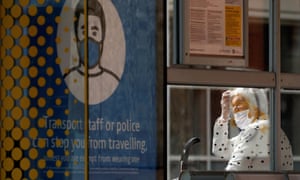
A woman wearing a protective face mask in Oldham, today, where restrictions have been tightened in response to a rise in coronavirus cases.
Photograph: Phil Noble/Reuters
The latest Guardian Politics Weekly podcast is out. This week Jonathan Freedland and Jessica Elgot discuss the latest from Westminster. Peter Walker talks to Lib Dem leadership candidate Ed Davey. Plus, Rajeev Syal talks to Dave Penman of the FDA union about the problems between this government and the civil service.
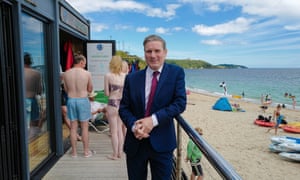
Sir Keir Starmer has been visiting Falmouth in Cornwall today, highlighting the employment problems facing areas reliant on tourism. (See 9.32am.) His itinerary even included a trip to the beach although (like Gordon Brown on these occasions), there was no dressing down, and Starmer stuck to a suit.
Keir Starmer on a visit to Falmouth today. Photograph: Hugh R Hastings/Getty Images
The Labour leader said he supported what the recent changes announced by the government to quarantine rules. He said:
We do support measures being taken to quarantine. It’s really unfortunate for those that are in other countries. I really feel for them. But it is necessary that we take all preventative measures to prevent a second spike.
But, interestingly, he also urged the government to cut the time needed for quarantine by combining it with testing. He explained:
There is some evidence that [quarantine] could be shortened to 10 or nine days. But that depends on really effective testing, and that is why we’ve pushed the government so hard on testing. There’s the capacity to test. The government needs to use that to test on arrival, and then after a short interval, because if that period of 14 days can be brought down to eight, nine or 10, then obviously there’s a huge benefit in that.
Starmer seemed to be referring to the recent report published by the the London School of Hygiene and Tropical Medicine (LSHTM) saying that quarantining people for eight days on arrival from the EU and testing them on day seven, with a 24-hour turnaround in test results, could reduce the number of infectious people re-entering the community by 94%, compared with no quarantine or testing.
Here is the report (pdf). And here is an extract from its conclusion.
While a 14-day quarantine will likely prevent most transmission from travellers, an eight-day quarantine (with testing on day seven) can capture as many infectious persons in approximately half the time. Testing passengers is resource-intensive but presents a way to either further reduce risks or allow a shorter quarantine at the same level of risk, particularly for arrival from countries with widespread Sars-CoV-2 transmission.
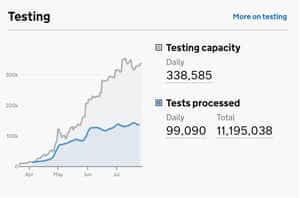
Starmer was right to say the government does have spare testing capacity available. The figures are published on the daily dashboard and, while the government has the ability to carry out more than 300,000 tests per day, according to the most recent figures, less than a third of that was being used.
Testing capacity and tests carried out Photograph: Testing capacity and tests carried out/PHE
Here are the main points from Nicola Sturgeon’s press briefing earlier.
Sturgeon, Scotland’s first minister, said that she did not want to give anyone “false hope” about the pace at which restrictions could be lifted. She said:
I want to give people hope. I think there’s a lot right now that should give all of us hope. It’s been painful, it’s been hard, but we’ve got this virus to really low levels.
But I don’t do my job, I don’t discharge my responsibilities and ultimately I don’t do anybody any favours if I give false hope, or if I get so desperate, as I am to get everybody back to normal, that I forget about the risks that we face, and then I’m standing here in a few weeks and we’re going backwards.
This seemed like a clear attempt to draw a contrast with Boris Johnson, who is temperamentally prone to favour optimism over realism. (This was particularly apparent the week before last, when he said it might be possible to abandon social distancing from November, although with coronavirus cases rising across Europe, his more recent comments have been more negative about the prospects of an early return to normality.)
She said her biggest worry was people getting “a bit lax” about social distancing rules. She said:
My biggest concern right now is that there are things that all of us can do to keep this under control that we’re all maybe getting a bit lax at doing.
She said the Scottish and UK governments could be taking part in a four-nations meeting this afternoon at which possible changes to quarantine rules would be discussed. (See 1.07pm.)
She rejected claims that she was using her daily coronavirus briefings for party political advantage. She said she used them to focus on public health messaging, and sought to avoid talking about party politics at the briefings. When it was put to her that she did comment on party political matters, she replied:
Sometimes one person’s political issue is another person’s very legitimate issue, part and parcel of dealing with Covid. And the fiscal flexibility of the government to deal with the overall consequences of Covid [an issue raised by the reporter] I would put into the latter category.
She urged the UK government to extend the furlough scheme beyond October. (See 1.04pm.)
She said the small increase in Scotland’s weekly coronavirus death toll was “regrettable and very unwelcome”. (See 12.40pm.)
Nicola Sturgeon at today’s Scottish government briefing. Photograph: Scottish government
The all-party parliamentary group on coronavirus, which is chaired by the Lib Dem MP Layla Moran, is holding its own inquiry into the lessons to be learnt from coronavirus, and today it has holding its first oral evidence session. Niall Dickson, the chief executive of the NHS Confederation, which represents NHS leaders, told the group that NHS managers were very worried about a second wave. He said:
I would say in relation to the second spike issue or something coming, the levels of concern among our members – the people who are leading NHS trusts, who are leading in primary care and all levels in the systems – is very high.
I mean, of course, there’s real concern about winter and the compounding factors there, but also about an earlier spike.
We have already mentioned exhausted staff [and] we are already trying to rebuild other services.