UK coronavirus live: daily death toll rises by 15; school exams in England could be delayed next summer
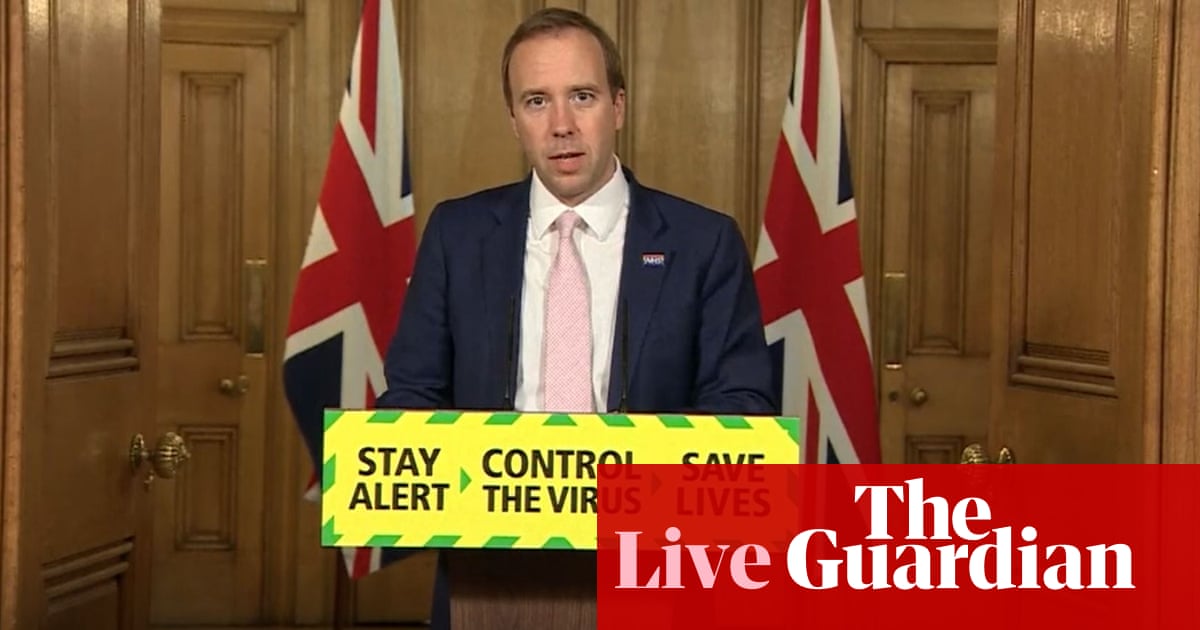
Matt Hancock, the health secretary, will be taking the UK government press conference at 5pm. He will be appearing with Dr Jenny Harries, the deputy chief medical officer for England.
This is from Andy Bell from 5 News.
Andy Bell
(@andybell5news).@MattHancock just went into Number 10 – is it the end of 2 metres ? I asked him; “lots of news” he replied #COVID19
June 22, 2020
Priti Patel indicated that the UK must continue to be vigilant, with the terror threat level currently at “substantial”.
SNP chief whip Patrick Grady said: “It is the third terrorist attack since the UK terror threat level was reduced in November.
“Is (Ms Patel) considering the use of the scale of the terror threat level and whether there is any consideration of reviewing the criteria and the circumstances around the raising or the lowering of the threat level?”
Patel responded: “That terror threat is independent of the Home Secretary and the Home Office, it’s a JTAC (Joint Terrorism Analysis Centre) assessment.
“The fact of the matter is the threat level is substantial and on that basis we all continue to be vigilant and obviously monitor situations and engage with our intelligence and security services and take the relevant advice.”
In Northern Ireland Robin Swann, the health minister, has announced two measures to reduce lockdown restrictions for people who are shielding (told to stay at home because they are deemed extremely clinically vulnerable). As the Northern Ireland Department of Health says in its news release:
From 6 July, people who are shielding will be able to meet up to six people outside the home, as long as social distancing is strictly observed.
In addition, people who are shielding and living alone will be able to form a support bubble from July 6 with one other household.
Swann also said that shielding would be put on hold from 31 July. He said people shielding would get a letter before then with further advice. He said:
I have no doubt that shielding has played a key role in saving many lives. It has undoubtedly been extremely difficult for those who are shielding. I have listened with great sympathy to what people have told us about feeling isolated and how they have missed their loved ones.
I know these easements that take effect on 6 July will be welcome news to many as we move towards the pause in shielding from the end of July.
Northern Ireland’s First Minister Arlene Foster has confirmed the Stormont Executive has agreed that groups of up to six people will be able to meet indoors from tomorrow.
“It is recommended that social distancing should still be maintained along with other mitigations such as ventilation and good hand hygiene,” she told Stormont’s briefing on Monday.
“This was the one relaxation remaining outstanding from the initial stage of our recovery plan and I know many of you have been desperate in recent weeks to visit your family and friends inside their homes.”
At the public accounts committee, the SNP MP Peter Grant is asking the questions now.
Q: When did it become clear that there would be a problem with PPE in care homes?
Rosamond Roughton, the director of adult social care at the DHSC, says on 13 March advice was issued relating to the use of face masks in care homes. She says at that point there were pressures on the system. She says it was not usual for face masks to be needed in care homes.
An MP has told of how one of his parliamentary assistants carried out CPR on a victim of the Forbury Gardens attack.
Speaking in the Commons, Tory Chris Loder (West Dorset) told MPs: “In the same way that (Tobias Ellwood) did so in March 2017, another member of our parliamentary family who, by chance was at Forbury Gardens on Saturday, ran courageously towards danger, his only focus to help the injured.”
Loder said a member of his staff “not only used his own shirt to stem the bleeding of one victim, but continued resuscitation on a second victim until the paramedics arrived”.
He added: “This was indeed a remarkable and extraordinary effort from a young man who has been with us in parliament for little over four months and whom I am extremely proud to have as part of the West Dorset parliamentary team as I hope is the whole house.”
Patel was questioned about whether the suspect in the alleged terror attack was known to security services and other authorities after it emerged he was under investigation as a person who might travel abroad “for extremist reasons”.
Patel said she would not get into speculation and commentary but the policy was as stated that: “If you commit crimes in the UK we will do everything in our power to remove you and that has been the focus of this government.”
She said: “It is not always easy and there are barriers to overcome”.
At the public accounts committee, Sir Chris Wormald, the DHSC permanent secretary, says the government did implement the recommendations of the report from the Cygnus planning exercise in 2016.
He said that involved plans for a flu pandemic. He said coronavirus had created a much higher demand for PPE in hospitals.
Nick Thomas-Symonds warned that legislation alone would not be enough to safeguard against future tragedies.
He said: “Legislation alone is not enough. We need a comprehensive look at de-radicalisation in our prisons, how people who pose a threat are risk-assessed and how different agencies can work together to safeguard against tragedies in the future.”
Priti Patel responded: “He’s absolutely right, legislation is never the only answer or the only solution, not just on issues of this nature but wider safeguarding, community measures and the responses that are put in place.”
At the public accounts committee Sir Simon Stevens, the NHS England chief executive, is being asked more questions about the NHS contract to use private hospitals.
Q: How many of the 8,000 beds in private hospitals you paid for were used?
Stevens says this was not just about beds. It was about freeing up the staff too for NHS use.
Q: But how many beds were used?
Stevens says several hundred thousand patient procedures took place under this arrangement.
Q: And can you give a rough figure for the cost?
Stevens says he can’t at this stage. But the first phase of this contract comes to an end at the end of June. At that point he will provide a figure to the committee, he says.
Read the original article at The Guardian