UK coronavirus live: excess deaths reached almost 55,000 in early May, says ONS
Access to places of worship will have to be “supervised” when they reopen as the country eases out of the Covid-19 lockdown, according to the head of the Catholic church in England and Wales.
Speaking on a Zoom panel about the safe reopening of places of worship, Cardinal Vincent Nichols suggested different sections of churches could be closed off each day to allow cleaning to take place. Acknowledging that supervision will be required, he explained that “it’s not as if the church doors will be flung open and say: ‘come in when you want.’”

Places of worship come under step three of the government’s recovery strategy, meaning they cannot open until 4 July at the earliest.
Nichols, the archbishop of Westminster, said: “I think one thing is very clear, access to a church in the foreseeable future will be supervised, so it’s not as if the church doors will be flung open and say: come in when you want. There will have to be people there, the whole process will have to be supervised.”
He added: “Each day a different section of the church might be made available, it doesn’t have to be the whole church, the whole time.
“So you could have the right hand back part for one day, and then the next day it will be the next session, so that would enable a cleaning routine to be more feasible, and it would leave parts of the church unused for maybe three days, which would help in terms of the hygiene.”
Nichols said last week that Catholic churches should be allowed to reopen before Pentecostal churches, or mosques owing to their different styles of worship.
Calderdale council in Yorkshire has become the latest local authority to advise its schools not to open on 1 June, defying government policy.
The Labour council leader, Tim Swift, said: “the clear professional advice we have” is that not all of the government’s five tests for opening schools were being met, citing concerns over the local rate of infection and limited access to testing. He added:
There is not enough evidence that the levels of infection in the community are low and falling; and we are not confident that there is guaranteed access to testing, so that in the event of a case both the individual concerned and all their contacts can be identified and rapidly tested for the virus.
Our priority as a council and as a Labour group throughout this crisis has been to put the safety and wellbeing of our community first. For these reasons, whilst we want our schools to plan for opening up to more children when it is safe to do so, we are strongly advising schools that they should not be doing this as soon as the 1 June.
Matt Hancock has been forced to explain why there was no requirement to test people for Covid-19 who were being discharged from hospital into care homes until weeks into the lockdown.

Asked by the shadow health minister Liz Kendall in the Commons about the apparent delay in implementing testing for those going back to care homes from hospitals, Hancock highlighted the importance of infection-control procedures. It comes amid fears that care homes may have unknowingly received Covid-19 patients hospitals early in the crisis.
Kendall asked: “NHS England rightly asked hospitals to free up at least 30,000 beds to cope with the virus, but can he explain why there was no requirement to test those being discharged to care homes, the very group most at risk, until 15 April?”
In response, Hancock said: “She raises the question of discharges, and I understand the questions that have been asked about discharges into care. It’s important to remember that hospital can be a dangerous place for people, as well as saving lives. It also can carry risks and does and so it is appropriate … in many cases for people to be discharged from hospital and safer for them to go to a care home.
“What’s important is that infection control procedures are in place in that care home and those infection control procedures were put in place at the start of this crisis and have been strengthened … as we’ve learned more and more about the virus as we’ve gone along.”
In the Commons, the health secretary, Matt Hancock, has been pressed over the government’s “slow” handling of the impact of the Covid-19 pandemic in care homes.
As the Office for National Statistics figures released this morning showing there have been nearly 10,000 coronavirus-related deaths in care homes in England and Wales, Hancock faced an urgent question from shadow health minister Liz Kendall.

Hancock defended the government’s approach, saying deaths in care homes were falling. The ONS figures show care home deaths fell to 1,666 in the week ending 8 May, from 2,423 deaths in the previous seven days – a decrease of 31%.
Kendall highlighted that more than 23,000 people had died in care homes in the first four months of this year compared with last, accusing ministers of being “too slow” to tackle the impact of the virus in social care.
She challenged Hancock to explain why guidance stating care homes were “very unlikely” to be infected was not withdrawn until 12 March. (the Labour leader, Keir Starmer, previously raised this issue with Boris Johnson last week).
In response, Hancock said: “She refers to the 13 March guidance, that was only a matter of days immediately after the risk to the public was raised on medical advice. And the guidance that was in place until then, as she probably knows, explicitly stated that… that guidance was in place while community transmission was low and said it would be updated as soon as community transmission went broader and that’s exactly what we did.”
At the start of the coronavirus crisis politicians and their scientific advisers seemed united, an impression created by Boris Johnson appearing with Prof Chris Whitty, the government’s chief medical adviser, and Sir Patrick Vallance, its chief scientific adviser, at the first government press conferences.
But these days Johnson rarely shows up and the scientists and the politicians are engaging in the preliminary rounds of a ‘blame game’ battle that will no doubt come to a grim and acrimonious conclusion at the long-awaited public inquiry.
Ministers stress they have been following the science, and this morning Thérése Coffey, the work and pensions secretary, took that formula to its logical conclusion by effectively saying it meant that, if the wrong decisions were taken, that was because the scientists gave the wrong advice. (See 9.32am.)
This morning Prof John Edmunds, professor of infectious disease modelling at the London School of Hygiene and Tropical Medicine and a member of Sage, the government’s Scientific Advisory Group for Emergencies, has been giving evidence to the Lords science committee and he offered a different perspective. His department has been responsible for some of the modelling that has helped to inform government decision making. But, when asked about whether schools should open, he insisted that ultimately this was a decision for politicians, not scientists. He said:
Clearly the decision to open primary schools or not is a political one. It is not a scientific decision. Scientists can offer some advice.
It looks like the risk to children is low and that the vast majority don’t have significant symptoms … It may be that they are less likely to transmit to others as well, and so the risk to others may be relatively low.
But, overall, you have to weigh up those risks with other things, risks to the community, problems with children – clearly, we can’t keep children off school forever. Weighing all of those things needs to be done by politicians.

The National Trust expects to take a £200m hit to its finances after closing all its properties during the lockdown.
Hilary McGrady, director general of the National Trust, told a parliamentary committee the financial blow had come after the charity shut its properties on 20 March.
The £200m figure represents nearly a third of the charity’s total income in the last financial year, meaning the organisation is facing a significant shortfall.

While McGrady said that National Trust parks and gardens would be first to reopen, the charity’s houses are unlikely to reopen before late August. She told the digital, culture, media and sport select committee that the estimated impact of Covid-19 “is going to be in the region of about £200m to the trust this year”.
The trust is “desperate to open” as soon as it is safe to do so, she said, highlighting the value of the spaces for the nation’s mental wellbeing. She added:
Our members want us to be open, but they do want us to open safely. And we will do this in a really controlled and careful way, that’s why we’ve introduced the booking system.
“But it is incredibly important just for, apart from anything else, the mental wellbeing of the nation that they can get out, and access places like the National Trust.
“We offer incredibly safe spaces for people to be able to visit and just, you know, have a bit of space and have access to nature and we think it’s really important to get doing that sooner rather than later.”
The trust received a total income of £634m in 2019, according to its accounts, up from £595m the year before. In 2019 it banked £192m from investment income. The market value of its investments totalled £1.3bn last year.
Wagamama is to reopen dozens of its restaurants across the country to expand its home delivery service.
The Japanese-inspired restaurant chain, which has been forced to shut its doors to customers amid the Covid-19 pandemic, launched a trial at five of its delivery kitchens earlier this month.

After the “successful” trials in London and Leeds, the company will reopen 24 more sites on Thursday with a further 20 next week. In total, the chain hopes to have 49 sites open for delivery by the start of June, expanding to 67 by the end of the month.
Sites opening on Thursday include those in Newcastle, Sheffield city centre, Liverpool, Manchester Spinningfields, as well as several in London.
Wagamama said it had devised a schedule of reopening new sites that would allow staff to slowly return to delivery-only work at their own discretion. Emma Woods, the Wagamama chief executive, said:
Over the past couple of months our focus has been on creating a safe working environment for our team members and our two-week trial has enabled our teams to return to work safely.
The next logical step for us is to open additional sites throughout the UK, this will still very much form a test and learn approach for the business.
The Queen has discussed “the state of the world” and the Covid-19 pandemic with the Canadian prime minister, Justin Trudeau.
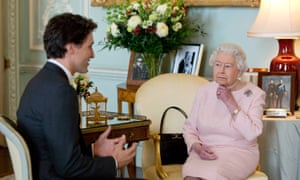
The 94-year-old monarch, who is also Queen of Canada, spoke to Trudeau yesterday – the day of her official birthday in the country. Trudeau tweeted:
We talked about the state of the world, Covid-19, and more. I also thanked her for the hopeful messages she has sent during these difficult times, and I wished her the very best this Victoria Day.”
Victoria Day – 18 May – is the Queen’s official birthday in Canada. As monarch of the Commonwealth, the Queen has a strong bond with Canada. It has been her most frequent overseas destination, visiting it more than 20 times.
As a young child in the 1970s, Trudeau met the Queen several times through his father, Pierre Trudeau, who was one of Canada’s longest-serving prime ministers.
Read the original article at The Guardian