UK coronavirus live: Keir Starmer warns of ‘months and months’ of local lockdowns without better testing and tracing
We’re now closing this live blog. This live blog is now closed. Head over to our global live blog for all the latest coronavirus updates from around the world:
Nick Cohen (@NickCohen4)
Just been talking to @leicesterliz who says Leicester not given virus info because Hancock signed testing contract with Deloitte and did not include the instruction to pass data on to the local authorities who could actually use it. t.co/6wbOFsgtV7
July 1, 2020
Nick Cohen (@NickCohen4)
The great @stellacreasy uncovered the failure. Not only do Deloitte not have to share info with local authorities. They don’t even have to share it with Public Health
July 1, 2020
Michelle O’Neill, Northern Ireland’s deputy first minister, has rejected claims that Sinn Fein was to blame for social distancing rules being breached at a Republican funeral yesterday. (See 10.21am.) Arlene Foster, the first minister, has urged O’Neill to apologise for what happened. But giving evidence to her assembly scrutiny committee, O’Neill declined the invitation to apologise to anyone who might have contracted Covid-19 as a result of being among the crowds at the funeral. She said that in the things the organisers could control – such as the size of the cortege and the numbers inside the church – the regulations were observed. She went on:
I’m satisfied that my actions were within the regulations and the public health guidance – my actions I stand over.
I can only control what’s within my gift.

Michelle O’Neill (right) at Bobby Storey’s funeral at the Milltown Cemetery in west Belfast yesterday. Photograph: Liam McBurney/PA
That’s all from me today.
But our coverage continues on the global coronavirus live blog.

Staff making preparations today at Alton Towers, ahead of its opening to the public on Saturday. Photograph: Fabio De Paola/PA Wire
Bradford Council has said it is “working hard” to prevent another lockdown as figures revealed it has one of the highest rates of Covid-19 infection in England.
As PA Media reports, latest data shows the West Yorkshire city has 69.4 cases per 100,000 population, the second highest in England behind Leicester with 140.2.
In a statement, council leader Susan Hinchcliff said:
We know that figures from Public Health England show Bradford with a high number of infections along with a number of other northern authorities, although we are some way behind Leicester. The number of people testing positive for the virus is still too high and we continue to work hard with all our partners to prevent infection spreading as no-one wants a second lockdown.
As we take more and more steps towards returning to a more normal life, it’s easy to believe that Covid-19 is less of a threat to our health and the health of our family and friends.
This is simply not the case. We urge all residents to continue to follow the guidelines around staying at home as much as possible, social distancing, washing hands frequently and ensuring that they self-isolate and get tested if they, or anyone in their household, develop any symptoms.
Communities could face local coronavirus lockdowns lasting months unless the Government delivers an effective contact-tracing system, Sir Keir Starmer has warned. Speaking to the Local Government Association annual conference – taking place online – the Labour leader said there was a “massive problem” with the NHS Test and Trace programme. As PA Media reports, he said figures from the ONS suggested that three-quarters of the people infected by the virus were not being contacted by the system. He said:
If we don’t get to grips with it we could be in local lockdown situations for months and months and months. It is going to be the story of the summer if we are not careful.
Starmer also called for local councils to be given additional powers to ensure they were able to enforce local lockdown regulations.
If you need to close down a particular area at the moment, I don’t think local authorities have got the necessary powers to do it.
What we can’t have is a situation where statutory instruments or other bits of legislation have to be passed in a hurry in response to each outbreak. There is a huge amount of work to do there.
Starmer also said that with councils facing an estimated £10bn “black hole” in their finances as a result of the pandemic, local services would be slashed without additional support from central government. He said:
After a decade of cuts the coronavirus crisis and the Government’s inaction have created a perfect storm.
Councils are faced with much higher costs for key services such as social care and much lower revenues through falls in areas such as business rates.
It could mean further cuts to social care, fewer police officers. It could mean street lights going on later and going off earlier. It could mean libraries, gyms and community centres staying closed.
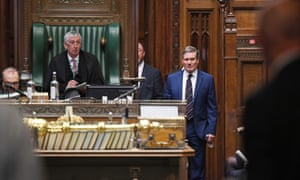
Keir Starmer in the Commons chamber earlier, waiting to take his place for PMQs. Photograph: UK Parliament/Jessica Taylor/PA
The Medical Research Council (MRC) Biostatistics Unit at Cambridge University, which is one of several groups producing R number (reproduction number) estimates for the government, has published its latest “nowcast and forecast”.
It says that R is probably below 1 in every region of England, that new infections are running at about 3,000 per day and that the number of deaths each day is likely to fall to between 35 and 70 by mid July.
The latest edition of the Guardian’s Politics Weekly podcast is out. Jonathan Freedland and Sonia Sodha break down a chock-a-block week for the government and opposition. Patrick Wintour explains the latest spat in the Commonwealth and local councillors David Williams and James Lewis discuss local council finance pressures post-Covid.
Oldham, a former mill town in Greater Manchester, has been mooted as “the next Leicester” by various public health experts today.
But Sean Fielding, Oldham’s council leader, insists the district is “nowhere near” Leicester in terms of the number of positive Covid-cases. He said the council finally had a complete picture of where positive cases have been reported in Oldham and “it shows we are some considerable distance behind Leicester (with others above us).”
He added:
We can’t relax because it’s right that we are high, relatively speaking, but Leicester seems to be something of an outlier.
The Greater Manchester combined authority released its infection figures today, showing what while there had been 135 cases in Leicester per 100,000 people over the last seven days, with numbers increasing, in Greater Manchester there were 13.3 and falling.
Of the ten local authorities in Greater Manchester, Rochdale has the highest rate, with 28.8 cases per 100,000 people, compared with 27.8 in Oldham.
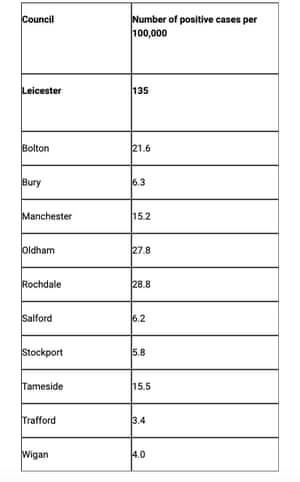
Coronavirus rates in Greater Manchester, compared to Leicester. Photograph: Greater Manchester combined authority
The government has not yet got an answer as to whether it met its target of returning the vast majority of coronavirus tests within 24 hours, as Boris Johnson promised would happen by the end of June. (See 10.13am.) In fact, we learned on the regular No 10 lobby media conference call, we won’t know for another week.
The first statistics on the number of tests completed within 24 hours will come out on Thursday as part of the weekly test and trace statistics, and will then be updated every week. However, this first batch will cover the period of 18-24 June. We will thus have to wait another seven days for the 30 June figure.
Asked whether even he knew if the target had been met, Johnson’s spokesman said: “I don’t, no.”
A sceptic might say that No 10 will at least have some idea, and if it looked like the 24-hour target had been reached, news would get out sooner. But time will tell.
At the science committee Prof Sir John Bell, regius professor of Medicine at Oxford University, says he thinks the figure from ONS surveys suggesting 70% of people infected with coronavirus don’t get symptoms is robust. That is why tackling Covid is so hard, he says; it is a largely asymptomatic disease.
He says that is why mass testing is so important.
He says “saturation testing” in hospitals should be an absolute requirement.
Back in the science committee Kate Bingham, chair of the government’s vaccine taskforce, tells MPs that Oxford University’s coronavirus vaccine is ahead of any other in the world.
At the Downing Street lobby briefing the prime minister’s spokesman defended the way coronavirus testing information had been shared with local authorities. He said:
Since April detailed local data has been shared by Public Health England with local areas. And since June 11 an operational data dashboard was made available by NHS Digital which includes counts of local tests, total positives and test and trace data – it’s to give local authorities a clear picture of the stats in their local area, it was provided to support directors of public health and councils.
Last week we started securely sharing postcode-level testing data with all local authorities including Leicester and that data is available to them at any time.
The UK has enough stocks of the drug remdesivir, the Department of Health has confirmed, after the US bought nearly all the manufacturing stock for the next three months. As PA Media reports, the Department of Health said it had secured supplies of remdesivir in advance and had enough to treat every NHS patient who needs it. It comes after the US Department of Health and Human Services (HSS) said it had secured more than 500,000 treatment courses of remdesivir for American hospitals.
But there have been no further deaths in Northern Ireland, according to today’s bulletin from its Department of Health.
There has been one further coronavirus death in Scotland, the Scottish government has said.
The UK’s official coronavirus death toll has gone up by 176 since yesterday, with a total of 43,906 people who have lost their lives in the pandemic in Britain.
The Department of Health and Social Care has also released the latest testing figures in its daily tweet:
Department of Health and Social Care (@DHSCgovuk)
As of 9am 1 July, there have been 9,662,051 tests, with 226,398 tests on 30 June.
313,483 people have tested positive.
As of 5pm on 30 June, of those tested positive for coronavirus, across all settings, 43,906 have sadly died.
Public Health Wales says a further six people have died after testing positive for coronavirus, taking the total number of deaths to 1,516.
Air pollution is likely to be increasing the number and severity of Covid-19 infections, according to the UK government’s expert advisers. As my colleague Damian Carrington writes, in a report published on Wednesday, the experts said further investigation of the link between dirty air and the coronavirus pandemic was “urgently required” and may be relevant to how the pandemic is managed. The report also found that levels of nitrogen oxides, produced mainly by diesel vehicles, fell by 30-40% in urban areas during the lockdown, though they are likely to be rising again as the restrictions are eased.