UK coronavirus live: Leicester mayor says there is no need to delay lockdown easing
In the Commons the two urgent questions are now over.
We were expecting Matt Hancock, the health secretary, to be making a statement now about the outbreak in Leicester. But it has been postponed until after the debate on the business and planning bill.
This is from the shadow health minister Justin Madders.
Justin Madders MP (@justinmadders)
The Government statement on COVID19 has been delayed by four hours until 9-15pm tonight, most peculiar
June 29, 2020
Given that the mayor of Leicester, Sir Peter Soulsby, has said he is opposed to the measure being proposed earlier by Hancock (an extension of the lockdown by two weeks in the city – see 3.31pm ), there may be some sort of stand-off still ongoing.
The government has published its latest UK coronavirus statistics on its new dashboard. Here are the figures for hospital admissions.
Coronavirus hospital admissions Photograph: No 10
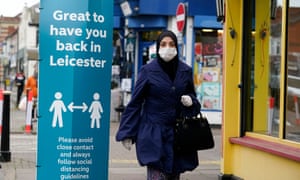
A woman wearing a face mask walking past social distance advisory signs in Leicester’s North Evington neighbourhood today. Photograph: Christopher Furlong/Getty Images
Thérèse Coffey, the work and pensions secretary, told MPs during DWP questions in the Commons this afternoon that sanctions will start to apply again to claimants who fail to turn up for jobcentre appointments after the jobcentres reopen in July. Explaining the decision, she said:
It is important that, as the jobcentres fully reopen this week, we do reinstate the need for having the claimant commitment and it is an essential part of the contract to help people start to reconsider what vacancies there may be.
Labour said the decision was “incomprehensible”. The shadow work and pensions secretary, Jonathan Reynolds, said:
It is incomprehensible that the government is bringing back conditionality and sanctions. At a time when unemployment has risen sharply, vacancies have dropped, people are still shielding and the schools aren’t back, threatening to reduce people’s financial support is untenable.
What’s more, Jobcentre Plus is still lacking guidance on how premises might even open safely. With the unemployment crisis looming, it is alarming that there is no thought being given on how to offer proper support to those seeking work at this time.
This is what Michel Barnier, the EU’s chief Brexit negotiator, posted on Twitter earlier this afternoon as the trade talks with the UK resumed.
Michel Barnier (@MichelBarnier)
Negotiations resumed this morning with @DavidGHFrost & team, in a restricted format. We will make the most of our intensified talks over the coming weeks & months.
Our goal: a comprehensive future relationship w/ 🇬🇧.
People in the UK are still travelling less than 50% of their pre-pandemic distance despite lockdown restrictions easing, according to new figures. As PA Media reports, movement is only increasing by around 2-3% each week, University of Oxford data shows. After sinking to a 98% reduction compared with pre-lockdown levels in mid-April, as of June 22 travelling had increased to around 45%.
One of the researchers involved in the study of movement, Dr Matthias Qian, said:
We explain the slow and steady increase in mobility with the lockdown fatigue of the population while destination choices are limited. The key driver of population movement is the daily commute to work, and these commutes remain muted as many offices have yet to reopen.
In his Times Radio interview this morning Boris Johnson confirmed that he was ruling out a return to austerity (see 10.01am) In adopting this stance, he is adopting a position first championed by Jeremy Corbyn. Both men would be horrified by the comparison, and their actual policies are very different, but Corbyn won the Labour leadership in 2015 partly by saying the party should reject austerity outright, instead of just proposing a milder version of it (as Ed Miliband was accused of doing).
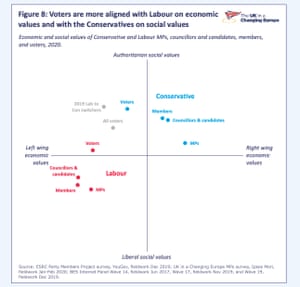
One conventional analysis of what Johnson is doing to the Conservative party is to say that he is moving it to the left on economics, while keeping it on the right on cultural or values issue. Happily, this would put him more or less where the average voter is, as a new report (pdf) for the UK in a Changing Europe project shows. Based on a survey of MPs by Ipsos MORI and new analysis of data from the Economic and Social Research Council’s party member’s project and from the British Election Study, it compares the views of the average voter on economics (left/right) and on values (authoritarian/liberal) with the views of Tory and Labour members, MPs, voters and councillors/candidates.
This chart illustrates the point.
All voter views on economics (left/right) and values (authoritarian/liberal), compared to party views Photograph: UK in a Changing Europe
As the report explains:
Labour across the organisation, whether a member, whether you have run for office for Labour, or whether you are a Labour MP – can be found in the bottom left quarter. The Conservatives – again, at every level – sit in the top right quarter. The voters sit in a different quarter altogether – the top left. Labour is relatively close to its voters on economic issues but is way out of kilter on social issues. For the Conservatives, the opposite is the case.
The report also suggests that, on certain issues, MPs from both parties are out of touch with their voters.
Schools in England will be urged to deploy Covid-secure “year bubbles” of up to 240 pupils under government plans to get all children safely back in the classroom from September, Paul Waugh is reporting in a story for HuffPost.
In an article for the Guardian Lord Kerslake, the former head of the civil service, says Sir Mark Sedwill, the outgoing cabinet secretary and national security adviser, and other senior civil servants have been the victims of “cowardly” hostile briefings condoned by the prime minister. Here’s an extract.
For those who watch these things, the departure of Sir Mark Sedwill as cabinet secretary and chief security adviser followed a now familiar and depressing pattern.
Weeks of anonymous hostile briefing to the newspapers, suggesting a rift between the country’s most senior civil servant and No 10 staff over the handling of coronavirus, had risen to a crescendo, ending with a hastily arranged statement …
In case it gets forgotten in the next news cycle it needs to be said loud and clear that this way of doing business, involving anonymous briefings to the media about individual civil servants, is cowardly, unfair and undermining. Civil servants themselves are simply not in a position to respond – such briefings damage not just the person affected, but also the relationship of trust generally between government ministers and civil servants. Ultimately everyone knows where such malicious briefings come from and it is within the prime minister’s powers to stop them.
In his Times Radio interview this morning Boris Johnson was asked about the negative briefing against Sedwill. He replied:
Look, I try not to read too much of the negative briefing. There’s an awful lot of stuff that comes out in the papers to which … I wouldn’t automatically attach the utmost credence.
But when he was asked directly to confirm that the negative briefing did not come directly from his office, Johnson equivocated, saying that he did not know what specific briefing the presenter was referring to and that “people brief all kinds of things into into the newspapers”.
And here is the full article from Kerslake.
The National Farmers Union has welcomed the creation of a new trade and agriculture commission that it says will help address the “challenges of safeguarding” high food and farming standards post-Brexit, symbolised by fears over trade deals with the US and other countries allowing imports of chlorinated chicken and hormone-fed beef. “This is a hugely important development,” said the NFU president, Minette Batters, who said it would be working to ensure its work was “genuinely valuable”.
The private equity owners of the burger chain Byron are preparing to place the company into administration in the hope of attracting a bidder to buy parts of the business in a so-called pre-pack administration, my colleague Rupert Neate reports.
Speaking before his meeting with Matt Hancock, the health secretary, at 1.30pm to discuss the response to the fresh coronavirus outbreaks in Leicester, the city’s mayor, Sir Peter Soulsby, said he welcomed some of the measures being proposed. He said:
I am pleased with some of the things being suggested.
More testing in Leicester guarantees that testing centres will remain in Leicester for the foreseeable future – that’s great because we’ve had a lot of difficulty in persuading them to keep the testing in Leicester.
Good public information and the use of the many community languages in Leicester to make sure that everybody is able to hear that communication – I’m all for that, of course I am.
But he said that he did not see the case for the easing of the lockdown in the city being delayed for two weeks beyond 4 July, when it is being eased in the rest of England. (See 10.28am.) He said:
What I don’t understand is what a continuation of the restrictions would add. I just can’t see how that could possibly lead to helping our joint effort to contain the virus …
I would say that if a further relaxation of the restrictions is good enough for the rest of England, there is nothing here that suggests it’s not good enough for Leicester.
Asked who would be able to implement further restrictions on the city, the Labour mayor said:
It is very unclear, but I would guess – and it is only a guess – that the government is able to take powers under the Covid legislation to impose a particular restriction in a particular place – in this case Leicester.
As yet, I don’t believe they’ve taken those powers – but I don’t believe it would be very difficult for them to do it if they wanted to.