UK coronavirus live: minister admits more testing capacity needed for care homes
More than 3m EU and European Economic Area citizens and their families have now been granted an immigration status that will secure their right to remain in the UK after Brexit, the Home Office has said.
Future borders minister Kevin Foster said the milestone was reached with over a year still to go until the closure of the settled status scheme “making it the biggest scheme of its kind in British history”.
But figures published today show that 1.29m of them have received “pre-settled status” which is granted to those that have been in the country for fewer than five years.
This suggests that almost half of the previously estimated number of EU citizens in the country, which has ranged from 3m to 3.8m, came to the UK in the past five years, undeterred by Brexit.
The high number could also reflect problems with the process. Previous studies have suggested that some who were qualified for settled status were only granted pre-settled status because they did not provide evidence satisfactory to the Home Office that they were in the country for more than 5 years when they first applied.
In total the Home Office said it has now received 3.5m applications for settled status with 3.1m concluded. It said:
Of the concluded applications 58% 1.8m were granted settled status, 41% (1.29m) settled status and 1% had other outcomes, including 640 refused applications, 23,740 withdrawn or void applications and 10,030 invalid applications.
The London mayor, Sadiq Khan, has told LBC that without the government agreeing a grant for Transport for London today, they will be forced to cut services on busses, tubes, trains and trams across the capital.
Over the last two months we’ve lost more than 90% of our fares and advertising is down and so is the congestion charge. So we’ve been spending £600m a month, paying for services and getting nothing back from our customers, or very little.
So although we had at the start of this crisis a cash reserve of north of £2.1bn, that’s running out and we’re required by law to keep two months’ worth of money in reserve to pay for services.
So we’ve been involved in weeks and weeks of negotiation with the government and its really hard in getting support from them. Being blunt, today is the last day. Unless the government today gives us confirmation of the grant that we need then the consequences could be quite severe and ramifications for all of us will be huge.
He continued:
[There’s] something called the Local Government Act, section 114, and that says basically we’re treated like a local authority and because we can’t go bust, we’ve got to make sure we’ve got the money to pay for services. The only way to balance the books is to cut services.
So ironically at a time when the government’s wanting us to increase services, ramp up services to get into the recovery phrase, we may be required to cut services because the government is failing to give us the grant support we desperately need.

Gordon Brown has called for international coordination to prevent a second or third wave of the Covid-19 pandemic, saying the crisis cannot truly be ended “unless it is eradicated in every continent”.
Writing in the foreword of a new report – Tipping Point: How the Covid-19 pandemic threatens to push the world’s poorest to the brink of survival – by international development charity Christian Aid, he said:
It is in all our interests to prevent a second or third wave starting in the poorest, least protected countries with the most underdeveloped health systems. So a threat to others is a threat to us, and we help ourselves by helping others. Protecting ourselves locally means we need to act globally…
Seventy-five years after VE Day, it is more critical than ever that in another global crisis we rediscover how we can work together to make this world a safer, more connected and a far fairer place. Today we face a global medical emergency, and we cannot end the coronavirus pandemic unless it is eradicated in every continent.
The report examines the situations and the solutions for vulnerable adults and children in a range of countries, where they say the need for cross-border cooperation is clear.
Brown said: “South Sudan is a story about a conflict-affected context with no functioning health system; the Sierra Leone example highlights the merits of a faith-based response and makes the case for debt cancellation; Bangladesh is about the desperate plight of Rohingya refugees; and the situation in Gaza and the surrounding region calls for cooperation across political boundaries.”

Turning back to the Office for National Statistics report on coronavirus and social impacts (see 10.35am), its survey also shows that people are increasingly resigned to it taking a while before life returns to normal.
As the ONS explains in its summary, 46% of adults now think it will be longer than six months for their life to return to normal, compared with 33% after the first week of lockdown.
But when you look at the detailed figures, what is surprising perhaps is that people do seem to think that one day life will get back to normal. Politicians have not been promising that. Nicola Sturgeon, Scotland’s first minister, talks about how people will have to get used to a “new normal”. And the UK government’s coronavirus recovery plan (pdf) does not talk about returning to normal. It says the plan is for life to return life “to as close to normal as possible”, but it also says life post-Covid will be different. It says:
The world will not return to ‘normal’ after Covid-19; much of the global economy is likely to change significantly. The UK will need to be agile in adapting to and shaping this new world if the government is to improve living standards across the nation as it recovers from Covid-19.
But only 3% of people told the ONS that their lives would never return to normal. People were asked how long it would take for their lives to return to normal. Here are the results.
Less than 3 months – 10%
4 to 6 months – 23%
7 to 12 months – 26%
More than 12 months – 20%
Never – 3%
Not sure – 18%

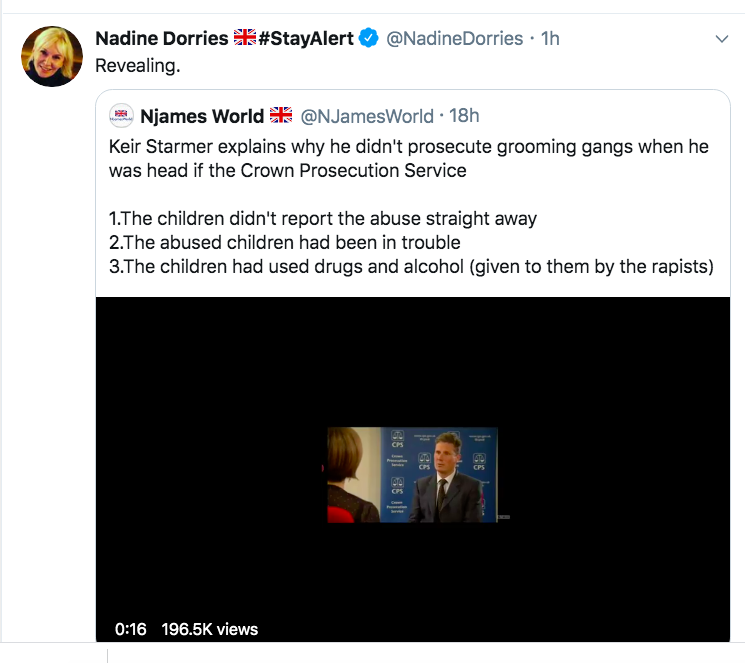
Labour has expressed alarm after a series of Conservative MPs, including a minister, shared a video tweeted by a hard-right Twitter account which falsely claimed Sir Keir Starmer obstructed the targeting of grooming gang victims when he led the Crown Prosecution Service.
The tweeted video was shared by Nadine Dorries, who is now a junior health minister, as well as Telford MP Lucy Allan and Maria Caulfield, who represents Lewes. All expressed alarm at what the video purported to show, with Dorries calling it “revealing”.
The 22-second clip from 2013 shows Starmer apparently recounting reasons why victims of grooming gangs might not be credible, talking about “the assumption that a victim of child sexual abuse will swiftly report what’s happened to them to the police; will be able to give a coherent, consistent account, first time; that they will not themselves have engaged in any offending or other behaviour; and that they will not have misused drugs or alcohol at any stage”.
The original tweeter, who also regularly posts anti-Islam messages and other hard-right content, titled the clip, “Keir Starmer explains why he didn’t prosecute grooming gangs when he was head if the Crown Prosecution Service”.
However, a fuller version of the video shows this is completely misleading. Starmer is in fact explaining why he had changed the prosecution guidelines, to move away from “a number of assumptions, which didn’t withstand scrutiny”.
A Labour source said:
This is a doctored video tweeted by far-right social media account. As a government minister, we hope Nadine Dorries acknowledges this and takes it down.
Dorries later did remove her tweet, as did Allan. Caulfield appeared to delete her entire Twitter account. None had as yet apologised for sharing the misleading message.
Peter Walker
(@peterwalker99)Here’s a screenshot for if/when the tweet is deleted. pic.twitter.com/oCcOALyOBP

A new study published this week in the International Journal of Clinical Practice suggests that more than one in four people in England are likely to have been infected already by the coronavirus.
The study, by researchers from the University of Manchester, Salford Royal and Res Consortium, is the first to use case data from 149 local authorities on the number of people infected in their areas. From this data, the researchers calculated the R-value – the number of people infected by one person with Covid-19 – within each area.
The data shows, they say, that more than 25% of people in England could already have had the virus by the second half of April – higher than previously thought.
The researchers said the UK’s R value, which was over three at the start of the outbreak in the middle of March, was now “well below 1”. This tallies with data published by Public Health England, showing that the overall UK R-value is 0.7 with variation from 0.4 in London to 0.8 in Yorkshire and the north-east of England.
Dr Adrian Heald from the University of Manchester, one of the researchers, said:
Covid-19 is a highly infectious condition and very dangerous for a small group of people. However, a much larger group seem to have low or no symptoms and have been unreported.
This study tries to provide an estimate of the number of historic infections – and gives us all a glimmer of hope that there may be light at the end of the tunnel.
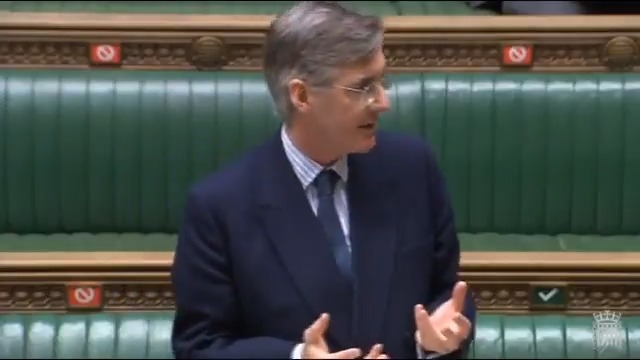
Yesterday Downing Street refused to endorse the claim from Jacob Rees-Mogg, the leader of the Commons, that MPs should “lead by example” by returning to work in parliament in June. The prime minister’s spokesman backed Rees-Mogg in saying MPs should get back to working more normally at some point, but the spokesman drew the line at using Rees-Mogg’s “lead by example” phraseology (which implies MPs needing to take a risk).
As my colleague Rajeev Syal reports, yesterday Sir Lindsay Hoyle, the Commons Speaker, also signalled his opposition to Rees-Mogg’s plan to get the house working again as normal from next month, telling MPs that he would suspend sittings if he thought conditions were not safe.
But Rees-Mogg is not backing down. This morning he has restated his call for MPs to “lead by example”.
Jacob Rees-Mogg
(@Jacob_Rees_Mogg)The Commons must lead by example. Democracy needs debate. pic.twitter.com/j3fw18SRuU
Read the original article at The Guardian