UK coronavirus live: MPs debate controversial plan to end remote voting in Commons
The London borough of Brent has recorded the highest coronavirus death rates in England among confirmed cases of the disease, new figures show.
Up to 13 May, the mortality rate for male confirmed Covid-19 cases in Brent stood at 244.9 deaths per 100,000 population, while for women the rate was 119.4 per 100,000.
The figures, published by NHS England, also show that the eight local authority areas with the highest death rates among male confirmed cases were all in London, with Brent followed by Lambeth (213.3 deaths per 100,000 population), Newham (196.6) and Lewisham (181.5).
The local authority area outside London with the highest death rate among males is Middlesbrough (156.0) followed by Luton (154.7).
For women, seven of the top 10 areas are in London, though Middlesbrough is ranked second (104.7 deaths per 100,000 population), followed by the London boroughs of Lambeth (100.8) and Lewisham (100.0).
Salford is ranked seventh (91.6) and Sunderland is ranked 10th (80.6).
Across England as a whole, the death rate among confirmed cases was highest in London for both males (140.3 per 100,000 population) and females (66.8).
South-west England had the lowest death rate among confirmed cases for both males (33.1) and females (16.3).
In every region of England, the death rate in males was higher than females.
All figures are age-standardised death rates and are based on laboratory-confirmed cases of Covid-19.
Here are the figures for each region in England:
Males
London: 140.3 per 100,000 population
North-west England: 91.2
West Midlands: 90.6
North-east England: 77.6
East of England: 70.1
Yorkshire and the Humber: 68.7
East Midlands: 61.6
South-east England: 55.7
South-west England: 33.1
Females
London: 66.8 per 100,000 population
North-east England: 48.6
North-west England: 48.0
West Midlands: 47.5
Yorkshire and the Humber: 34.4
East of England: 33.5
East Midlands: 31.0
South-east England: 28.3
South-west England: 16.3
Labour MP Dr Rosena Allin-Khan has said Jacob Rees-Mogg’s proposals to end remote parliament voting is “democracy for the elite”.
Dr Rosena Allin-Khan (@DrRosena)
He has also claimed that MPs who have traveled to Parliament today have shown ‘dedication’.
He also suggested that MPs cannot infect each other in Parliament because each sit 2m apart.
Two people have been charged under Scotland’s coronavirus legislation after they needed to be rescued from a munro last Saturday.
Police Scotland confirmed that a 27-year-old man and a 23-year-old woman have been charged in connection with culpable and reckless conduct after travelling more than 60 miles from Glasgow to climb Beinn A’ Chroin, near Crianlarich.
While Scotland’s mountain bothies were closed at the beginning of the pandemic, the country’s mountain rescue teams said they were “nervous” about easing restrictions over the weekend, after they reported the longest period in 20 years without a single rescue during lockdown.
It is clear that the sunny weather encouraged urban hikers to head for the closest munros to Glasgow, with traffic on the A82 at Loch Lomond and in Glen Coe 200% higher than the previous weekend.
Police received reports of the pair – who were not suitably equipped for the climb – being in difficulty on the munro at around 2.40pm on Saturday, when officers and members of Killin Mountain rescue team were deployed to rescue them.
Chief Inspector Gill Marshall, area commander for Stirling, said:
The actions of this man and woman and their lack of equipment not only placed themselves at risk of injury, but also the officers and mountain rescue volunteers who were called to assist them.
We recognise that people have made significant sacrifices until now and while the temptation may be to head straight for one of our beauty spots, we would ask people to use their judgement and avoid going to places which are normally busy during the good weather or, in this case, could put individuals’ lives at risk.
We want people to enjoy our outdoor spaces safely and exercise should be done locally, not exceeding five miles from your home.
So lockdown is eased, sparking one of nature’s most stunning spectacles: the great migration of the humans across the Ikea car park, writes Guardian columnist Marina Hyde.
The Swedish store has replaced Wimbledon as the perfect sport for people who don’t like sport. They even have the dawn queuing. Do you have tickets this year? I’m indifferent to the furniture but I do like to watch the arguments. Seeing couples becoming a singles match over a side table is a quintessential part of British life, like cream teas and the Conservative party polling over 40%.
Meanwhile, and all of a sudden, the government has announced that some of the most vulnerable people in the country can go outside again. “Government eases lockdown for shielders”, was the big news.
And it’s hard to think of a more reassuring headline for this particular group, coming from this particular government.
“Government asks shielders to engage a 1980s Wall Street bro to take care of any household repairs/tree surgery they’ve been putting off during lockdown. Contractor will provide own nailgun and chainsaw.”
NHS England has announced 143 new deaths of people who tested positive for Covid-19, bringing the total number of confirmed reported deaths in hospitals in England to 26,865.
Of the 143 new deaths announced on Tuesday:
19 occurred on 1 June
34 occurred on 31 May
20 occurred on 30 May
The figures also show 58 of the new deaths took place between 5 May and 29 May, eight occurred in April, and the remaining four deaths took place in March, with the earliest on 22 March.
NHS England releases updated figures each day showing the dates of every coronavirus-related death in hospitals in England, often including previously uncounted deaths that took place several days or even weeks ago.
This is because of the time it takes for deaths to be confirmed as testing positive for Covid-19, for post-mortem examinations to be processed and for data from the tests to be validated.
The figures published on Tuesday by NHS England show 8 April continues to have the highest number of hospital deaths on a single day, with a current total of 895.
The decision for England’s official coronavirus alert level to remain at four despite this week’s easing of some lockdown restrictions was made by the chief medical officer, Downing Street has said, indicating he vetoed the government’s wish for it to be lowered.
Prof Chris Whitty’s decision was guided by data provided by the government’s new Joint Biosecurity Centre (JBC), Boris Johnson’s spokesman added.
The government’s formal roadmap for emerging from coronavirus restrictions, published last month, gave a different rationale, stating: “The JBC will be responsible for setting the new Covid-19 alert level to communicate the current level of risk clearly to the public.”
The expectation had been that by the time Monday’s loosened rules came into force, with more businesses opening and groups of up to six people allowed to meet outside, the five-point alert system would have been reduced from four, which means coronavirus transmission “is high or rising exponentially”, to three, where the virus is only “in general circulation”.
Death rates from Covid-19 in England have been higher among people of black and Asian origin than any other ethnic group, a government-ordered inquiry has found.
In addition, those people of black backgrounds are the ethnic group most likely to be diagnosed with the disease, which has claimed almost 50,000 lives in the UK since February.
People of Bangladeshi background face the greatest danger of dying from the disease, according to a review by Public Health England. Their risk of death is double that seen among white British people, says PHE’s report, which was published on Tuesday.
People of Chinese, Indian, Pakistani, other Asian, Caribbean and other black backgrounds also face a much higher risk of death – of between 10% and 50% – compared with white Britons.
The high death rates in black and Asian communities are a significant reversal of previous trends, because until the pandemic white Britons were the ethnic group most likely to die from any cause, PHE says.
British households repaid record amounts of debt racked up on credit cards and personal loans in April as consumers stayed away from the high street during lockdown.
Figures from the Bank of England show £7.4bn of consumer credit was repaid during the first full month of strict restrictions on business and social life, the largest net repayment since records began in 1993.
Reflecting a record plunge in retail spending in April as people stayed indoors, the Bank said £5bn in credit card debt was paid off in April, more than double the previous month and far more than the typical £300m paid back monthly by consumers.
However, outstanding debts on credit cards remain about £64bn. Experts also warned that while many households managed to repay their debts during lockdown, the hit to workers’ wages and rising job losses at the onset of the deepest recession in living memory would force others deep into the red.
A further seven people have died after testing positive for coronavirus in Wales, taking the total number of deaths to 1,354.
Another 67 people have tested positive for Covid-19, bringing the total number of confirmed cases in the country to 14,121.
The daily Downing Street press conferences will no longer take place at weekends when viewing figures are “significantly lower”, Number 10 has said.
Briefings have been held on all but two days since 16 March, but the government has decided to scrap them on Saturdays and Sundays from this week.
The prime minister’s official spokesman told a Westminster briefing:
From this week, the press conferences will be on weekdays only, so no longer on Saturdays and Sundays.
The PM will take a press conference every week alongside … the scientific and medical experts.
Others will be led by secretaries of state, alongside scientific and medical experts where relevant.
Asked why the change was being made, the spokesman said: “It is just a fact that the numbers who are viewing at weekends do tend to be significantly lower.”
Number 10 insisted the government was “absolutely committed to keeping people updated”.
The health secretary, Matt Hancock, has led the most Downing Street press conferences so far, totalling 17 as of Tuesday, while Boris Johnson has led 12 and the foreign secretary, Dominic Raab, has taken 11.
In the Commons Jacob Rees-Mogg accepts the new voting system will involve some “teething problems”.
An MP asks if Rees-Mogg has ever been to Alton Towers. (The queuing system has been compared to the one at the attraction – see 2.26pm.) To the surprise of some MPs, Rees-Mogg tells them he has been there. He took his sister, Annunziata, many years ago, he says.
A further two people have died after contracting Covid-19 in Northern Ireland, bringing the total toll to 526.
Four more positive tests brought the total diagnosed, largely in hospitals, to 4,732.
In the Commons Jacob Rees-Mogg, the leader of the Commons, said that he disapproved of remote voting because voting was a serious act. He said that it was wrong for MPs to be able to exercise their vote while at home, perhaps watching TV.
He also said that he did not accept that, under his plan, MPs who had to shield at home were being disenfranchised. They would still be able to participate in other parliamentary affairs, such as by asking questions, he said.
MPs unable to attend parliament to vote in person could in theory pair with an MP from another party. (That would mean both agreeing not to vote, cancelling each other out.) But the political parties never reveal which MPs are paired, with the result that if an MP pairs, people do not know why they were absent.
Asked if pairing information should be published, Rees-Mogg said he could not give a commitment on this, but he suggested the idea should be raised with party whips.
And, asked if the proxy voting system (that allows MPs on maternity leave to vote by proxy) could be extended for those shielding, Rees-Mogg did not embrace the idea – but he said he was not ruling it out either.
The decision for England’s official coronavirus alert level to remain at four despite this week’s easing of some lockdown restrictions was made by the chief medical officer, Downing Street has said, indicating he vetoed the government’s wish for it to be lowered. Our colleague Peter Walker has the full story here.
In the Commons Jacob Rees-Mogg, the leader of the Commons, has just opened the debate on his plan to end electronic, or remote, voting in the Commons. This is hugely controversial because MPs who have been told they cannot attend parliament because they are shielding say they will be disenfranchised. (See 9.35am and 2.14pm.)
Rees-Mogg said he would tomorrow table a plan to allow MPs who cannot attend the Commons on health grounds to participate in debates (presumably via Zoom, as MPs were able to do under the “hybrid” proceedings arrangements in place before the Whitsun recess.)
But he is receiving many hostile interventions from MPs who argue that the new system will not work. The DUP’s Ian Paisley said it was hard for MPs to travel from Northern Ireland to London at the moment and that, if they came to London, they wanted to concentrate on debating. He said that under the Rees-Mogg plan, which would involve MPs having to queue at great length to vote in person, divisions would take too much time.
Rees-Mogg did not accept the point. He said voting would only take a little longer.
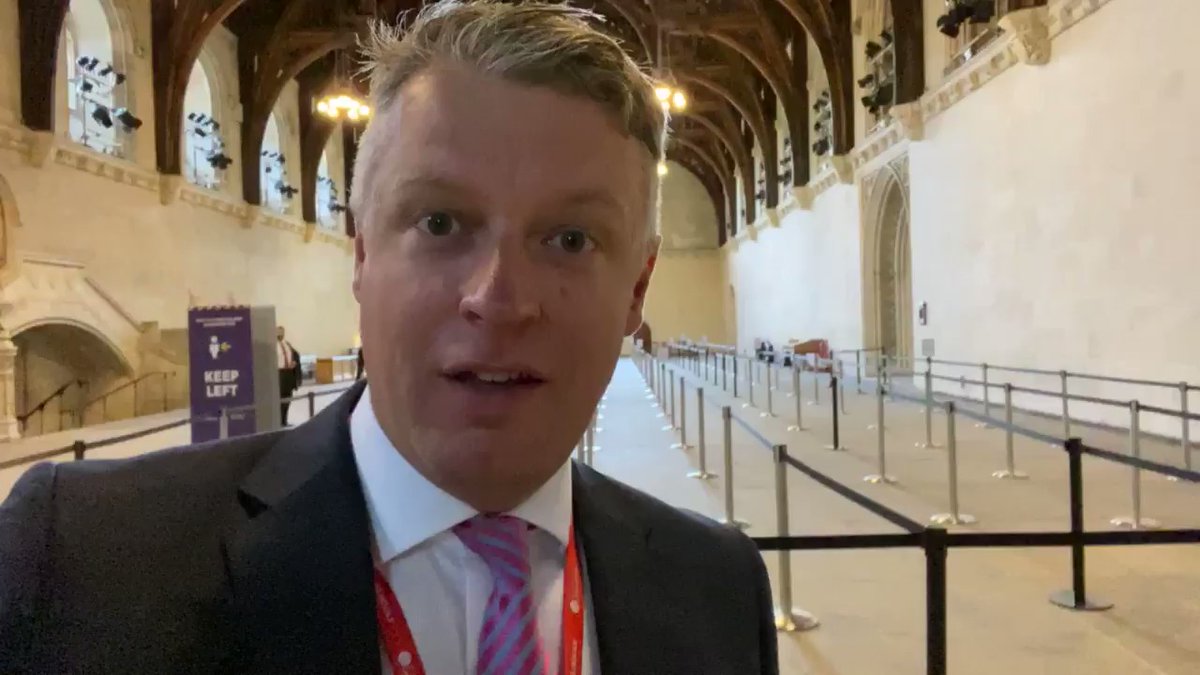
The Labour MP Luke Pollard has posted this video showing the scene in Westminster Hall this afternoon, where MPs will be expected to queue as they line up to vote later.
The Equality and Human Rights Commission has condemned the UK government’s plan to only allow MPs to participate in Commons debates and votes in person, saying it “cannot be right” to exclude older MPs or those with disabilities or illnesses, our colleague Peter Walker reports.
In a joint statement welcoming the move the Conservative MP Robert Halfon, chair of the Commons education committee, and Labour’s Vicky Foxcroft, the shadow minister for disabilities, said:
What stronger message can you get than the EHRC, one of the government’s own non-departmental public bodies, confirming that the ending of remote participation for those of us who are shielding or otherwise unable to attend parliament is discriminatory?
As MPs – from opposite sides of the house – who are shielding, we have many important issues we need to raise on behalf of disabled people and our fellow shielders.
Disabled people have felt like an afterthought throughout this pandemic and it is therefore vital that the government looks again at the proposed return to physical participation.
This briefing, produced by barristers from Cloisters chambers, looks at the equality and human rights implications of Jacob Rees-Mogg’s plan to end electronic voting, and whether it could be challenged in the courts. It concludes:
The ability of MPs to participate in the parliamentary process on an equal basis regardless of age, disability, ethnicity, sex and carer status engages fundamental equality and human rights principles. The legal mechanisms for enforcing these principles through the courts are far from straightforward … However, although the legal issues are technical, the basic question is not. What kind of democracy are we, if our elected representatives can be excluded from carrying out their democratic functions because of, or for reasons relating, to their age, race, sex or state of health?
Under the initial lockdown law – the Health Protection (Coronavirus, Restrictions) (England) Regulations 2020 – the rules had to be reviewed at least every three weeks.
But, in a Commons written statement, Matt Hancock, the health secretary, has said they will now be reviewed every four weeks. He explained:
This will allow decisions to align more closely with the period of time necessary to assess the impact of previous changes on key data feeds, including the R (infection) rate.
The government will also keep all the measures under continual review and will account to parliament on an ongoing basis.