UK coronavirus live: No 10 refuses call for urgent review of ‘second wave’ readiness; death toll rises by 154
Downing Street has refused accept a call from Britain’s medical leaders for a review into how prepared the country is for a second wave of coronavirus. (See 2.46pm.)
The Department for Health and Social Care has recorded a further 154 coronavirus deaths in the UK, taking the total to 43,081. (See 4.05pm.)
Labour Whips (@labourwhips)
Govt don’t oppose the motion so it goes through without a division. t.co/D97oo8L8Zr
June 24, 2020
Liz Truss, the international trade secretary, has told MPs that the UK will not allow US chlorine-washed chicken to be stocked in supermarkets as a ban is already written into law. Giving evidence to the international trade committee, she said a ban on importing chlorinated chicken was “already in UK law” as part of the Brexit withdrawal agreement ratified by parliament.
That’s all from me for today.
But the coverage continues on our global coronavirus live blog.
The Guardian’s latest Politics Weekly podcast is out. Jonathan Freedland and Kate Proctor discuss the latest in Westminster, and Peter Walker updates us on Robert Jenrick’s troubles. Plus, Miatta Fahnbulleh and Anoosh Chakelian discuss what’s next for the UK economy, post-furlough scheme.
The Department for Health and Social Care has recorded a further 154 coronavirus deaths in the UK, taking the total to 43,081. The full figures are here.
These figures only cover the deaths of people who have tested positive for coronavirus and died. The UK figure for all deaths caused by coronavirus is more than 54,000.
Department of Health and Social Care (@DHSCgovuk)
As of 9am 24 June, there have been 8,542,186 tests, with 232,086 tests on 23 June.
306,862 people have tested positive.
As of 5pm on 23 June, of those tested positive for coronavirus, across all settings, 43,081 have sadly died.
For comparison, here are the equivalent daily UK figures for the past two weeks.
Wednesday 10 June – 245
Thursday 11 June – 151
Friday 12 June – 202
Saturday 13 June – 181
Sunday 14 June – 36
Monday 15 June – 38
Tuesday 16 June – 233
Wednesday 17 June – 184
Thursday 18 June – 135
Friday 19 June – 173
Saturday 20 June – 128
Sunday 21 June – 43
Monday 22 June – 15
Tuesday 23 June – 171
And in another article for the Guardian Stephen Reicher, a psychology professor and member of SPI-B, the Sage subcommittee advising the government on behavioural issues, has strongly criticised Boris Johnson’s decision to abandon the two-metre rule. Here’s an extract.
Whatever the prime minister might say, his policies lead to banner headlines such as Freedom Pass and Independence Day. But we don’t even need to read the papers. Every time we pass an open bar, it will scream to us that the danger is all but gone and we are “back to normal”. After all, who in their right mind would reopen the pubs and abandon distancing in the midst of a deadly pandemic?
But perhaps that is overstating things a little. After all, the government isn’t abandoning all distancing measures. It is saying 1 metre is acceptable when 2 metres is impossible, as long as other measures are applied. True. However, research in the field of proxemics – the study of space and social interaction – shows that, in the UK, 1 metre is roughly the distance we ordinarily maintain with others. So reducing it to 1 metre is akin to removing any restrictions from distancing, and hence functions as another signal of back to normal.
The full article is here.
UPDATE: And this is what Prof Stephen Reicher had to say about Boris Johnson’s comments about the test and trace system at PMQs.
Stephen Reicher (@ReicherStephen)
At PMQ Johnson calls the test and trace system a stunning success based on 87,000 people being contacted and asked to self-isolate in two weeks. Assuming (modestly) 30,000 infections a week and each having 10 contacts that is 87,000/600,000 (14.5%)… pic.twitter.com/NaowysC9jG
June 24, 2020
Stephen Reicher (@ReicherStephen)
.. and that’s before you count in how many of those contacted did actually self-isolate. So the real figure is probably less thatn 10% of contacts of those infected actually self-isolating. A stunning success? In what world?
June 24, 2020
Stephen Reicher (@ReicherStephen)
The only thing worse than not having a functional test and trace system is not admitting to not having a functional test and trace system. That way you won’t improve and you will make premature decisions to relax restrictions. Which, of course, is what has just happened.
June 24, 2020
Labour has warned Rishi Sunak that the Treasury’s one-size-fits-all approach to ending wage subsidies risks a period of mass unemployment that will reverse much of the good done by the furlough, my colleague Larry Elliott reports. Writing for the Guardian, the shadow chancellor, Anneliese Dodds, called on Sunak to use his planned summer statement next month to extend financial support to vulnerable sectors beyond the October deadline for winding up the scheme.
The full story from Larry is here.
Tracey Crouch, the Conservative former sports minister, has revealed that she is being treated for breast cancer.
Tracey Crouch (@tracey_crouch)
A bit of personal news… Unfortunately I was recently diagnosed with breast cancer. It was caught early & am in the hands of the excellent team at @MTWnhs. Full statement below. 1/ pic.twitter.com/2xVZwLUSQr
June 24, 2020
There has been one further coronavirus death in Northern Ireland, according to the Department of Health in Northern Ireland, taking the total to 547.
The head of Scotland’s largest teaching union has written an excoriating letter to members highlighting the “anxiety, frustration, confusion and even anger” prompted by the Scottish government’s decision yesterday to park agreed plans for a socially distanced return to schools in August, instead telling teachers to prepare for full-time return with no distancing.
The move came after a significant backlash from concerned parents who were facing indefinite part-time schooling as some years groups were told pupils would only be spending one or two days each week in classrooms and the rest at home.
The general secretary of the Educational Institute of Scotland (EIS), Larry Flanagan, described it as a “political announcement”, and said that the statement had not been discussed with the CERG (Covid Education Recovery Group), of which he is a member.
In a strongly-worded members’ email, Flanagan said the sudden policy shift from blended model of at-home and in-school learning to accommodate distancing to no distancing was a “maybes aye; maybes naw” scenario, dependent on levels of virus suppression in seven weeks’ time and giving no certainty in the interim.
He also highlighted to frustration of teachers who had been working hard to put blended learning in place, only to have the plans change dramatically in the week – and in some cases on the day – that term ends.
He added that the EIS “is not convinced that no physical distancing between pupils is safe and we are absolutely certain that physical distancing between pupils and teachers remains essential”. Accepting that by August the amount of distance required may have been reduced from the current 2-metre requirement – the Scottish government’s scientific advisory group will report on this by 2 July – Flannagan insisted “there cannot be a social distancing rule for outside of schools and a different one for inside classrooms”.
A woman wearing a mask on the beach at Southend on Sea today. Photograph: Ben Stansall/AFP/Getty Images
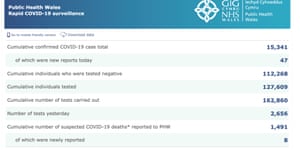
Public Health Wales has recorded a further eight coronavirus deaths in Wales, taking the total to 1,491. The full details are here.
Coronavirus figures Photograph: Public Health Wales
NHS England has recorded a further 51 hospital coronavirus deaths in England, taking the total to 28,435. The full details are here.
For comparison, here are the equivalent daily figures announced over the last two weeks.
Wednesday 10 June – 88
Thursday 11 June – 83
Friday 12 June – 70
Saturday 13 June – 67
Sunday 14 June – 27
Monday 15 June – 28
Tuesday 16 June – 79
Wednesday 17 June – 77
Thursday 18 June – 62
Friday 19 June – 46
Saturday 20 June – 71
Sunday 21 June – 26
Monday 22 June – 20
Tuesday 23 June – 46
The Downing Street lobby briefing is over. Here are the main points.
No 10 is refusing to accept the call from Britain’s medical leaders for a review into how prepared the country is for a second wave of coronavirus. (See 11.40am.) Asked about the letter from them in the BMJ, the prime minister’s spokesman said that the government had taken “unprecedented action” to support the NHS. He also said the emergency Nightingale hospitals were on standby and could be used in the winter if necessary. The Nightingale hospitals in London, Manchester, Bristol, Harrogate and Sunderland have all been mothballed. The one in Exeter is still being built, but will also be put on standby when it is ready, the spokesman indicated.
The spokesman defended Boris Johnson’s claim that no country in the world has a “functional” contact-tracing app. Echoing a claim he made in the Commons yesterday, Johnson told MPs at PMQs:
I wonder whether [Starmer] can name a single country in the world that has a functional contact-tracing app? Because there isn’t one.
When it was put to him that other countries do have apps, the spokesman said that they did not fully record people’s contacts and that they were not reliable enough to be used to tell people to self-isolate. The spokesman also referred to this blog from the Full Fact factchecking website. The article concluded:
While it’s certainly true that some countries have launched track-and-trace apps, it may be too early to know whether these apps are having the intended effect in helping to contain the spread of the pandemic.
The spokesman said, under the new rules coming into force in England from 4 July, the police would be able to break up “large and irresponsible gatherings of over 30 people”. But largely the new guidance will be advisory, rather than mandatory. The spokesman also said that the police would be able to enforce the rule about wearing face masks on public transport and the rules relating to quarantine.
The spokesman played down suggestions that it might be necessary for signs in England telling people to observe the 2-metre rule to be replaced. He said that at the press conference yesterday Prof Chris Whitty, the government’s chief medical adviser, had stressed that the 2-metre rule was still a good one to follow.
Downing Street was unable to defend Johnson’s claim at PMQs today that “actually there are 100,000 fewer children in absolute poverty and 500,000 falling below the thresholds of low income and material deprivation”. As the Mirror’s Dan Bloom reports, official figures suggest both claims are wrong (although Johnson did not explain what timeframe he was using).
Dan Bloom (@danbloom1)
Boris Johnson makes misleading PMQs child poverty claims for second week in a
June 24, 2020
The spokesman suggested that Johnson was not proposing any new help for people who have to self-isolate, when he told MPs at PMQs that “nobody should be penalised for doing the right thing”. (See 12.20pm.) The spokesman said that this was a phrase Johnson has used before. It was a reference to statutory sick pay being available, he said, adding that some employers also offered their own help to workers who were self-isolating.
The spokesman would not commit to the government holding a coronavirus press conference at least once a week, now that the daily one has been cancelled. He just said they would take place when the government had significant news to announce.
The spokesman said that the government would be publishing more documents today providing guidance for businesses about opening up in England from 4 July. It published 11 overnight. (See 9.29am.)
Robert Jenrick, the housing secretary, has pledged to release “all relevant information” connected to a major property development involving the Tory party donor Richard Desmond. Speaking in the Commons, in the debate on a Labour motion saying all the papers should be published, he said he would outline the timeline of events and the rationale for his decision-making over the Westferry Printworks planning decision.
As PA Media reports, Jenrick said further information would be released later today, noting that discussions and correspondence “which the government would not normally release” would be made public.
He accused Labour of making “wild accusations” against him and claimed the documents would show a decision was taken with an “open mind” on the merits of the case.
Robert Jenrick in the Commons. Photograph: House of Commons/PA
At the Commons home affairs committee this morning Yvette Cooper, the Labour chair, said she was “shocked” when told that full police data on the proportion of lockdown fines handed to BAME people would not be released until late July.
As PA Media reports, the chairman of the National Police Chiefs’ Council (NPCC), Martin Hewitt, told the committee the figures would only be ready in the third week of July. Publicly available data suggests that black, Asian and minority ethnic (BAME) people have been at least 50% more likely to receive coronavirus lockdown fines in England than white people. The Government Statistical Service is looking through all police data up to 8 June, before it will be published by the NPCC. Hewitt told the committee:
I think it is really important that data is contextualised. Ultimately each force has to account for the way that they ran the operation through the pandemic.
In response, Cooper said:
This is a very long time to wait for what seems to be some extremely basic data that actually seems to be really important in the policing decisions that need to be made.
I’ll be honest with you, I’m really shocked that you don’t have this data that you haven’t got a system for collecting this data built in from the beginning and that it is taking so long.
I do appreciate that these were completely new regulations that you had to enforce but I don’t understand why this data wouldn’t be collected normally anyway and that you can’t provide it more swiftly.