UK coronavirus: Wales to prioritise reopening schools; M&S sandwich supplier closes factory after outbreak – as it happened
That’s all from the UK blog today, as always you can continue reading over on our global coronavirus blog after Italy records its biggest daily infection rise since May.
Thanks for reading along, and to all those who got in touch throughout the day.
Here’s a quick summary of the day’s events:
Four-week reprieve for renters in England and Wales facing eviction in Covid pandemic. Renters in England and Wales facing eviction after falling behind on rent during the coronavirus pandemic are to be given a one-month reprieve.
Oldham to face tougher restrictions but spared full Covid lockdown. Oldham, which had the highest infection rate in the UK last week, has avoided a full Leicester-style lockdown after arguing it would do little to reduce the spread of coronavirus and would cripple the economy and fuel racism. Meanwhile, Wigan in Greater Manchester and Rossendale and Darwen in Lancashire are to be released from lockdown before the rest of the region from Wednesday as the government takes a “much more targeted approach” to managing outbreaks, local MPs have claimed.
Travellers scramble to return before new quarantine deadline as Shapps rules out regional approach. Thousands of British holidaymakers in Croatia are trying to cut their trip short or change their plans to avoid having to quarantine for 14 days on their return home, after the Balkan country was removed from the UK government’s travel corridor list.
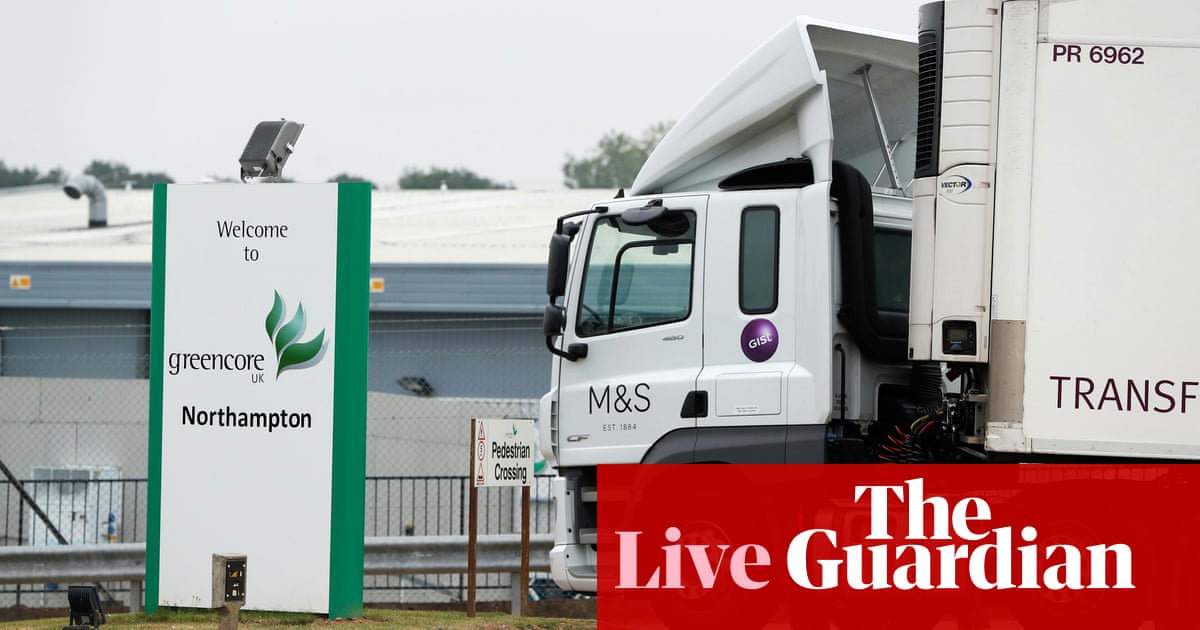
M&S sandwich supplier to close factory and staff to self-isolate for 14 days. The Greencore factory in Northampton will close from Friday, after it was announced last week that more than 200 people had tested positive for Covid-19 in an outbreak linked to the sandwich factory.
UK’s cheap food could fuel Covid-19 spread, says WHO envoy. Britain’s demand for cheap food could be fuelling the spread of coronavirus in factories, a leading health expert has said, as analysis shows nearly 1,500 cases across the UK.
Make Covid-19 tests compulsory for students, say scientists. Covid-19 tests should be compulsory for all university students and staff to prevent outbreaks on campuses and protect communities, according to an independent group of scientists.
Wales will prioritise reopening schools over everything else: first minister. Reopening schools in September will be given “top priority” over easing any further coronavirus regulations in Wales, the first minister has said.
Outsourced firms miss 46% of Covid test contacts in England’s worst-hit areas. Outsourcing companies running the government’s flagship test-and-trace system have failed to reach nearly half of potentially exposed people in areas with the highest Covid infections rates in England, official figures show.
Birmingham: 1m asked to restrict home visitors to prevent new lockdown. More than a million people in Birmingham will be advised to limit the number of people entering their homes to two as part of voluntary restrictions to stave off a local lockdown.
R value for UK may have risen above 1.0 for first time since weekly reporting of data began. The figure reflects the average number of people a person infected with coronavirus passes the disease on to. When the figure is above 1, an outbreak can grow exponentially.
Universities warn of pandemic risk if upgraded A-level students admitted. University vice-chancellors are warning that taking large numbers of extra undergraduates would put students, staff and local communities at risk from Covid-19.
The chair of Ofqual threatened to quit this week unless Gavin Williamson publicly backed the exams regulator and admitted it was behind the U-turn that salvaged millions of student grades, the Guardian has learned.
Roger Taylor’s ultimatum came after the education secretary tried to lay the blame for the exams fiasco at the door of Ofqual following a humiliating climbdown that scrapped A-levels and GCSEs awarded by algorithm.
Taylor went directly to Williamson to demand a public statement of support or he would resign. It came the day before hundreds of thousands of pupils in England received their GCSE results.
So serious was the threat of a void at the top of Ofqual that Amanda Spielman, Taylor’s predecessor and now chief inspector of the schools watchdog Ofsted, was being lined up to potentially step in and support the regulator, it is understood. She could still be called on if Taylor or Ofqual’s chief regulator, Sally Collier, resigns.
Williamson’s Department for Education (DfE) – after seeking approval from Downing Street – hurriedly issued a statement on Wednesday saying: “We have full confidence in Ofqual and its leadership in their role as independent regulator.”
To placate Taylor, the DfE also confirmed that it had been Ofqual’s decision to drop grades decided by algorithm in favour of grades recommended by teachers, and that it had been backed by the government in doing so.
More than a million people in Birmingham will be advised to limit the number of people entering their homes to two as part of voluntary restrictions to stave off a local lockdown.
The UK’s second biggest city was placed on the government’s “watch list” on Friday as cases rose, prompting the council to suggest a series of voluntary measures which include limiting public gatherings to 30 people except for communal prayer and asking drivers and passengers in taxis to wear face coverings.
There will also be a pause on any areas of the Birmingham economy opening up which remain closed, such as nightclubs and conference centres.
Cases of Covid-19 are rising quickly in the city, with 30.2 cases per 100,000 and the percentage of people testing positive up to 4.3%. More than half of cases in the last week have been within the 18-34 age demographic.
Sushi chain Wasabi has launched a restructuring plan which could see up to 12 stores shut after sales were hit by the coronavirus pandemic.
Sources told the PA news agency that a “handful of stores” could cease trading, with this potentially rising to “as many as twelve” depending on conversations with landlords.
It is the latest sushi retailer to pursue a company voluntary arrangement (CVA) restructuring process after rivals Itsu and Yo! announced similar proposals in recent weeks.
The company, which employs more than 1,500 and runs 51 sushi and bento shops across the UK, said it was “impacted profoundly” by lockdown measures introduced in March.
Henry Birts, chief executive officer of Wasabi, said:
Prior to the outbreak of the pandemic, Wasabi had been performing strongly on the back of the investment and operational improvements we had made during 2019.
However, the extraordinary impact of Covid-19 on trading has meant that we now need to take additional steps to address our fixed cost-base if we are to secure the long-term future of our business.
In recent weeks, we have had constructive engagement with landlords regarding better alignment of the rents of certain sites in proportion with footfall and trading, and we will continue to work closely with them over the days ahead.
We strongly believe that this turnaround programme will provide us with a stable platform upon which we can emerge from this difficult period as a healthy and sustainable business, for our staff, suppliers and loyal customers.
Housing secretary Robert Jenrick said ministers had set out to protect the most vulnerable in society during the pandemic, concluding it was “important” to extend the eviction ban for a further four weeks.
He told BBC News:
At the start of the pandemic we said that we would set out to protect the most vulnerable people in society.
We did that by helping rough sleepers off the streets, we did it through the shielding programme and we did it importantly by ensuring that nobody could be evicted during the height of Covid.
This week, we have reviewed the evidence as we said we would and concluded that it is important to keep that stay on evictions going for another four weeks.
We have also put in place extra protections for renters, in particular a new six-month notice period before which proceedings could start.
We’ve worked with the judiciary and the courts service, so that when the courts do reopen, they will rigorously prioritise the cases that come forwards, so that the first cases are the most egregious ones, including anti-social behaviour and domestic abuse.
It’s time the government delivered on its pledge to end ‘no fault’ notices that allow landlords to throw people out on the street, writes Alicia Kennedy, director of the campaign group Generation Rent.
The housing secretary, Robert Jenrick, pledged in March that no renter who had lost income due to coronavirus would be forced out of their home and introduced a ban on evictions in England and Wales. On Friday, after growing pressure from housing charities, MPs, legal experts and local authorities, the government extended the ban for four weeks.
Postponing eviction proceedings will keep renters in their homes for now, but it’s just a sticking plaster. The number of private renters in arrears in England is double what it was this time last year, and for some the rent debt will keep racking up. The furlough scheme is coming to an end, unemployment continues to rise and benefit payments are insufficient to cover average rents. Without extra protections thousands of renters are at serious risk of losing their homes when the ban ends.
New research from Generation Rent this week found that just 12% of those who applied for benefits after lockdown have been able to cover their rent – meaning hundreds of thousands of renters have been forced to rely solely on their landlord’s goodwill.
Learner drivers were left unable to book a driving test on Friday after the website crashed under “unprecedented demand”.
The Driver and Vehicle Standards Agency (DVSA) started taking bookings for England and Wales once again from 8am, after several months of suspension due to lockdown.
But people complained about problems arranging a slot on social media. When attempting to access the application page users were met with an error message.
The DVSA said in a statement:
Coronavirus has severely impacted our business as usual operations, including by stopping driving tests for many months as part of social distancing.
Following unprecedented demand for the driving test booking system after its reopening, we are aware that some users have not been able to complete their test bookings.
We are urgently working to fix this and apologise for any inconvenience caused to those who have been unable to book so far.
The agency added: “There are limited numbers of tests available today but more will be released on Monday.
“We’re not taking bookings for any further than 6 weeks in advance.”
Learners whose tests were cancelled during lockdown were invited to rebook first in July.
The DVSA said some 210,000 tests were cancelled and tens of thousands more were delayed because of the virus.
Driving tests in Scotland are set to restart from 14 September, but people are not yet able to book a slot.
All Btec students will receive their results by the end of next week following delays, the awarding organisation has said.
A spokeswoman for Pearson said: “We have now written to colleges to confirm that all eligible results will be available by August 28.”
It comes after hundreds of thousands of students were told last-minute that they would not receive their Btec results this week amid a U-turn.
The exam board made the decision to review the grading of their level one to three Btec qualifications following Ofqual’s announcement that A-level and GCSE students would receive grades based on their teachers’ estimates.
A statement from Pearson added:
We know this has caused frustration and additional uncertainty for students, and we are truly sorry.
No grades will go down as part of this review.
The R value for the UK may have risen above 1.0 for the first time since weekly reporting of data began.
The figure reflects the average number of people a person infected with coronavirus passes the disease on to. When the figure is above 1, an outbreak can grow exponentially.
The latest figures for the UK reveal an R value of between 0.9 and 1.1, with the number of new infections somewhere between shrinking by 3% and growing by 1% every day. The figures for England are between 0.9 and 1.0, with the growth in new infections between -3% and 0.
This is the highest the R rate has been since the UK government started releasing the figures to reflect developments in the pandemic on 15 May.
The official figure has previously reached 0.8-1.0 for the UK as a whole, but it has never moved above 1, although previous modelling has suggested it may have edged above this threshold in some regions.
“We have been seeing indications that these values may be increasing, with estimated ranges increasing slightly from previous publications,” the team behind the data said.
It is an increasingly common modern annoyance: arriving at the front of the queue to pay in a shop, pulling out a smartphone for a hygienic contact-free payment, and staring down at an error message because your phone fails to recognise your masked face.
As more and more nations mandate masks to prevent the spread of coronavirus, technology companies are scrambling to keep up with the changing world. But some experts warn the change may have to start with users themselves.
People across the UK are being urged to take up the call to be part of the ongoing and expanding study into coronavirus levels throughout the population.
The head of the Office for National Statistics (ONS) has encouraged people who are contacted to be part of the survey to make the “small commitment” in order to help “contain this terrible virus and get on with our lives”.
Hundreds of thousands are likely to be asked to take part after officials this week announced plans to expand the programme to include 400,000 across the UK, up from the 28,000 people who are regularly being tested.
By October, 150,000 people will be involved, the Department of Health and Social Care said.
Professor Sir Ian Diamond, who is also the UK’s national statistician, said the response to date had been “brilliant” but that researchers were now “setting our sights higher”. He said:
The more tests we do, the more accurate our figures will become. Without the best information we can’t expect the authorities to make the best decisions about imposing or lifting restrictions.
We want to recruit up to 400,000 people right across England, with more in Scotland, Wales and Northern Ireland too. Their test results will give us a much more localised view of the presence of the virus down to city and county level.
Addresses are randomly chosen and householders invited to take part in the coronavirus infection survey.
The random selection, rather than volunteers coming forward, helps make estimates more scientifically reliable, Sir Ian said.
Those who take part are tested once a week for the first month and up to once a month after that, by a trained visitor to their home “to make sure the test is done properly and safely”.
The samples are then taken for analysis and results passed on to the volunteer’s doctor.
Sir Ian said: “So, if you get our letter do please take part. You will be helping us all to contain this terrible virus and get on with our lives.”
On Friday ONS figures showed that an estimated 24,600 people in private households in England had Covid-19 between August 7 and 13.
The organisation said that while recent figures had suggested the percentage of individuals testing positive for Covid-19 in households in England had risen slightly in July, this trend now appears to have levelled off.
A contact tracer in the north-west tells how she has not been given any cases since she started in May:
In 12 weeks I have not made a single call despite working 42 hours a week for £10.12 an hour. One of my friends started at the same time and they haven’t been assigned any cases either. We are not alone: we have a Whatsapp group comparing notes with other call handlers and quite a few haven’t had even one job the entire time.
My understanding was that we were going to be allocated local cases. Given that the north-west has seen some of the biggest spikes in infections you would think we would be especially busy but apparently not.
Outsourcing companies running the government’s flagship test-and-trace system have failed to reach nearly half of potentially exposed people in areas with the highest Covid infections rates in England, official figures show.
In the country’s 20 worst-hit areas, Serco and Sitel – paid £200m between them – reached only 54% of people who had been in close proximity to an infected person, meaning more than 21,000 exposed people were not contacted.
In Bradford, 42% of exposed people were reached, with 3,691 of those potentially infected not traced. In Birmingham, which was on Friday placed on the national watch list after a sharp rise in cases, 52% of close contacts were reached and 1,462 missed.
The figures will prompt further scrutiny of Serco and Sitel roles in running a large chunk of the system. The two private firms, whose contracts are due for renewal on Sunday, were paid an initial £192m for the first three months of the programme, with the value of the contract reaching £730m over 12 months.
Paul Hunter, a professor in medicine at the University of East Anglia, said the system was not “world-beating”, as the prime minister has said.
The biggest mistake was making it a commercially run thing. That was never going to work.
I think it’s got better recently but that should never have been allowed to happen – that disconnect between the national and local level.
Teams will be withdrawn from the Tour de France if two riders or staff show symptoms or test positive for Covid-19 under strict protocols from race organisers.
However the race, which starts in Nice on 29 August, will continue even if there is a confirmed case of coronavirus in the peloton, according to an 18-page document shared with teams this week.
“If two persons or more from the same team present strongly suspect symptoms or have tested positive for Covid-19 the team in question will be expelled from the Tour de France,” states the document, which has been obtained by the cycling website VeloNews.
“Its riders will not be authorised to start the Tour de France (or the next stage) and the team’s personnel will have their accreditation withdrawn.”
All team members will have to enter a “bubble” three days before the race by passing two Covid-19 tests – and everyone in the Tour entourage will be tested again on both rest days, 7 and 14 September.
The government said 41,405 people had died in the UK within 28 days of testing positive for Covid-19 as of 5pm on Thursday, an increase of two on the day before.
Separate figures published by the UK’s statistics agencies show there have now been 57,000 deaths registered in the UK where Covid-19 was mentioned on the death certificate.
The government also said that as of 9am on Friday, there had been a further 1,033 lab-confirmed cases of coronavirus. Overall, 323,313 cases have been confirmed.
The last time Boris Johnson went on a proper break, in January, he chose the Caribbean and stayed in a luxury villa on the island of Mustique that costs £15,000 a week.
His summer holiday, it emerged on Friday, had a studiedly different vibe: a remote three-bedroom cottage on the coast of Scotland – with a tent in the garden.
In some ways, the property fits the bill for the prime ministerial getaway: chintzy furniture, log-burner, a cot, pets allowed, will comfortably accommodate his family of three, appears ideally located to avoid passersby (or, at least, it must have done until a long-lens photographer of the Daily Mail showed up).
But the tent?
With Downing Street reluctant to be drawn on any aspect of the holiday, speculation about the canvas yurt abounded.