UK economy shrinks by 2% as Covid-19 slump begins – business live
The prospect of tax rises and spending cuts to fund the UK’s £300bn Covid-19 bill hasn’t gone down well with some in the City.
Bill Blain, market strategist at Shard Capital argues forcibly that the government should look to grow its way out of the crisis, not inflict more austerity.
The Treasury plan looks a tad premature… We are still in immediate crisis mode. They are also utterly misguided.
The virus is the smoking gun pointed at the heart of the $90 trillion global economy. It’s bad. There is blood and gore everywhere. Just how bad we don’t yet know, but it’s clear of we don’t choose the right policies/treatments to address the deepening economic catastrophe, then we’re doomed.
The growth reality is simple. Every single corporate on the planet is going to figure out the outlook. If they are watching and listening to governments rein in spending too early and institute austerity spending, then they will predict and prepare for deeper recession. If every corporate is cutting investment plans, reducing headcount, and instituting cost controls – then the economic effect is inevitable; rising unemployment and an ongoing demand shock.
This is the time to be spending our way out the Coronavirus recession.
It doesn’t all have to be negative. Losing our God-given-right to an exotic beach holiday every year spells a massive boost to staycations! (Why did I not buy that cottage in Rock last year!!) It’s going to change, not end, the way we do business. Redirecting the resources currently employed in aerospace towards renewables and new tech will take time – but is possible. Time is the critical ingredient we need to re-order the economy.
If there isn’t a vaccine soon, the border will remain closed and global trade will wither. Protectionism and the growing China/US cold war will deepen. Get used to a new normal economy.
The government would argue that it is trying to limit economic damage through gradually easing its lockdown this week, so that people who can’t work from home return to work.
But even here there is confusion, as Mike Hampson, CEO of Bishopsgate Financial, writes:
We need to get the economy going again but the chaotic nature of the government messaging on how this is going to happen is a real problem. They need to get a grip on a clear message for business, and other sectors as to what they can do and how they can safely restart operations.
The slump in UK GDP is likely to be followed by a spike in unemployment.
Professor Costas Milas of the University of Liverpool has plotted together the UK unemployment rate and his measure of the UK output gap* based on today’s data.
And it’s bad news….
The output gap (output relative to potential) is now already as bad as it was during the peak of the 2009 crisis. In fact, my quantitative estimates suggest that unemployment might have already reached a 4.1% jobless rate in 2020 Q1 (official figures are due next week).
Since the 2020 Q2 GDP figure will be much worse, it is extremely likely that UK unemployment might reach double figures by summer… And all this despite the job retention scheme…
UK output gap vs unemployment Photograph: Professor Costas Milas
[* – for economists in the room, he’s used 3 statistical trend filters: a Quadratic trend filter, a Hodrick-Prescott filter and a Band-pass filter]
Investors are now paying for the privilege of holding some UK government debt.
Economist Shaun Richards has flagged up that the yield on two-year British gilts fell to -0.04% this morning.
Yields (or the interest rate on the bond) move inversely to prices, so a negative bond yield means you’d be guaranteed a small loss if you held it until maturity.
Shaun Richards (@notayesmansecon)
Negative Interest-Rates in the UK Klaxon!
The two-year UK Gilt yield has fallen to -0.04% this morning
Low bond yields are a sign that investors are worried about growth and inflation prospects, and looking for a safe place for their money. It also suggests they expect the Bank of England to ease monetary policy soon by expanding its bond-buying QE programme.
Deputy governor Ben Broadbent hinted as much yesterday.
Services output fell by 6.2%, the largest monthly fall since records began in January 1997. Several sectors suffered their largest falls on record, including accommodation and food services (down 31%), and transportation and storage (down 13).
Film and TV production declined by 18.5% while personal services (such as hairdressers and dry cleaning) declined by 24.8%.
But the computer programming industry grew by 1.5%.
The ONS says this was:
…driven by large businesses and with responder-led evidence suggesting that “there was a high demand for IT equipment such as desktops and laptops” because of the increase in home working. However, small businesses did experience a fall during March.
Production output slumped by 4.2%, which the ONS says was the worst fall since the Winter of Discontent in 1979 .
UK production output in March 2020 (the drop in 2019 was due to car factories pausing work in case of a hard Brexit) Photograph: Office for National Statistics
But there were bright spots –including 13.0% increase in production of industrial gases, inorganics or fertilisers, which is the third-strongest growth since records began.
This appears to be driven by strong demand for chemicals used in disinfectants and hand sanitisers.
And the paper industry had a record-breaking month, thanks to stockpiling:
Monthly growth for the paper and paper products industry of 11.3% has never been stronger, underpinned by the “panic buying” of products such as toilet roll, kitchen roll and facial tissues.
Paper production in UK, March 2020 Photograph: Office for National Statistics
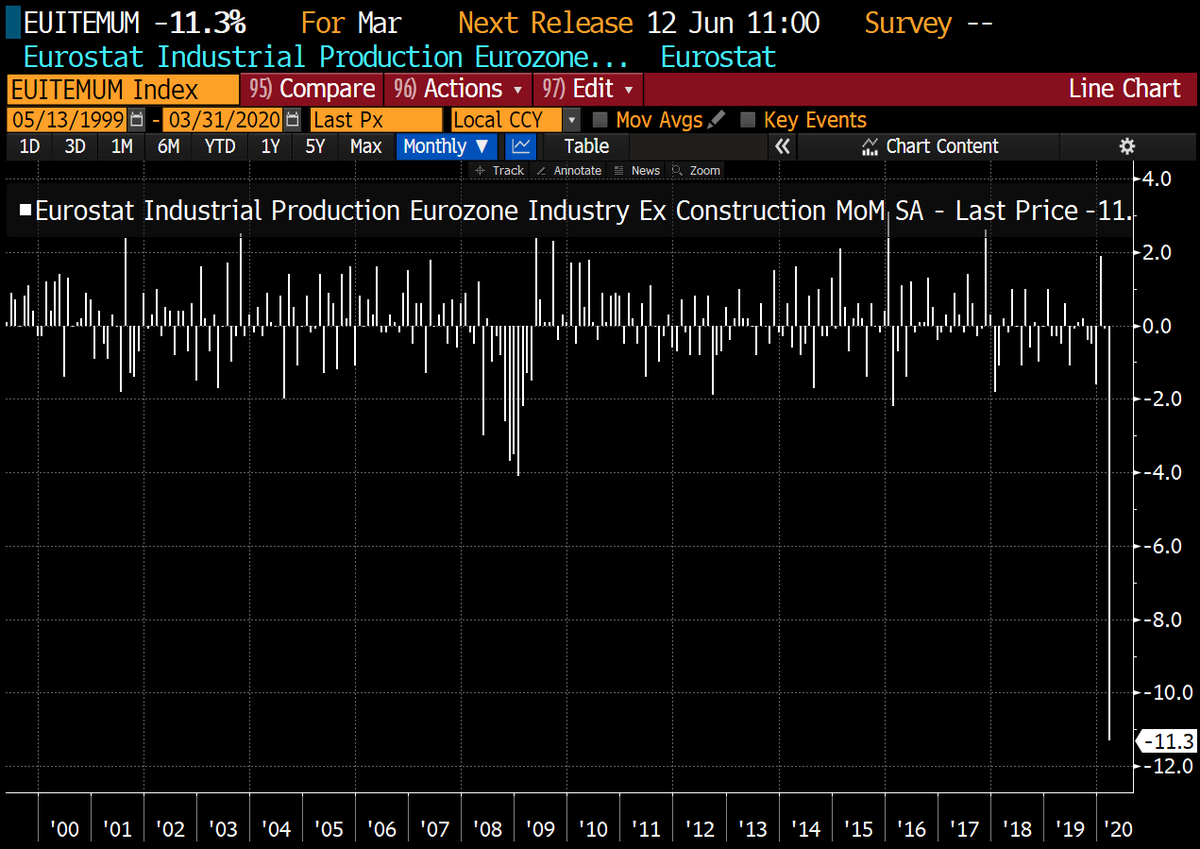
Eurozone factories also had a torrid March, with widespread shutdown hurting the industry.
New data today shows that industrial production across the euro area slumped by over 11%, a record low – and nearly three times as bad as any single month in the financial crisis.
Production of ‘durable consumer goods’ (ie TV sets, kitchen appliances or cars) slumped by 26% during the month.
Capital goods (heavy-duty machinery and equipment) fell by 15.9% compared with February. But non-durable goods (ie food and drink) only fell by 1.6% – propped up by strong demand as people stocked up.
Howard Archer (@HowardArcherUK)
March #Eurozone#industrial production down record 11.3% m/m & 12.9% y/y as #coronavirus restrictions took major toll on already struggling #manufacturing sector. Sharp m/m falls in output of consumer durable goods (26.3%) & capital goods (15.9%) t.co/Mq90wb1HK6
The Observer’s economics editor, Phillip Inman, tackled the subject of debt and austerity last weekend.
This anticipated today’s concerns that a huge deficit in public spending this year would trigger a traditional Treasury response of higher taxes, cuts to welfare payments and state services.
He says higher levels of debt can be maintained in the post-Covid world following a steep fall in interest rates that is not likely to reverse for more than a decade or two.
With almost every developed world country experiencing a dramatic increase in debt, lenders seeking a safe haven will have nowhere to go.
Here’s the piece:
Economist Rupert Seggins has helpfully plotted the Q1 growth figures from major economies, showing that the UK is in a mid-table spot:
Rupert Seggins (@Rupert_Seggins)
UK GDP fell 2%q/q in the first quarter of the year (1st estimate), as Coronavirus effect hit in March. Largest GDP fall since 2008, although the figure for Q2 will see a far bigger fall. France’s GDP currently hardest hit in Q1 among OECD countries that have reported. pic.twitter.com/7wQUmkmVEQ
Keen gardeners have seized the opportunity to return to garden centres as they reopened in England this morning.
Between 30 and 40 customers queued outside Chessington Garden Centre in Surrey before it reopened at 9am this morning.
Shoppers filled the trolleys with bright plants, hanging baskets and compost, with many saying they wanted to bring some colour to their pots and gardens.
Chessington Garden Centre today Photograph: Joanna Partridge
Chessington Garden Centre today Photograph: Joanna Partridge
Being allowed to reopen is a “relief” for managing director Jolyon Martin, although he says they have already lost 30% of their annual turnover – having been forced to close during almost two months of their peak sales season.
Joanna Partridge (@JoannaPartridge)
It’s the day gardeners have been waiting for. Between 30 – 40 shoppers queued to get into Chessington Garden Centre as it reopened at 9am this morning pic.twitter.com/2Sp6A4Esud
And once the Covid-19 downturn is over, the UK will have to decide how it pays the bill.
Today’s Daily Telegraph reports that tax rises or a public sector wage freeze are being considered as options that might be needed to help the government cover the cost of the coronavirus crisis.
This raises the dire prospect of another bout of austerity… but Sunak insists it’s ‘premature’ to think about it.
Faisal Islam (@faisalislam)
On Telegraph leak that says internally “v-shaped” bounce back seem as optimistic: Sunak: “ I think it’s premature to speculate. But what we do know is in order to make sure that recovery is as swift as strong as we will like it to be we need to take action now to protect jobs…”
Transport secretary Grant Shapps has also played this down, saying:
In terms of payment, we’ll have to have future budgets, we’ll get to that, but right now we are still in the midst of this thing and we’re clear that we’re not going to go back to world of austerity in order to do that.
Our main UK Covid-19 liveblog has all the details:
It’s worth noting that Britain’s borrowing costs are near record lows at present. The UK can borrow for 30 years at just 0.8% per year — so there’s plenty of appetite for gilts.
The Covid-19 recession is forcing Europe’s largest travel company, TUI, to cut 8,000 jobs:
Economists don’t agree on everything. But the universal consensus is that today’s grim UK GDP figures are only a taster for what’s ahead of us.
Stefan Koopman, senior market economist at Rabobank, fears Britain will suffer a U-shaped recover, with a ‘double-digit’ slump in the April-June quarter:
“The UK’s economic engine will be much harder to kickstart than it was to stall, as illustrated by the latest raft of data releases. Talk of a V-shaped recovery feels like wishful thinking and we expect prolonged periods of depressed growth across the majority of the economy. A flatter, U-shaped recovery is more likely.
“Double-digit declines in GDP growth will follow for the second quarter and the full year, but forecasts for beyond that horizon are near-impossible to predict. The risk of a second lockdown should another outbreak occur combined with rock-bottom levels of consumer confidence make for a potent mix of issues for businesses to deal with.”
Hugh Gimber, global market strategist at J.P. Morgan Asset Management, fears the economy won’t recover from the Covid-19 shock until 2022:
“While economic activity should improve from the second half of this year, it still appears that a rebound is likely to be very gradual, and one that leaves GDP levels at the end of 2021 below where they finished 2019.”
Artur Baluszynski, head of research at investment managers Henderson Rowe, points out that other European countries fared even worse as they had tougher lockdowns (as explained earlier).
“The numbers are really bad, especially considering that the lockdown only started mid-March. One of the reasons why the -2% figure is better than expected is because the real impairment of the consumer demand is likely to show up in April numbers.
However, we can now see how the UK’s more relaxed lockdown measures helped the economy to fare better than France or Spain which contracted close to 6% over the same period.
But this doesn’t mean that the UK economy will spring back unharmed, explains Melanie Baker, senior economist at Royal London Asset Management:
“The economic damage from roughly only a week of lockdown is striking. Activity growth in April will be much worse.
“As social distancing is eased, we will probably see a strong initial bounce in activity. However, there isn’t a straightforward trade-off between social distancing and activity.
“Until businesses and households are confident that the virus poses little danger to lives and livelihoods, the recovery is likely to lag and activity levels will struggle to return to pre-crisis norms.”
Here’s our economics editor Larry Elliott on today’s grim UK growth figures:
A record monthly plunge in activity meant the UK economy contracted by 2% in the first quarter of 2020, according to official figures.
Data from the Office for National Statistics revealed the immediate impact of the coronavirus lockdown, producing an unprecedented decline in output in March and the sharpest three-month contraction since the depths of the financial crisis in late 2008.
UK quarterly GDP Photograph: Office for National Statistics
Although restrictions on businesses and individuals were only introduced in mid-March, the ONS said it was enough to cause a 5.8% plunge in activity in March.
All three main components of growth, services, production and construction, were affected by the fallout from the global pandemic – with factories, shops, restaurants, hotels and building sites all closed on government orders.
Ruth Gregory, UK economist at consultancy Capital Economics, said: “March’s GDP figures showed the UK economy was already in freefall within two weeks of the lockdown going into effect. And with the restrictions in place until mid-May and then only lifted very slightly, April will be far worse.”
Service sector output – which accounts four-fifths of GDP – declined by more than 6% in March, while production fell by 4.2% and construction by 5.9%.
Over the year to the first quarter of this year, the economy grew smaller by 1.6% – its fastest rate of decline since late 2009.
Here’s Larry’s full story:
Prince Charles, Prince of Wales, inspecting Aston Martin’s first SUV, the DBX, at its Lagonda factory in St Athan in February Photograph: Chris Jackson/Getty Images
Aston Martin’s losses ballooned to £119m in the first three months of the year as the coronavirus pandemic caused the already struggling British carmaker’s sales to plunge across the world.
The company sold only 578 cars to dealers in the first quarter of 2020, down 45% from the same period in 2019.
Sales slumped by 86% in China in the quarter, while they were down by 57% and 30% in the Americas and Europe respectively, despite lockdown conditions not starting in earnest until late March.
The company is now focusing on reducing the number of cars held by dealers, as well as delivering its new DBX SUV, a car whose success is crucial for Aston Martin’s survival.
Aston Martin was the last of the large UK carmakers to pause production as the pandemic hit in March. It reopened its new St Athan plant in south Wales on 5 May in order to ramp up to full DBX production in “the next few weeks”. Deliveries to customers who have pre-ordered are on track to start in the summer.
However, the first-quarter figures revealed the strain the company was under before it agreed the bailout, with net debt rising to almost £1bn – 16 times higher than a year’s adjusted operating profitability.
Aston Martin will now only build cars to fulfill order demand, and it also suspended its financial guidance for the year.
Over in the City, the FTSE 100 index of blue-chip shares has fallen by 1.3% in early trading, down 78 points to 5916 points.
Other European markets are also in the red, as investors fret about the risk of a second wave of Covid-19 infections as lockdowns are lifted.
Yesterday, a key member of the White House’s coronavirus task force warned that reopening the US economy too soon could lead to ‘really serious’ consequences.
Dr Anthony Fauci warned that ‘little spikes’ in infection could soon turn into fresh outbreaks, forcing lockdown measures to be reimposed.
Fauci told US senators that:
..there is a real risk that you will trigger an outbreak that you might not be able to control, which in fact, paradoxically, will set you back — not only leading to some suffering and death that could be avoided, but could even set you back on the road on trying to get economic recovery
Anthony Fauci: ‘serious consequences’ if US exits lockdown too early – video
Jing Teow, senior economist at PwC, says the outlook for the UK economy is also ‘highly uncertain’.
The government’s announcement that workers in the manufacturing and construction sector should return to work this week where safe, as well as opening the housing market, could mitigate some of the disruption to business activity in the current quarter.
However, this will depend on the effectiveness of current lockdown measures in preventing a second wave of infections, which may necessitate the reimposition of these measures later on in the year.”
Tej Parikh, chief economist at the Institute of Directors, isn’t convinced that Britain will ‘emerge stronger’ from the lockdown slump, as Rishi Sunak claims.
Parikh fears that activity levels among UK firms will remain depressed “for the foreseeable future”, given the challenge of obeying physical distancing rules:
“While countless companies have made adjustments with admirable speed, many will find it difficult to operate at anything like normal capacity under social distancing rules. The furlough scheme has undoubtedly staved off redundancies, and the new flexibility provides businesses a better chance of rebooting.
“The Treasury will need to continue innovating to kickstart any recovery. The Government’s loan scheme provided ready cash, but now leaves many firms saddled with debt. Unless this is managed well, it will drag on business investment for long after the lockdown ends.”
Sunak blamed the economic damage caused by the Covid-19 pandemic, adding that his freshly-extended jobs retention scheme should help Britain get through the crisis.
He says (via Sky News):
In common with pretty much every other economy around the world we’re facing severe impact from the coronavirus. You’re seeing that in the numbers.
That’s why we’ve taken the unprecedented action that we have to support people’s jobs, their incomes and livelihoods at this time, and support businesses, so we can get through this period of severe disruption and emerge stronger on the other side.
SkyNews (@SkyNews)
BREAKING: Chancellor Rishi Sunak says it is “no surprise” the UK economy shrank by 2% in the three months to the end of March, as the UK faces “severe impact” from the #coronavirus.