UK factories suffer worst quarter on record amid coronavirus lockdown – as it happened
Time for a quick recap.
UK factories have suffered their worst quarterly slump in activity since at least the 1970s, as the coronavirus lockdown hit the economy. Manufacturers are also anxious about their prospects for the coming months, with export orders down sharply.
Investors continue to fret about the possibility of a second wave of Covid-19 infections as Western economies reopen. Several US states have reported a rise in cases in recent days, while a local infection in Germany has pushed its R-rate sharply higher.
The FTSE 100 is down 47 points, or 0.75%, in late trading in London at 6251 points, while Wall Street has opened lower.
Drinks firm Diageo (-3.6%), jet engine maker Rolls-Royce (-3.5%) and medical equipment firm Smith & Nephew (-2.8%) are the top fallers on the FTSE 100.
US home sales have fallen to their lowest level in some eight years, as property transactions were curbed by the pandemic.
David Rosenberg (@EconguyRosie)
Housing looks like an M-shaped recovery. Resale activity well below expectations in May to a ten-year low. And this is supposed to be the sector that blazes the trail for this (alleged) recovery! pic.twitter.com/cxRHg6pU0f
June 22, 2020
Consumer confidence across Europe is also weak, although not as bad as in April and May.
Bank of England governor Andrew Bailey has revealed that the UK government could have been left temporarily unable to borrow during the March market panic, before the BoE stepped in.
Bailey has also suggested that the Bank could unwind its QE bond-buying programme before raising interest rates from their record lows.
The London Stock Exchange boss Nikhil Rathi has been appointed chief executive of the Financial Conduct Authority, making him the first BAME leader of the UK’s City regulator.
Ian Mason, head of UK Financial Services at Gowling WLG, thinks Rathi is a good choice to replace Bailey at the FCA:
“Mr Rathi will join the FCA with a full in-tray, but his previous background and experience suggest that he is well equipped to make a flying start. His work at the Treasury on EU and international markets will be important in working with the Government to navigate a workable regulatory outcome on Brexit for the UK.
His CEO role at the London Stock Exchange will have provided commercial experience at the sharp end of the financial markets. Another major challenge will be dealing with post COVID-19 planning, including the accumulated consumer and corporate debts, which are building up. His relative youth should provide the energy and impetus required at the time, and as we have seen with Rishi Sunak, who appointed him, age is no barrier to ability in high profile positions. As an external appointment, he will also bring a new perspective to the FCA’s culture and priorities.”
Thanks for reading, We’ll be back tomorrow… GW
This is why US realtors are optimistic, despite sliding home sales last month.
MacroMarketsDaily (@macro_daily)
The surge in mortgage applications to a decade-high so far in June suggests that, even with a potential much higher rejection rate, home sales will rebound from June pic.twitter.com/SOO5NuRxwT
June 22, 2020
In another unsurprising development, sales of homes across America have fallen sharply.
Sales of existing homes (rather than new builds) crashed last month to an annual rate of just 3.91m units, which is the lowest since 2012. Potential buyers were kept away by lockdown restrictions, and the surge in unemployment across the US.
But estate agents are hopeful that sales could recover as the economy returns to more normal conditions….
James Picerno (@jpicerno)
US existing home sales crashed in May,falling to the lowest level since 2012 — 3.91 million units (seasonally adjusted annual rate). But a rebound is near as the economy reopens, predicts the economist at Nat’l Assoc of Realtors, which publishes the data: t.co/4SAk18wC7Mpic.twitter.com/EgN9zUDxeX
June 22, 2020
Consumer confidence across the eurozone has risen slightly, but remains extremely weak as the pandemic rumbles on.
The EC’s gauge of consumer morale has risen to -14.7 this month, according to provisional data just released, up from -18.8 in May. That’s a little better than feared, but still lower than average (understandably!).
Jeremy (@mehabecapital)
EUROZONE JUNE 2020 PRELIM CONSUMER CONFIDENCE -14.7 VS -15 EXP, PRIOR -18.8.$EUR
June 22, 2020
Howard Archer (@HowardArcherUK)
#Eurozone #consumer confidence improved appreciably in June amid widespread easing of lockdown restrictions according to European Commission’s flash reading. Index up to 3-month high of -14.7 from -18.8 in May & -22.0 in April (lowest since Dec 2012). Long-term average is -11.1
June 22, 2020
New figures show that UK shops are still rather quieter than a year ago, despite a surge in visitors after some lockdown restrictions were lifted.
Our economics editor Larry Elliott explains:
Shoppers flocked back to the high streets in England over the past week as non-essential stores reopened but numbers remained well down on a year earlier, according to the latest survey of retail footfall.
Springboard, a company that measures the number of potential customers at retail outlets across the UK, found that footfall in the week starting 15 June was up 45% on the previous week.
But with numbers influenced by later reopenings in Scotland and Wales, restrictions on pubic transport and a shift to online shopping, footfall was down 54% on the same week in 2019.
A sign for Wall Street near the New York Stock Exchange in New York Photograph: Justin Lane/EPA
The US stock market has dipped in early trading, as investors weighed up the recent increase in Covid-19 cases in some American states.
The Dow has lost 193 points, or 0.75%, at the open to 25,678, matching the small losses in Europe earlier today.
The broader S&P 500 has lost 0.5%, while the tech-heavy focused Nasdaq is 0.2% lower.
Edward Moya of OANDA says investors are watching the Covid case numbers closely, but aren’t panicking.
While the number of new COVID-19 cases is noticeably higher in the southeast regions, that is being attributed to reopening before seeing their cases come down to low levels.
Despite the surge in new cases, risk appetite is holding up because confidence is higher with how doctors can treat the virus and now that the virus is working its way through younger individuals. If the seven states that hit record highs with daily cases continues to grow exponentially, that should start to weigh on risk appetite.
The BBC are reporting that sandwich chain Pret a Manger could cut jobs early next month, after suffering a slump in sales under the lockdown.
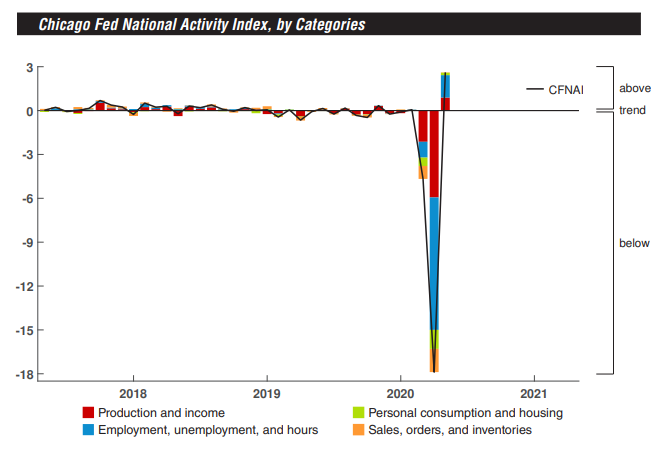
In an encouraging sign, the Chicago Federal Reserve’s index of economic activity across the US has climbed into positive territory.
The Chicago Fed’s national activity index has risen to 2.61 for May, from -17.89 in April as US states locked down.
This index measures production, employment, consumption and sales, so this suggests economic growth increased substantially in May after a terrible April.
The record slump in UK factory output in the last three months is “very disappointing,” says Howard Archer, chief economic advisor to the EY ITEM Club
It suggests that the economy is still struggling, several weeks after the government started to relax some of its lockdown restrictions to get people back to work.
Archer says:
The June CBI industrial trends survey is still extremely weak overall indicating that the manufacturing sector is still struggling hugely despite the progressive easing of lockdown restrictions since mid-May.
There have been signs that the economy started to recover in May from April’s lows, and the expectation is that June will see further improvement in economic activity as lockdown restrictions have been eased further. However, the disappointing June CBI industrial trends survey highlights the fact that major uncertainty remains as to just how robust the recovery will be
We suspect that the economy will likely contract around 17% quarter-on-quarter in the second quarter. We expect the economy to return to clear growth in the third quarter with GDP expanding close to 10% quarter-on-quarter. This assumes a further easing of lockdown restrictions, including a relaxation of social distancing rules. We expect GDP to contract around 8.0% over 2020
The CBI survey showed only a slight pick-up in orders in June from May’s lowest level since October 1981, as foreign demand fell to an all-time low. Output over the past three months contracted at a record rate
Prices over the next three months are expected to fall markedly, clearly reflecting manufacturers’ perceived need to discount to try to gain business by discounting
Output expectations for the next three months picked up modestly for a second month running in June from April’s record low, although they remained extremely low and well in contraction territory
Bank of England governor Andrew Bailey is certainly making headlines today.
He’s been interviewed by Sky News, and warned that Britain’s government could have been unable to finance itself without the Bank’s stimulus packages.
Bailey explained that the core financial markets came “pretty near” to meltdown in March, adding:
“We had a lot of volatility in core markets: the core exchange rate, core government bond markets.
“We were seeing things that were pretty unprecedented, certainly in recent times. And we were facing serious disorder.
And if the Bank hasn’t intervened by cutting interest rates and boosting its QE programme? Bailey says Britain could have been in deep trouble….
“I think the prospects would have been very bad. It would have been very serious.
“I think we would have a situation where in the worst element, the government would have struggled to fund itself in the short run.”
Former FCA board member Mick McAteer says Nikhil Rathi’s appointment as the new City watchdog CEO is a “very big statement” on the regulator’s priorities post-Brexit, given his background in international financial services.
Between 2009-2014, Rathi led the Treasury’s work on the UK’s EU and international financial services interests, and after joining the London Stock Exchange as its chief executive, also served as the group’s international development executive.
McAteer, who now runs the Financial Inclusion Centre thinktank, said:
“It sends a powerful signal that FCA is likely to become more internationally focused in the post Brexit world.
The regulator is likely to play a bigger role in protecting the City as a pre-eminent international financial centre given the potential loss of business post Brexit.”
However, McAteer worries that consumer protections might take a backseat and that Rathi may be pushed to row back on key regulations.
“I hope it does not signal that consumer protection will be relegated as a priority. For years, prior to the FCA being created, consumer protection played second fiddle to financial stability and market regulation.
Campaigners will need to be on their guard to make sure that this does not happen again. There are already concerns that industry lobbies are pushing for deregulation post Brexit.”
Here’s our news story on the latest Wirecard developments:
UK manufacturers also expect average selling prices to fall over the next quarter, reflecting weak demand.
Photograph: CBI
It’s not surprise that factory output slumped since the pandemic began (it shows the lockdown is working as planned).
But the CBI is particularly concerned that factory order books are “remarkably poor”, suggesting manufacturing is still very weak.
CBI Economics (@CBI_Economics)
The UK #manufacturing sector remained in a deep downturn in June due to the ongoing COVID-19 crisis. Output volumes fell at a record pace in the three months to June, exceeding the previous record from May 2020 #ITS t.co/L9gEFq8WBqpic.twitter.com/2iC2AC2z8K
June 22, 2020
CBI Economics (@CBI_Economics)
Total order books remained remarkably poor, despite improving slightly on May, while export order books worsened to their lowest on record #ITS t.co/L9gEFq8WBqpic.twitter.com/Z7ss6n7yGV
June 22, 2020
Breaking: UK factories have suffered their worst quarter on record, thanks to the ongoing lockdown.
The CBI reports that British industrial output shrank at an unprecedented pace in the three months to June as COVID-19 heavily disrupted operations.
Factory bosses also fear further declines in the months ahead, undermining hopes of a rapid recovery from the pandemic.
The CBI’s monthly Industrial Trends Survey found thatoutput dropped in 15 out of 17 sub-sectors. The headline fall in output volumes was driven by the motor vehicles & transport equipment, mechanical engineering, and metal products sub-sectors.
This pulled its gauge of industrial output down to -57 for the last quarter, from -54 a month ago, the lowest since the measure started in July 1975.
CBI industrial trends survey Photograph: CBI
Total order books remained poor by historical standards, the CBI adds, despite improving slightly on last month. Meanwhile, export orders books worsened on the previous month, falling to their lowest since the survey began in April 1977.
Anna Leach, CBI Deputy Chief Economist, is urging the government to keep supporting the industry until the pandemic is over:
“The UK manufacturing sector remained in a deep downturn in June due to the ongoing COVID-19 crisis. Output volumes declined at a new record pace and export order books fell to an all-time low, reflecting the significant fall in demand in the UK and abroad. Firms are again hoping that this will ease somewhat in the next three months.
“The Government has already undertaken a huge amount of work to provide financial lifelines to businesses throughout this unprecedented period. With firms having been encouraged to restart operations, the Government must continue to engage with the sector to understand their specific concerns and provide support as needed.”
German financial watchdog Bafin has described the unfolding financial scandal at payment group Wirecard as a “total disaster”, Reuters reports.
Bafin president Felix Hufeld said this morning:
“It is a scandal that something like this could happen”.
The news that €1.9bn of funds are missing, and probably never existed, is certainly a disaster for investors. Many trusted Wirecard’s denials, when the Financial Times raised serious questions about its sales and profit figures. It’s a serious blow to the reputation of Germany’s wider tech sector.
And it’s also a disaster for Bafin’s reputation. The regulator clearly missed whatever went wrong at Wirecard, and chose to file a criminal complaint against the FT in 2019 after it first reported suspicious transactions.
Just in: Britain’s City watchdog has a new leader.
Nikhil Rathi, the CEO of London Stock Exchange Plc, has been appointed as the chief executives of the Financial Conduct Authority (FCA), to succeed Andrew Bailey.
It’s a tough job — back in March, MPs criticised the FCA’s “culture, transparency and insufficient speed of action” following recent scandals including London Capital & Finance and the Woodford debacle.
Rathi, who led UK Treasury’s Financial Services Group before joining the LSE, will be the first BAME leader of the financial watchdog. He says:
FCA colleagues can be very proud of their achievements in supporting consumers and the economy in all parts of the UK in recent months.
In the years ahead, we will create together an even more diverse organisation, supporting the recovery with a special focus on vulnerable consumers, embracing new technology, playing our part in tackling climate change, enforcing high standards and ensuring the UK is a thought leader in international regulatory discussions.
Chancellor Rishi Sunak has tweeted:
Rishi Sunak (@RishiSunak)
Delighted to appoint Nikhil Rathi as CEO of @theFCA.
I’m confident that he will bring ambitious vision and leadership to the role. I would also like to thank Christopher Woolard for his leadership, and dedication at the FCO in this challenging period. t.co/7RMefeJT7j
June 22, 2020
Here’s more reaction:
Tommaso Valletti (@TomValletti)
Nikhil Rathi chosen by @RishiSunak to succeed Andrew Bailey as Chief Executive of @TheFCA . He’s young (41) and currently CEO of @LSEplc.
A massive thanks to Chris Woolard for the way he handled the Interim role during the pandemic.