UK politics: Corbyn criticises Labour’s decision to settle antisemitism libel case – as it happened
Britain is to cut its global aid budget by £2.9bn this year due to the economic hit of the coronavirus crisis, PA Media reports. However, Dominic Raab, the foreign secretary, insists the UK will still meet its commitment to spend 0.7% of gross national income (GNI) on international development. Government sources said that a “line by line” review of aid projects had taken place and what were considered the “40 most vulnerable countries” were prioritised for assistance.
That’s all from me for today.
Our coronavirus coverage continues on our global coronavirus live blog. It’s here.
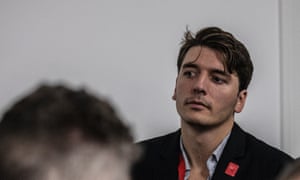
James Schneider, who used to work for Jeremy Corbyn as a senior communications adviser, told Radio 4’s PM programme that he was “quite sad” and “a bit angry” about Labour’s decision to settle the libel action brought by – as he described them – the “self-styled whistleblowers”. Schneider said Sir Keir Starmer had decided to settle even before he had seen the party’s legal advice. It was a political decision, intended “to draw a line under the Corbyn era”, Schneider said. He went on:
You can understand why he is trying to do that. But what is it he is trying to draw a line under? It is not to understand what it is that really happened, and what role everybody played in it. It is so that it ceases to be such a political line of attack that can be used against the Labour party. It is not to do with truth. It is to do with power.
Schneider said he thought some people in the party would be “appalled” by the decision. But he accepted it would not be reversed.
Asked how he thought Starmer was doing as leader, Schneider said he was concerned that Starmer was concentrating on being “less hated than the Tories rather than [trying] to inspire people around a particular programme”. He said Labour should be doing more to articulate a vision of how the world could be different after the coronavirus pandemic.
James Schneider. Photograph: Sean Smith/The Guardian
Blackburn with Darwen is the local authority area in England recording the largest proportion of new coronavirus cases, PA Media reports.
The figures, for the seven days to 19 July, are based on tests carried out in laboratories (pillar one of the government’s testing programme) and in the wider community (pillar two). The rate is expressed as the number of new cases per 100,000 people. Data for the most recent three days (July 20-22) has been excluded as it is incomplete and likely to be revised.
As PA Media reports, in Blackburn with Darwen the rate has jumped from 48.3 cases per 100,000 people in the seven days to 12 July to 79.9 in the seven days to 19 July, with 119 new cases recorded.
Second on the list is Leicester, where the rate has gone down from 110.6 to 71.8, and where 255 new cases have been recorded.
Other areas reporting notable week-on-week jumps include:
Oadby and Wigston (up from 35.1 to 68.4, with 39 new cases recorded in the seven days to July 19)
Rochdale (up from 33.6 to 47.3, with 104 new cases)
Hyndburn (up from 4.9 to 38.4, with 31 new cases)
Sandwell (up from 8.6 to 23.2, with 76 new cases)
The list is based on Public Health England figures updated today on the government’s coronavirus online dashboard.
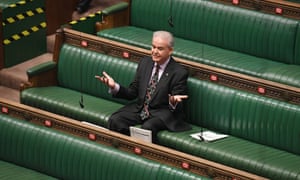
Julian Lewis, the chair of the parliamentary intelligence and security committee, in the Commons earlier for a UQ on the ISC’s Russia report. Photograph: UK Parliament/Jessica Taylor/Julian Lewis
Savanta ComRes has released a new poll suggesting the Conservatives have a six-point lead over Labour.
Savanta ComRes (@SavantaComRes)
The latest Westminster voting intention from our July monthly political tracker:
According to Savanta ComRes, on favourability (“to what extent do you feel favourably or unfavourably towards X?”), Boris Johnson has fallen four points over the past month and is on -2. Sir Keir Starmer has risen four points in the last month and is on +5.
But on “who would make the best PM?” (a different question), Johnson retains a lead over Starmer, by 40% to 31%.
The latest edition of the Guardian’s Politics Weekly podcast is out. This week, Jonathan Freedland talks to Kate Proctor on the latest from Westminster. Luke Harding breaks down what we learned from the Russia report. Jennifer Rankin talks just through an acrimonious EU summit. Plus Peter Walker talks to two candidates taking on the incumbents in next month’s leadership election for the Green party of England and Wales.
This is a Public Health England figure for the UK as a whole. It gets published on the government’s website. But, confusingly, the Department of Health and Social Care has given up publishing this figure as part of its only daily update, because it no longer views it as reliable.
The PHE figure is suspect because it includes people in England who tested positive for coronavirus and died – even if they died of something else.
But the main problem with the headline total is that it is an underestimate because it does not include people who died from coronavirus without testing positive. When these deaths are included, total UK coronavirus deaths are more than 55,000.
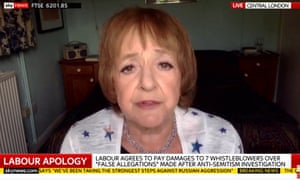
Dame Margaret Hodge, the Labour MP who frequently accused Jeremy Corbyn when he was party leader of not doing enough to combat antisemitism, has criticised the statement he has issued today about the party’s decision to settle the Panorama libel case. (See 2.02pm.) Asked for her reaction to Corbyn describing the move as a political decision not a legal one, she told Sky News:
I’ve seen that statement. I think it’s bizarre, it’s obsessional, and I think a little humility shown by Jeremy Corbyn at this point of time would be most welcome.
Not only did nine out of 10 Jewish people before the last general election fear the advent of Jeremy Corbyn as our prime minister, not only have we got the inquiry by the human rights commission, but we have the most resounding defeat ever in the last general election. The British people spoke. And I think Jeremy’s just got to start listening to that. He’s got to start showing a little humility. The less said by him at the moment, the better, not just for us, the Labour party, but for him too, and for his future and reputation.
(In fact, the 2019 general election, which saw Labour win 202 seats, was not the worst ever for the party. But it was the worst since 1935.)
Dame Margaret Hodge. Photograph: Sky News
Thérèse Coffey, the work and pensions secretary, has refused to rule out stopping payments to vulnerable benefit claimants as she was quizzed on how the department is learning from cases of suicide, PA Media reports.
The Department for Work and Pensions (DWP) has appointed 10 lead safeguarding officials and will recruit more to be a point of contact across England’s regions and escalate concerns about claimants who may need additional support. They will require a multi-agency case conference involving representatives such as social landlords and adult social services before decisions on stopping benefits are made.
A National Audit Office (NAO) report in February showed that the DWP had investigated 69 instances where people receiving benefits had killed themselves since 2014-15. They included Errol Graham, who starved to death in 2018, months after his disability benefit payments were stopped.
As PA Media reports, the DWP permanent secretary Peter Schofield told the Commons work and pensions committee this morning that if safeguarding concerns are identified relating to a claimant who has stopped engaging, a meeting with other agencies will take place so the department can better understand the context. These could include social landlords, adult social services or third sector charities who may know about and be able to support an individual’s additional needs.
Coffey was asked by the Labour MP Stephen Timms, who chairs the committee, if this meant no benefits would be stopped if a claimant had been identified as vulnerable, but she said decisions would be taken on a case-by-case basis. She replied:
It’s difficult to try and set blanket rules when you’re dealing with individuals.
So I think what Peter’s set out is the approach that’s now being taken by the department, but we can’t say in every situation, every case, this X, Y or Z would definitively happen, it’s got to be tailored to the individual situation.
Labour has declined to reveal the amount of the payout given to antisemitism whistleblowers who contributed to a BBC Panorama investigation. When asked about speculation that the “substantial damages” amounted to as much as £500,000, Sir Keir Starmer’s spokesman told reporters: “I’m not going to get into that, full stop.”
On Radio 4’s World at One Nigel Inkster, a former MI6 director of operations and intelligence, explained why he thought new espionage legislation was needed, including plans for possible foreign agent registration. (See 3.04pm.) He said:
The 1911 Act, and modified in 1989, really leaves the security services and police in a situation where unless they can actually catch somebody red handed taking delivery of papers marked ‘Secret’, it is really difficult to prosecute anybody for espionage.
So if this new register is brought into effect, of course it is not going to stop countries like Russia from sending covert operatives to the United Kingdom to undertake intelligence operations, but it does make it possible, more realistically, to prosecute the people who are supplying them with information – their agents.
Here are today’s daily coronavirus death figures from the four nations of the UK.
NHS England has recorded 10 hospital deaths. The details are here.
There have been no further deaths in Scotland.
Public Health Wales has recorded one further death in Wales.
And in Northern Ireland there have been no further deaths.
The housing secretary, Robert Jenrick, has admitted he regrets sitting next to the Tory donor Richard Desmond at a fundraising dinner before overruling a local authority and the government planning inspectorate to give permission for the billionaire’s £1bn Westferry property development, my colleague Simon Murphy reports.
Benjamin Westerman, one of the former Labour employees who received an apology from the party today for its response to his antisemitism whistleblowing on Panorama, told the World at One that it would take a “long time to repair the damage done” by the accusations made against him. He explained:
It was incredibly difficult. Having gone to work for the Labour party and having always supported the Labour party throughout my life, I never expected to find myself in this position where I was publicly speaking out against the Labour party – that in itself was difficult.
Then of course there has been the fact that I’ve been accused of various things, both in my time with the party and since – having bad motives, having an axe to grind, being a Tory or whatever, which is just deeply hurtful and today is a very momentous step in moving forward from that.
I’m very pleased that our reputations have been restored and that the truth of what we said has been acknowledged by the party – that means a great deal.
But of course it will take a long time to repair the damage done to our character by these unfounded attacks.
Downing Street has confirmed that it is planning to introduce an espionage bill that will “modernise existing offences, deal more effectively with the espionage threat and also look at what new offences and powers are needed”. Speaking at the No 10 lobby briefing, the prime minister’s spokesman said:
It includes the review of the Official Secrets Act and also considering the introduction of a form of foreign agent registration such as that which some of our allies have.
He said the work was complex and would take time to get right “but we are fully committed to taking whatever action is necessary to combat the threat posed by hostile states”.
The spokesman also said that tier 1 investor visas issued before April 2015 were being reviewed. The ISC report said these were being abused. The spokesman said:
That work is ongoing and we have also made some changes to the tier 1 route, in particular to give better protection from illegally obtained funds.
We don’t rule out making further changes as well, we keep all immigration routes under review to ensure that they are working in the national interest.
Here’s footage of Keir Starmer firing questions at Boris Johnson over the Russia report during the final PMQs before summer recess.
Russia report: Keir Starmer questions Boris Johnson at PMQs – video highlights
Sir Keir Starmer has challenged Nicola Sturgeon to condemn the former SNP leader Alex Salmond for appearing on RT (formally Russia Today). At his post-PMQs briefing, asked whether Starmer would “condemn” Salmond’s appearances on the Kremlin-backed channel, the Labour leader’s spokesman told reporters:
We completely condemn it and we advise the first minister, Nicola Sturgeon, to do the same. She should make a public statement condemning it.