Eradicating dracunculiasis: Ethiopia investigates six suspected human cases in Gambella region
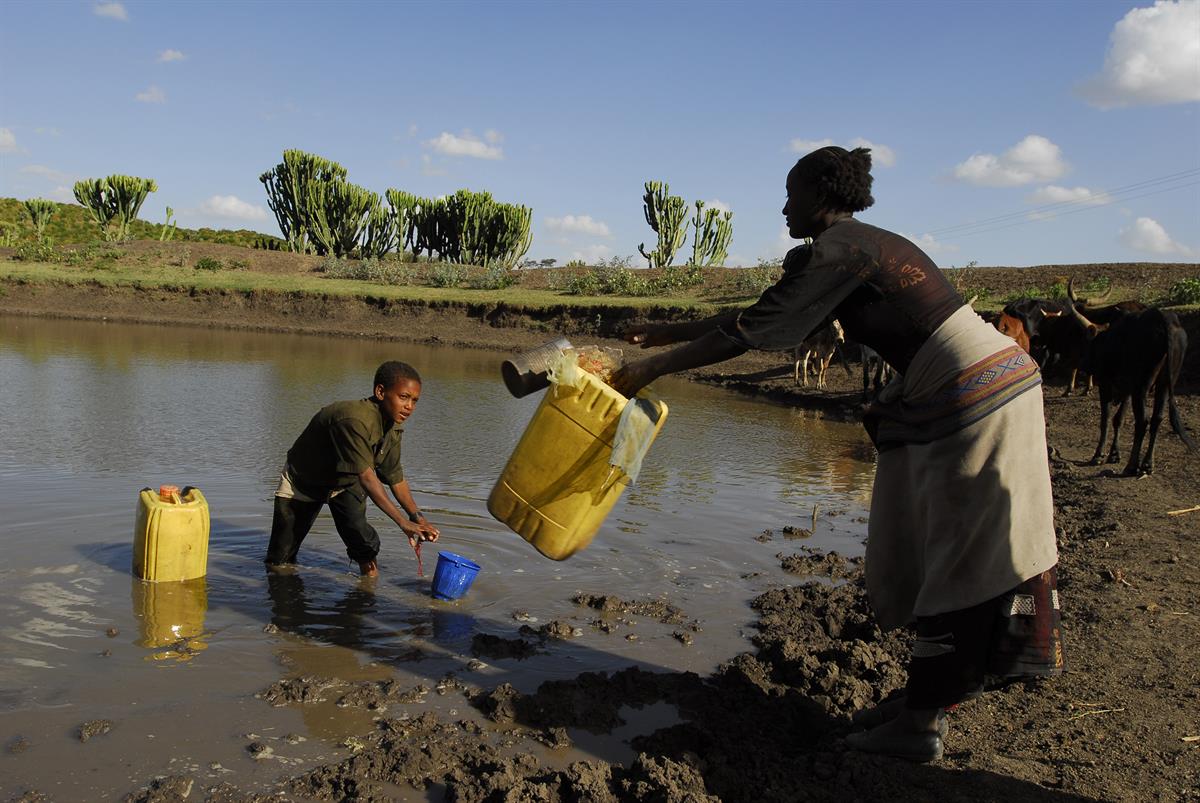
Besides\n the six-suspected new infection, a further 40 suspected cases are also \nbeing followed up in the Guinea Worm Case Containment Center. \nFurthermore, an estimated 200 households have been visited and 1254 \npeople interviewed and provided with health education.
The\n Ethiopian Dracunculiasis Eradication Programme (EDEP) is scheduled to \ncontinue the larviciding of ponds in the area; further assess the \nutilization of filters by residents and devise a mechanism to maximize \nand maintain its utilization. The EDEP also plans to work with relevant \nstakeholders to provide safe water to the villages with suspected cases.\n\n\n\n\n\n
“Despite\n redeployment of health staff due to COVID-19, response to this outbreak\n was swift and in accordance with established protocols” said Mr Kassahun Demissie, National Programme Coordinator for Guinea Worm Eradication, Ethiopian Public Health Institute. “Preliminary\n investigations were carried out and immediate intervention measures \ntaken, including active case search in seven villages where the \nsuspected cases were detected and in nearby at-risk villages.”
Other measures that have been immediately implemented include:\n
- treatment of more than 41 ponds in the vicinity with the larvicide Temephos3. This is in addition to the regular cycle of larviciding of all ponds in the area;
- assessment of water filter utilization and their replacement;
- delivery of health education in all villages that were visited.\n
A\n visit is also scheduled to the region by WHO’s National Programme \nOfficer and the acting National Coordinator from 24 April to 1 May to \nmonitor containment and prevention activities and provide overall \nsupport as part of outbreak response.
Dracunculiasis eradication in Ethiopia
Since\n Ethiopia established its national dracunculiasis eradication programme \nin 1994 considerable progress has been made to reduce the number of \nhuman cases, with most of them focused in Gambella.
For\n the past decade, the region consistently reported low level \ntransmission, including few infections in animals. In 2019, health and \nrural development officials in the region announced a series of measures\n aimed at ending transmission of dracunculiasis. It included a \nhigh-level advocacy mission led by the Federal Minister of Health and \nthe announcement of a Board to oversee the functioning of the \neradication programme in the region.
To\n increase the sensitivity of the surveillance system, the authorities \nhave also introduced a cash reward for the voluntary reporting of \ndracunculiasis cases.\n
Human cases in 2019
In\n 2019, a total of 54 human cases were reported to WHO, with Chad \nreporting 48 out of the 54 cases. Chad is also reporting a high number \nof animal infections.
The\n other three countries that reported human cases last year were Angola \n(1 case) and South Sudan (4 cases), and Cameroon (1 case which is likely\n a spillover from neighbouring endemic villages in Chad). Mali, where \nanimal infections are occurring, has not reported any human case since \n2016.\n\n
The disease
Dracunculiasis is a crippling parasitic disease caused by infection with D. medinensis,\n a long, thread-like worm. It is usually transmitted when people drink \nstagnant water contaminated with parasite-infected water fleas.
During the 1980s, dracunculiasis was endemic in 20 countries.
Finding\n and containing the last remaining cases, particularly in settings where\n there are security concerns and displaced populations, are the most \ndifficult stages of the eradication process.\n\n
——————————-
1The six cases are macroscopically consistent with guinea worm disease and are pending laboratory confirmation.
2Containment centres have been set up in chosen locations in \nendemic regions of countries reporting active transmission of \ndracunculiasis. The centres are equipped to provide treatment and \nsupport to infected people to prevent them from contaminating drinking \nwater sources.
3Temephos is a cyclopicide. It is used to kill water fleas (cyclops) that carry the infective guinea-worm larvae.
“,”datePublished”:”2020-04-17T01:00:00.0000000+00:00″,”image”:”https://www.who.int/images/default-source/departments/ntd-library/dracunculiasis/8178132724-c70e069c02-o.jpg?sfvrsn=93dc060c_6″,”publisher”:{“@type”:”Organization”,”name”:”World Health Organization: WHO”,”logo”:{“@type”:”ImageObject”,”url”:”http://www.who.int/Images/SchemaOrg/schemaOrgLogo.jpg”,”width”:250,”height”:60}},”dateModified”:”2020-04-17T01:00:00.0000000+00:00″,”mainEntityOfPage”:”https://www.who.int/news-room/detail/17-04-2020-eradicating-dracunculiasis-ethiopia-investigates-six-suspected-human-cases-in-gambella-region”,”@context”:”http://schema.org”,”@type”:”NewsArticle”}; Read the original article at WHO website