Australia coronavirus live update: Victoria records 70 new cases and five deaths as NSW relaxes border rules
The NSW premier is asked about what is happening with conversations north of the border, and well, apparently there is a bit of ‘you can’t sit with us’ happening between Annastacia Palaszczuk and Gladys Berejiklian.
Berejiklian:
I think it’s important for all of us as leaders, no matter what political background we have, to work together for the benefit of local communities.
I mean absolutely. Absolutely. And certainly if I was closing, you know – I don’t think the public has appetite, and I certainly don’t have appetite for any public bickering, but I think it’s really important for us to be talking to each other, and certainly keeping each other informed.
I know that my office and Premier Andrews’s office are in constant contact to make sure each of us are aware of what’s going on because any decision he takes affects my communities and vice versa.
So I think it’s really important to keep those lines of communication open. But it also gives us confidence. If we’re sharing information, if we’re, you know, trying to help each other out, it also means we can make decisions in the best interests of our as soon as with confident without being worried about what circumstances we don’t know about.
Oh, apparently the local mayors were left out of the meet and greet.
Gladys Berejiklian says today was about thanking frontline workers.
There is a lot of ‘we hear you, we see you, we feel you’ in this press conference.
Gladys Berejiklian:
Please know we appreciate deeply that the state border doesn’t really exist here.
You are one community and I acknowledge everybody who has reminded the Government of that day in and day out and we’ve tried to respond, acknowledging that very important factor which I think is unique to all of Australia.
If you look around Australia, I don’t think there’s a border where the communities feel as one as much as here.
I don’t think there are two states that have had as much to do with each other for the last century as New South Wales and Victoria.
And that’s why it has been a very difficult decision, a difficult process, and I want to really thank everybody for their patience and acknowledge your frustration and angst and also say that I think it’s completely justified, completely justified, because if I was in your shoes and something changed overnight which was going to impact my life, I would feel let down and disheartened and concerned, so I completely empathise with what many people in our communities have felt.
And then Queensland gets a hit.
Gladys Berejiklian says she has not had a conversation with Annastacia Palaszczuk on the Qld border closure:
I don’t begrudge the Victorian Government because obviously they’ve been in crisis management mode and perhaps we’re not top of the list in terms of what they need to address but we’re starting to see a better flow of information.
Case numbers are coming down in Victoria.
We’re seeing a better flow of information on what’s happening in the border communities and as a result, we can move forward with Friday’s announcement and, again, my heart goes out to anybody, including our front-line workers.
Many community members have been at the forefront and brunt of community frustration.
When you’ve been a community leader for a long time and then have you to implement a policy you know will be received under difficult circumstances, it’s a difficult situation, and please know that I hope my visit today is a sign about how much I care about this community, how much I care about our border communities.
We are in all this together and that’s why before my Government took the decision to close the border, I consulted with the Victorian Premier, I consulted with the Prime Minister. We came to the mutual conclusion that this was the best thing to do all round and I have to say it’s a different approach to what I’ve experienced on our northern border when I’ve still not had a conversation on the northern border, but certainly, certainly down here I’ve felt that even though it’s been difficult for many members of the community, that we have tried to make the process as easy as possible and I hope the decision from Friday will make a positive difference for people.
Gladys Berejiklian then throws Victoria into the mix:
I also want to add – and I don’t make this as a criticism, but I just want people to appreciate where we’re coming from is it has been difficult for us to get information on the other side of the border about rates of testing, community transmission and that has, in part, led to our angst about how we can move forward.
It’s really important for us to understand what’s happening on the other side of the border and I know my counterpart, Premier Andrews, is going through a difficult time but pleasingly the numbers are coming down and that gives us greater confidence in relation to what’s happening alongside the border communities south of the border.
Unlike our side of the border, we know that if we have any suspected cases or contact tracing or testing, we’re able to jump onto it straightaway.
We don’t have that level of confidence on the other side, only because we’re not in charge of the system on the other side and therefore we have to make sure we’re not introducing unnecessary risk into our regional communities here in New South Wales.
We’ve also made sure that we’ve supported the Victorian Government in any way we can because the risk to wails and to our border communities is greatly reduced when the number of cases in Victoria come down and we want that to be sustainable and we hope once restrictions in Victoria are eased, they’re able to main Thane that low level of cases because that will ensure we don’t need to leave the border open a single day more than we have to.
That is our aim. I was very hesitant in closing the border but we won’t be hesitant… We won’t leave it a day longer than we need to but we have to make sure it’s the right thing to do at the right time and it’s in order to make sure we’re keeping the community safe. I’d rather be having this conversation with you today rather than having a conversation about why there are hundreds of cases in regional New South Wales because of what’s happening in Victoria.
Gladys Berejiklian makes a point of taking the blame for the NSW side of the border angst – at least when it comes to the timing of it all.
Pandemics are far from perfection when it comes to having to make decisions quickly and can I tell you, hand on heart, that one of the most difficult decisions I’ve made personally and the government’s made during this pandemic has been closing the New South Wales-Victorian border?
It was a decision of last resort and, in fact, I remember getting heavily criticised for not moving earlier and one of the main reasons we didn’t move earlier was because we knew the disruption and angst it would cause people in the border communities.
For all of you – you don’t see yourselves as a state border, as two communities, but one. And I deeply appreciate what that government decision has resulted in in terms of disruption and angst felt by many and I want to say how deeply I regret everybody’s challenges during this time, but please know you’re not alone.
We’ve had many people on both sides of the border, within the border communities, and outside the border communities, who have been deeply impacted by the pandemic and as the Victorian numbers continue to decline, that gives us greater confidence to ease restrictions and to listen to the concerns raised by border communities. Can I, on this occasion, thank a number of community leaders for their support.
Firstly, to my parliamentary colleague Justin Clancy, who has been outstanding. Please know that he has very much been on the side of his community and raised with me – almost initially on a daily basis but certainly at least every couple of days through direct phone calls, meetings and other forms of communication the concerns expressed by his community, especially when the initial 50km zone was reduced and the impacts it had.
I regret deeply the fact that the community wasn’t prepared for what we had to do at that time and I want to assure everybody that Justin Clancy, until this point in time, has been outstanding and any frustration people feel should be against me and nobody else. I’m the leader and the buck stops with me and I want people to appreciate that every decision we take is in the interests of our citizens.
The alternative to what we did could have resulted in high rates of infection in rural and regional New South Wales, not just on the border communities, but throughout the state. We have had a few close calls in respect to the virus seeping into or seeding into regional communities and border communities, but our health officials have done an outstanding job in contact tracing.
I also wanted to acknowledge Justin’s colleague on the other side of the border, Mr Tilly, for his advocacy and I know his community is equally anxious about the changes that have occurred.
NSW has recorded 13 new diagnoses of Covid in the last 24 hours – two are in hotel quarantine.
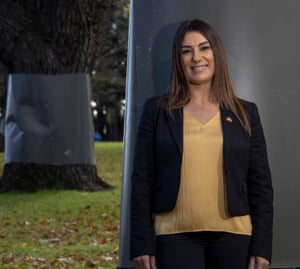
Incoming Greens senator, Lidia Thorpe, the replacement for Victorian senator and former leader Richard Di Natale, joined the party room (remotely) today. Victorian parliament will confirm Thorpe as the replacement this Friday, meaning she’ll be sworn in in budget week in October.
The Greens are currently trying to lobby the crossbench to refer two government bills to inquiries: the EPBC Act changes and the Jobs Ready Graduate package.
Both of those will require Labor, the Greens, Stirling Griff, Rex Patrick and Jacqui Lambie to stick together or risk watching them sail through with Coalition, PHON plus one more vote enough to pass them.
Their other projects are:
A private members bill for 14 days paid pandemic leave – possibly to be debated on Wednesday or Thursday; and
Amendments to the jobkeeper 2.0 legislation
The new Greens senator for Victoria, Lidia Thorpe. Photograph: Luis Ascui/AAP
Daniel Andrews will be getting his state of emergency declaration extension on the numbers here.
Shannon Deery (@s_deery)
Here’s the Statement of Emergency bill to be debated and voted on today. It looks set to pass with support of @AndyMeddickMP, @FionaPattenMLC and @SamanthaRatnam. #springst @theheraldsun #auspol t.co/MvNs4HN2cM
September 1, 2020
Daniel Andrews will hold his press conference at 11.30am today.
It’s with the jobs minister, Martin Pakula.
The roadmap is being sketched out.
Here is that exchange between Simon Birmingham and Fran Kelly on ABC radio this morning, about Cheng Lei:
Kelly: The government was – our government was notified on 14 August I understand, that Cheng Lei had been arrested. Has the government been told why she’s been detained?
Birmingham: Fran, I don’t have any details that I can provide on that matter. We did have consular access with Ms Cheng on 27 August through virtual and video means. We’ve been obviously in contact with her family who, as you would have seen, have issued a statement acknowledging that they are doing everything they can to support Cheng Lei and her welfare, that they acknowledge the process that is underway, and they’ve asked for both privacy and restraint in relation to commentary on these matters. And we will continue to do what we can to support Ms Cheng and her family through what must be difficult and trying times.
Kelly: Absolutely. Australian officials have had consular access to her as you mentioned by video link. How is she? And do we know where she’s been detained?
Birmingham: Fran, I understand that we have some of those details. As I said, we though, will be restrained in what we say publicly out of acknowledgement for the process, the family, and we simply hope that these matters can be dealt with according to proper process and as expeditiously as possible.
Kelly: What is proper process? Because the ABC reports that Cheng Lei has not been charged, she’s being held under what’s known as residential surveillance which means you can be detained and questioned for up to six months with no access to lawyers. Is that acceptable to the Australian government? That such an arbitrary attention can occur to – detention can occurred on Australian citizens?
Birmingham: China’s systems are obviously very, very different to our systems, and we have to acknowledge that. And those risks that Australians face when they travel overseas – a risk that we often point out in relation to many, many different countries that are different compared with if they were operating in Australia. We don’t see the same legal system, but ultimately there is a process there, we will provide whatever assistance we can. The family, I know, are working to try to provide legal advice and assistance as well, and we will give them whatever support we can as well.
Kelly: Do you think Cheng Lei is a pawn in a worsening relationship between China and Australia?
Birmingham: Nothing would be particularly helpful for me to try to draw that link, Fran. Cheng Lei is an Australian, a journalist who has been working in China for some period of time. I’ve actually met her and been interviewed by her while overseas myself. I feel for her family very much at this point in time, and it’s why we will do what we can to assist her, as we would and have any Australian in these sorts of circumstances. There is a long history of different consular cases and points of difficulty that we’ve seen over the years, and so we shouldn’t see this as a first or a one off. But obviously it’s concerning for her family, and we will provide the assistance that we can.
The Australian government was notified in mid-August that Australian citizen and CGTN news anchor Cheng Lei was being detained in China. Photograph: CGTN
All eyes on Jacqui Lambie
Morning all. As Amy flagged earlier, Labor is planning to vote against government legislation allowing the minister to prohibit items, like mobile phones, in immigration detention.
That vote is likely in the House this afternoon. The proposal will then go to the Senate. As things stand right now, the government doesn’t have the numbers to get this through, so the legislation has dropped down today’s batting order in the Senate.
Stirling Griff from Centre Alliance is opposed. “100%” he tells me.
Rex Patrick is also opposed. He tells me: “Immigration detention serves an administrative purpose, not a punitive purpose. In these circumstances the restrictions on detainee rights must be reasonable and proportionate.
“The government already has powers to deal with items of a criminal nature, or of concern, and with detainees breaking the law”.
So the Senate numbers make Jacqui Lambie the critical vote. Lambie’s office tells me she’s sceptical about the legislation, but is keeping an open mind.
Presumably the government has slowed down consideration this afternoon in an effort to get Lambie over the line.
Her office is being lobbied heavily by refugee advocates. As they say in the classics: watch this space.
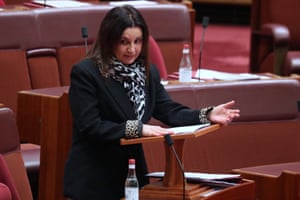
Senator Jacqui Lambie. Photograph: Mike Bowers/The Guardian
I imagine this is the consequence of when Liberal upper house MPs, Bernie Finn and Craig Ondarchie, asked to be excused from a Good Friday vote for “religious reasons” – and given a pair – meaning two government MPs were dismissed from the vote to even it out – and then showed up to vote, thereby defeating the government.
Sumeyya Ilanbey (@sumeyyailanbey)
Greens MP @SamanthaRatnam will interrupt her maternity leave and head to Parliament today to vote in favour of the state of emergency bill. #springst
September 1, 2020
Almost 75% of Australians support the establishment of a national integrity commission this year, new polling shows. The Australia Institute has just released polling conducted in June on the establishment of a federal integrity commission.
The results, broadly in line with previous polling, show strong support for such a body. Support was recorded among 74% of Australians. Only 7% opposed. The support was seen across all parties, and was 77% for both Coalition and Labor voters. Surprisingly, support was lower among Greens voters at 69% of voters.
The federal government has so far not moved to introduce draft legislation for its model of a federal integrity commission.
The attorney general Christian Porter said nine months ago that the draft legislation for its Commonwealth Integrity Commission would be released shortly.
It has been 20 months since the government’s consultation paper was first released.
Most recently, Porter said the Covid-19 response had delayed further action on the commission. Independent MP Helen Haines is planning to today flag an intention to introduce a bill to the lower house to establish a stronger anti-corruption body, called the Australian Federal Integrity Commission (AFIC).
Haines’ commission will be supplemented by other integrity measures.
Former Victorian judge David Harper, QC, said the Haines’ initiative improves the numerous failings of the federal government’s body, bringing with it a broad jurisdiction, stronger investigative powers, and an ability to hold fair public hearings.
“The Australian Federal Integrity Commission bill package named by Dr Haines in the House today signals to parliament the importance of bringing those principles to reality,” Harper said.
The Australia Institute’s polling used a representative sample of 1,012 people. The margin of error is 3.1%.
Facebook is starting to get real pushy about the proposed legislation which would make internet giants like Facebook and Google pay for the news it publishes:
This statement is not playing around:
The ACCC presumes that Facebook benefits most in its relationship with publishers, when in fact the reverse is true. News represents a fraction of what people see in their News Feed and is not a significant source of revenue for us. Still, we recognize that news provides a vitally important role in society and democracy, which is why we offer free tools and training to help media companies reach an audience many times larger than they have previously.
News organisations in Australia and elsewhere choose to post news on Facebook for this precise reason, and they encourage readers to share news across social platforms to increase readership of their stories. This in turn allows them to sell more subscriptions and advertising. Over the first five months of 2020 we sent 2.3 billion clicks from Facebook’s News Feed back to Australian news websites at no charge – additional traffic worth an estimated $200 million AUD to Australian publishers.
We already invest millions of dollars in Australian news businesses and, during discussions over this legislation, we offered to invest millions more. We had also hoped to bring Facebook News to Australia, a feature on our platform exclusively for news, where we pay publishers for their content. Since it launched last year in the US, publishers we partner with have seen the benefit of additional traffic and new audiences.
But these proposals were overlooked. Instead, we are left with a choice of either removing news entirely or accepting a system that lets publishers charge us for as much content as they want at a price with no clear limits. Unfortunately, no business can operate that way.
Facebook products and services in Australia that allow family and friends to connect will not be impacted by this decision. Our global commitment to quality news around the world will not change either. And we will continue to work with governments and regulators who rightly hold our feet to the fire. But successful regulation, like the best journalism, will be grounded in and built on facts. In this instance, it is not.
Ged Kearney spoke out against the mobile phone ban legislation in the parliament yesterday:
My community of Cooper regularly tell me how sickened and saddened they are to be governed by a party who continues with the cruel policy of indefinite detention. I don’t doubt the desire to silence these brave refugees also lies at the heart of this bill. I don’t doubt that there is a desire to silence these brave refugees.
No one is capable of enduring the torture of indefinite detention.
Again, the ASRC: Continued detention of these refugees, many with histories of trauma, is used as collective punishment for them having attempted to exercise their right to seek Australia’s protection more than seven years ago.
After up to seven years on Manus or Nauru, the men at the Mantra have been confined to cramped hotel rooms for more than 12 months. They’re unable to go outside except for sparse rostered visits to closed detention facilities to exercise.
The Covid outbreak has been extremely stressful, and many are rapidly deteriorating in terms of mental and physical health. I wrote to the minister back in April requesting that he consider community detention as a way to minimise the risk of a Covid outbreak.
The UNHCR, lawyers and public health officials made similar requests. The government’s response to the risk of a Covid outbreak is to threaten the men with a move to over 3,000km away, to Yongah Hill, where they will lose access to their caseworkers, legal representation and community supports.
All the while, they are facing the prospect of losing access to their phones – their one connection to the outside world.
I genuinely fear what the passing of this legislation will do to the refugees. So I end with a plea to those who sit opposite. The people affected by this bill have been through enough. Many have escaped war, famine and other horrors and have spent much of the last seven years detained by this government.
This government has the power to drop this bill. It has the power to release refugees, where appropriate, into community detention.
It can make sure that refugees and people seeking asylum have access to medical treatment, and, most importantly, it has the power to resettle these people in safe, permanent homes. They must do this. They must act justly and with humanity.